
"Why do I feel so unmotivated lately?" "I don't want to do anything..." "I toss and turn all night, only to feel more exhausted in the morning." If these thoughts sound familiar, your mind might be asking for help. In this article, we'll use the PHQ-9 assessment—officially recognized by WHO and the National Mental Health Center—to objectively evaluate your current state, explore evidence-based relief methods from the latest 2026 research, and share inspiring recovery stories that prove hope is real.
🧠 Understanding Depression: Your Mind's Distress Signal
"Why do I feel so unmotivated lately?" "I don't want to do anything..." "I toss and turn all night, only to feel more exhausted in the morning."
If these thoughts sound familiar, your mind might be asking for help. Depression is not simply "feeling sad." It's a complex mental health condition affecting over 350 million people worldwide, caused by a combination of brain chemical imbalances, psychological factors, and social circumstances.
According to the 2026 Korean Medication Algorithm Project for Depressive Disorder (KMAP-DD 2026), depression manifests differently across age groups and genders. Women experience unique symptom patterns related to hormonal fluctuations (premenstrual dysphoric disorder, pregnancy, postpartum), while older adults often present with atypical features such as cognitive decline or somatic complaints, making early detection even more crucial.
But here's the most important fact: depression is treatable. Early detection and appropriate intervention can lead to complete recovery. In this article, we'll use the PHQ-9 assessment—officially recognized by WHO and the National Mental Health Center—to objectively evaluate your current state, explore evidence-based relief methods from the latest 2026 research, and share inspiring recovery stories that prove hope is real.
"Depression is not your fault. And you are not alone." – A message shared by countless survivors
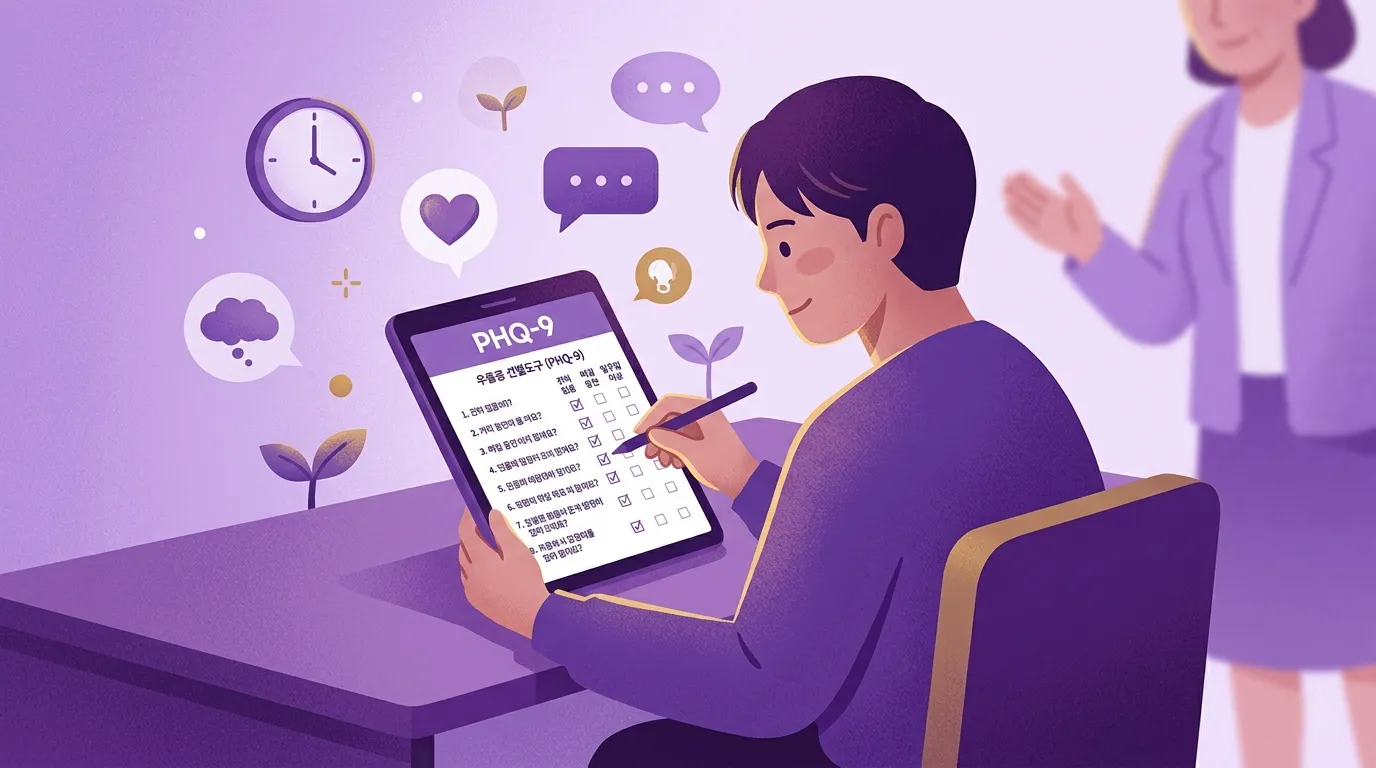
📋 PHQ-9: A Professional Self-Assessment in Just 2 Minutes
The PHQ-9 (Patient Health Questionnaire-9) is an officially recognized depression screening tool endorsed by the American Psychiatric Association (APA) and WHO. With just 9 questions, it comprehensively evaluates your mood, sleep, appetite, and energy levels over the past two weeks. The National Mental Health Center offers this test for free, and it's the most widely used clinical tool globally.
💡 Important Disclaimer
This assessment is a screening tool, not a diagnosis. If your score is elevated, we recommend consulting a professional—but don't label yourself as "sick." Depression is like a cold of the mind; with proper care, it can improve significantly.
📝 PHQ-9 Self-Assessment Checklist
Check how often the following problems have bothered you over the past 2 weeks. Each item is scored from 0 (not at all) to 3 (nearly every day).
| No | Question | Score (0-3) |
|---|---|---|
| 1 | Little interest or pleasure in doing things | |
| 2 | Feeling down, depressed, or hopeless | |
| 3 | Trouble falling or staying asleep, or sleeping too much | |
| 4 | Feeling tired or having little energy | |
| 5 | Poor appetite or overeating | |
| 6 | Feeling bad about yourself—or that you are a failure or have let yourself or your family down | |
| 7 | Trouble concentrating on things, such as reading the newspaper or watching television | |
| 8 | Moving or speaking so slowly that other people could have noticed, or the opposite—being so fidgety or restless that you have been moving around a lot more than usual | |
| 9 | Thoughts that you would be better off dead, or of hurting yourself |
🏃♀️ 7 Evidence-Based Depression Relief Methods (2026 Research)
While medication and professional counseling are core treatments for depression, lifestyle improvements play a crucial role in recovery. 2026 medical research has validated the following methods as effective for alleviating depressive symptoms:
1️⃣ Exercise: As Powerful as Medication
A February 2026 meta-analysis by James Cook University (Australia), covering 79,000 participants, found that regular exercise significantly reduces both depression and anxiety symptoms. Aerobic exercise and group activities showed the strongest effects.
You don't need intense workouts from day one. Start with 30 minutes of brisk walking daily, swimming 3 times a week, or yoga/pilates. The key is exercising "together" rather than alone. Group activities provide social connection that helps combat the isolation of depression.

2️⃣ Sleep Hygiene: Rebooting Your Brain
Depression and sleep problems create a vicious cycle. If you scored high on PHQ-9 question 3, sleep improvement should be your priority. 2026 research emphasizes these sleep hygiene principles:
- Fixed sleep/wake times: Maintain within ±1 hour even on weekends
- Block blue light: Stop smartphone use 1 hour before bed
- Caffeine curfew: Avoid coffee, tea, and soda after 2 PM
- Limit naps: Keep under 20 minutes, no naps after 3 PM
3️⃣ Mindfulness and Meditation
This practice helps you focus on "the present moment" rather than regretting the past or worrying about the future. The 2026 KMAP-DD guidelines recognize this as a complementary treatment, especially effective when combined with rTMS (repetitive transcranial magnetic stimulation).
Start with 5-minute "breathing meditation." Simply breathe in through your nose (4 seconds), hold (4 seconds), and exhale through your mouth (6 seconds). This pattern activates the parasympathetic nervous system, reducing anxiety.
4️⃣ Maintain Social Connections: Remember You're Not Alone
Depression drives isolation—but isolation deepens depression. Countless recovery stories on Reddit's r/depressionrecovery community identify "realizing I wasn't alone" as the most critical factor in their healing.
You don't need to meet many people. Have one meaningful conversation daily—with family, friends, or a counselor. These connections stimulate your brain's reward circuits, essential for restoring positive emotions.
5️⃣ Nutrition: The Gut-Brain Axis
Recent neuroscience research confirms the intimate connection between gut health and mental health. These nutrients are known for their antidepressant effects:
- Omega-3 fatty acids: Salmon, sardines, walnuts, flaxseeds
- Vitamin D: Sunlight exposure + supplements (especially in winter)
- B vitamins: Leafy greens, whole grains, eggs
- Tryptophan: Turkey, chicken, tofu (serotonin precursor)
- Probiotics: Yogurt, kimchi, fermented foods (gut health)
6️⃣ Light Therapy: Beyond Seasonal Depression
Originally developed for winter seasonal depression, light therapy has recently proven effective for non-seasonal depression as well. 30 minutes of 10,000 lux bright light in the morning stimulates serotonin production and normalizes sleep-wake cycles.
7️⃣ Creative Activities and Hobby Restoration
Depression paralyzes your ability to "feel pleasure"—this is what PHQ-9 question 1 measures. Intentionally restart activities you once enjoyed, even if you don't feel like it. Initially, emotions may not follow, but repeated behavior gradually restores your brain's reward system through neuroplasticity.

💊 When to Seek Professional Help
Self-assessment and lifestyle improvements are effective for prevention and adjunctive treatment, but moderate-to-severe depression (PHQ-9 score 10+) requires professional intervention. Seek immediate consultation if you experience:
🚨 Immediate Professional Help Needed If:
- You scored 1+ on PHQ-9 question 9 (self-harm/suicidal thoughts)
- Daily functioning (work, school, relationships) severely impaired for 2+ weeks
- Extreme changes in sleep and appetite (insomnia/hypersomnia, appetite loss/binge eating)
- Persistent worthlessness, guilt, or concentration difficulties
2026 Latest Treatment Options
According to the KMAP-DD 2026 guidelines, depression treatment follows this stepped approach:
| Stage | Treatment Method | Features |
|---|---|---|
| Stage 1 | Lifestyle improvement + Counseling | First-line for mild depression (5-9 points) |
| Stage 2 | Antidepressant (SSRIs) monotherapy | Escitalopram etc. recommended as first-line |
| Stage 3 | rTMS (Repetitive Transcranial Magnetic Stimulation) | Upgraded to first-line in 2026 guidelines, non-invasive |
| Stage 4 | Antidepressant + Antipsychotic combination | For severe depression with psychotic features |
| Stage 5 | Electroconvulsive Therapy (ECT) | Treatment-resistant depression, emergency situations |
A major change in the 2026 guidelines is that rTMS is now included as a first-line treatment for depression during pregnancy, offering a relatively safe biological alternative for pregnant women concerned about medication.
🌟 "I Recovered Too": Real Stories of Hope
Beyond theory and statistics, stories from people who actually overcame depression provide the most powerful messages of hope. Here are real recovery experiences from professional media sources:
Tara's Story: Recovery from Treatment-Resistant Depression
Tara Duncan had "treatment-resistant depression"—she tried 9 different medications without success. While taking two medications at maximum doses, she lived in terror: "What happens when my body adapts to these maximum doses? What comes next?"
After a year-long battle for insurance approval, rTMS treatment changed her life. "It was uncomfortable at first, a gradual improvement. Then one day I woke up and realized my brain was quieter—I wasn't thinking about ending things as much."
Two years post-rTMS, Tara's suicidal thoughts have completely disappeared and her depression is in remission. She maintains TMS benefits with just half the dose of one medication. "Now I have appropriate emotional responses, enjoy life more, and I'm more positive. I highly recommend rTMS!"
Stephanie's Story: The Power of Social Media Community
Stephanie Forlini tried so many SSRIs and SNRIs that she "lost count." Most helped only temporarily or not at all, accompanied by heinous side effects.
She began documenting her depression journey on social media. "Living with depression when loved ones 'don't get it' makes recovery harder." The support and encouragement from her online community became crucial motivation to continue treatment.
Currently receiving TMS, Stephanie experienced a 7-point PHQ-9 reduction within just 7 sessions. "At this rate, remission seems possible—like so many others who've done this treatment."
Sarah's Story: Combining Therapy and Self-Care
Sarah says small daily changes, combined with therapy, created massive transformation. Starting with 10-minute walks and gradually increasing, plus meditation and mood journaling to identify her patterns.
"Therapy provided the tools; self-care was practicing using them. There's no perfect recovery, but now I live 'outside' my depression. Realizing depression isn't my whole identity changed everything."

✨ Conclusion: Your Recovery Has Already Begun
By reading this article, you've already taken the first step toward recovery. Searching for information about depression and checking your condition proves that your will to "do something" is alive, even amid feelings of helplessness.
"Depression is not your identity. It's a 'temporary state' you're experiencing. Countless people have walked this path before you, and they've all proven that recovery is possible—and you deserve it too." – Gardenee Blog
Don't despair if your PHQ-9 score is high. As Tara, Stephanie, and Sarah's stories show, with proper treatment and support, recovery is possible. Early detection actually leads to faster recovery.
3 Things You Can Do Right Now
- Breathe: Inhale through nose (4 sec), hold (4 sec), exhale through mouth (6 sec). Repeat 3 times. This alone activates your parasympathetic nervous system.
- Reach out to one person: Call family, friends, or the National Suicide Prevention Lifeline (988). Simply saying "I'm struggling" cuts the weight in half.
- One small action: Get out of bed, open a window, and get 5 minutes of sunlight. Taking a shower or drinking a glass of water is a victory.
Depression is like a cold of the mind—it needs treatment, it gets treated, and after treatment, you emerge with stronger immunity. Your efforts today are a gift your future self will thank you for.
🌈 "This too shall pass. And when it passes, you will be stronger."