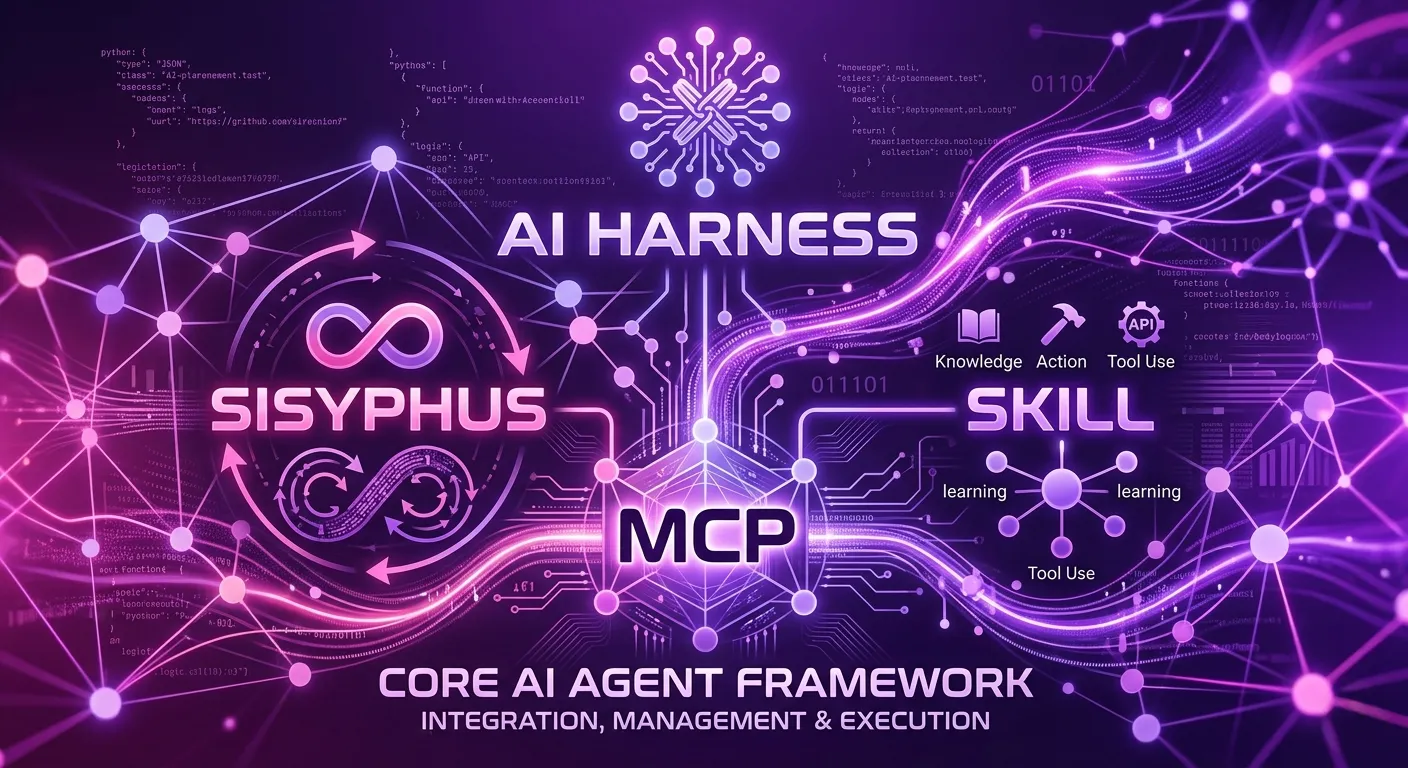
A new era of AI agent development is unfolding. In 2026, major companies including Anthropic and OpenAI are unleashing new concepts for AI to evolve beyond simple chatbots into "true agents" that autonomously perform tasks. AI Harness, Sisyphus, SKILL, MCP... If these terms still feel unfamiliar, don't worry. In this article, we'll dive deep into the essential terminology that every 2026 AI developer must know, along with vivid reactions from Reddit and developer communities.
1. AI Harness: The "Operating System" for Agents 🎠
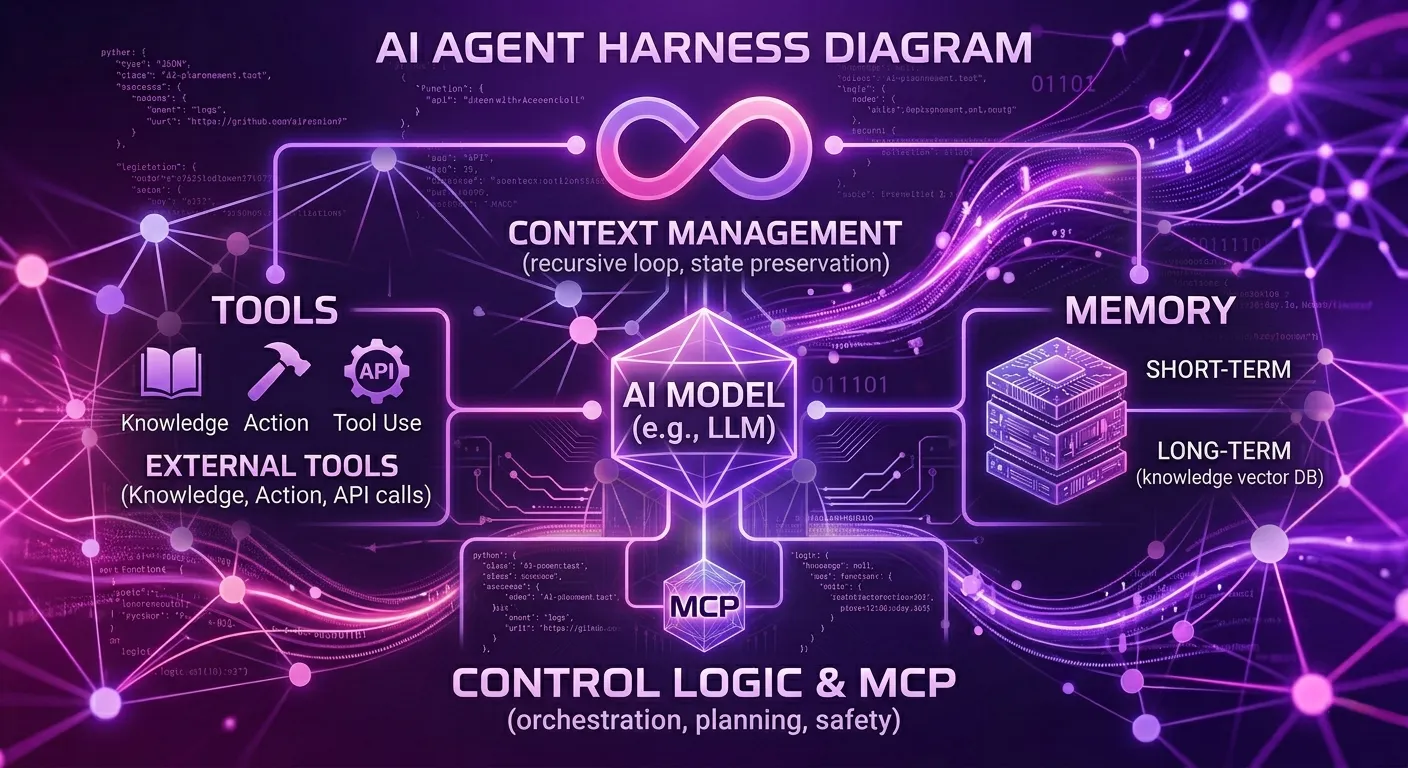
In 2026, one of the hottest topics in the AI development community is "AI Harness." This concept has established itself not merely as a buzzword, but as the decisive architectural layer that makes AI agents actually work in production environments.
This term, officially adopted in recent announcements from Anthropic's official documentation and OpenAI, is best explained through Philipp Schmid's famous computer analogy:
"The model is raw processing capability. The context window is limited working memory. The harness is the operating system... managing context, initialization sequences, and standard tool drivers. The agent is the application that runs on top." – Philipp Schmid, AI Architect
Six Core Components of Harness
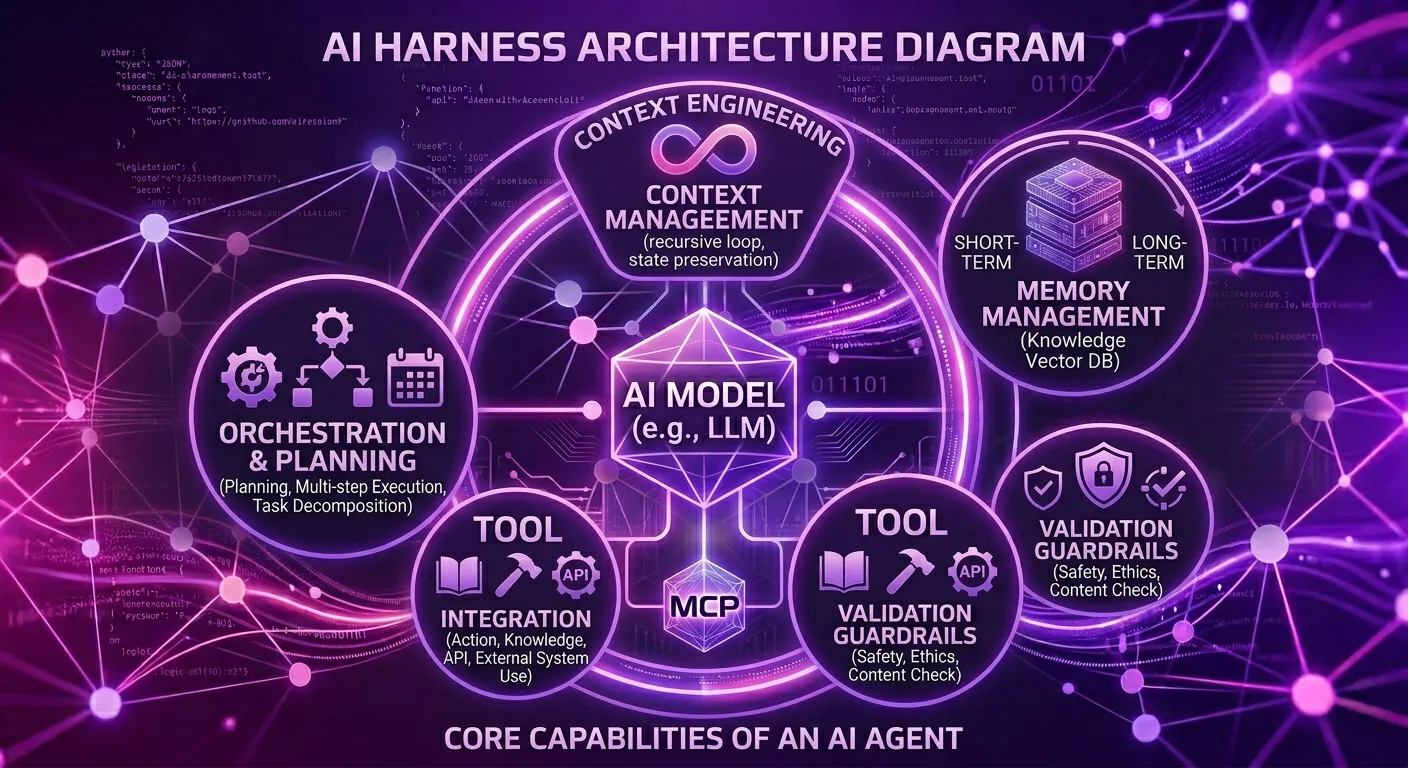
The six core components of Harness as defined by the parallel.ai team are:
- 🔧 Tool Integration Layer: Connects external APIs, databases, code execution environments via defined protocols
- 🧠 Memory and State Management: Multi-layered structure of working context, session state, long-term memory
- 📝 Context Engineering: Dynamic information curation (not static prompt templates)
- 📋 Planning and Decomposition: Guides models through structured task sequences
- 🛡️ Validation and Guardrails: Self-correcting loops, safety filters, format validation
- 🔌 Modularity and Extensibility: Pluggable components that can be independently enabled/disabled
Anthropic's Claude Code is a prime example of a Harness. Claude Code is not just a coding tool—it's a complete Harness system managing filesystem access, tool orchestration, sub-agent management, prompts, and lifecycle.
"If Framework answers 'how to build agents,' Harness answers 'how agents run.' This difference determines production success or failure."
2. Sisyphus: AI That Never Forgets 🧠
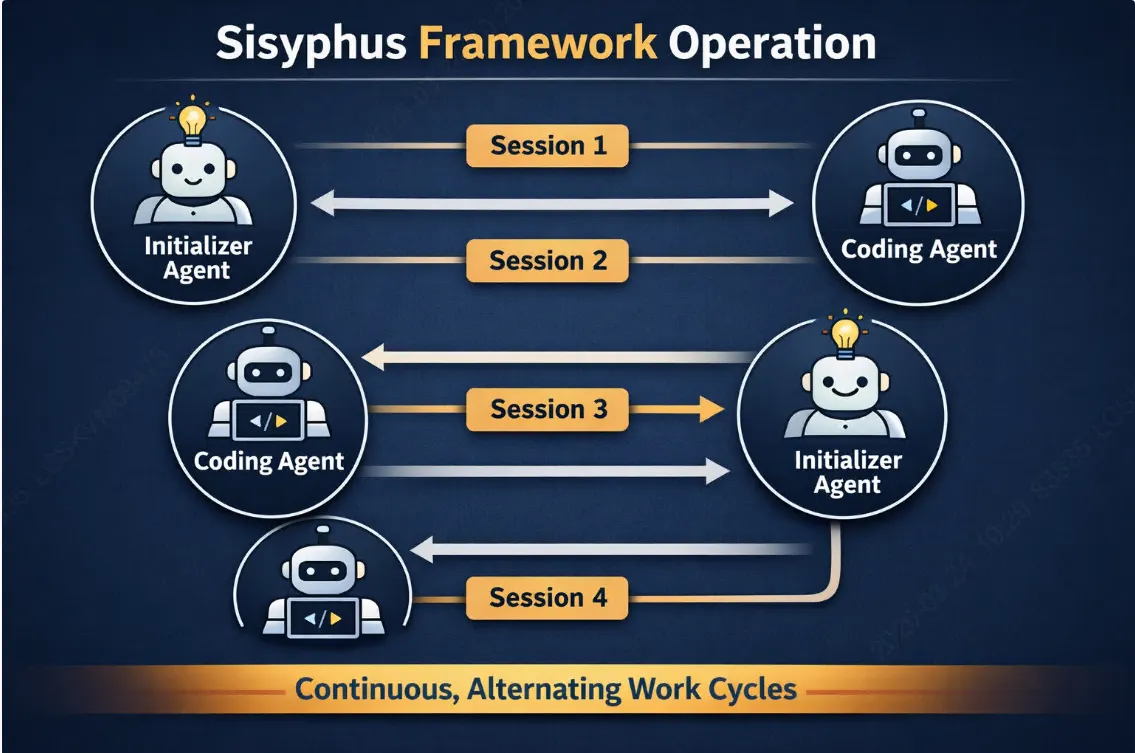
In Greek mythology, Sisyphus was condemned to roll a boulder uphill for eternity. This might sound like a terrible metaphor for AI developers, but Anthropic has reinterpreted this name with the exact opposite meaning. The Sisyphus framework is an innovative approach that enables AI to perform complex tasks over extended periods without "losing its memory."
The Core Problem: Context Window Limitations
The most chronic problem with AI agents is that "when the context window closes, AI loses its memory." It's like having a team of engineers working 24-hour shifts where each shift completely forgets what the previous shift did. No matter how skilled the engineers are, the project cannot progress under such circumstances.
According to Anthropic's research, 68% of traditional agents experience performance degradation after 4 hours. The Sisyphus framework proposes a dual-agent architecture to solve this problem:
Sisyphus Dual-Agent Structure
Sets up the environment at the start of each session. Reads artifacts left from previous sessions (progress files, git history, etc.) and restores current work state.
Performs actual work within each session. Makes incremental progress and leaves artifacts for the next session.
Anthropic's experiments showed that agents with the Sisyphus framework achieved 63% improvement in content consistency over 8-hour complex tasks, with 47% reduction in task failure rates. This isn't just a performance improvement—it's a paradigm shift for making AI agents truly useful in production environments.
"The 'progress files' and git history-based memory bridging proposed by Sisyphus is a truly elegant solution. Just like human developers, AI leaves work logs too."
3. SKILL vs MCP: Tools vs Recipes 🔧
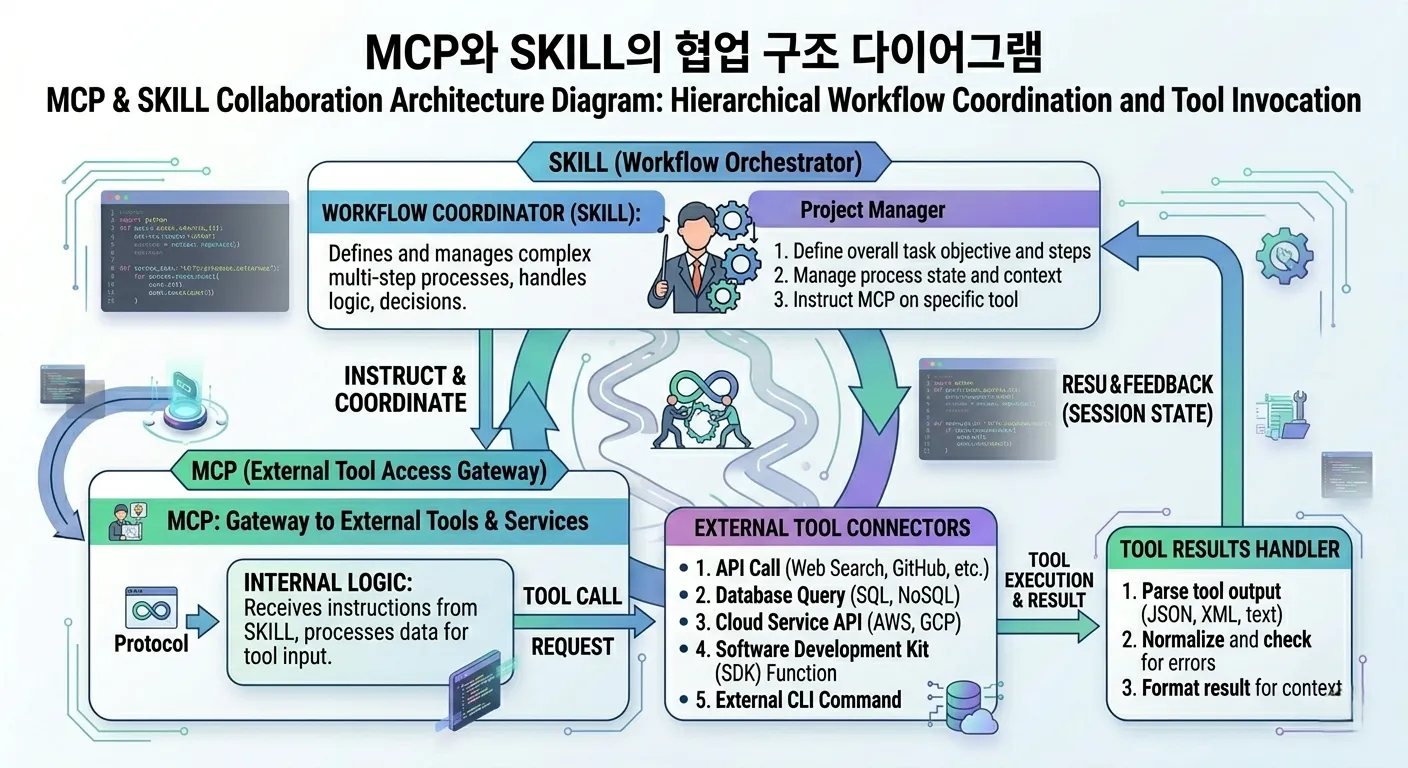
One of the hottest debates in the 2025-2026 AI community is the difference and relationship between MCP (Model Context Protocol) and SKILL. On Reddit's r/AI_Agents and Hacker News, fierce discussions rage about whether one will replace the other. However, the answer is surprisingly clear: they must work together.
🍳 Understanding Through Food Analogy
The easiest way to understand these two concepts is through a food preparation analogy:
MCP = Ingredients
MCPs are raw ingredients like flour, eggs, salt, and olive oil. Each is atomic and serves a specific purpose:
- Database queries
- REST API calls
- File read/write
- Web scraping
Characteristics: Stateless, external service connections, deterministic execution
SKILL = Recipe Cards
SKILLs are recipes like "making a cake" or "pasta cooking method." They combine multiple steps in specific order:
- TDD (Test-Driven Development) workflow
- Quarterly P&L analysis procedures
- Code review checklists
- Deployment processes
Characteristics: Natural language-based, progressive disclosure, behavior-centric
📊 Detailed Comparison Table
| Characteristic | MCP (Model Context Protocol) | SKILL |
|---|---|---|
| Abstraction Level | Low-level | High-level |
| Reusability | Technical | Behavioral |
| Ownership | Platform/Framework | App/Domain |
| Execution Model | Deterministic API calls | LLM interprets natural language instructions |
| Performance | Network latency occurs | Local execution, no latency |
| Setup Complexity | Medium (server required) | Low (markdown files) |
| Data Freshness | Real-time | Static (manual updates) |
| Offline Support | No | Yes |
"MCP answers 'what can Claude do,' while SKILL answers 'how should Claude approach it.' The clean separation between them is key."
🔄 Real Collaboration Scenario
Let's take a financial analysis AI agent as an example:
In this example, SKILL orchestrates the entire workflow while MCP serves as tools for accessing external data at specific steps. SKILL can call MCP, but MCP cannot call SKILL. This is an important directional difference.
4. A2A and Multi-Agent Architecture 👥
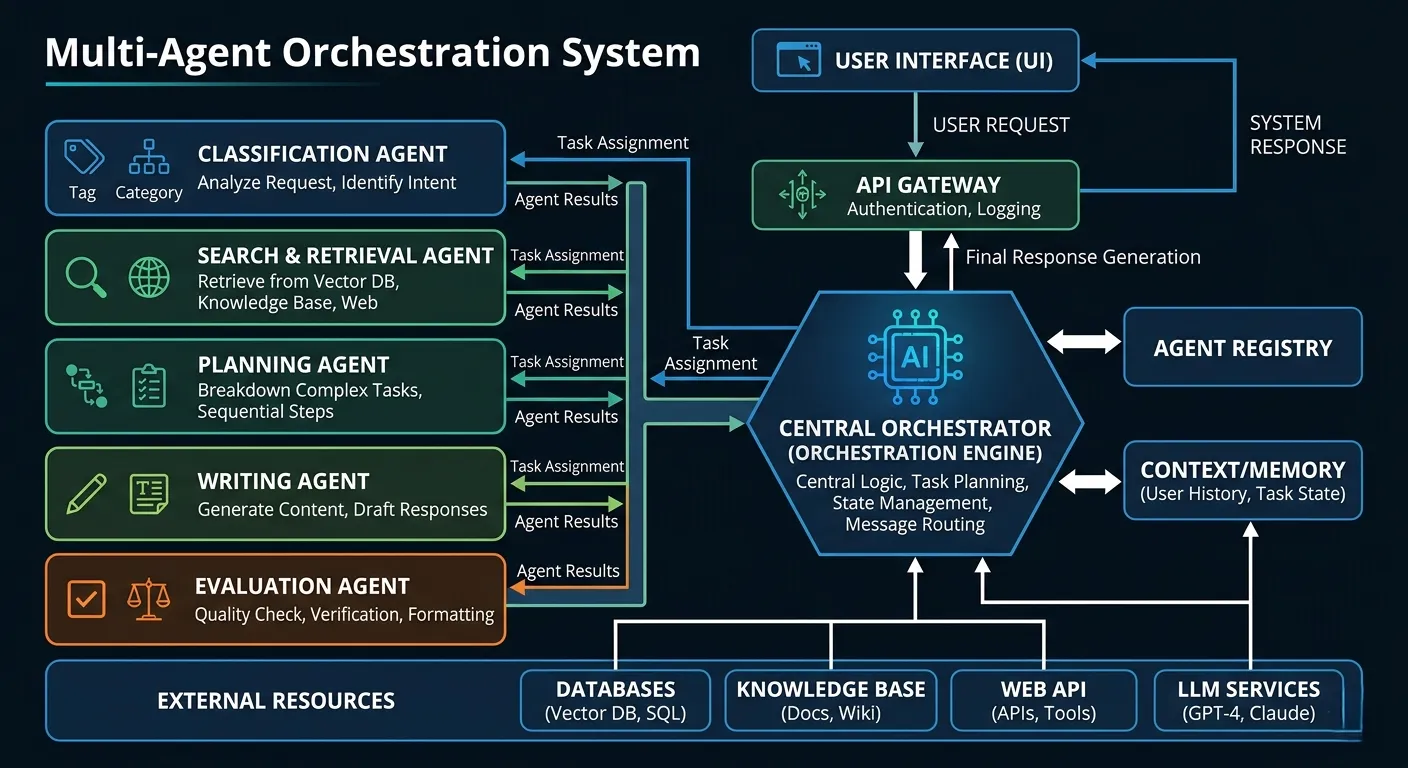
Another major trend in 2026 AI development is the rise of multi-agent architecture. A2A (Agent-to-Agent) serves as the core communication layer for this architecture, enabling agents to talk to each other and delegate tasks.
🎭 Multi-Agent Role Division Example
Multi-Agent Structure in Customer Support System
Categorizes customer inquiries by type (technical/billing/general)
Searches customer info and order history from DB
Writes final response and adjusts tone
This division of labor structure provides AI with greater scalability and stability. According to Anthropic's research, properly designed multi-agent systems achieve over 40% higher completion rates for complex tasks compared to single agents.
"While CrewAI and AutoGen are specialized for multi-agent, LangGraph provides explicit state machine control. The choice should vary by use case."
5. Practical Application: Which Technology to Choose? 🎯
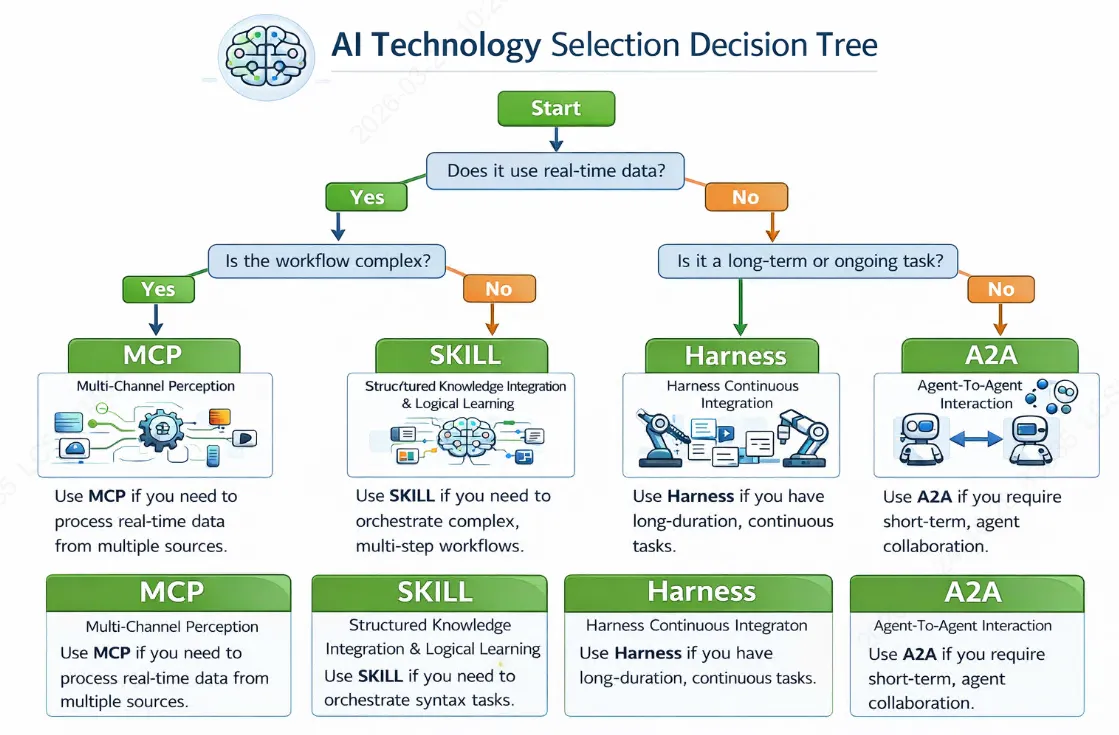
Now let's move from theory to practical application. Here's a concrete guide on which technology to choose when, from both developer and enterprise perspectives.
🚀 Quick Start Guide
1. Start with MCP
Find and install MCPs that connect to tools you already use (Linear, Sentry, databases, etc.). It's important to get a feel for how Claude autonomously calls tools.
2. Watch for Patterns
Have you found yourself repeatedly requesting the same multi-step sequence from Claude? That's your signal to create a SKILL. Instead of explaining "implement this feature using TDD" every time, create a TDD SKILL.
3. Build Harness: Step-by-Step Approach
When building a Harness for production readiness, follow this order:
- Build atomic tools: Start with small, robust single-purpose tools
- Delegate planning to model: Use model's reasoning ability instead of complex orchestration logic
- Add guardrails, retries, validation: Build safety measures
- Apply Sisyphus pattern: Session management for long-term tasks
📋 Decision Matrix
| Situation | Recommended Technology | Reason |
|---|---|---|
| Need real-time data queries? | MCP | Real-time API connections |
| Have repetitive workflows? | SKILL | Consistent procedure application |
| Task lasting several hours? | Sisyphus + Harness | Memory persistence across sessions |
| Need multiple specialized areas? | A2A Multi-Agent | Role division and collaboration |
| Offline environment? | SKILL | Local execution possible |
| Production stability is critical? | AI Harness | Validation, guardrails, monitoring |
"Our team uses the pattern of prototyping with Langflow, then productionizing with LangChain/LangGraph. We orchestrate with n8n and handle complex multi-agent logic with CrewAI."
6. 2026 AI Agent Development Outlook 🔮
The 2026 AI agent ecosystem is evolving rapidly. Here are the major trends and outlook:
📈 Major Trends
2026 Key Outlooks
As the boundary between the two technologies blurs, the pattern of calling MCP within SKILL will become standardized.
Industry standards for Agent-to-Agent communication will be established, improving interoperability between agents from different vendors.
Managed services that abstract the complexity of building AI Harnesses will emerge, letting developers focus only on business logic.
With advances in Ollama, LM Studio, etc., the pattern of running powerful agents offline will spread.
💡 Advice for Developers
Here are the most upvoted pieces of advice from Reddit's r/AI_Agents community:
"Start with your constraints, not your preferences. First understand your team's current tech stack, deployment environment, and data boundaries, then choose tools that fit." – Popular r/AI_Agents comment
"Framework doesn't replace Harness. Framework tells you how to 'build' agents, Harness manages how agents 'run.' You need both." – Popular Hacker News comment
Key Takeaway
The key to 2026 AI agent development is choosing the appropriate abstraction layer. MCP handles tool connections, SKILL handles behavior patterns, Harness handles execution environment, and Sisyphus handles long-term memory. Combine these to build AI systems suited to your purpose.
