"What if you could ask an AI a question and have the answer appear in the blink of an eye?" 🌟 On February 24, 2026, Inception Labs, led by Stanford professor Stefano Ermon, unveiled Mercury 2. This isn't just an update—it's a fundamental paradigm shift in artificial intelligence. The diffusion-based language model breaks through the limitations of autoregressive approaches, generating 1,000+ tokens per second— 10x faster than GPT-4 or Claude. This article provides a deep dive into Mercury 2's revolutionary architecture, real-world performance, use cases, and authentic reactions from the developer community.
1. The Prison of Autoregression: Why Traditional AI Must Be Slow 🐌
Every major language model we use today—ChatGPT, Claude, Gemini, Llama—shares common DNA: the autoregressive approach. Like typing on a typewriter, it generates text one token at a time, sequentially.
Autoregressive Approach
↓ Predict token 1: "jumps"
"The quick brown fox jumps"
↓ Predict token 2: "over"
"The quick brown fox jumps over"
↓ Predict token 3: "the"
...Repeat this 1,000 times
⚠️ Sequential dependency: Token N waits for token N-1 to complete
Diffusion Approach (Mercury 2)
✓ Parallel refinement: Generate all tokens simultaneously and iteratively improve
The fundamental limitation of autoregressive models is sequential dependency. To generate token #100, tokens #1 through #99 must all be complete. No matter how powerful the hardware, this bottleneck cannot be eliminated. Inception Labs CEO Stefano Ermon describes it as "the world's most expensive typewriter".
"the world's most expensive typewriter"
— Stefano Ermon, Inception Labs CEOThe AI industry has spent billions on specialized chips, optimized serving stacks, and model compression to improve speed, but the fundamental structure of token-by-token sequential generation has never changed. Mercury 2 flips this structure on its head.
2. The Diffusion Revolution: Image Generation Tech Comes to Language 🎨
Diffusion models aren't new to AI. Stable Diffusion, DALL-E, Midjourney, Sora— all are diffusion-based. Their core principle: start from noise and iteratively refine to generate images.
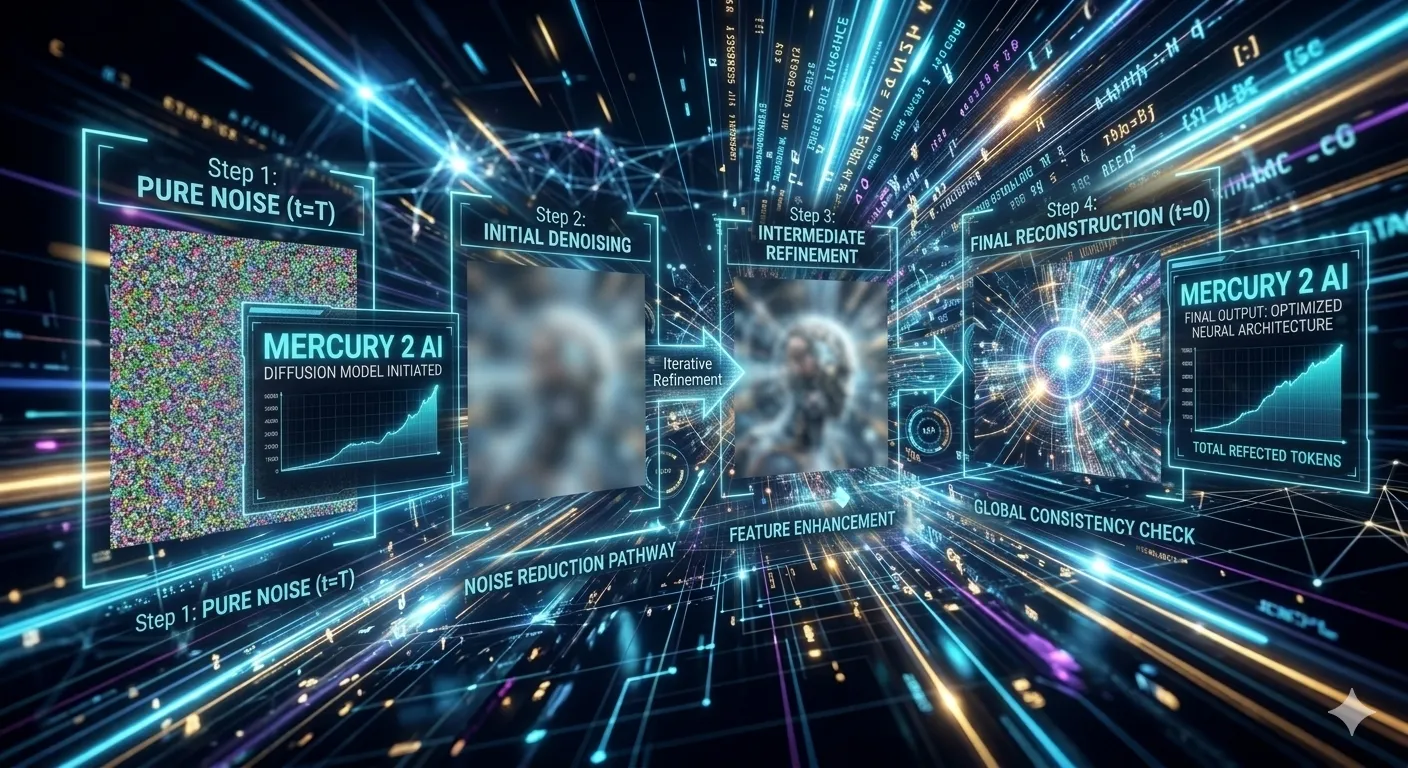
Mercury 2's Text Diffusion Process
Step 1: Initialization (Masking)
Starts with a completely masked (hidden) token sequence. Like a sentence where every word is ████.
Step 2: Parallel Prediction
The transformer model predicts tokens at all positions simultaneously. Calculates probability distributions for each position.
Step 3: Confidence-Based Unmasking
Confirms tokens with highest confidence first. This provides better context for subsequent refinement steps.
Step 4: Iterative Refinement (8-20 steps)
Repeatedly improves remaining masked positions. Updates the entire sequence simultaneously at each step.
"Mercury 2 doesn't type one character at a time like a typewriter. Like an editor, it reviews and revises the entire draft at once. This parallelism is the secret of its speed."
— Stefano Ermon, Inception Labs CEOStefano Ermon is a pioneer who developed the foundations of diffusion models at Stanford University. His research became the core technology behind Stable Diffusion and DALL-E, and he's the author of the text diffusion paper that won Best Paper at ICML 2024. After two years of research, he perfected the application of diffusion to language— the result is Mercury 2.
3. Mercury 2 Deep Dive: Specs and Benchmarks 📊
Key Specifications
| Specification | Mercury 2 | Notes |
|---|---|---|
| Throughput | 1,009 tokens/sec | On NVIDIA Blackwell GPU |
| End-to-End Latency | 1.7 seconds | Total round-trip time |
| Input Token Price | $0.25 / 1M tokens | Half of Gemini 3 Flash |
| Output Token Price | $0.75 / 1M tokens | 6.5x cheaper than Claude Haiku |
| Context Window | 128K tokens | ~300 pages worth |
| Special Features | Tunable reasoning, tool use, JSON output | OpenAI API compatible |
Speed Comparison: Independent Verification Results
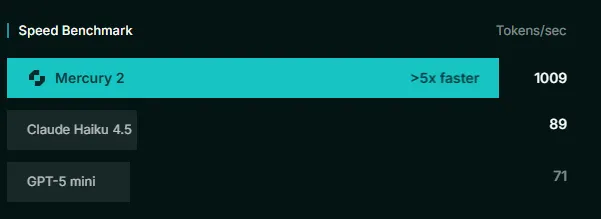
According to independent benchmarking by Artificial Analysis, Mercury 2 achieved 711.6-1,196 tokens per second in standardized multi-turn evaluations— ranking #1 among 132 tracked models.
🚀 Throughput Comparison (tokens/sec)
Source: Artificial Analysis Independent Verification (February 2026)
Quality Benchmarks: Is It as Smart as It Is Fast?
| Benchmark | Mercury 2 | Description |
|---|---|---|
| AIME 2025 (Math) | 91.1 | Competitive mathematical reasoning |
| GPQA Diamond (Science) | 73.6 | Graduate-level science questions |
| IFBench (Instruction Following) | 71.3 | Complex instruction execution ability |
| LiveCodeBench (Coding) | 67.3 | Contamination-resistant coding evaluation |
| SciCode (Science Coding) | 38.4 | Multi-step science problem solving |
| TAU-bench (Agent) | 52.9 | Complex agent evaluation |
On the Artificial Analysis Intelligence Index, Mercury 2 scored 33 out of 100, ranking 22nd among 132 models. Considering the median is 19 points, this places it in the top 15%. While there's a gap with Claude Opus or Gemini 3.1 Pro (80-90 point range), it offers the fastest and most competitive quality among Haiku/Mini-class models.
4. Real-World Testing: From Car Wash Problems to Document Summarization 🧪
Test 1: "The Car Wash Problem" (Reasoning Ability Test)
🚗 Prompt:
"A car wash is 50 meters away. Should I walk or drive?"
This simple question tests Mercury 2's unique tunable reasoning effort setting.
Low Reasoning Effort
- Instant answer: "Walk. It's a short distance, just a few minutes."
- Cost-efficient
- Suitable for simple questions
High Reasoning Effort
- Context-aware: "It depends on the type of car wash."
- Drive-thru car wash: Drive
- Self-service car wash: Consider weather and luggage
- More realistic and thoughtful advice
Test 2: 5,000-Word Document Summarization
In Analytics Vidhya's real-world test, Mercury 2 summarized 5,000-10,000 word articles in 3 seconds. Testing the same prompt with ChatGPT required 25 seconds of thinking time + 10 seconds of generation time— making Mercury 2 over 10x faster.
"Using Mercury 2, you can't fully process your question before the answer appears. For someone who's waited years for inference pipelines, it feels slightly uncanny."
— Awesome Agents Review5. Developer Community Reactions: Hacker News and Expert Perspectives 💬
Hacker News Community Reactions
Mercury 2's launch sparked active discussion on Hacker News. Here's a summary of key developer reactions:
Voice Agent Developer
"Thinking of testing this with my voice agent. Should be useful for reducing latency at least for user-facing agents."
Architecture Analyst
"Probably need to modify with multi-shot generation. Each diffusion would represent a single 'thought'. Speed being fast means that's not really an issue."
IDE Integration Developer
"Mercury v1 is already in production use in mainstream IDEs like Zed. Excellent for autocomplete and next-edit prediction."
Expert Evaluations
Davis Treybig (LinkedIn): "While the benchmarking is impressive—delivering Haiku/Nano-level intelligence 5-8x faster—the most interesting aspect is the intuitively different feel when using it in products. With frontier-level intelligence executing in ~1 second, you can build completely different types of product experiences."
NVIDIA Shruti Koparkar: "Inception's Mercury 2 shows what's possible when new model architectures meet NVIDIA AI infrastructure. Achieving 1,000+ tokens per second on NVIDIA GPUs highlights the performance, scalability, and versatility of our platform in supporting AI workloads across the board."
Some developers have pointed out that chains of thought may be hidden or less transparent. While classified as a "reasoning model," the transparency of its thinking process may be inferior to traditional models. You can see some thinking process by clicking "thought for n seconds" at high reasoning effort settings.
6. Use Cases: Where Should You Use Mercury 2? 🎯
Real-Time Voice AI
Sub-1-second response times enable natural conversations. Ideal for customer service bots, personal assistants, and real-time translation.
Instant Coding Tools
Real-time code completion, immediate refactoring suggestions, rapid debugging support. Maximizes developer productivity.
Real-Time Search Systems
Instant result generation for complex queries. Dramatically reduces response time in RAG pipelines.
Agent Loops
Latency doesn't accumulate in multi-step agent workflows. Processes 5-step tasks as fast as traditional models handle 1 step.
Large-Scale Document Processing
128K context window with ultra-fast generation enables real-time summarization, extraction, and analysis of long documents.
Autocomplete & Prediction
Already proven next-edit prediction in Zed IDE. Reads user intent and provides instant suggestions.
7. Limitations and Considerations: Why It's Not Perfect ⚠️
Structural Limitations
- Text-only: No multimodal capabilities
- Cloud-only: No on-premise deployment
- No fine-tuning: Limited customization
- Inefficient for short outputs: Full refinement process needed even for "yes/no"
Usage Considerations
- Verbose by default: Prompt engineering needed for output length control
- Ecosystem maturity: Less production experience than GPT/Claude/Gemini
- Optimal hardware: NVIDIA Blackwell needed for best speeds
- No streaming: Only completed output, no intermediate results
"Mercury 2 isn't a silver bullet. For teams needing multimodal capabilities, on-premise deployment, or frontier-level reasoning, it's the wrong tool. But for teams building agent frameworks, voice interfaces, or high-volume document processing pipelines that can accept Haiku-level quality, it's the best price-performance option available."
— Awesome Agents Review (Rating: 7.4/10)Reasoning Depth Limitations
Extended chain-of-thought reasoning requires sequential dependencies between steps. Diffusion models process all positions simultaneously, so for tasks requiring 10+ steps of logical chaining, autoregressive models like Claude Opus 4.6 or GPT-5.2 remain superior. AIME problems are well-defined in short contexts that diffusion models handle cleanly, but there's no public data on multi-turn consistency across 10K+ tokens or rare edge cases in complex agent loops.
8. Future Outlook: The Next Phase of Diffusion LLMs 🔮
Hybrid Architectures
The most likely near-term evolution is hybrid architectures. A diffusion model like Mercury 2 generates fast drafts, while an autoregressive model like Claude Opus 4.6 refines sections where quality matters. This mirrors the principle of speculative decoding: fast model proposes, slow model verifies. The difference is Mercury 2 proposes entire sequences, not individual tokens.
Scaling Laws
Scaling laws for diffusion LLMs aren't yet established. The autoregressive scaling curve—more parameters and data consistently making better models— has been mapped over years. Inception Labs and other research groups are determining whether diffusion models follow similar scaling patterns or require different optimization strategies. If diffusion models scale as predictably as autoregressive ones, the 85-95% quality gap could close to 95-99% within two generations.
Competitive Landscape Shift
OpenAI, Google DeepMind, and Anthropic are all researching non-autoregressive generation techniques. If frontier labs combine diffusion speed with frontier-level training data and RLHF alignment, the speed-quality tradeoff could disappear entirely. Mercury 2 is the proof of concept that makes this research direction commercially viable.
9. Getting Started: API Access & Capabilities 💻
Account Setup & Authentication
Getting started with the Inception Platform is seamless. When you sign in and create an account, you are initially assigned 10 million free tokens to help you explore and test the API.
export INCEPTION_API_KEY="your_api_key_here"
# Base API Endpoint URL
https://api.inceptionlabs.ai/v1
Quick Start: Python & Third-Party Libraries
The Inception API provides a powerful interface that is fully OpenAI-compatible. This means you can use existing client libraries like openai, LangChain, LiteLLM, VercelAI, and AISuite without rewriting your codebase[1].
import os
from openai import OpenAI

# Initialize client using Inception Labs base URL
client = OpenAI(
    api_key=os.environ.get("INCEPTION_API_KEY"),
    base_url="https://api.inceptionlabs.ai/v1"
)

# Call Mercury 2 using Chat Completions
response = client.chat.completions.create(
    model="mercury-2",
    messages=[
        {"role": "user", "content": "Explain quantum computing in simple terms"}
    ],
    extra_body={"reasoning_effort": "high"},  # API parameter to tune depth
    max_tokens=1000
)

print(response.choices[0].message.content)
Core Capabilities
According to the official Inception documentation, Mercury 2 goes far beyond standard Chat Completions. It natively supports an array of specialized capabilities tailored for complex workflows:
Streaming & Diffusion
Choose between receiving Instant complete responses, or use Streaming & Diffusion which streams the iterative refinement steps in real-time rather than traditional token-by-token output.
Tool Use & Structured Outputs
Natively supports external Tool Use (function calling) and guaranteed Structured Outputs (strict JSON schemas) to ensure reliability in complex agentic applications.
Code: FIM, Next Edit, Apply Edit
Offers specialized endpoints for coding, including Autocomplete (FIM) for fill-in-the-middle generation, predictive Next Edit capabilities, and targeted Apply Edit for intelligent refactoring.
Adjusting API Parameters (Reasoning Effort)
You can fine-tune the model's speed and quality via API parameters like reasoning_effort:
| Setting | Combined Use Case | Expected Latency |
|---|---|---|
low |
Simple questions, quick Autocomplete (FIM) | < 1 second |
medium |
General Chat Completions, Structured Outputs | 1-2 seconds |
high |
Complex reasoning, Tool Use, Next Edit predictions | 2-4 seconds |
🚀 Try It Now
Want to experience Mercury 2's capabilities firsthand? Sign up to grab your free tokens from the dashboard, or test it out at the official Inception Chat interface.
Experience Mercury 2