
An itch that keeps you up at night, skin that calms down only to flare red again a few days later. If you've lived with atopic dermatitis, this cycle probably feels familiar. Some days your skin looks completely fine, and then a change in season is all it takes for the itching to start again, even after trying every moisturizer that's supposed to help. It's common for symptoms that started in infancy to persist into adulthood, and just as common for skin that's been calm for years to suddenly flare during a stressful stretch of life. Search online and you'll find no shortage of information, but it's often hard to tell what actually applies to your situation, let alone separate solid evidence from popular myth. Why does it keep coming back? Today we'll walk through what actually causes atopic dermatitis, how it shows up differently across life stages, the big picture on diagnosis and treatment, common misconceptions worth clearing up, and practical, everyday habits that help calm flare-ups and protect your skin barrier.
This article is intended to provide general health and lifestyle information and is not a substitute for a medical diagnosis, consultation, or treatment from a qualified physician. If you have a specific condition or symptoms, please consult a medical professional.
What Is Atopic Dermatitis? Two Key Mechanisms
Atopic dermatitis is a chronic, relapsing inflammatory skin condition. It's often dismissed as simply "sensitive skin," but two distinct mechanisms are usually at play: a breakdown in the skin's outer defense layer, known as the skin barrier, and an immune system that overreacts once irritants slip through that weakened barrier. Either factor alone might cause mild dryness or a brief bout of inflammation, but when both act together, the result is often a chronic cycle of itching and rash.
What happens when the skin barrier breaks down
The outermost layer of skin, the stratum corneum, relies on a protein called filaggrin to hold onto moisture. When the body doesn't produce enough of this protein — often due to genetics — or when it's damaged by outside irritants, water evaporates from the skin's surface more quickly and skin dries out easily. At the same time, gaps open up between skin cells, making it easier for pollen, dust mites, bacteria, and other outside substances to penetrate deeper into the skin. Think of the skin barrier as a fence around your body — in atopic dermatitis, that fence ends up full of holes.
An immune system that overreacts
Once irritants get through a compromised barrier, the immune system — particularly a pathway known as the Th2 response — tends to activate excessively. Inflammatory mediators released in this process trigger intense itching, and scratching that itch damages the skin barrier even further, letting in more irritants. This is often called the "itch-scratch cycle," and breaking that cycle at any point is really the central goal of managing atopic dermatitis.
Where genetics and environment intersect
Research has consistently shown that having a parent with atopic dermatitis, asthma, or allergic rhinitis increases the likelihood that a child will develop atopic dermatitis. But genetics alone don't determine the outcome. Dry climates, urbanized living environments, shifts in skin bacteria from frequent hand-washing and sanitizing, and exposure to air pollution can all contribute to the onset or worsening of symptoms. While atopic dermatitis most commonly begins in infancy, it can also first appear in adulthood or resurface after years of remission. It also tends to cluster with asthma, allergic rhinitis, and food allergies — a pattern researchers often describe as the "atopic march."
How common is it, and how does it typically progress?
Atopic dermatitis is reported to be common enough worldwide that a substantial share of infants experience it at least once, with prevalence trending higher in industrialized, urban environments. Fortunately, a large portion of cases that begin in infancy improve naturally with age, though some persist into adolescence and adulthood, or disappear for years only to return later. Because the course varies so much from person to person, there's no single answer to "when will this go away." What is consistent, regardless of individual course, is that steady skin barrier care reliably helps reduce how often flares occur and how severe they are.
"Managing atopic dermatitis isn't about a single 'cure' — it's about consistently protecting the skin barrier through daily habits." – Dermatologist
Symptoms and Severity by Age
Symptoms of atopic dermatitis vary quite a bit by age and life stage. Even though it's the same underlying condition, the body areas affected and how symptoms present can look very different in infancy, childhood, and adulthood — largely because skin thickness, activity patterns, and areas of friction differ at each stage. Knowing which pattern typically applies to your situation, or your child's, can ease unnecessary worry and help guide the right kind of care. Realizing that the same diagnosis can look completely different depending on age often brings real relief on its own.
Infancy (birth to age 2)
At this stage, red, sometimes weeping patches typically appear first on the face — especially the cheeks — and scalp. Areas covered by a diaper tend to stay relatively moist and are less affected, while exposed areas like the face and the outer arms and legs are more noticeably involved.
Childhood (age 2 through adolescence)
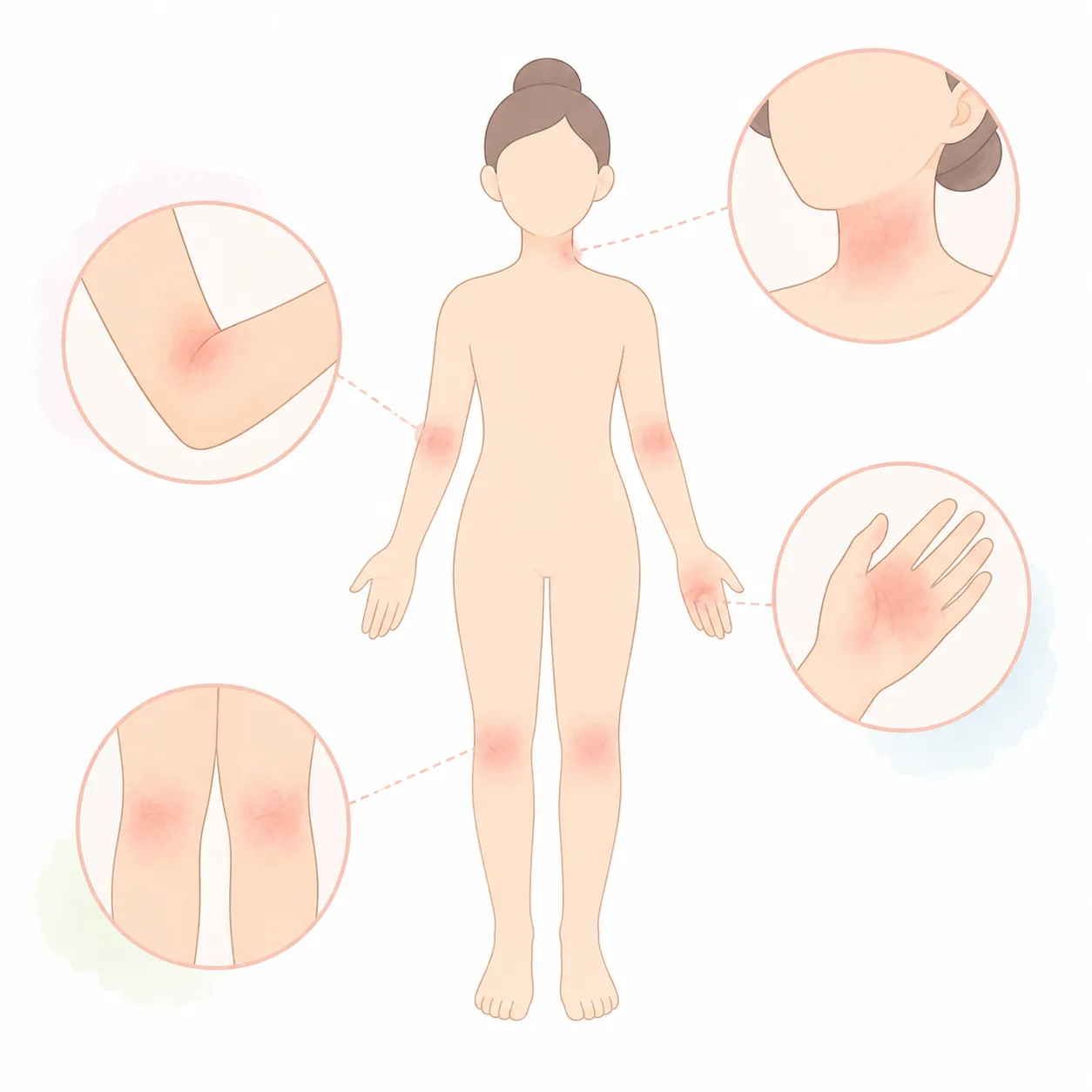
As children grow, symptoms tend to shift toward flexural areas — the inner elbows and the backs of the knees. From this stage onward, repeatedly scratched skin can start to thicken and take on a leathery texture, known as lichenification, and poor sleep from itching can begin to affect schoolwork and concentration, making careful management especially important.
Adulthood
In adults, symptoms often stand out on the hands, neck, eyelids, and face — areas frequently exposed to cosmetics or other irritants. Areas that are chronically scratched or rubbed tend to show more pronounced lichenification, and for people who frequently submerge their hands in water or handle chemicals at work, symptoms can worsen into a form of hand eczema.
| Life Stage | Common Sites | Typical Presentation |
|---|---|---|
| Infancy | Face (cheeks), scalp, outer arms and legs | Red, weeping patches |
| Childhood | Inner elbows, backs of knees, neck | Dryness with early lichenification |
| Adulthood | Hands, neck, eyelids, face | Chronic lichenification, possible hand eczema |
How severity is classified
Clinicians typically combine factors like the percentage of body surface affected, the degree of redness and oozing, and whether itching disrupts sleep to classify cases as mild, moderate, or severe. Mild cases involve localized dryness and itching with little impact on daily life; moderate cases extend across multiple areas and begin affecting sleep; severe cases involve widespread symptoms that affect daily functioning and mental health. These classifications are measured more objectively using clinical scoring tools such as SCORAD and EASI, which play an important role in guiding treatment decisions.
Practical care tips by age
Parents of infants often wonder whether one bath a day is enough, or how often to reapply lotion. The general recommendation is a quick lukewarm bath followed immediately by generous moisturizer applied to the whole body, repeated daily, with gentle cleaning around the mouth after meals to reduce irritation from saliva or food residue.
School-age children sometimes resist applying moisturizer in front of classmates, or push through itching instead of addressing it, which can affect concentration in class. Packing a small, portable moisturizer in their backpack and briefly informing their teacher can make it easier to manage symptoms during breaks.
Adults who frequently submerge their hands in water or wear gloves for extended periods at work are prone to developing hand eczema alongside their existing atopic dermatitis. Keeping hand cream nearby before and after work, and wearing thin cotton gloves underneath work gloves when possible, can meaningfully reduce irritation.
Conditions That Often Accompany Atopic Dermatitis
As the "atopic march" concept suggests, atopic dermatitis frequently appears alongside other allergic conditions. Many cases that begin as atopic dermatitis in infancy go on to develop into asthma or allergic rhinitis later, a pattern explained by the fact that all three conditions share a similar immunological background — namely, a Th2-skewed immune response.
Food allergies are also observed more frequently in infants with atopic dermatitis. That doesn't mean every person with atopic dermatitis also has a food allergy, and it's better to consult a specialist when symptoms clearly worsen after eating a specific food, rather than restricting foods preemptively out of vague concern. If seasonal symptoms like allergic rhinitis or conjunctivitis appear alongside skin symptoms, it may be worth seeing an ENT specialist or allergist in addition to a dermatologist. Knowing which comorbidities tend to travel together can help you respond calmly and seek the right kind of care when symptoms appear in combination.
In adults, occupational contact dermatitis often overlaps with existing atopic dermatitis. People in fields like cosmetology, food service, or healthcare — where hands are frequently submerged in water or exposed to chemicals — may find that occupational hand eczema compounds their existing symptoms, making it worth examining the work environment itself as part of the care plan.
Common Myths About Atopic Dermatitis, Fact-Checked
Atopic dermatitis attracts an unusual number of myths and half-truths. Some information shared online or by acquaintances is genuinely helpful, but following unverified claims can sometimes worsen symptoms or delay proper treatment. Let's fact-check a few of the most common ones.
Myth 1: Atopic dermatitis is caused by poor hygiene
Not true. Atopic dermatitis stems from skin barrier dysfunction and immune imbalance, not cleanliness. In fact, excessive washing or harsh cleansers can damage the skin barrier even further.
Myth 2: Moisturizer alone will fully cure it
Moisturizing is essential, but it isn't a cure-all. Moderate-to-severe cases typically need moisturizing combined with treatment prescribed by a physician to be effectively controlled.
Myth 3: "Natural" or "organic" products are automatically safe
Labels like "natural" or "organic" don't guarantee a product is gentle. Some plant-derived ingredients can still trigger allergic reactions, so checking the ingredient list and doing a patch test is the safer approach.
Myth 4: Allergy testing reveals the exact cause
Allergy tests are a reference point, not a definitive answer — test results don't always match real-world symptoms. A positive result doesn't necessarily mean that substance must be avoided; it needs to be interpreted alongside actual clinical symptoms.
Myth 5: Stress has nothing to do with skin symptoms
Research has reported that stress hormones can affect inflammatory responses and the speed of skin barrier recovery. Habits that help you relax can reasonably be considered part of skin care.
Myth 6: Once you have it, the severity stays the same forever
In reality, severity fluctuates significantly with timing and environment. Many people achieve long stretches of minimal symptoms through proper management, and the overall course varies widely from person to person.
Common Triggers at a Glance
Identifying your personal triggers matters just as much as recognizing the symptoms themselves. Sensitivities vary from person to person, so it helps to compare your own routine against the common categories below.
| Trigger | Common Examples | Management Tip |
|---|---|---|
| Dry environments | Winter heating, low humidity | Keep indoor humidity around 40–60% |
| Sweat & overheating | Lingering in sweaty clothes, heavy layers | Rinse off sweat quickly; wear breathable fabrics |
| Irritating fabrics | Wool, synthetics, clothing tags | Choose soft, 100% cotton clothing |
| Harsh cleansers | Fragranced soaps and detergents | Switch to fragrance-free, gentle cleansers |
| Stress | Sleep deprivation, mental strain | Prioritize consistent sleep and relaxation |
| Dust mites, etc. | Allergens in bedding, carpets | Wash bedding regularly; ventilate often |
| Sudden temperature shifts | Seasonal changes, indoor-outdoor gaps | Adjust layers before heading out |
| Specific foods (in some people) | Eggs, milk, etc. | Confirm through testing rather than self-restricting |
One thing worth remembering: not every item on this list applies equally to everyone. Some people react strongly to sweat but not at all to food, and the reverse is just as common. If you want to pinpoint your own triggers, keeping a simple symptom journal can help. Tracking what you ate, what you wore, the weather, your stress level, and how itchy you felt that night for two to three weeks often reveals a surprisingly clear pattern.
Breaking down the triggers, one by one
Irritating fabrics aren't limited to clothing — they can include bedding, sofa covers, and car seats, anywhere skin makes prolonged contact. With cleansers, a "gentle" label alone isn't a reliable guide; checking how your own skin actually reacts after use is more accurate. Stress doesn't usually trigger itching directly so much as it heightens your sensitivity to itch and increases how often you scratch, which is why a separate relaxation strategy matters.
Dust mites are easy to overlook since they're invisible, but they thrive especially in bedding, mattresses, and old stuffed toys or cushions. Hot-water washing, regular ventilation, and sun-drying bedding can meaningfully reduce their presence. Sudden temperature shifts cause blood vessels to rapidly expand and contract, which can trigger itching — layering an outer garment when moving between indoor and outdoor spaces helps buffer that change.
Key Takeaway
Rather than chasing a "cure," the most realistic goal is to protect your skin barrier and consistently avoid your own personal triggers — that's what actually reduces how often and how severely flare-ups occur.
How Is Atopic Dermatitis Diagnosed?
Atopic dermatitis isn't something a single blood test can confirm or rule out. A doctor typically asks detailed questions — when symptoms started, whether there's a family history, what makes things better or worse — and combines that with a visual examination of the skin to form a diagnosis. Chronic itching, characteristic affected areas, a relapsing-remitting course, and a personal or family history of allergic conditions are all considered together, often guided by established diagnostic frameworks such as the Hanifin-Rajka criteria, which are widely used in clinical practice. Most first visits involve nothing more than a visual exam, so there's no need to feel anxious about going in.
If an allergic component is suspected, doctors may order additional tests such as blood IgE levels or skin prick testing, which exposes the skin to small amounts of potential allergens to observe the reaction. A positive result on these tests doesn't necessarily mean that substance is the direct cause of your symptoms, so results should always be interpreted together with a specialist. It's also important to rule out conditions that can look similar but require different treatment, such as contact dermatitis, seborrheic dermatitis, or psoriasis. If you notice oozing, yellow crusting, sudden spreading, or pain that's different from your usual symptoms, it may not be a simple flare — it could signal a bacterial infection, and you should seek care promptly.
When you shouldn't wait to see a doctor
It's safer to see a doctor rather than rely on self-care alone if you notice any of the following: oozing, yellow crusting, or warmth spreading rapidly; itching severe enough to disrupt a full week or more of sleep; no improvement after two or more weeks of consistent moisturizing and lifestyle care; or eyelid involvement severe enough to affect vision. Before your appointment, it helps to jot down when symptoms started, any new products or foods you've recently introduced, and whether family members have similar symptoms or allergic conditions — this makes your time with the doctor far more productive.
A Daily Skin Care Routine That Actually Helps
There's no single miracle fix — it's the small routine you repeat every day that shapes your skin's condition over time. The steps below reflect the basic care flow commonly recommended across dermatology practices.
- Keep showers short and lukewarm. Hot water strips natural oils from skin and can actually worsen dryness. Aim for 5–10 minutes in lukewarm water with a gentle, low-fragrance cleanser worked into a soft lather. Avoid scrubbing or using rough towels, which can physically damage the skin barrier.
- Moisturize within 3 minutes of bathing. Pat skin gently dry instead of rubbing, then apply moisturizer while skin is still slightly damp — a technique often called "soak and seal" — to lock in moisture. The longer you wait, the more surface moisture evaporates, reducing the technique's effectiveness.
- Choose ceramide-based moisturizers. Look for ingredients like ceramides and hyaluronic acid that mirror your skin barrier's natural composition, and avoid products with added fragrance or alcohol. Thicker creams or ointments generally hold moisture better than thinner lotions.
- Stick to soft cotton for clothing and bedding. Wash new clothing before wearing it, and watch for tags or rough seams that may rub directly against skin. The same applies to pillowcases and sheets — soft cotton reduces friction-related irritation during sleep.
- Manage indoor humidity and temperature. Use a humidifier during dry seasons to keep humidity around 40–60%, and keep your bedroom cool and comfortable at night. Clean humidifiers regularly to prevent mold or bacterial growth.
- Keep nails short and rounded. This small habit limits the skin damage caused by unconscious scratching, especially during sleep. For children who tend to scratch unconsciously while asleep, thin cotton gloves at night can help too.
Choosing moisturizer ingredients wisely
With so many moisturizers on the market, it's easy to feel overwhelmed. The table below outlines commonly recommended ingredients, as well as ones that may cause irritation and warrant caution. That said, reactions to the same ingredient can vary from person to person, so it's safest to test any new product on a small area, like the inner arm, before applying it more broadly.
| Category | Example Ingredients | Notes |
|---|---|---|
| Generally helpful | Ceramides, hyaluronic acid, glycerin | Mirror skin barrier components or draw in moisture |
| Soothing properties reported | Colloidal oatmeal, panthenol | Associated with reduced itching and irritation |
| Use with caution | Synthetic fragrance, high-concentration alcohol | Can add further irritation to an already compromised barrier |

Clothing and laundry: small details that matter more than you'd think
How you wash clothes matters just as much as the fabric itself. Leftover detergent residue can be an irritant on its own, so use a thorough rinse cycle and minimize fabric softener. Wash new clothing before wearing it rather than putting it on straight away, and cut off tags or choose garments with a soft inner lining where seams might directly touch the skin. Fragrance-free detergent is worth choosing when possible, and lighter-colored clothing tends to carry a somewhat lower risk of dye-related irritation than darker garments.
Frequency over quantity
Reapplying moisturizer throughout the day as skin feels dry works better than one heavy application.
Watch sudden heat changes
Saunas and steam rooms can trigger sudden itching due to rapid temperature shifts.
Don't eliminate foods on a hunch
If you suspect a food trigger, get it confirmed through testing rather than cutting it out on your own.
Protect sleep quality
Poor sleep raises stress hormones, which can worsen inflammatory flare-ups.
Patch test new products
Apply a small amount to your inner arm and check for reactions over 24–48 hours first.
Rinse laundry thoroughly
Leftover detergent in fabric can be an irritant, so a full rinse cycle matters.
Diet and Nutrition: What to Know
Claims that "eating X will fix your eczema" are everywhere online, but it's unlikely that any single food dramatically transforms symptoms on its own. That said, overall dietary patterns aren't unrelated to skin health, and it's a topic researchers continue to study closely.
Fatty fish rich in omega-3s, along with a variety of antioxidant-rich vegetables and fruits, are generally recommended as part of a balanced diet that supports management of systemic inflammation. On the other hand, diets heavy in added sugar or ultra-processed foods have been reported to have a less favorable impact on overall inflammation levels.
| Category | Examples | Notes |
|---|---|---|
| Supports a balanced diet | Fatty fish, nuts, a variety of vegetables and fruits | Rich in omega-3s and antioxidants |
| Gut-health-related foods | Yogurt, fermented foods | Some studies link these to symptom improvement |
| Worth limiting | Sugary drinks, snacks, ultra-processed foods | May influence overall inflammation levels |
Some studies have linked probiotic supplementation, which supports gut microbial balance, to improved skin symptoms, but it's too early to say this effect is consistent across all patients. Before starting any new supplement, it's safest to check with a physician or nutrition professional to confirm it's appropriate for your situation. Most importantly, avoid cutting out entire food groups or adopting extreme dietary restrictions based on unverified online claims — this is especially important for growing children, where unnecessary food restriction can lead to nutritional imbalances. Staying well hydrated is also a simple habit that supports moisture from within and can contribute meaningfully to overall skin condition.
Staying Active With Atopic Dermatitis
Because sweat can be a trigger, some people avoid exercise altogether — but regular physical activity genuinely helps relieve stress and improve sleep quality, both of which can benefit skin health over the long run. The key isn't giving up exercise, but adjusting how you care for your skin before and after.
Applying a light layer of moisturizer before exercising can reduce friction, and breathable cotton workout clothes help too. Right after exercising, rinse off quickly with lukewarm water so sweat doesn't linger on skin, then finish with moisturizer — this simple routine prevents a significant share of exercise-related flares. For swimming, chlorinated water can be irritating, so rinsing thoroughly with clean water and moisturizing afterward is especially important.
There's no single "correct" sport to choose, but starting with activities that involve less friction and easier sweat management — walking, light jogging, yoga, cycling — and observing how your skin responds is a reasonable approach rather than ruling out exercise altogether. Think of it less as avoiding exercise and more as a process of finding the intensity and setting that works for your skin.
Medical Treatment Options and Managing Infection
During flares severe enough to disrupt daily life, lifestyle habits alone may not be sufficient. Fortunately, treatment options for atopic dermatitis have continued to expand in recent years, and care is typically approached in a stepwise fashion tailored to each person's severity and lifestyle.
Topical treatment: the foundation of care
Topical corticosteroids, applied directly to affected areas, are effective at quickly calming inflammation, and physicians prescribe strength and duration based on the area and severity involved. Concerns about long-term use on the same area are understandable, but staying within a doctor's prescribed plan generally allows for safe, effective management. For thin-skinned areas like the face or eyelids, or for situations requiring longer-term management, calcineurin inhibitors such as tacrolimus ointment are often used as an alternative to steroids. More recently, a "proactive therapy" approach — alternating between these treatments during flares and during stable periods — has gained traction in clinical practice, with some evidence suggesting it reduces relapses more effectively than treating only when symptoms appear.
Treatment options for moderate-to-severe cases
For moderate-to-severe atopic dermatitis that isn't well controlled with topical treatment alone, phototherapy using ultraviolet light or systemic immunomodulators are sometimes used. Phototherapy typically involves scheduled UV exposure at a clinic, often two to three sessions a week over a set period, with effects monitored over time. More recently, biologic therapies that target specific immune pathways (such as dupilumab) and JAK inhibitor oral medications have emerged as newer options, helping many patients who didn't respond adequately to older treatments. These newer therapies tend to act more selectively on inflammatory pathways than older treatments, but they come with their own considerations, so choosing the right option always requires a thorough discussion with a specialist.
Skin infections: a signal you shouldn't miss
Skin weakened by atopic dermatitis becomes an easier environment for bacteria — particularly Staphylococcus aureus — to colonize. If you notice more oozing than usual, yellow crusting, pain, or warmth, it may not be a simple flare but a bacterial infection layered on top. In these cases, it's important to seek prompt medical care rather than trying to manage it through self-care alone.
Sticking with treatment matters more than the treatment itself
Even the best treatment plan won't work if it isn't followed consistently. Stopping an ointment as soon as symptoms slightly improve often leads to a quick relapse. Following your prescribed treatment plan through to completion, and discussing any concerns about effectiveness or side effects with your doctor rather than adjusting things on your own, tends to lead to better outcomes over time.
The Skin Microbiome and Emerging Research
One of the most actively studied topics in dermatology right now is the skin microbiome — the community of microorganisms living on the skin's surface. Healthy skin hosts a diverse, balanced mix of bacterial species, but in skin affected by atopic dermatitis, Staphylococcus aureus tends to become abnormally dominant, disrupting that balance. This microbial imbalance is increasingly recognized as a factor that may further drive skin barrier damage and inflammation.
Building on this, researchers are actively exploring treatments and skincare formulations aimed at restoring microbial balance, and some moisturizers now include ingredients designed with the skin's resident bacteria in mind. Since this research is still evolving, it's reasonable to treat marketing claims about "correcting" the microbiome as informational rather than something to place excessive expectations on. As more research accumulates, this is a field likely to bring increasingly personalized approaches to care.
Interestingly, related research around the "hygiene hypothesis" suggests that early exposure to diverse environments may actually increase the diversity of skin and gut microbiomes, potentially helping prevent allergic conditions. This perspective — that excessive disinfecting and sterilizing isn't necessarily beneficial — suggests there's wisdom in striking a balance with everyday cleanliness habits rather than maximizing sanitation at all costs.
Seasonal and Environmental Care Tips
Atopic dermatitis is strongly influenced by season and surrounding environment. Knowing what to focus on at different times of year can help you avoid sudden, unexpected flares.
Winter: the fight against dryness
Indoor heating drastically lowers humidity in winter, so it's worth increasing how often you moisturize during this season. Use a humidifier to maintain a comfortable humidity level, and choose soft fabrics that protect skin from cold winds when heading outside.
Summer: managing sweat and UV exposure
Sweat is one of the most common triggers, so rinsing off gently after exercise or time outdoors is a good habit. When choosing sunscreen, look for low-fragrance, low-irritation formulas, and stay mindful of indoor dryness caused by extended air conditioning use.
Managing your indoor environment
Wash bedding in hot water at least once a week to reduce dust mites, and opt for flooring that's easier to clean than carpet where possible. If you're sensitive to pet dander or fur, restricting pets from the bedroom specifically is worth considering.
Managing care while traveling
Long trips and travel often disrupt your usual routine, which can lead to flares. Pack a travel-sized moisturizer in addition to your regular one so you can address dryness immediately while out and about. Airplane cabins have extremely low humidity, so increasing how often you moisturize before and after long flights is worthwhile. Unfamiliar water or climate can introduce new irritants, so it helps to stick with your usual products for the first few days while monitoring your skin, and don't forget to pack any prescribed medication in case symptoms flare significantly while you're away.
A simple checklist for packing: your regular moisturizer and cleanser in travel sizes, any prescribed ointments or medications, sunscreen, lightweight long-sleeved clothing (a useful physical barrier against irritants), and an emergency contact or copy of your prescription in case symptoms worsen significantly. Covering these basics will get you through most situations without much trouble.
The Link Between Itching and Mental Health
Atopic dermatitis isn't purely a skin-deep issue. Constant itching disrupts sleep quality, and chronic sleep deprivation can raise stress hormone levels, worsening inflammatory responses in a cycle that feeds back on itself. Visible skin symptoms can also lead to social withdrawal or discomfort in relationships and social settings.
This is especially true when symptoms appear on highly visible areas like the face or hands — some people report avoiding social situations or experiencing a hit to their self-esteem as a result. This isn't simply a matter of being "too sensitive" — it's a natural psychological response that anyone living with a chronic condition might experience. Talking openly about these feelings with family or someone close to you, rather than carrying them alone, often makes the burden noticeably lighter.
This psychological burden isn't a side issue — it deserves to be treated as a core part of managing the condition. Learning quick relaxation techniques, like deep breathing or light stretching, to use when itching intensifies can help, and if stress or low mood from your symptoms is consistently affecting daily life, working with a mental health professional alongside your physical treatment is a reasonable option worth considering.
A Caregiver's Guide: Helping a Child With Atopic Dermatitis
Watching a child toss and turn all night from scratching is stressful for caregivers too. Since young children often can't clearly express that they're itchy, increased restlessness or irritability can be an early clue worth checking against their skin condition.
Thorough moisturizing before bed, keeping nails short, and using thin cotton gloves at night when needed are practical ways to reduce skin damage from scratching during sleep. It also helps to approach skin care matter-of-factly with your child rather than showing excessive worry in front of them — a calm, steady approach to the routine tends to support their emotional well-being too.
If your child attends daycare or school, sharing their condition and emergency response steps with their teacher or school nurse in advance allows for a quicker response if symptoms suddenly worsen during the day. Above all, working with a physician through regular checkups to track how symptoms evolve as your child grows is the most stable long-term approach to care.
A Tracking Checklist to Find Your Own Triggers
If you'd like to start the symptom journal mentioned earlier, try jotting down the items below each day. You don't need an elaborate format — a short note in your phone is plenty.
| What to Track | Example Note |
|---|---|
| Weather and humidity | Dry conditions, air quality level |
| Any new product used | Switched detergent, new cosmetic, new cleanser |
| Anything unusual eaten | New food, eating out |
| Activity level and sweat | Exercise, time spent outdoors |
| Stress and sleep | Hours slept the night before, overall condition |
| Nighttime itch level | Simple 1–5 scale |
After tracking consistently for two to three weeks, patterns often start to emerge — certain days of the week, or the day after a specific activity, may consistently bring worse itching. Bringing this record to your next appointment can lead to a much more precise conversation with your doctor, making your care more efficient and saving time during the visit itself. If keeping a full log feels like too much, start small — just jot down a quick note on days when itching was especially bad. Small habits like this add up into something like your own personal "user manual" for your skin.
Frequently Asked Questions
Q. Is atopic dermatitis genetic?
Genetic predisposition does increase the likelihood of developing it, but genes alone don't determine the outcome. Environmental factors, skin barrier condition, and immune response all interact to produce actual symptoms, so even with a family history, environmental management can meaningfully ease symptoms.
Q. Does it go away on its own in adulthood?
A good portion of cases that begin in infancy do tend to improve with age, but that's not true for everyone. Symptoms can persist into adulthood, or return after a long quiet period, so ongoing management remains important regardless of age.
Q. Do I need food allergy testing?
Not every person with atopic dermatitis needs food allergy testing. But if you notice a repeated, clear pattern of symptoms worsening after eating a specific food, it's worth discussing testing options with a specialist.
Q. Is it okay to bathe every day?
Generally, yes — as long as it's a short, lukewarm bath followed by thorough moisturizing right afterward. Proper bathing can actually help remove irritants and bacteria from the skin; the real key isn't whether you bathe, but whether you moisturize within 3 minutes afterward.
Q. Is it safe to keep using topical steroid ointment long-term?
Used within the strength and duration your doctor prescribes, it's generally safe to manage this way. That said, using it on the same area indefinitely or increasing the amount on your own isn't recommended — regular follow-up visits to adjust your treatment plan as symptoms change is the better approach.
Q. Can atopic dermatitis be managed during pregnancy?
Hormonal changes during pregnancy can shift how your skin behaves. Basic approaches like moisturizing and lifestyle management still apply, but if medication is needed, it's essential to consult both an OB-GYN and a dermatologist to confirm which options are safe to use during pregnancy.
Q. Can herbal remedies or folk treatments help?
Some people report positive experiences, but unverified home remedies can sometimes cause additional skin irritation or delay proper treatment. If you'd like to try something new, it's safest to discuss it with your physician first.
Q. Does atopic dermatitis affect vaccination?
In general, having atopic dermatitis alone isn't a reason to avoid vaccination. That said, severe inflammation at the injection site in specific situations may require scheduling adjustments, so it's worth informing your provider about your skin condition before vaccination.
Q. Can I wear makeup or use sunscreen?
If the area is currently stable, you can use low-irritation, fragrance-free products. Test any new product on a small area first, and if you notice irritation after use, stop immediately and rinse thoroughly.
Q. Will having a pet make symptoms worse?
If you're allergic to pet dander or fur, symptoms may worsen, but this doesn't apply to everyone. Many people manage to live with pets while keeping symptoms under control through measures like restricting bedroom access and regular cleaning.
Q. Can atopic dermatitis first appear later in life?
Yes, it can. While it's commonly known as a condition of infancy, immune system changes, environmental shifts, or stress can all trigger atopic dermatitis appearing for the first time in adulthood, and this isn't uncommon.
Q. Is atopic dermatitis contagious?
No. Atopic dermatitis stems from skin barrier and immune dysfunction, not infection, so it cannot be passed to others. That said, if a bacterial infection has developed on top of existing symptoms, that infection itself may carry some risk of spreading depending on the situation.
Final Thoughts: When to See a Specialist
We've covered a lot of ground here — from the causes of atopic dermatitis and how symptoms vary by age, to diagnosis, treatment, and everyday management. It may feel like a lot to take in, but the core message is simple. Atopic dermatitis is a chronic condition shaped by both skin barrier function and immune response, so the realistic goal isn't a one-time fix but steady, ongoing management.
Sticking to the basics — lukewarm showers, moisturizing within 3 minutes, and avoiding your own personal triggers — can make a real, noticeable difference. Add a balanced diet, regular activity, and a mindset that treats stress management as part of your care, and long-term management becomes considerably more manageable.
That said, if you notice oozing or yellow crusting, sleep is being seriously disrupted by itching, or symptoms aren't improving despite consistent care, self-management alone may not be enough. At that point, consulting a dermatologist or allergist to build a personalized treatment plan is the safest and most effective next step. Symptoms look different for everyone, and ultimately, finding the right approach is a process of discovering what works specifically for you. We hope this guide gives you a useful starting point for refining your own skin care routine — and for having a more specific conversation at your next appointment.
One last thing: try not to be discouraged if skin that looked good today flares up again tomorrow. Atopic dermatitis typically follows a pattern of improving and worsening as it gradually stabilizes over time. Rather than reacting to short-term ups and downs, keeping an eye on the bigger picture over weeks and months — and staying consistent with care — tends to lead to the best outcomes in the long run.