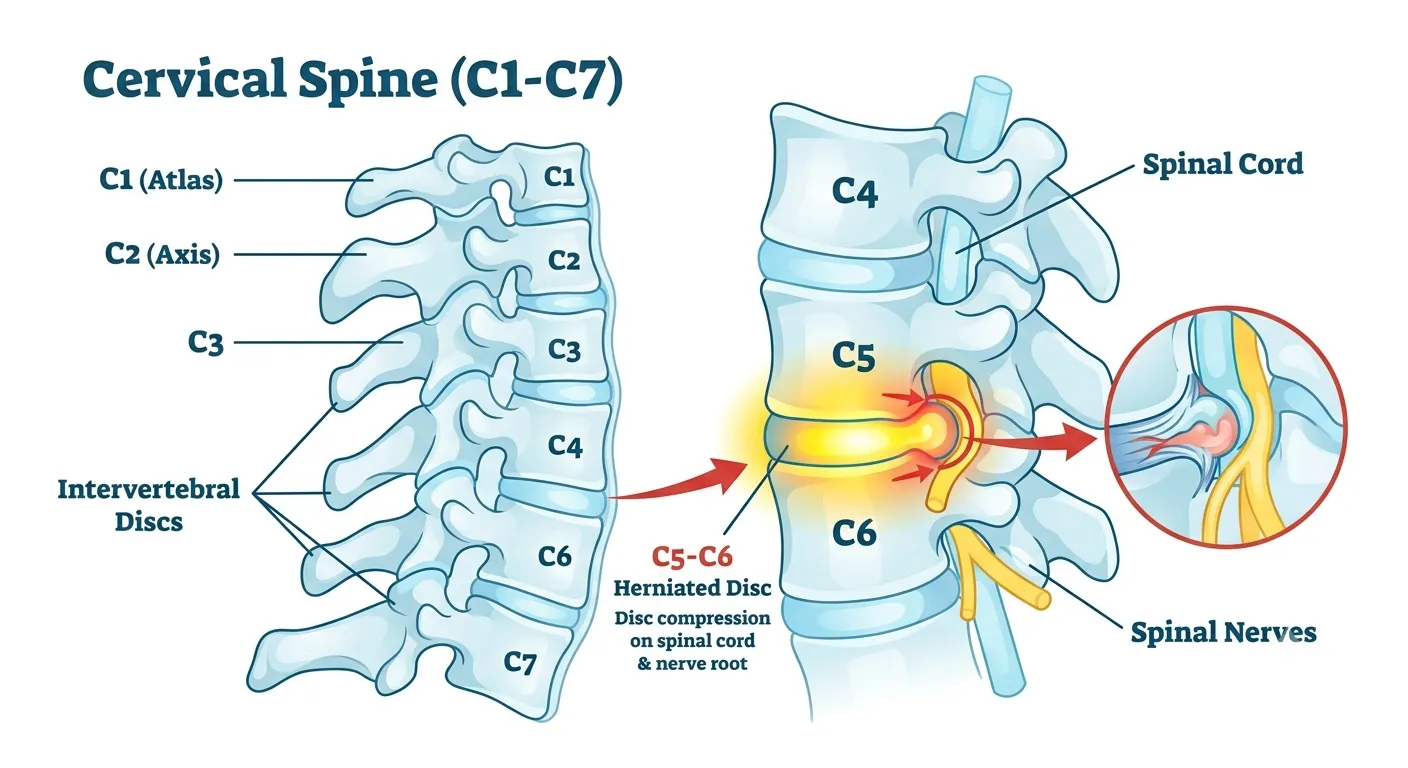
You wake up with a stiff, aching neck. After an hour on your phone, a dull electric pain shoots down your arm. Sound familiar? More than 80% of adults experience significant neck pain at some point in their lives — yet few know how to tell a simple muscle knot from an early cervical disc herniation. This guide breaks down everything: the true causes of cervical disc problems, the 5 red-flag symptoms, and a practical 7-exercise routine to protect your neck starting today.
Medical Disclaimer
This article is intended for general health information purposes only and does not substitute professional medical diagnosis, advice, or treatment. If you have specific symptoms or a medical condition, please consult a qualified healthcare provider.
What Is a Cervical Disc Herniation? — Causes & Mechanisms
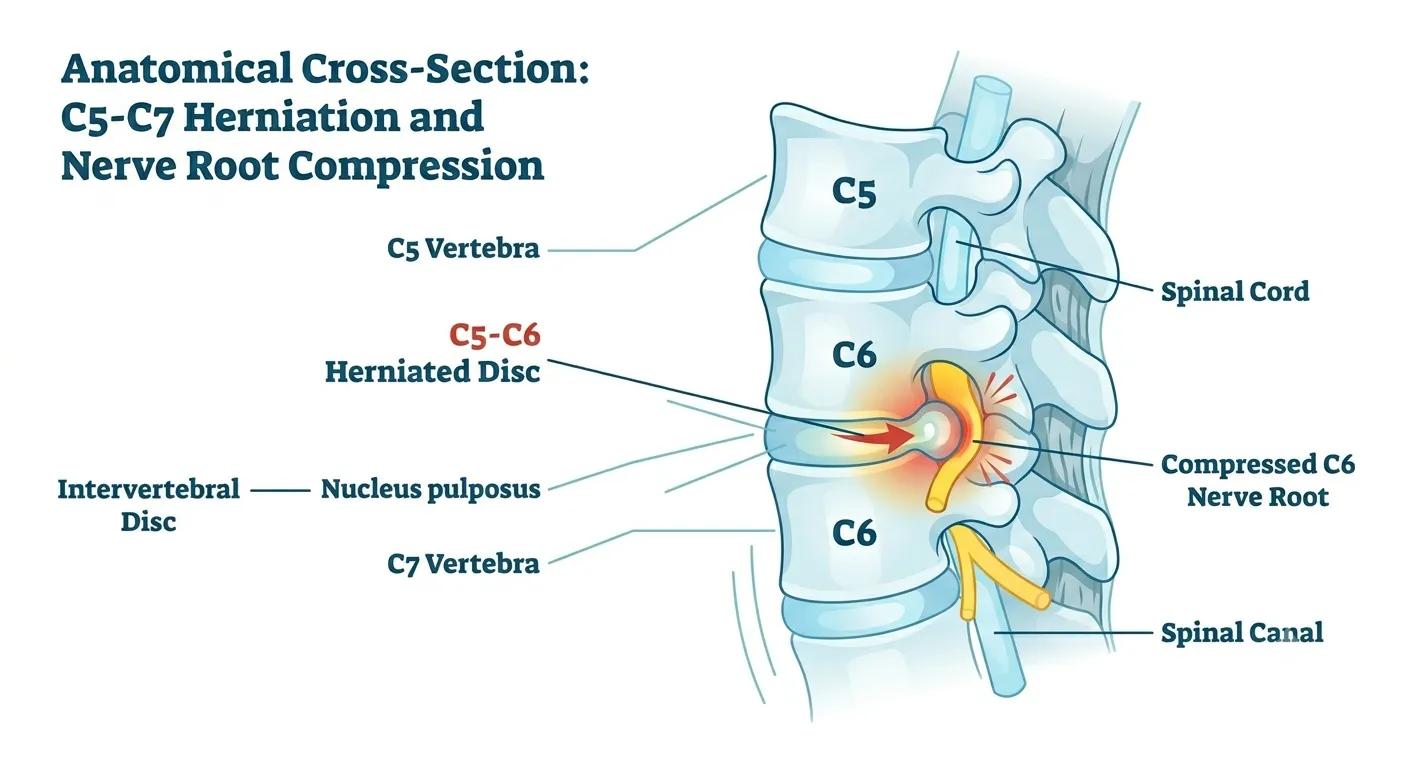
A cervical disc herniation occurs when the soft cushion (intervertebral disc) between two neck vertebrae tears or bulges outward, compressing nearby nerve roots or the spinal cord itself. The cervical spine has seven vertebrae (C1–C7), and the most commonly affected levels are C5–C6 and C6–C7, accounting for over 70% of all cervical disc cases.
The disc itself has two parts: a tough outer ring called the annulus fibrosus, and a gel-like inner core called the nucleus pulposus. When repetitive stress or trauma weakens the outer ring, the nucleus can push through — pressing on the nerve root that exits the spine at that level. The pain pattern you feel in your arm corresponds directly to which nerve is being compressed.
The 4 Main Causes of Cervical Disc Problems
Poor Posture (Most Common)
Forward head posture from prolonged phone and computer use creates cumulative disc overload — the single most preventable cause in modern life.
Acute Trauma
Whiplash injuries (car accidents), contact sports impacts, and falls can acutely rupture the annulus fibrosus and immediately herniate the disc.
Degenerative Changes
Discs naturally lose water content and elasticity with age. Even minor stresses can herniate a dehydrated disc that would have been fine at age 25.
Genetic Predisposition
Variants in collagen-synthesis genes can make the annulus fibrosus structurally weaker, predisposing some individuals to earlier disc degeneration.
5 Key Symptoms to Watch For — Self-Check Guide
The critical distinction between a muscle strain and a disc herniation is the presence of neurological symptoms. Muscle strains improve within a few days; disc herniation causes arm pain, numbness, and weakness that persists and can worsen with certain neck positions. Use the table below to assess your symptoms honestly.
| # | Symptom | What It Feels Like | Concern Level |
|---|---|---|---|
| 1 | Radicular Arm Pain | Electric or burning pain radiating from the neck into the shoulder, down the arm, and into specific fingers | High |
| 2 | Numbness & Tingling | Pins-and-needles or deadness in fingers. The pattern (which fingers) often tells which disc level is involved | High |
| 3 | Muscle Weakness | Difficulty gripping objects, weakness when raising the arm, or trouble with fine motor tasks | High |
| 4 | Neck & Shoulder Pain | Deep ache or stiffness at the base of the skull and upper trapezius area; limited range of rotation | Moderate |
| 5 | Headaches & Dizziness | Occipital headaches (starting at the base of the skull), occasional dizziness when turning the head | Moderate |
Quick self-test (Spurling's Test): Tilt your head toward the symptomatic side and gently press down on the top of your head. If this reproduces or worsens arm pain or tingling, it is a positive result suggesting nerve root compression. This is not a substitute for clinical examination, but a positive result warrants prompt evaluation by a spine specialist.
Go to the Emergency Room Immediately If You Experience:
- Sudden loss of bladder or bowel control
- Rapid-onset weakness or paralysis in both arms and/or legs
- Severe headache with stiff neck (possible meningitis)
- Progressive numbness spreading to both sides of the body
Forward Head Posture: The Silent Driver of Disc Disease
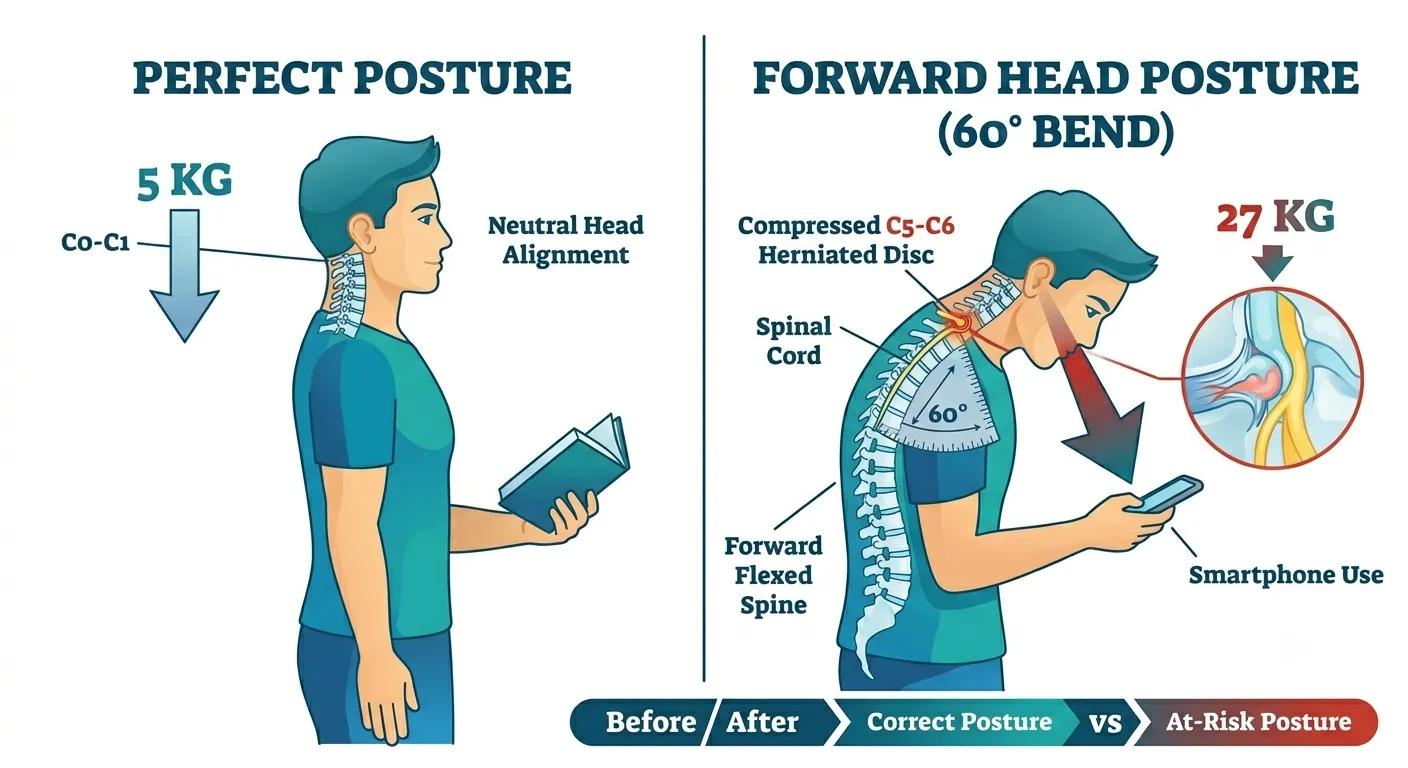
Forward head posture (FHP) — sometimes called "text neck" — describes a position in which the head sits more than 2 cm in front of the shoulder midline. It looks like a turtle poking its head out of its shell, which is exactly why Koreans call it "거북목" (turtle neck). The appearance is the least of the problems.
In a landmark 2014 study published in Surgical Technology International, spine surgeon Dr. Kenneth Hansraj demonstrated with biomechanical modelling that the effective weight the cervical spine must support increases dramatically as the head tilts forward — not linearly, but exponentially.
How FHP Becomes a Disc Herniation
Spending 4–6 hours daily sustaining 22–27 kg of effective head load gradually dehydrates disc tissue and fatigues the annulus fibrosus. Simultaneously, the deep cervical flexors — the muscles that hold the neck in neutral — weaken from disuse, while the upper trapezius and sternocleidomastoid become chronically overloaded and shortened. This muscle imbalance creates a feedback loop: poor posture causes weakness, and weakness makes maintaining good posture even harder. Left uncorrected for years, the stage is set for disc herniation at physiologically predictable levels.
Key Takeaway
Forward head posture is not merely aesthetic. Four hours of daily smartphone use means your cervical spine is sustaining 22 kg of force for 240 minutes — every single day. Correcting posture now is the single most impactful thing you can do to prevent disc disease in your 40s and 50s.
7 Evidence-Based Exercises to Prevent Forward Head Posture
The following exercises are drawn from cervical physical therapy protocols consistently supported in clinical research. Start at half the stated volume and work up only when you can perform each movement without reproducing arm symptoms. A 3–5 minute warm heat pack on the neck before exercising improves tissue compliance significantly.
Chin Tuck (Cervical Retraction)
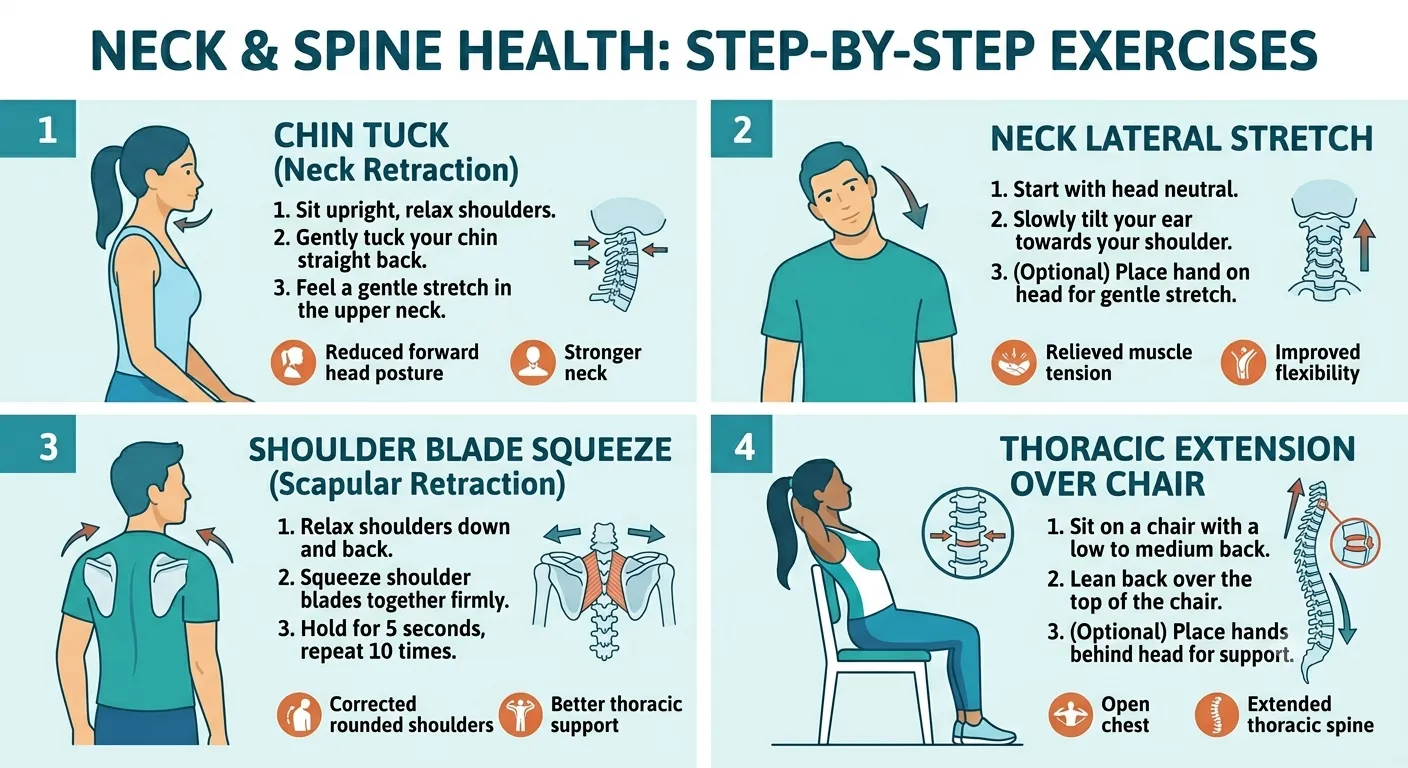
Sitting tall, gently draw your chin straight back — as if making a double chin — while keeping your gaze level. You should feel the base of your skull lift slightly. Hold 5 seconds, release.
Lateral Neck Stretch
Place your right hand gently on the left side of your head and tilt toward the right shoulder until you feel a stretch along the left side of the neck. Keep both shoulders relaxed and down. Hold 15 seconds, then switch sides.
Shoulder Blade Squeeze (Scapular Retraction)
Sit or stand with arms at your sides. Pull your shoulder blades together and slightly downward as if trying to hold a pencil between them. Hold 5 seconds. This counteracts the rounded-shoulder posture that contributes to FHP.
Levator Scapulae Stretch
Rotate your head 45° to the right, then tuck your chin and gently look down toward your armpit. Use your right hand to add a small, controlled stretch. Hold 20 seconds. Switch sides. This targets the muscle that chronically tightens with FHP.
Thoracic Extension (Over Chair or Foam Roller)
Place the top of a chair back — or a foam roller — under your mid-thoracic spine and gently extend backward over it. FHP originates partly in excessive thoracic kyphosis; this directly corrects that root cause.
Wall Angel
Stand with your back flat against a wall, feet slightly out. Raise arms to 90° (W position) and slide them upward to a Y, keeping your elbows and wrists touching the wall throughout. One of the best all-in-one posture reset exercises.
Deep Neck Flexor Strengthening
Lie on your back. Perform a chin tuck and hold it while you slowly lift your head 1–2 cm off the floor. Hold 10 seconds. The goal is activating longus colli and longus capitis — not the sternocleidomastoid. Quality over quantity.
Important: If any exercise reproduces arm pain, tingling, or increases dizziness — stop immediately. Do not push through neurological symptoms. This indicates possible active nerve compression requiring professional evaluation before continuing any exercise programme.
Diagnosis Methods & Treatment Options
If neck pain persists beyond two weeks — or if neurological symptoms are present — a clinical evaluation is warranted. The gold-standard diagnostic tool is MRI (Magnetic Resonance Imaging), which precisely maps disc herniation location, size, and the degree of nerve compression. X-rays help assess bony alignment and degeneration but cannot visualize soft tissue disc material.
| Stage | Treatment | Timeline | Notes |
|---|---|---|---|
| Stage 1 Conservative |
Relative rest, NSAIDs, muscle relaxants, physical therapy, cervical traction | 4–6 weeks | 85–90% of patients improve here; surgery avoided |
| Stage 2 Rehabilitation |
McKenzie Method PT, manual therapy, shockwave therapy, nerve block injections | 6–12 weeks | Applied when conservative care stalls. Also prevents recurrence |
| Stage 3 Injection |
Epidural Steroid Injection (ESI), selective nerve root block | 1–3 injections | Excellent for acute pain control; does not address the underlying disc |
| Stage 4 Surgery |
ACDF (Anterior Cervical Discectomy and Fusion), Total Disc Replacement (TDR) | 1–2 hour procedure | Reserved for progressive weakness, refractory pain, or myelopathy — ~5–10% of cases |
Daily Habits That Make a Real Difference
- Raise your monitor: Position the top of your screen at eye level. Laptop users: invest in an external keyboard and monitor stand. Looking down at a screen is the desk-based equivalent of carrying a backpack on the front of your head.
- Lift your phone: Hold your phone at eye level rather than tilting your head down. Awkward at first, but your neck will thank you after two weeks of adaptation.
- Move every hour: Set a timer. Five minutes of neck and shoulder movement every hour breaks the cumulative loading cycle. Even just standing and doing a few chin tucks counts.
- Optimize your pillow: Choose a pillow 6–8 cm high that maintains the natural cervical lordosis (the forward curve). Too high or too flat both stress the cervical discs during sleep — roughly 7–8 hours of compression every night.
- Adjust your headrest: The headrest center should contact the middle of the back of your head (not your neck). Recline to 90–100° and make sure your back is fully supported by the seat. Most drivers set their seat too far reclined, creating a classic FHP driving position.
Frequently Asked Questions (FAQ)
Early-stage disc herniations often resolve with conservative care. However, untreated ongoing compression can lead to permanent nerve damage — chronic numbness, muscle atrophy, or weakness that may not fully reverse even after surgery. The most serious consequence is cervical myelopathy: spinal cord compression causing balance problems, hand clumsiness, and in severe cases, paralysis. Any bowel or bladder dysfunction requires same-day emergency evaluation.
Yes — in the vast majority of cases. Research consistently shows that 85–90% of cervical radiculopathy patients recover well with conservative management within 6 weeks to 3 months. The disc material itself can actually resorb over time as the body treats it as foreign matter, and the nucleus loses water, shrinking away from the nerve. Surgery is considered when progressive weakness continues, or when conservative care has genuinely failed over 6–12 weeks.
The key is maintaining the natural cervical lordosis during sleep. For back sleepers, a contoured memory foam or latex pillow 6–8 cm high works well. Side sleepers generally need a higher loft (10–12 cm) to fill the gap between the shoulder and head. Avoid down pillows that flatten out, very high foam pillows that push the head forward, and buckwheat pillows that are too firm to allow natural curve support.
Appropriate exercise is actually beneficial. However, during an acute flare, avoid movements that load the cervical spine directly: heavy barbell back squats, overhead pressing, and high-contact sports. Swimming (backstroke, freestyle with a snorkel to keep the head neutral), walking, cycling, and Pilates are excellent low-impact options. Core strengthening also indirectly stabilizes the cervical spine by reducing compensatory neck tension from a weak trunk.
Three changes matter most: raise your monitor to eye level today; set a 50-minute timer and do chin tucks + shoulder blade squeezes for 3 minutes; and sit with your full back against the chair back, not perched at the edge. Research from occupational health programmes shows these three interventions alone can reduce cumulative cervical load by 30–40% in desk workers — without changing anything else.
Closing Thoughts: The Neck You Take Care of Today
Cervical disc disease and forward head posture can feel like inevitable consequences of living in a smartphone-saturated world — but they really aren't. The biomechanics are well understood, the interventions are evidence-based, and most of the meaningful prevention strategies cost nothing beyond attention and habit. Raise your monitor, lift your phone, and do 10 chin tucks every hour. These three things alone substantially change the long-term trajectory of your cervical spine health.
If you're already experiencing symptoms, please resist the urge to self-diagnose from internet articles alone (including this one). An MRI and a proper clinical examination take an hour and give you actual information to act on. The earlier a genuine herniation is identified, the more treatment options you have — and the less likely you are to ever need surgery.
"The cervical spine is the most mobile segment of the axial skeleton — and that mobility is a gift we systematically undo every time we put our heads down over a screen." – Cervical spine surgery specialist