
Widespread pain throughout your body, yet every test comes back normal — and people around you suggest it might all be in your head. If this sounds familiar, fibromyalgia may be the answer you have been searching for. Affecting roughly 2–4% of the global population, this chronic pain condition was long misunderstood and dismissed. Today, advances in neuroscience and rheumatology are finally shedding light on the real mechanisms behind it — and offering genuine paths toward relief.
Medical Disclaimer: This article is intended for general health information purposes only and does not substitute for professional medical advice, diagnosis, or treatment. If you suspect fibromyalgia or experience persistent widespread pain, please consult a qualified healthcare provider such as a rheumatologist or pain specialist.
(adult population)
(significantly higher in women)
(from first symptom)
What Is Fibromyalgia? Myths vs. Reality
Fibromyalgia is a chronic, widespread musculoskeletal pain syndrome affecting the muscles, ligaments, and tendons throughout the body. The defining characteristic is the word "widespread" — this is not localized pain in a single joint or region but persistent aching, fatigue, and cognitive difficulties spanning the entire body.
For decades, fibromyalgia was dismissed as hypochondria or a psychological problem, largely because standard blood tests, MRIs, and X-rays return normal results. However, the U.S. National Institutes of Health (NIH) and countless research institutions have since confirmed fibromyalgia to be a genuine neurobiological condition rooted in how the brain and spinal cord process pain signals.
"Fibromyalgia essentially reprograms the brain to amplify pain signals. This phenomenon, known as Central Sensitization, means the patient's suffering is a neurological reality — not psychological exaggeration." – American College of Rheumatology (ACR)
A landmark step in legitimizing fibromyalgia came in 2007 and 2008 when the U.S. Food and Drug Administration (FDA) approved pregabalin, duloxetine, and milnacipran — the first medications specifically indicated for fibromyalgia. This regulatory recognition cemented its status as a distinct medical condition rather than a symptom of something else.
Key Symptoms: A Full Breakdown
Fibromyalgia is far more than "feeling sore all over." The symptom profile is broad and variable between individuals, which is part of what makes it so challenging to recognize — and so exhausting to live with.
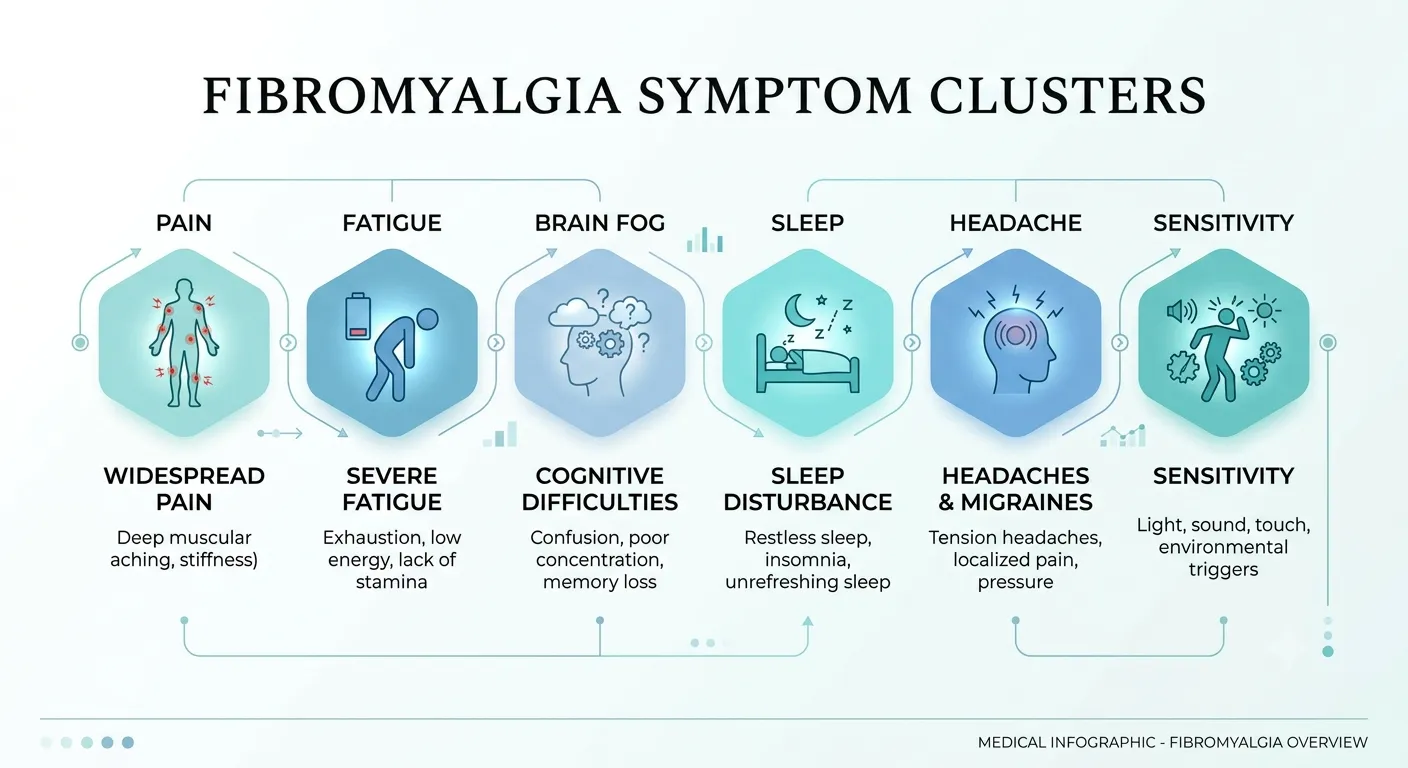
Widespread Musculoskeletal Pain
Persistent aching, burning, or stiffness across the neck, shoulders, back, and limbs. Intensity fluctuates with weather, stress, and activity levels.
Profound Fatigue
Exhaustion that sleep does not relieve. Even minor physical or mental exertion can produce disproportionate tiredness lasting hours or days.
Fibro Fog (Cognitive Dysfunction)
Difficulty concentrating, short-term memory lapses, and word-finding problems. Patients often describe it as "thinking through cotton wool."
Non-Restorative Sleep
Difficulty falling or staying asleep. Sleep studies commonly reveal disruptions in deep (slow-wave) sleep, which is essential for physical recovery.
Headaches and Migraines
Tension-type headaches and migraines occur frequently, often linked to neck and shoulder muscle tension that accompanies the condition.
Irritable Bowel Syndrome (IBS)
Abdominal cramping, bloating, alternating diarrhea and constipation. IBS co-occurs in approximately 50–70% of fibromyalgia patients.
Heightened Sensory Sensitivity
Overreaction to noise, bright light, odors, and temperature changes — a direct consequence of central sensitization amplifying all sensory input.
Restless Legs Syndrome (RLS)
An irresistible urge to move the legs at rest, often accompanied by uncomfortable crawling sensations. Frequently worsens sleep quality further.
Causes and Risk Factors
The precise cause of fibromyalgia remains an active area of research, but the most well-supported mechanism is central sensitization — a state in which the central nervous system becomes chronically over-sensitized, interpreting normal or low-level stimuli as painful. Think of it as the brain's pain volume dial being stuck on maximum.
Understanding Central Sensitization
In fibromyalgia, the brain's pain-inhibitory circuits underperform while levels of pain-amplifying neurotransmitters — particularly Substance P — run roughly three times higher than in healthy individuals. A 2022 neuroimaging study from the University of Bologna found measurable structural changes in the pain-regulation networks of fibromyalgia patients, confirming that the experience of pain is neurologically real, not imagined.
Risk Factors
| Risk Factor | Details | Evidence Level |
|---|---|---|
| Genetics | First-degree relatives of fibromyalgia patients are approximately 8× more likely to develop the condition. Variants in serotonin and dopamine metabolism genes are under active investigation. | Strong |
| Sex | Women are diagnosed roughly 7× more often than men. Estrogen is believed to modulate pain sensitivity and may play a regulatory role. | Strong |
| Trauma / Stress | Physical injury (e.g., car accident), surgery, or significant psychological trauma such as PTSD has been documented as a trigger in many cases. | Strong |
| Rheumatic Comorbidities | Fibromyalgia co-occurs in 20–30% of patients with rheumatoid arthritis, lupus, or ankylosing spondylitis. | Moderate |
| Certain Infections | Lyme disease, hepatitis C, and Epstein-Barr virus have been linked to fibromyalgia onset in some individuals. | Moderate |
| Chronic Sleep Disruption | Persistent poor sleep lowers pain thresholds and may both trigger and perpetuate fibromyalgia symptoms. | Moderate |
Diagnosis: Criteria and Process
Fibromyalgia is a diagnosis of exclusion. Clinicians first rule out conditions that can mimic its symptoms — such as hypothyroidism, rheumatoid arthritis, lupus, or multiple sclerosis — through blood tests and imaging. Once those are excluded, the diagnosis is made using validated clinical criteria.
ACR 2010/2016 Diagnostic Criteria (the current standard)
Criterion 1: Widespread Pain Index (WPI)
The clinician scores the number of body regions (out of 19 defined areas) in which the patient has experienced pain over the past week. A score of 7 or higher is required, and symptoms must have been present for at least 3 months.
Criterion 2: Symptom Severity Scale (SSS)
The severity of fatigue, non-restorative sleep, and cognitive symptoms is rated from 0–3, with additional points for somatic symptoms such as headaches, abdominal pain, and depression. The combined WPI + SSS score determines whether criteria are met.
Criterion 3: No Better Explanation
The symptoms cannot be fully explained by another diagnosis. Notably, fibromyalgia can be diagnosed alongside other conditions — it is not mutually exclusive with rheumatoid arthritis or lupus, for example.
Multidisciplinary Treatment Strategies
Both the European League Against Rheumatism (EULAR) and the American College of Rheumatology (ACR) agree: fibromyalgia responds best to a multidisciplinary approach that combines non-pharmacological and, when appropriate, pharmacological therapies. Non-drug treatments are consistently recommended as the foundation.
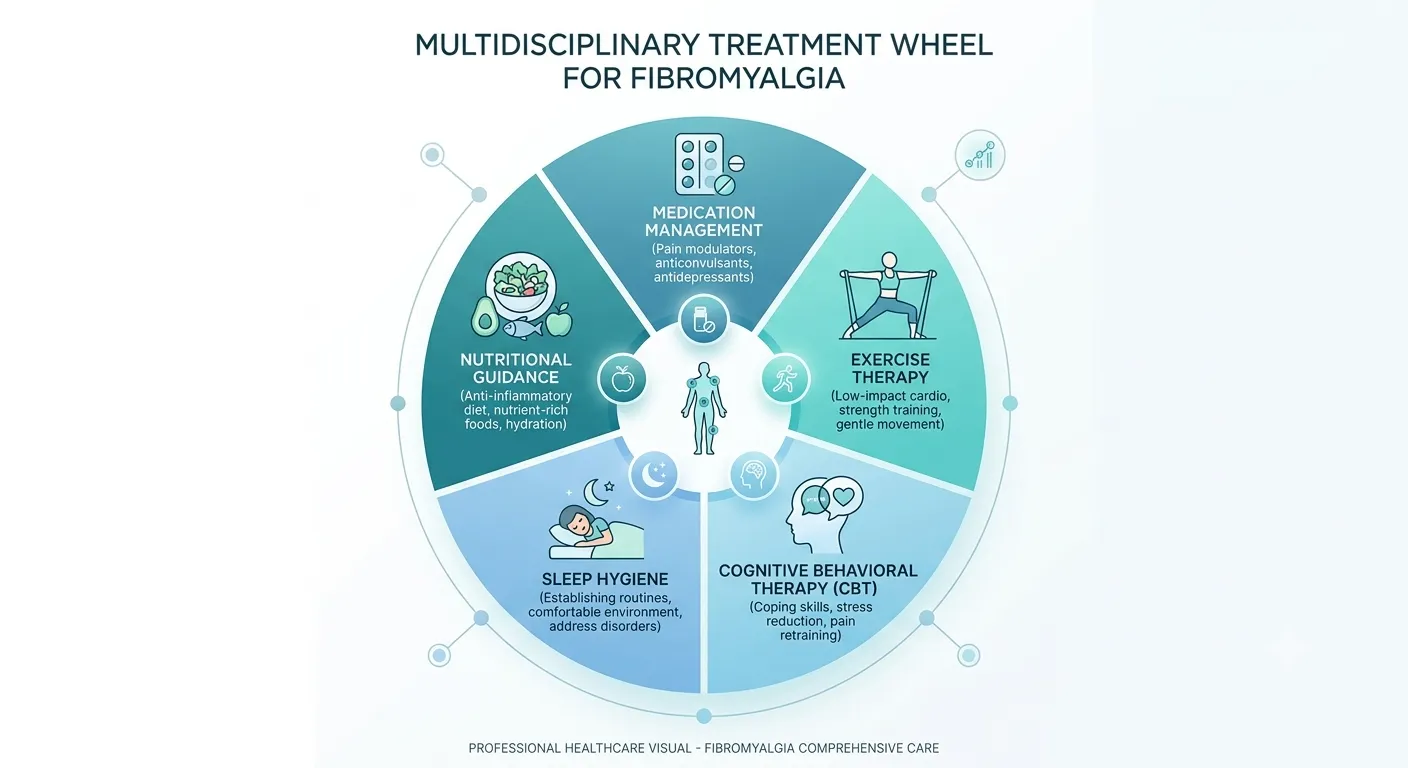
Medications
- Pregabalin (Lyrica): Anticonvulsant that dampens neuronal overexcitement. First FDA-approved fibromyalgia medication.
- Duloxetine (Cymbalta): Serotonin-norepinephrine reuptake inhibitor (SNRI). Addresses both pain and concurrent depression.
- Milnacipran (Savella): SNRI approved in the U.S. exclusively for fibromyalgia.
- Low-Dose Naltrexone (LDN): Emerging research suggests anti-neuroinflammatory effects; not yet standard of care.
- All medications require a physician's prescription and supervision.
Exercise Therapy
- Aerobic Exercise: Walking, swimming, cycling. Promotes endorphin release and gradually desensitizes the central nervous system.
- Aquatic Therapy: Water buoyancy reduces joint load, making movement more accessible in early stages.
- Resistance Training: Progressive loading improves muscular function and reduces pain over time.
- Yoga / Tai Chi: Multiple randomized trials confirm meaningful improvements in pain, fatigue, and quality of life.
Psychological Therapies
- Cognitive Behavioral Therapy (CBT): Addresses maladaptive pain-related thought patterns and builds coping capacity. Highest quality evidence of any non-drug intervention.
- Mindfulness-Based Stress Reduction (MBSR): Promotes pain acceptance and improves quality of life.
- Acceptance and Commitment Therapy (ACT): Trains psychological flexibility around pain without fighting it.
Sleep Management
- Sleep Hygiene Education: Consistent sleep-wake schedule, optimizing bedroom environment for darkness and cool temperature.
- CBT for Insomnia (CBT-I): Restructures sleep-interfering thought patterns without medication.
- Low-Dose Amitriptyline: A tricyclic antidepressant sometimes prescribed at low doses specifically to improve sleep architecture.
- Sleep and pain exist in a bidirectional vicious cycle; addressing sleep is central to overall symptom improvement.
Treatment Effectiveness at a Glance
| Treatment | Pain | Fatigue | Sleep | Quality of Life |
|---|---|---|---|---|
| Aerobic Exercise | ★★★★ | ★★★★ | ★★★ | ★★★★ |
| CBT | ★★★ | ★★★ | ★★★ | ★★★★★ |
| Duloxetine / Milnacipran | ★★★ | ★★★ | ★★ | ★★★ |
| Pregabalin | ★★★ | ★★ | ★★★ | ★★★ |
| Aquatic Therapy | ★★★★ | ★★★ | ★★ | ★★★★ |
| MBSR | ★★★ | ★★★ | ★★★ | ★★★★ |
★ ratings reflect approximate benefit levels drawn from current meta-analyses; individual responses vary considerably.
Daily Self-Management Tips
Effective fibromyalgia management extends well beyond clinic visits. Active self-management — applying evidence-based strategies in daily life — plays an equally important role in reducing symptom burden and reclaiming quality of life.

- Practice Pacing: Resist the temptation to do everything on a good day. Alternate activity with rest and spread tasks throughout the week. Overdoing it on a pain-free day reliably triggers a multi-day flare.
- Keep a Symptom Journal: Log pain levels (0–10), sleep hours, activity, food, and weather daily. Identifying your personal flare triggers is one of the most empowering steps you can take.
- Apply Heat Therapy: Warm baths, heating pads, and infrared saunas ease muscle tension and improve local blood flow. Many patients find evening warm baths help transition to sleep.
- Establish a Sleep Routine: Consistent bedtime and wake time — even on weekends. Reduce screen exposure 1–2 hours before bed and keep your bedroom cool and dark.
- Manage Stress Proactively: Diaphragmatic breathing, brief meditation sessions, or a 10-minute walk can serve as daily stress-release valves before tension accumulates.
- Adopt an Anti-Inflammatory Diet: Reduce ultra-processed foods and refined sugar. Increase omega-3 fatty acids (oily fish, flaxseed), antioxidant-rich vegetables, and fruits. Several studies link Mediterranean dietary patterns to reduced fibromyalgia symptom scores.
- Connect with a Support Group: Sharing experiences with others who understand fibromyalgia reduces psychological isolation and provides practical coping ideas.
- Moderate Alcohol and Caffeine: Excess alcohol disrupts sleep architecture; excessive caffeine can increase anxiety and amplify pain sensitivity.
Key Takeaways: What to Remember About Fibromyalgia
- Fibromyalgia is a real neurobiological condition — not a psychological invention or exaggeration of pain.
- Central sensitization is the core mechanism: the brain amplifies pain signals that would not normally register as painful.
- If you have experienced widespread pain, fatigue, sleep disturbance, and cognitive difficulties for more than 3 months, seek specialist evaluation.
- Aerobic exercise and CBT have the strongest evidence base among non-drug treatments.
- A multidisciplinary combination of exercise, psychological therapy, sleep management, and targeted medication outperforms any single approach.
- The realistic goal is symptom management and improved quality of life — achievable for most people with the right long-term approach.
Frequently Asked Questions (FAQ)
Living Forward: Life with Fibromyalgia
Fibromyalgia is a condition that tests not only the body but also the spirit — years of undiagnosed pain, the frustration of being doubted, and the relentless effort of managing invisible symptoms take a real toll. What matters most is this: your pain is real, your experience is valid, and you are far from alone.
Medicine continues to advance rapidly. Active research into the gut-brain axis, neuroinflammation, and small fiber neuropathy as mechanisms in fibromyalgia is already revealing potential new therapeutic targets. There is genuine reason for optimism about the coming decade of treatment options.
In the meantime, building a trusted care team, committing to evidence-based strategies, and practicing self-compassion form the most powerful foundation available today. Every small, consistent step — a 10-minute walk, one good night of sleep, one stress management practice — compounds over time into a meaningfully better life.