
A mild headache becomes a brain tumor. A racing heart turns into a heart attack in your mind. You leave the doctor's office reassured — only to find the doubt creeping back within hours. If this sounds familiar, you're not weak or irrational. Health anxiety is a real and remarkably common condition, affecting an estimated 4–5% of the general population at a clinically significant level. The good news? It responds well to the right treatment.
This article is intended for general health and informational purposes only, and is not a substitute for professional medical diagnosis, advice, or treatment. If you are experiencing specific symptoms or health concerns, please consult a qualified healthcare professional.
What Is Health Anxiety?
Health anxiety — historically called hypochondria or hypochondriasis — is the persistent, excessive preoccupation with the fear of having or developing a serious illness, despite little or no medical evidence to support that fear. In 2013, the DSM-5 replaced the term "hypochondriasis" with two distinct diagnoses: Illness Anxiety Disorder (IAD), for cases where minimal or no physical symptoms are present, and Somatic Symptom Disorder (SSD), where real physical symptoms are experienced but interpreted in an exaggerated way.
The defining feature is not the fear of death, but the conviction of being currently ill. A doctor's reassurance provides only momentary relief before the cycle resets. This is the tell-tale sign that separates health anxiety from ordinary caution.
According to NICE (National Institute for Health and Care Excellence) guidelines, health anxiety is distinct from simply being a "worrier." Without appropriate treatment it can persist for years or decades, significantly degrading quality of life. The encouraging reality is that Cognitive Behavioral Therapy (CBT) and certain medications show strong, replicable results.
Key Symptoms & Self-Check List
Health anxiety manifests across three domains: cognitive (how you think), behavioral (what you do), and physical (how your body responds). Understanding all three is essential, because they reinforce each other in a tight loop.
Cognitive Symptoms
Minor bodily sensations — a headache, muscle twitch, heart flutter — are interpreted as signs of serious disease. Intrusive thoughts like "What if this is cancer?" repeat despite the absence of evidence.
Behavioral Symptoms
Compulsive symptom-checking online, frequent doctor visits, repeatedly touching or examining body parts — or the opposite: avoiding medical appointments out of fear of a bad diagnosis.
Physical Symptoms
Anxiety itself causes an elevated heart rate, muscle tension, headaches, and gastrointestinal upset — which are then misread as proof of illness, completing the feedback loop.
Reassurance-Seeking
Repeatedly asking loved ones or the internet for confirmation that everything is fine. This provides momentary relief but functions as a "safety behavior" that maintains — not breaks — the anxiety cycle.
※ If 3 or more of these apply and have persisted for 6+ months, consider speaking with a psychiatrist, psychologist, or licensed therapist. This checklist is not a clinical diagnosis.
Why Does It Happen? Causes & Risk Factors
Health anxiety rarely has a single cause. It emerges from an interplay of biological, psychological, and environmental factors.
- Anxiety Sensitivity: The tendency to interpret bodily sensations as threatening. Oxford University research has found that high anxiety sensitivity is one of the strongest predictors of health anxiety onset.
- Past Health Experiences: Serious illness in oneself or a close family member during childhood can establish hypervigilance around physical symptoms as a learned response.
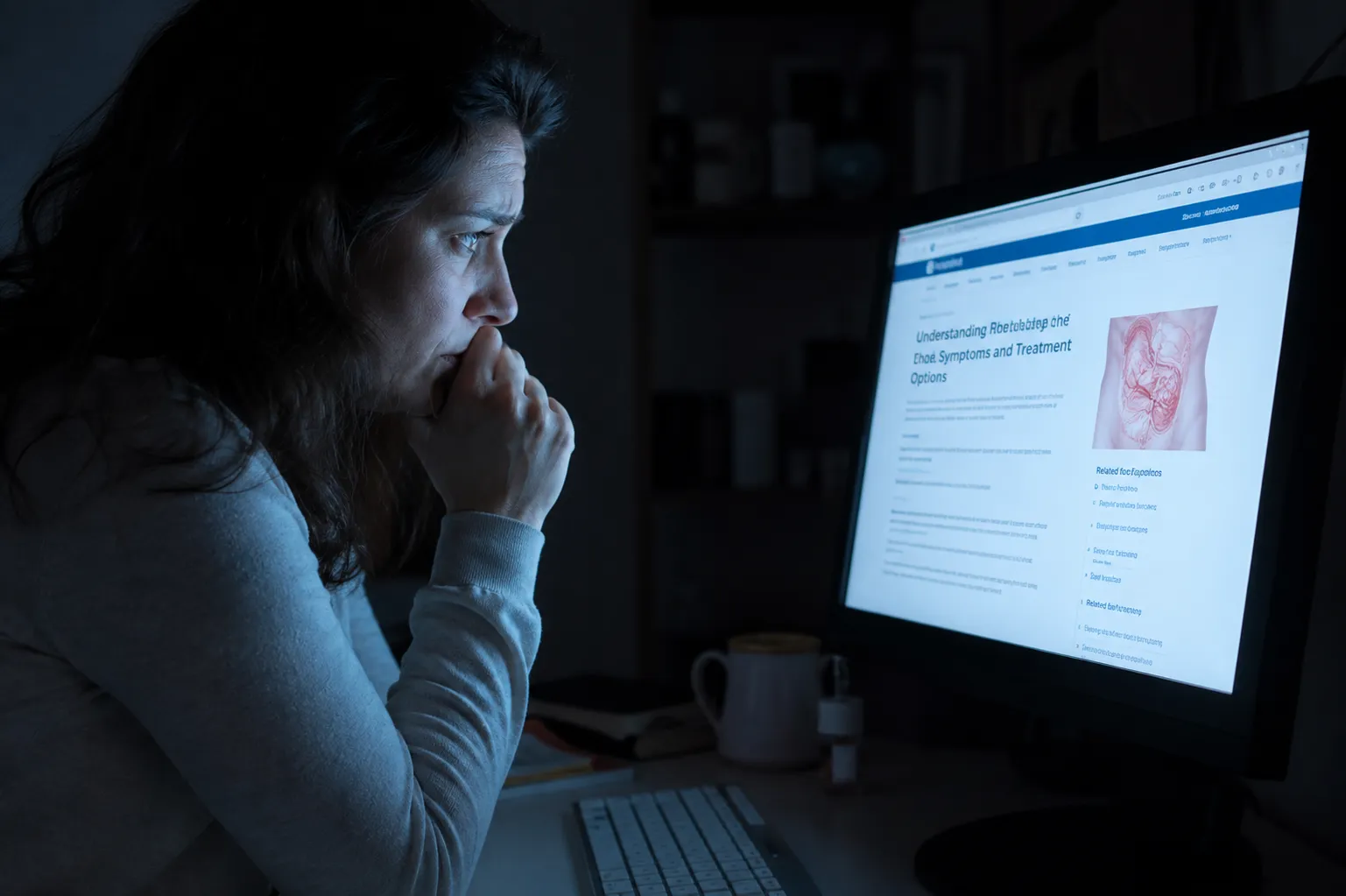
- Cyberchondria — The Information Overload Effect: Repeatedly searching symptoms online provides short-term relief but entrenches the anxiety over time. Microsoft Research confirmed that health-related search behavior is a key amplification pathway for health anxiety.
- Comorbid Mental Health Conditions: Generalized Anxiety Disorder (GAD), OCD, and depression overlap substantially with health anxiety and often require concurrent treatment.
- Personality Traits: High neuroticism and perfectionism are consistently associated with elevated health anxiety.
Why Does Googling Symptoms Always Lead to Cancer?
It's not a coincidence — it's platform architecture. Search algorithms prioritize high-click content, and people spend more time on pages describing worst-case scenarios. This isn't deliberate fearmongering; it's an emergent property of engagement-optimized systems. Understanding this can take some of the sting out of what you read.
Health Anxiety vs. Normal Health Concern: How to Tell the Difference
Caring about your health is sensible and normal. The dividing line is whether your worry impairs your ability to function and whether it persists despite medical reassurance.
| Factor | Normal Health Concern | Health Anxiety |
|---|---|---|
| After medical reassurance | Relief is lasting | Worry returns within hours or days |
| Symptom searching | Occasional, purposeful | Compulsive, lasting hours |
| Daily functioning | Minimally disrupted | Work, sleep, relationships impaired |
| Duration | Resolves with the concern | Persists for 6+ months |
| Doctor visits | Proportional to symptoms | Excessive or completely avoided |
| Physical impact | Usually no secondary symptoms | Anxiety itself causes real physical symptoms |
Evidence-Based Treatments
The landscape of effective treatment for health anxiety has never been richer. Here are the four approaches with the strongest research support.

-
Cognitive Behavioral Therapy (CBT)
The first-line psychological treatment for health anxiety. CBT identifies the catastrophic thinking patterns that fuel the worry cycle and restructures them into more realistic appraisals. A meta-analysis published in Cognitive Therapy and Research found CBT reduces health anxiety symptoms by an average of 50–60%. A standard course runs 12–20 sessions; internet-delivered CBT has shown comparable outcomes for those without easy access to in-person therapy.
-
Acceptance and Commitment Therapy (ACT)
Rather than trying to eliminate anxious thoughts, ACT focuses on changing your relationship with them. You learn to observe thoughts like "I might have cancer" without being controlled by them, and to commit to meaningful activities even in the presence of anxiety. Particularly useful when CBT's challenging of thoughts feels counterproductive.
-
SSRIs (Selective Serotonin Reuptake Inhibitors)
When health anxiety is severe or accompanied by depression or other anxiety disorders, a psychiatrist may recommend medication alongside therapy. Escitalopram and paroxetine, among others, have demonstrated meaningful symptom reduction in clinical trials. Medication must always be taken under medical supervision.
-
Mindfulness-Based Cognitive Therapy (MBCT)
A fusion of mindfulness meditation and CBT techniques. MBCT trains you to notice bodily sensations with neutral awareness rather than alarm, reducing the hyper-focused body monitoring that drives health anxiety. It's particularly effective for relapse prevention once acute symptoms have improved.
Key Takeaway
Research consistently shows that the quality of the therapeutic relationship and consistency of engagement matter more than which specific therapy you choose. If the first approach doesn't feel right, try another. You have the right to find a fit that works for you.
Daily Self-Management Strategies
Whether you're waiting for professional support or looking to reinforce it, these evidence-informed strategies can meaningfully reduce health anxiety in your daily life.
| Strategy | How to Practice | Why It Works |
|---|---|---|
| Postpone the search | When the urge to Google a symptom hits, delay it by 30 minutes. Set a timer. | Interrupts the compulsive search-anxiety feedback loop |
| Stick to one trusted GP | Establish a primary care physician and resist "doctor shopping" | Consistent medical relationships reduce unnecessary testing and conflicting information |
| Log body-checking behaviors | Count how often you check your body each day; aim to gradually reduce | Reduces hypervigilant body focus, a core driver of the cycle |
| Regular aerobic exercise | 30 minutes of walking, running, or swimming 3–5 times a week | Lowers cortisol, boosts endorphins, improves both mood and anxiety |
| Sleep hygiene | No screens 1 hour before bed; fixed sleep-wake schedule | Sleep deprivation is a direct amplifier of anxiety |
| Notice reassurance-seeking | Become aware of asking others "Am I okay?" and practice tolerating the uncertainty instead | Reassurance-seeking maintains, not breaks, the anxiety circuit |

3 Things You Can Do Today
- Hit "postpone" on the next search urge: Wait 30 minutes before Googling. You'll find the anxious thought often fades on its own — and if it doesn't, the search will still be there.
- Write a worry-time entry: Spend 5 minutes writing down your health worry, then read it back with fresh eyes. Externalizing thoughts on paper creates cognitive distance and reveals distortions.
- Schedule something meaningful: Replace one health-focused hour with a social activity or hobby. Behavioral activation is one of the fastest routes out of the anxiety spiral.
When to Seek Professional Help
Health concerns are part of the human experience. But any of the following signals indicate it's time to reach out to a professional:
Functional Impairment
Health worries are clearly disrupting your work performance, family relationships, or social life
6+ Months' Duration
Despite medical check-ups and reassurance, worry has persisted continuously over months
Comorbid Symptoms
Persistent low mood, sleep disruption, or panic attacks are appearing alongside health worries
Self-Help Isn't Enough
You've tried self-management strategies consistently but see no improvement — or symptoms are worsening
Where Can You Find Support?
- Psychiatrist: Diagnosis, medication management, and referral to therapy
- Clinical Psychologist / Licensed Therapist: CBT, ACT, MBCT and other evidence-based therapies
- Your Primary Care Physician: A good first port of call who can coordinate appropriate referrals
- Online CBT Programs: Platforms offering structured, therapist-guided digital therapy can be highly effective when in-person access is limited
Final Thoughts: Your Anxiety Is Not Your Fault
Health anxiety doesn't reflect a weak character or a fragile mind. It reflects a caring person whose brain's threat-detection system has been tuned too sensitively. That's not a character flaw — it's a calibration problem, and calibration problems can be corrected.
With the right support — whether CBT, medication, mindfulness, or a combination — the vast majority of people with health anxiety regain control of their daily lives. The fact that you've read this article to the end suggests you're already taking that first, quietly courageous step.