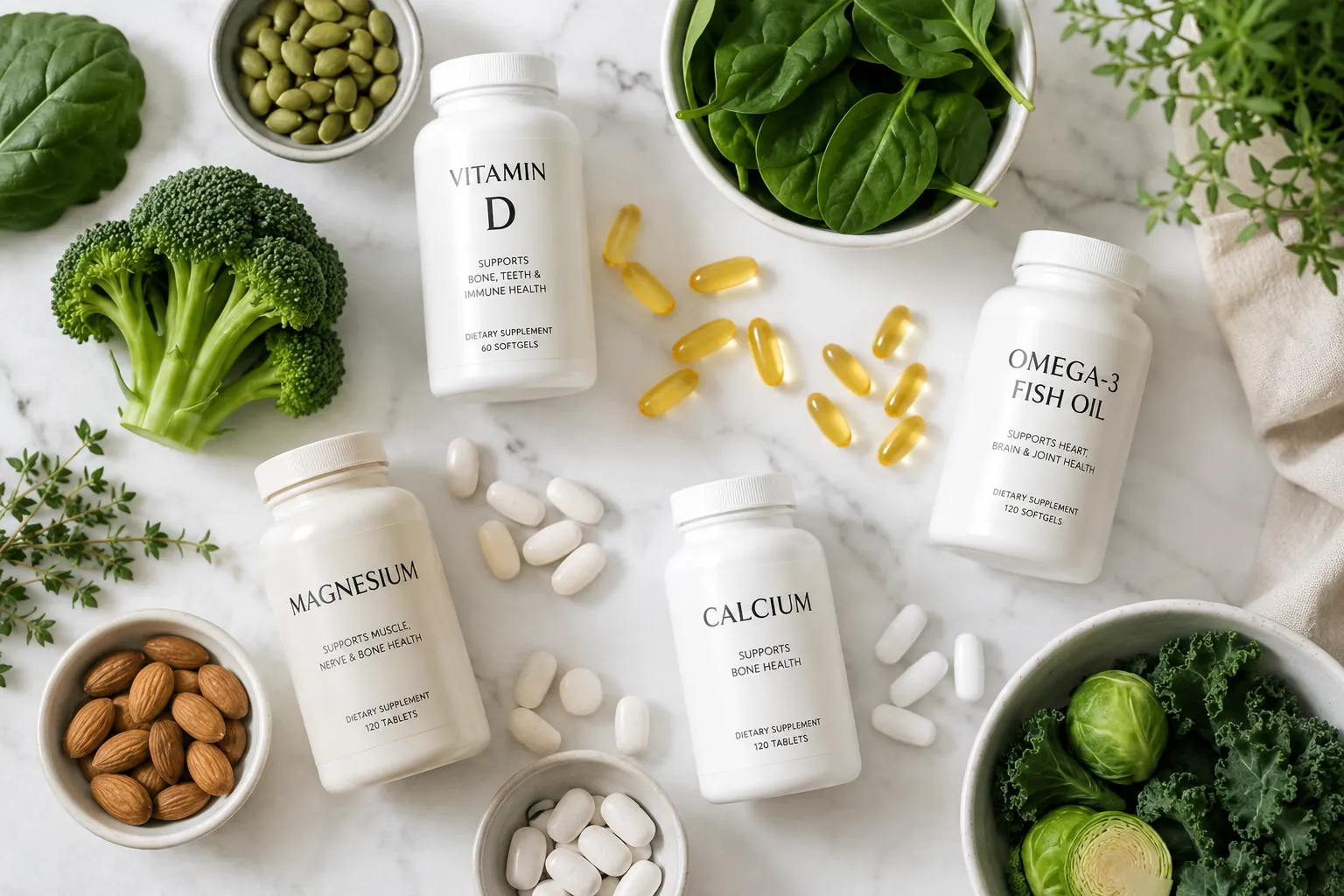
As we age, our bodies become increasingly efficient at wasting nutrients — and frustratingly bad at absorbing them. Stomach acid declines, gut absorption efficiency drops, and the skin's ability to synthesize vitamin D can fall by as much as 40% compared to younger years. Add chronic stress, reduced sun exposure, and the typical modern diet, and nutritional gaps quietly compound year after year. This guide cuts through the noise to focus on the seven supplements with the strongest evidence base for adults in their 50s and 60s.
Why Nutrient Needs Change After 50
Many adults over 50 eat reasonably well yet still develop measurable nutritional deficiencies. The issue isn't intake — it's absorption. Several physiological shifts converge to make this worse over time.
- Reduced gastric acid: The stomach lining thins with age, producing less acid. Without adequate acid, absorption of vitamin B12, iron, calcium, and magnesium falls significantly.
- Declining skin synthesis: By our 50s, the skin produces roughly 40% less vitamin D from the same amount of sunlight compared to our 20s — a well-documented phenomenon noted in endocrinology literature.
- Sarcopenia (muscle loss): Starting around age 40, muscle mass declines by roughly 1% per year. Preserving what remains demands adequate protein and the minerals that support neuromuscular function.
- Increased oxidative stress: Cellular aging reduces the efficiency of antioxidant defense systems, raising the demand for antioxidant micronutrients.
"You might think you eat well enough — and you probably do. But after 50, the bottleneck isn't what goes in your mouth; it's what your gut actually absorbs." – Clinical nutrition specialist
The Core 7: Essential Supplements Explained
The following seven nutrients are consistently highlighted by international nutrition bodies and recent clinical literature as particularly important for adults over 50. That said, optimal doses vary widely depending on individual health status and diet — a blood test to confirm actual deficiency is always the ideal starting point.
☀️ Vitamin D3
Critical for bone integrity, immune modulation, and muscle function. The landmark VITAL study led by Harvard Medical School suggested that high-dose vitamin D supplementation may meaningfully influence cardiovascular disease and cancer mortality. Many adults — especially those spending most of their time indoors — are chronically below optimal levels.
General range: 1,000–2,000 IU/day🐟 Omega-3 (EPA & DHA)
Well-established benefits include lowering triglycerides, modestly reducing blood pressure, and reducing systemic inflammation. The American Heart Association formally recommends omega-3 supplementation for patients with diagnosed coronary artery disease. Starting from the 50s, omega-3 plays an increasingly important role in maintaining vascular health alongside LDL management.
General range: 1,000 mg EPA+DHA combined/day💪 Magnesium
Involved in over 300 enzymatic reactions in the body. A meta-analysis published in a leading nutrition journal found that magnesium supplementation was statistically associated with reduced type 2 diabetes risk. Practical benefits often noticed first: improved sleep quality, fewer muscle cramps, and better stress tolerance. Widely deficient in diets high in processed foods.
General range: Men 350mg / Women 280mg/day🦴 Calcium
The foundation mineral for bone density. Post-menopausal women face accelerated bone loss as estrogen drops, making adequate calcium especially urgent. Important caveat: food sources have far better absorption than supplements, and some studies have flagged a possible cardiovascular risk signal with high-dose calcium supplements, making dose management critical.
General range: 1,000–1,200 mg/day (food + supplement combined)🧠 Vitamin B12
Essential for nerve cell protection and red blood cell formation. Because B12 absorption requires adequate gastric acid and a protein called intrinsic factor — both of which decline with age — the U.S. National Academy of Sciences recommends that adults over 50 obtain B12 primarily through supplements or fortified foods rather than from whole food sources alone. Users of metformin face additional risk.
General range: 2.4 μg/day (higher doses often needed for absorption)⚡ Coenzyme Q10 (CoQ10)
CoQ10 supports mitochondrial energy production and acts as a potent antioxidant. The body's own synthesis declines sharply from the 40s onward. Those on statin medications face an additional CoQ10 reduction, as statins block the same metabolic pathway used to produce it. Often used to address chronic fatigue and support cardiovascular function.
General range: 100–200 mg/day (ubiquinol form preferred)👁️ Lutein & Zeaxanthin
The primary pigments of the macular region of the eye. A growing body of evidence suggests they protect against oxidative damage and may slow progression of age-related macular degeneration (AMD). The National Eye Institute's landmark AREDS2 trial found that lutein and zeaxanthin reduced the risk of advanced AMD progression in patients with intermediate-stage disease.
General range: Lutein 10–20 mg / Zeaxanthin 2 mg/day| Supplement | Key Benefits | Preferred Form | Best Timing |
|---|---|---|---|
| Vitamin D3 | Bone, immunity, muscle | D3 + K2 combo | With meal |
| Omega-3 | Cardiovascular, anti-inflammatory | High-concentrate rTG form | With meal |
| Magnesium | Sleep, blood sugar, muscles | Glycinate or malate | Before bed |
| Calcium | Bone density | Citrate (ok on empty stomach) | Split doses |
| Vitamin B12 | Nerve health, red blood cells | Methylcobalamin | Morning |
| CoQ10 | Energy, antioxidant | Ubiquinol | With meal (fat-soluble) |
| Lutein & Zeaxanthin | Eye health, macular protection | Marigold extract | With meal |

Key Point
The form of a supplement matters enormously. Magnesium glycinate absorbs far better than magnesium oxide. Calcium citrate can be taken on an empty stomach; calcium carbonate cannot. A cheaper product in a poorly absorbed form is often worth less than nothing — always check the chemical form, not just the brand.
Optimal Timing: When to Take Each Supplement
Even the best supplement can underperform if taken at the wrong time. The fat-soluble vs. water-soluble distinction, and the relationship with food and other supplements, has a real impact on how much your body actually uses.
-
Morning with Breakfast — Fat-Soluble Cluster Vitamin D3/K2, omega-3, lutein, and CoQ10 are all fat-soluble and absorb best when taken with a meal containing dietary fat. Breakfast is ideal — and convenient enough to build a lasting habit.
-
Lunch — Calcium Split Dose #1 Calcium absorption drops sharply above 500 mg per dose. Splitting the daily target across three meals is far more efficient than a single large dose. This is the most commonly ignored rule in calcium supplementation.
-
Dinner — Calcium Split Dose #2 + Vitamin B12 B12 absorption is enhanced when taken alongside food, as it improves binding to intrinsic factor. If you're using the active methylcobalamin form, however, it can also be taken on an empty stomach without issue.
-
1 Hour Before Bed — Magnesium Magnesium has a mild calming effect on the nervous system, making it a natural fit for the hour before sleep. Taken at night, it delivers dual value: you replenish magnesium stores and support sleep quality. Choose glycinate to minimize the laxative effect common with other forms.
Combinations to Avoid
Taking multiple supplements simultaneously can sometimes cause them to compete for absorption or amplify unintended effects. The following interactions are the most clinically relevant for adults over 50.
💊 Pre-Supplement Checklist
- If you take prescription medications, check for interactions with your pharmacist or physician before starting
- Impaired kidney function warrants extra caution with magnesium and calcium supplements
- Thyroid medications should be taken at least 4 hours apart from any supplements
- Don't self-increase doses; periodic blood tests are the most reliable way to track your levels
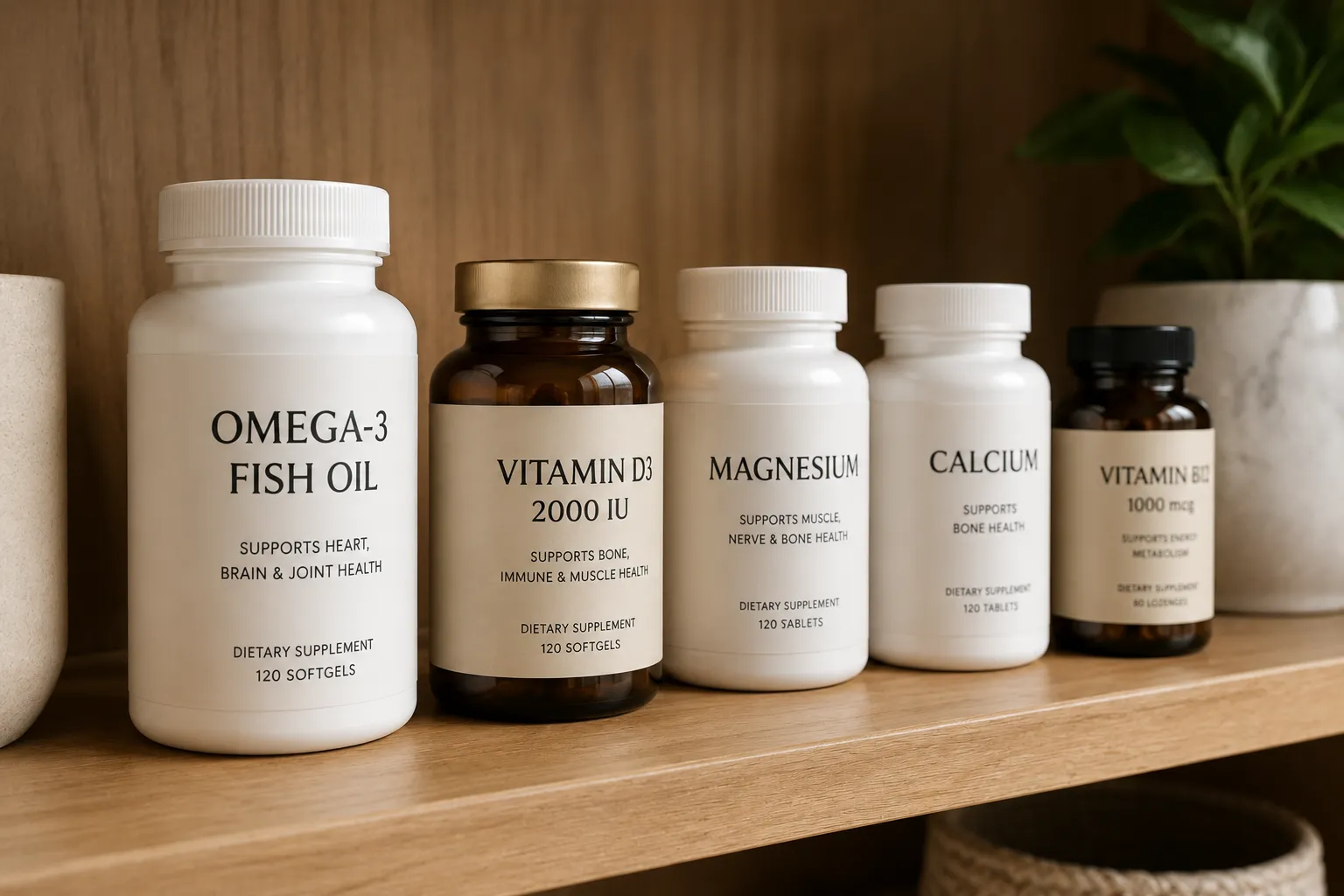
The Bottom Line
Supplements are exactly what the name says: supplemental. The evidence for their benefits assumes a reasonably solid foundation — adequate sleep, regular resistance exercise, and a diet anchored in protein and vegetables. Spending a fortune on capsules while skipping the gym is a bit like polishing your car's wheels without putting fuel in the tank.
The smartest approach: get a blood panel done first. Knowing your actual vitamin D, B12, and magnesium levels takes the guesswork out of the equation and ensures you're addressing real deficiencies rather than imagined ones. From there, this guide gives you the form, dose, and timing to make the most of what you take.
Today's Key Takeaways ✅
- After 50, nutrient absorption decreases — supplementation fills genuine gaps
- The core 7: Vitamin D3, omega-3, magnesium, calcium, B12, CoQ10, lutein/zeaxanthin
- Supplement form directly affects bioavailability — always check the chemical form
- Fat-solubles with food, magnesium before bed, calcium in split doses
- If you take prescription medications, consult your doctor or pharmacist first
- Supplements support health; sleep, exercise, and diet are the foundation