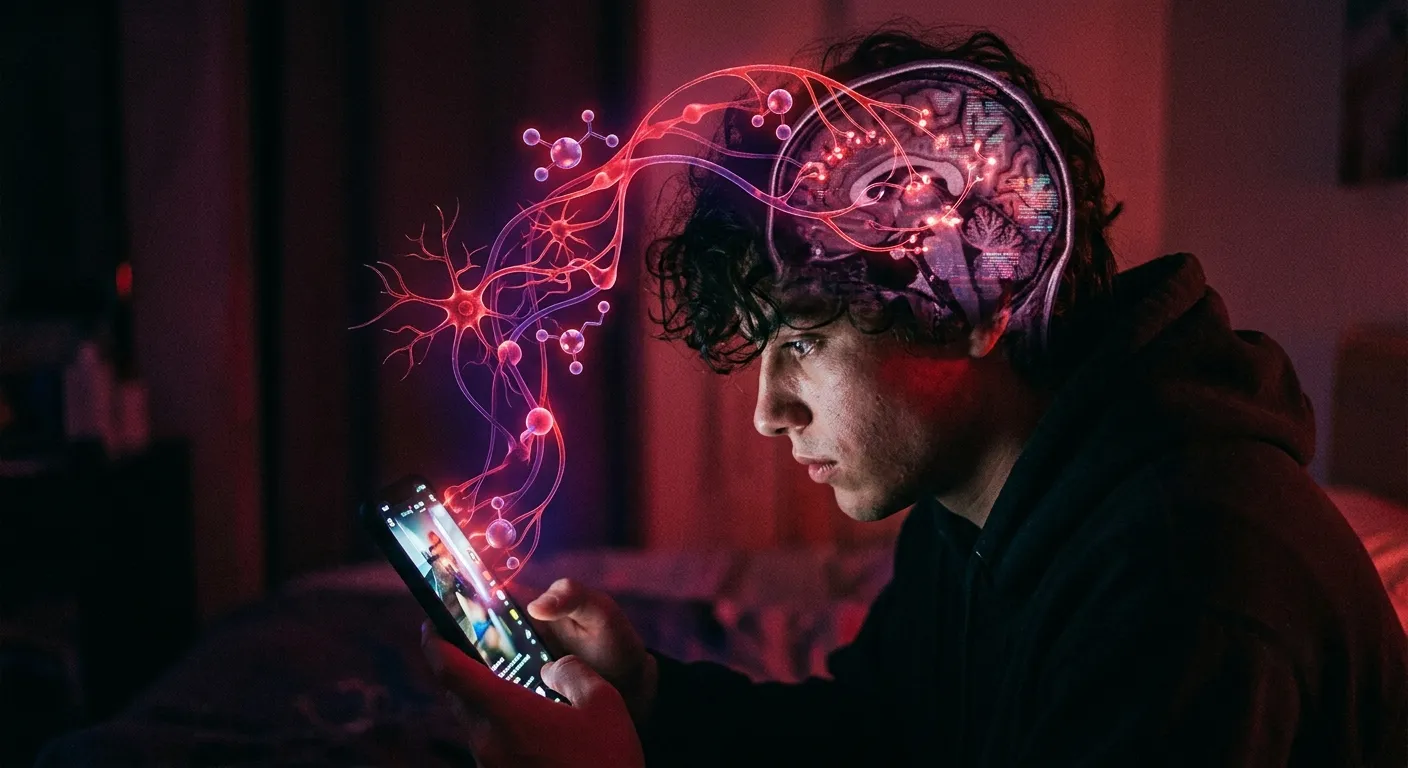
On the subway, in a café, even in the bathroom — we can't stop scrolling. Before one 15-second clip ends, our thumb has already swiped to the next. We're watching, but we can't remember what we watched. Is this just a habit? Or is our brain actually changing? The latest neuroscience has a startling answer.
(down from 2.5 min in 2003)
as of 2024
per person (global)
What Is Dopamine? The Real Role of the "Pleasure Chemical"
Many people call dopamine the "happiness hormone," but that's only half the story. Dopamine is a neurotransmitter produced in the brain's neurons, and more precisely, it is associated with the anticipation of pleasure — not the experience of it. Dopamine fires most strongly not when you get what you want, but in the moment you expect to get it. This distinction is everything.
The dopamine system evolved to reinforce survival-critical behaviors — eating, mating, avoiding danger. When you see delicious food, encounter an attractive person, or receive novel information, neurons in the Ventral Tegmental Area (VTA) release dopamine into the Nucleus Accumbens. This is the biological basis of "reward."
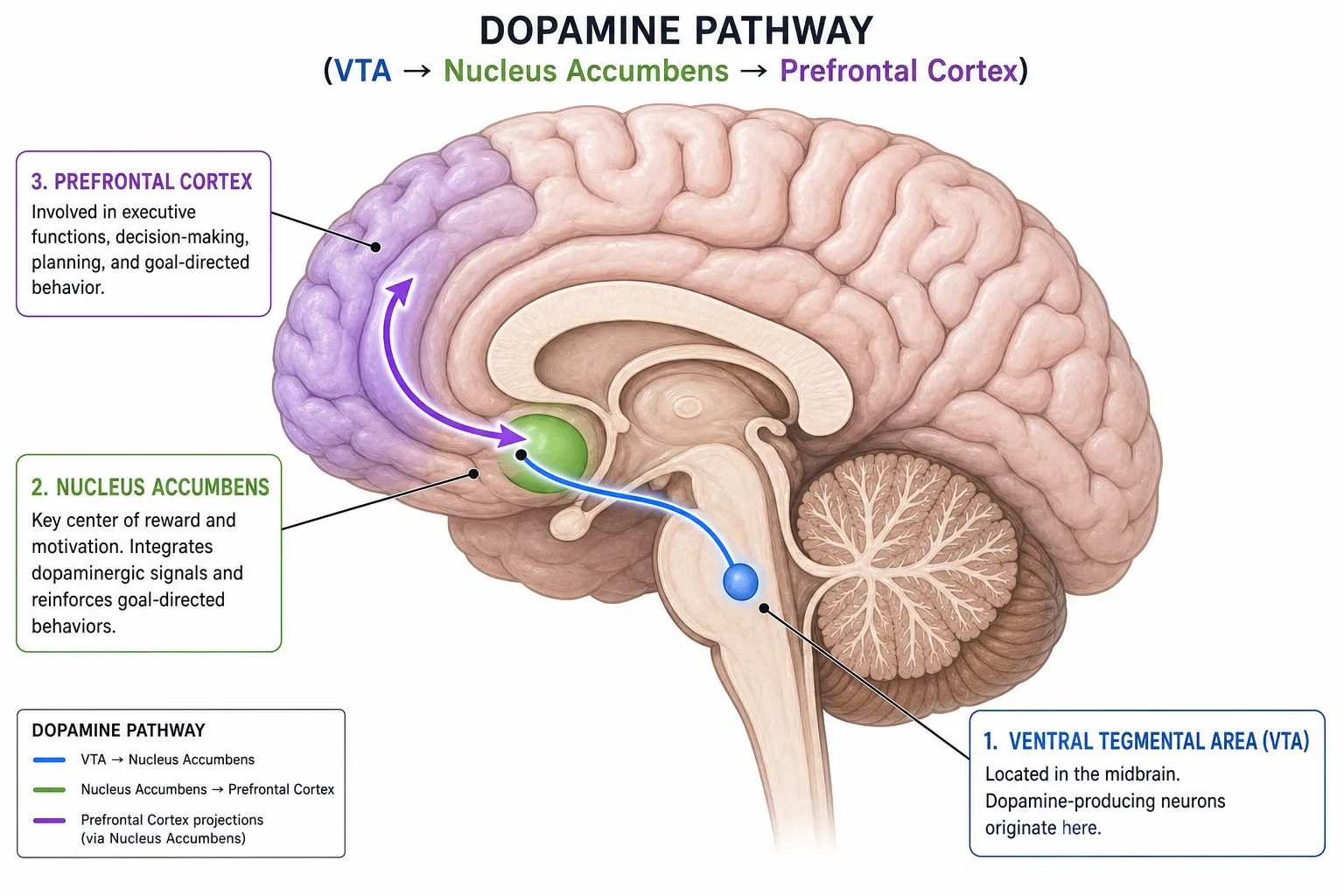
Ventral Tegmental Area (VTA)
The primary dopamine-producing hub. The origin of reward anticipation and motivational signals. Short-form video's unpredictable content continuously stimulates this region.
Nucleus Accumbens
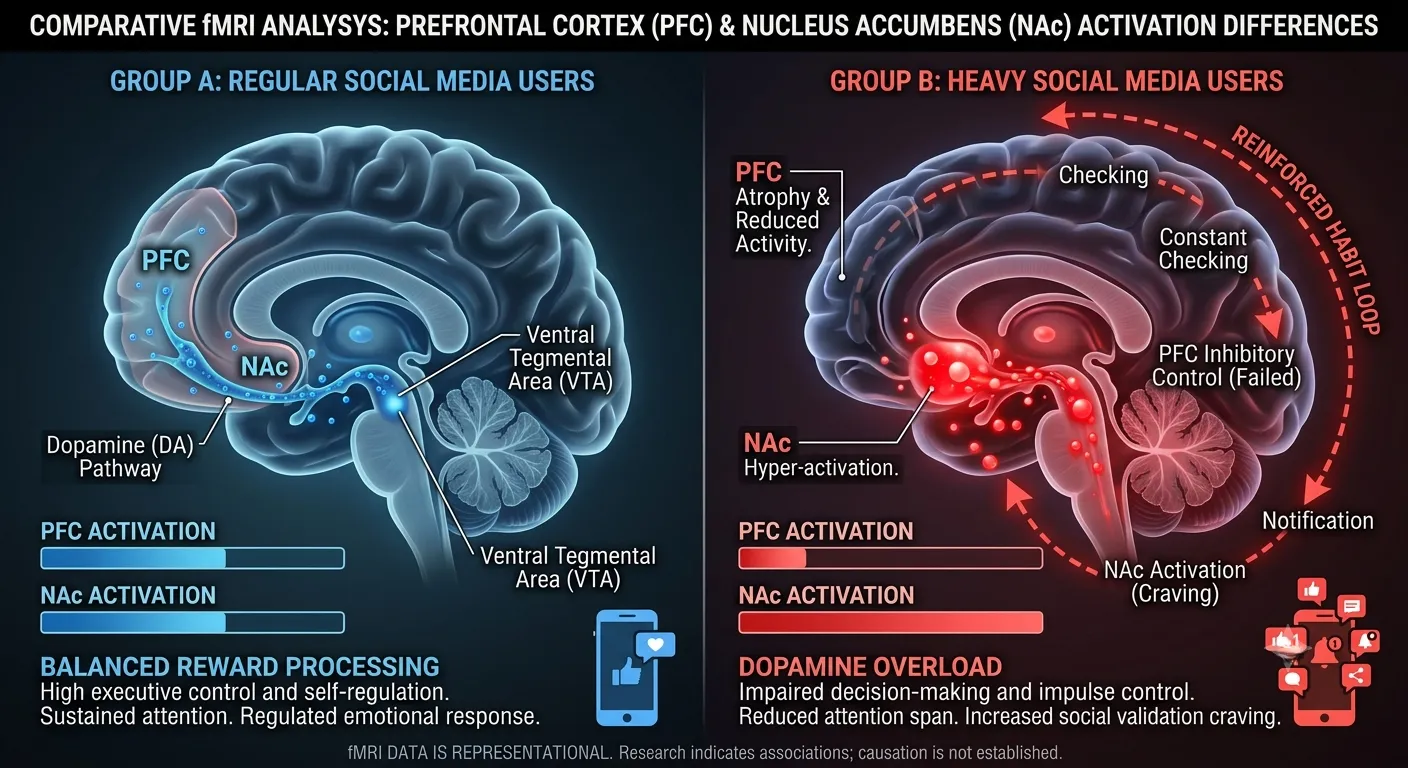
The so-called "pleasure center." Receives dopamine signals and generates intense satisfaction. It activates just from the sound of a notification, before you even check it.
Prefrontal Cortex (PFC)
The "rational brain" — responsible for impulse control, decision-making, and long-term planning. Chronic dopamine overstimulation weakens this area, eroding self-control.
Amygdala
The emotional processing center, especially for fear and anxiety. Negative social media content and social comparison chronically overactivate the amygdala, potentially causing persistent anxiety states.
The critical problem is that the dopamine system develops tolerance. Repeat the same stimulus and you need progressively stronger stimuli to get the same response. Like a casino slot machine that pays out on a random schedule, social media algorithms deliberately use this "variable reward" mechanism. Because you never know when the next great video will appear, you keep scrolling — and can't stop.
How Short-Form Video Targets Your Brain: Anatomy of an Algorithm
TikTok, Instagram Reels, YouTube Shorts. These three platforms now dominate the digital landscape — not by accident. They are brain-stimulation optimization systems built by engineers with deep knowledge of human psychology and neuroscience.
"Short-form platforms are designed to capture the user's attention economy. Constantly changing content, unpredictable rewards, and infinite scroll — this combination is a perfect trigger that targets the human dopamine pathway." – Attention Economy theory (Davenport & Beck, 2001), cited in short-form video research (2025)
🔴 Dopamine Response Levels by Activity (Visualization)
Relative intensity of dopamine reward system stimulation per activity (higher = stronger stimulus)
3 Core Mechanisms Platforms Use to Keep You Hooked
① Infinite Scroll & Autoplay
An endless feed provides no natural stopping signal. Old-school TV had a clear endpoint — the show ended, and you could naturally disengage. Infinite scroll eliminates that off-ramp entirely. One video ends and the next starts automatically, leaving your judgment no chance to intervene.
② Variable Reward Structure
Just like a slot machine's jackpot, you never know when the next great video will appear in your feed. Psychologist B.F. Skinner's research showed that unpredictable intermittent rewards create the strongest behavioral reinforcement patterns. TikTok's recommendation algorithm runs precisely on this principle. This is why "just one more" never actually stops.
③ Social Validation Triggers
Likes, follower counts, comment reactions — all of these tap into humans' core need for social approval. Whether a notification arrives or you check and there isn't one, dopamine flows either way. This is why you keep checking social media even when you've decided to quit.
🔁 The Vicious Dopamine Addiction Cycle
This cycle reinforces itself with each repetition, demanding progressively stronger stimuli
Stimulus Exposure
Open short-form / SNS
Dopamine Spike
VTA → Nucleus Accumbens fires
Temporary Pleasure
Satisfaction, excitement
Baseline Drops
Dopamine set-point decreases
Craving Stronger Hits
Tolerance forms → repeat
Here's what makes this cycle particularly insidious: when a dopamine spike occurs, the brain doesn't return dopamine levels back to baseline — it drops them below baseline. This is precisely why you often feel inexplicably flat, empty, or down after a long scrolling session. To relieve that discomfort, you pick up the phone again. And the cycle continues.
Popcorn Brain: The Scientific Evidence for Collapsing Attention
In 2011, Professor David Levy at the University of Washington introduced a concept that would prove prophetic: "Popcorn Brain." Like popcorn kernels popping under heat, the brain becomes wired to respond only to intense, fast-paced stimuli and grows numb to the slower, quieter rhythms of everyday life.
Levy warned: "The online world is so stimulating and changes so quickly that it's making the real world feel boring and difficult to process." Fourteen years later, his warning has become reality.
📊 The Collapse of Human Attention Span
Prof. Gloria Mark (UC Irvine) — 20-year longitudinal study
🔬 What the Latest Research Says
Analyzing 71 studies involving 98,299 participants on TikTok, Instagram Reels, and YouTube Shorts: a troubling association was found between excessive short-form video viewing and degraded cognitive function, particularly attention management and self-control. All age groups showed significant reduction in attention span.
Simply blocking mobile internet access on smartphones improved sustained attention, mental health, and subjective well-being. 91% of participants experienced at least one positive change. Researchers found that when internet was blocked, people naturally increased face-to-face social activities, physical activity, and time in nature.
Problematic social media use displays neurobiological characteristics similar to addictive substances. Compulsive use, loss of control, and other behavioral features parallel substance use disorders, with brain imaging studies showing addiction-like neural patterns.
Even without using your phone, simply having it nearby reduces cognitive capacity. This "brain drain" effect occurs even with the phone face-down and on silent mode — still consuming available working memory.
Popcorn Brain manifests in many ways: difficulty concentrating, shortened attention spans, increased impulsivity, trouble making decisions, and heightened stress and anxiety. None of these are character flaws — they are the result of the brain adapting to digital stimulation.
The Neurobiology of SNS Addiction: How Different Is It from Drugs?
"It's just an app. Comparing it to drugs seems like an exaggeration, doesn't it?" Many people think this. But neuroscience offers an uncomfortable answer.
Cocaine and heroin directly trigger an explosive surge of dopamine in the Nucleus Accumbens, "hijacking" the reward system so it no longer responds to normal pleasures. What about social media? The degree differs, but the fundamental mechanism is the same.
| Comparison | Substance Addiction (Drugs) | SNS / Short-Form Addiction |
|---|---|---|
| Dopamine Surge Mechanism | Direct chemical stimulation (very intense) | Indirect stimulation (continuous, repetitive) |
| Tolerance Formation | Very rapid | Weeks to months |
| Withdrawal Symptoms | Severe (including physical) | Anxiety, irritability, lethargy |
| Prefrontal Cortex Damage | Severe | Moderate to severe |
| Social Acceptance | Illegal / stigmatized | Perceived as normal behavior |
| Official DSM-5 Diagnosis | Yes | Not yet formally listed |
| Societal Risk Scale | Individual-focused | Spreading broadly across all of society |
In some ways, SNS addiction may be more dangerous than drugs — precisely because it looks normal. Nobody would ignore a person injecting heroin on the subway. But no one says anything about someone scrolling for six straight hours beside them.
Key Takeaway
A June 2025 study in the American Society of Addiction Medicine Journal found that compulsive social media use shows addiction-like neural patterns on brain imaging — patterns comparable to substance use disorders. The absence of a formal DSM-5 diagnosis does not mean the impact isn't real. Researchers are actively working on establishing diagnostic criteria.
Why Teen Brains Are at Greater Risk
Adults face risks, but for teenagers it's a categorically different story. Brain development isn't complete until around age 25. The prefrontal cortex — responsible for impulse control, judgment, and long-term planning — is the very last region to fully mature.
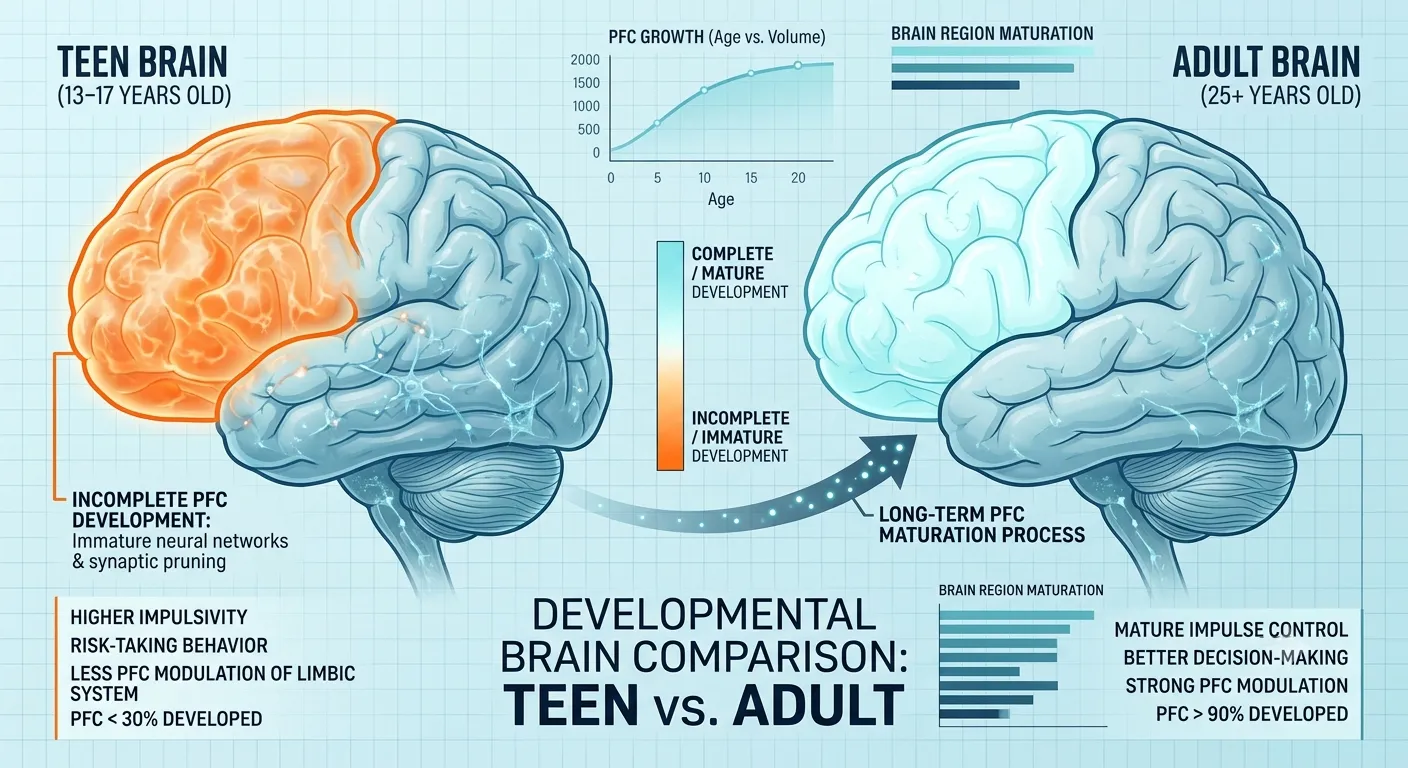
Dr. Michael Manos, clinical director of the attention and learning center at Cleveland Clinic's Children's Hospital, put it clearly: "When kids' brains become accustomed to the constant change, the brain finds it difficult to adapt to slower-paced, non-digital activities." Children addicted to short-form video are literally losing the capacity to focus on reading, class instruction, or extended conversations.
Daily Average Smartphone Use by Age Group
"Even without using your phone — simply having it nearby reduces cognitive capacity. The phone face-down, on silent, still drains your available working memory." – Journal of Consumer Research (USA), 2017 — "Brain Drain Effect" Study
Real Voices from Online Communities 🌐
This isn't just a Korean or Asian story. Millions of people worldwide are sharing their experiences with short-form and SNS addiction on Reddit, X, and countless forums. Here are some of those voices.
From Reddit r/nosurf & r/digitalminimalism

Dopamine Detox: Scientifically Backed Strategies That Work 💡
First, let's clear up a misconception. A "dopamine detox" does not mean eliminating dopamine. Dopamine is essential for survival and cannot be suppressed. More precisely, it's about reducing the frequency of high-stimulation activities that have artificially inflated your brain's dopamine baseline, so you can once again respond to natural, quieter pleasures.
A February 2025 PNAS Nexus study proved this experimentally. Simply blocking internet access on smartphones led to improvements in sustained attention, mental health, and well-being in 91% of participants.
Set Screen Time Limits
Use iOS Screen Time or Android Digital Wellbeing to limit app usage. Start by reducing just 30% of your current usage. Abrupt full withdrawal can cause a rebound effect. Gradual reduction is sustainable change.
Replace with Nature & Exercise
Exercise, walking in nature, and gardening release dopamine in a healthy way. PNAS Nexus participants naturally increased time in nature after internet was blocked. Just 30 minutes of walking begins restoring dopamine and serotonin levels.
Train Long-Form Reading
Build a habit of reading long-form content — physical books or articles — for 10–20 minutes daily. It may feel impossible at first. That's normal. The brain needs 3–4 weeks to re-adapt to "slow rewards." Physical books outperform e-readers in research.
Kill All Non-Essential Notifications
Turn off notifications for every app except essential contacts (calls, texts). The sound of a notification alone activates your dopamine system. Studies show this single change dramatically reduces how often you check your phone during the day.
Digital Fast Before Sleep
Turning off all screens one hour before bed has the most immediate impact on sleep quality and next-day focus. Keeping your phone out of the bedroom is one of the most evidence-backed sleep improvements available. "Charger in the living room" is the one rule that changes everything.
Allow Yourself to Be Bored
Boredom is the birthplace of creativity. Modern people reach for their phones the instant they feel bored. Try spending just 10 minutes each day doing absolutely nothing. This is the most direct way to restore the brain's Default Mode Network (DMN) — the system that enables deep thinking and creativity.
Mental health professionals emphasize one thing: dopamine detox is never about abstinence. Social media itself isn't the enemy — it's the state of having lost control that's the problem. The goal is reclaiming agency: "I control the app; the app does not control me."
Am I Addicted? Self-Assessment Checklist 🔍
The items below are adapted from behavioral addiction diagnostic criteria used in neuroscience and clinical research. Click any that apply to you.
🧠 Dopamine Overload Self-Assessment
Conclusion: Making Peace with Your Brain
If you found yourself wanting to check your phone while reading this article — that impulse is exactly the reality we're discussing. Dopamine addiction isn't a willpower problem. It's the result of some of the world's greatest engineering minds systematically reprogramming our brains.
But there is hope. The brain possesses extraordinary plasticity. What neuroscientists call "rewiring" is genuinely achievable through intentional behavioral change. Research consistently shows that just 2–4 weeks of conscious effort can yield measurable improvements in attention, mental health, and quality of life.

Most importantly: let go of the guilt. Watching short-form content isn't inherently wrong. The problem is not choosing to watch, but being chosen by the algorithm to watch. Today, change just one thing. No screens for the last hour before bed. That single shift will quietly begin your brain's recovery tonight. 🌿
📌 Three Things You Can Start Right Now
Check your Screen Time data. Seeing exactly how many hours you spend in which apps is the first step. It may be shocking. That's fine. Awareness is the beginning of change.
No screens for one hour before bed. Charge your phone in the living room, not the bedroom. This single rule will measurably improve your sleep quality and next-day concentration.
Delete your most-used short-form app, or limit it to 30 minutes per day. You don't need to quit cold turkey. Gradual reduction creates sustainable change — and that's change that actually lasts.