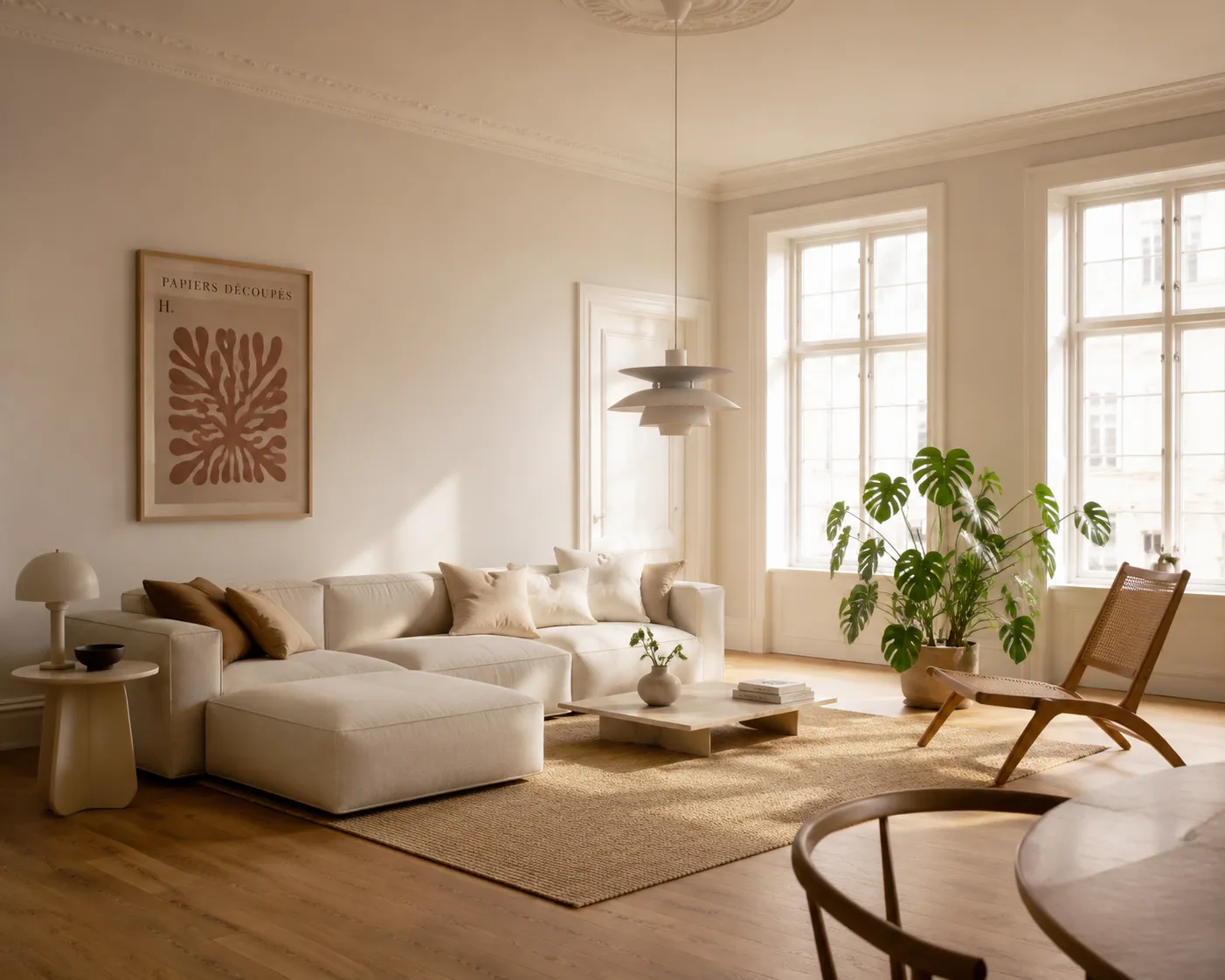
Picture a Copenhagen café on a winter evening. Through the window, you catch a glimpse: white walls, an oak table, a linen cushion, and a person quietly sipping coffee by the soft glow of a single candle. It looks effortless — almost nothing — yet you find yourself thinking, "I want to live in that space." That quiet, unassuming pull is the power of Danish minimal interior design.
What Is Hygge? — The Philosophy Behind the Space
The Danish word Hygge (pronounced roughly "hoo-ga") resists direct translation. It encompasses coziness, warmth, togetherness, and intentional comfort all at once. Added to the Oxford English Dictionary in 2016, Hygge has grown from a quirky Scandinavian concept into a global lifestyle philosophy — and it's the beating heart of Danish interior design.
Denmark has ranked among the top three on the UN World Happiness Report every year from 2022 through 2026. Researchers often cite Hygge culture as a contributing factor. How does a country with long, dark winters and limited sunshine maintain such extraordinary wellbeing? The answer lies in how Danes relate to the spaces around them.
Hygge is not about perfection. It's not the magazine-spread home that took a professional stylist six hours to arrange. It's the space where you genuinely feel at ease, where conversation flows naturally, where you want to linger over a second cup of coffee. Danish people see the home not as a showroom but as a living, breathing extension of who they are.
5 Elements That Create Hygge in Any Space
- Candlelight (Stearinlys): Denmark is among the world's highest per-capita candle consumers. The soft, flickering warmth of a candle transforms any room. A single scented candle on a bedside table is arguably the fastest, cheapest Hygge upgrade you can make.
- Natural Materials (Naturmaterialer): Instead of cold metals and plastic, Danes choose oak wood, linen, wool, and ceramics — materials that feel warm and alive in your hand. The tactile quality of a material contributes as much to a space's atmosphere as its visual appearance.
- A Cozy Corner (Hyggekrog): Many Danish homes feature a dedicated nook — often near a window — with deep cushions, a wool throw, and a reading lamp. This personal sanctuary is where Danes decompress, read, and think.
- Presence (Nærvær): Hygge encourages putting the phone down and engaging with the people and the moment in front of you. Danish living rooms are arranged for conversation, not for optimal TV-viewing angles.
- Togetherness (Samvær): While solo Hygge is entirely valid, at its core Hygge is about connection. The Danish kitchen and dining table are the heart of the home — a space deliberately designed to draw people together.
💡 Common Misconception: Is Hygge Just White Walls and Grey Sofas?
Many people equate Hygge with the stark white-grey Scandinavian aesthetic that dominated the 2010s. That's only half the picture. By 2025–2026, Danish interiors have shifted decisively toward Warm Minimalism — rich earth tones (terracotta, caramel, sage green) layered with tactile textures. The key isn't color; it's intentionality. When every object in a space earns its place, the room becomes naturally cozy — whatever its palette.
A Brief History of Danish Design 🏛️
How did a country of just 5.9 million people come to define global design taste for nearly a century? The answer involves a deliberate marriage of craft, function, and cultural values that took root in the early twentieth century and never let go.
The Rise of Functionalism
Influenced by Germany's Bauhaus movement, Danish designers developed the conviction that beauty and utility are inseparable. Kaare Klint pioneered ergonomic furniture design and established a rigorous methodology that would shape generations of Danish designers.
The Golden Age — Jacobsen and Panton
Arne Jacobsen releases the Series 7 Chair (1955), the Egg Chair (1958), and the Swan Chair (1958) in rapid succession, reshaping global furniture design. Verner Panton unveils the all-plastic Panton Chair (1967). Danish furniture floods MoMA's permanent collection. This era defines "Scandinavian design" for the world.
Democratization and New Voices
Brands like HAY (founded 2002) and Muuto (founded 2006) emerge with a mission: bring authentic Danish design sensibility to a broader audience at accessible prices. IKEA democratizes the Scandinavian aesthetic globally, while discerning consumers seek out the real thing.
Warm Minimalism and Sustainability
Post-pandemic, the home gains new significance. Cold white minimalism gives way to warm earth tones and rich textures. Biophilic design — integrating natural elements indoors — becomes a defining trend. Sustainability moves from a talking point to a core purchase criterion, with vintage furniture markets booming across Copenhagen.
"Design is not just what it looks like and feels like. Design is how it works." — Arne Jacobsen (1902–1971), paraphrased
The 5 Core Principles of Nordic Minimalism ✨
Danish interior design is far more than bare white rooms and a single potted plant. Underpinning every great Nordic space are principles refined over decades. Understanding these five will help you make better choices — regardless of your budget.
Connection to Nature
The Primacy of Light
Intentional Simplicity
Coziness & Personality
Principle 1: Form Follows Function
Every great Danish piece does its job beautifully. The Jacobsen Series 7 Chair is wafer-thin and elegant — yet the precisely engineered curve of its backrest supports your spine with unexpected comfort. When shopping for furniture, ask "Will I actually use this, and how?" before "Is this pretty?" This principle also applies to storage: Danish open shelving serves double duty as functional display, combining daily-use items with meaningful objects.
Principle 2: Biophilic Design — Nature Indoors
By 2025–2026, biophilic design has moved from trend to cornerstone in Danish interiors. The concept is simple: integrate natural elements — plants, natural materials, organic shapes, and daylight — to create spaces that feel alive. A large Monstera in a terracotta pot, a windowsill herb garden, or an oil-finished oak credenza can bring this principle to life without significant investment.
Principle 3: Light Is Architecture
Copenhagen's brutal winters — sometimes just seven hours of daylight — have made Danes world-class experts in artificial light. The rules: sheer curtains only (to let in maximum daylight), no objects on windowsills, and multiple layers of warm-toned (2700–3000K) artificial light at different heights. A room with a single overhead light source will never feel Danish. A room with three or four different light sources at different heights will feel like Copenhagen.
Principle 4: Intentional Simplicity
True Danish simplicity isn't poverty — it's curation. Keep the objects you genuinely love: the mug brought back from Kyoto, the dog-eared novels you reread, the small sculpture from a local market. Release everything else. Interestingly, the Danish approach to simplicity also embraces the "Old & New" mix — a grandmother's vintage armchair paired with a sleek modern side table creates exactly the kind of layered, personal space Danes prize.
Principle 5: Coziness and Character
Danish interiors are not meant to look like hotel lobbies. A rumpled linen throw, a stack of books on the floor, a well-used wooden cutting board on the counter — these signs of life are welcome. What matters is that the space tells your story. Striving for a photographable perfection that doesn't reflect real life is the opposite of Hygge.
Room-by-Room Guide 🏠 — Living Room to Home Office
Before buying a single new piece, clarify the feeling you want each room to create. Danish designers think in terms of a room's primary function and atmosphere first, aesthetics second. Use the tabs below to explore key points for each space.
Living Room — The Space for Connection
The Danish living room centers conversation, not the screen. Arrange sofas and armchairs to face each other, with a coffee table in between. If eliminating the TV feels radical, consider hiding it inside a cabinet or downsizing to a smaller display.
- SofaLinen or wool upholstery in neutral tones — ivory, warm grey, caramel. A 3-seat sofa plus an armchair creates better conversation flow than an L-shape. 2026's hero: low-profile boucle sofa in cream.
- RugSize matters enormously: all front furniture legs should sit on the rug. 100% wool in a herringbone or plain weave. Too-small rugs are the single most common Danish interior mistake.
- Side TableOil-finished oak or walnut. HAY's CPH series or Muuto's Under the Bell are excellent references. Odd numbers (1 or 3) feel more natural than pairs.
- LightingThree layers are standard: ambient pendant + floor lamp + table lamp, all at 2700K. Never rely on a single overhead source. A dimmer switch transforms the room.
- PlantsOne large statement plant (Monstera, rubber tree, fiddle-leaf fig) beats a cluster of small ones. Use terracotta or matte ceramic pots.
- ObjectsCeramic vases, candle holders, 3–4 cherished books. Style in odd numbers and leave deliberate empty space on shelves.
Bedroom — Dedicated to Recovery
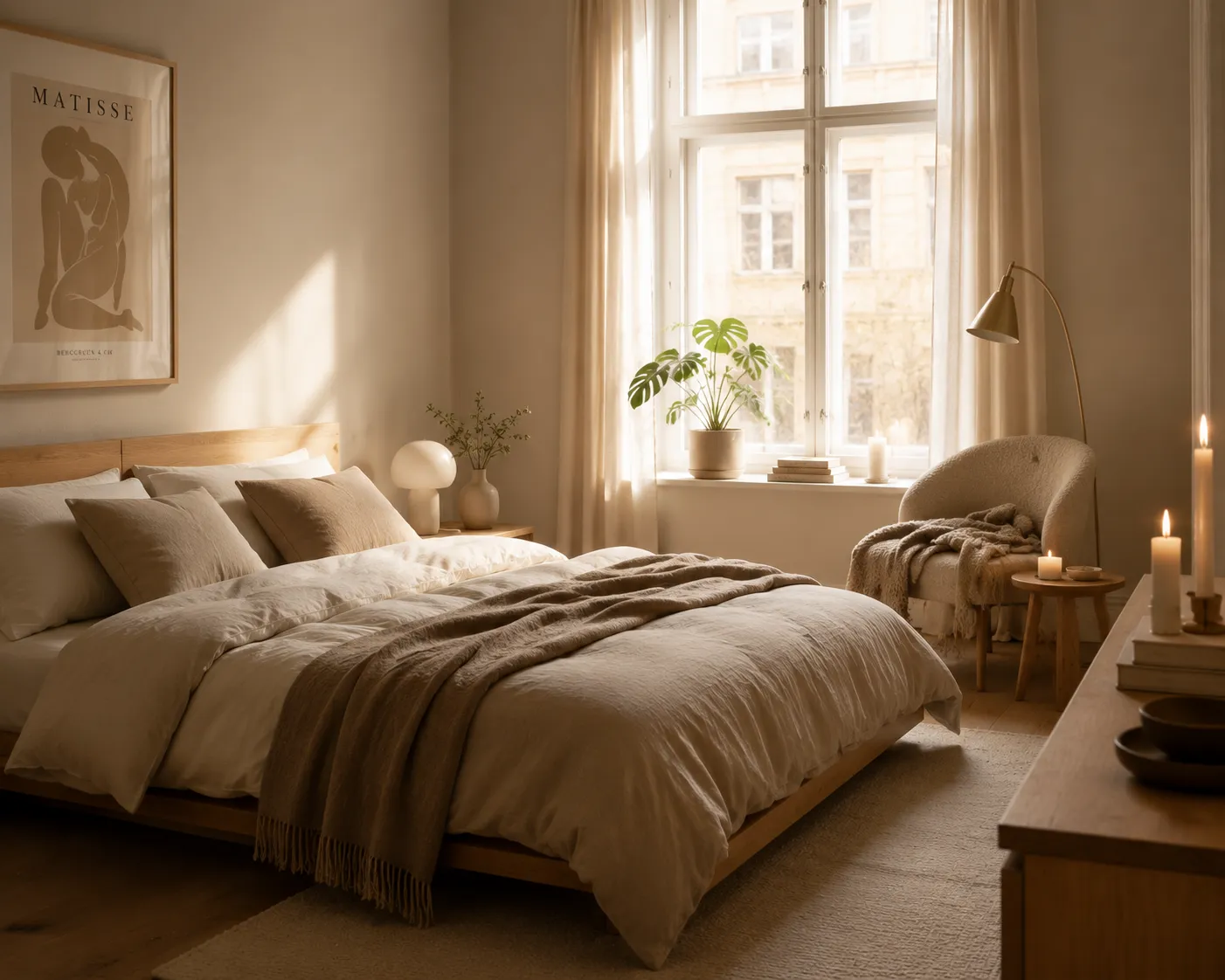
Danish bedroom philosophy starts with subtraction: remove everything that doesn't support sleep or genuine rest. Desk, TV, exercise equipment — these belong elsewhere. The bedroom is one thing only: a place to restore.
- Bed FrameLow platform frame in oak, walnut, or rattan headboard. The closer to the floor, the more spacious the room feels. Natural oil or wax finish preferred over lacquer.
- BeddingLinen duvet cover + cotton sheets in a 3-tone layer. 2026's trending combination: terracotta + ivory + sage green. Let linen wrinkle naturally — ironing defeats the point.
- NightstandSmall, minimal round table. On it: 1–2 books, a small vase, one candle. Phone charger goes in the drawer. The bedroom should be a digital-lite zone.
- Cozy CornerA low chair or floor cushion + chunky wool throw + floor lamp near the window. This nook alone will transform your bedroom's feeling.
- StorageFull-panel wardrobe doors conceal everything. Open shelves should be organized with matching baskets or boxes in a single color.
Kitchen & Dining — The Heart of the Home
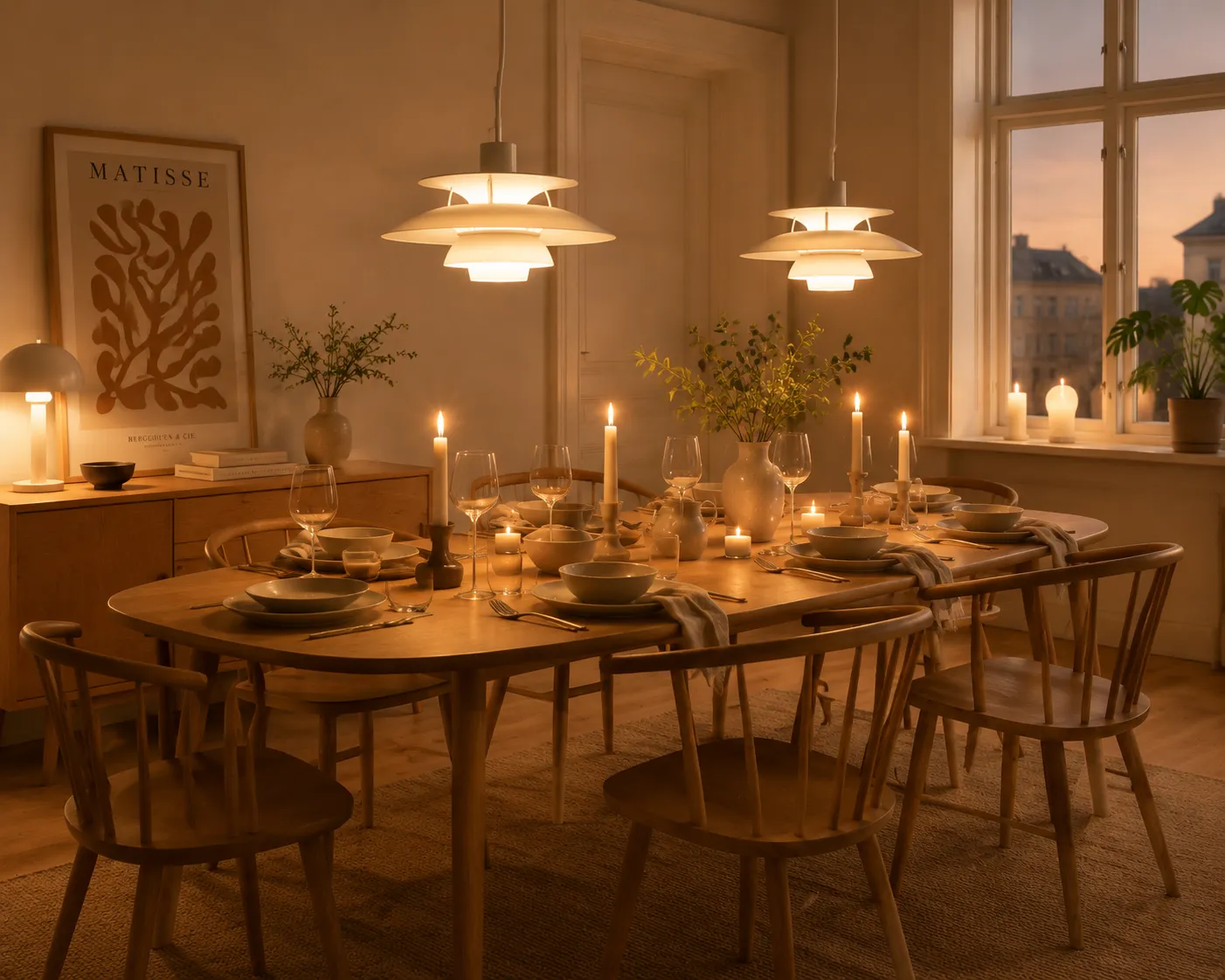
In Denmark, the kitchen and dining table are the emotional center of the home. Open-plan kitchens are strongly preferred — the person cooking should be part of the conversation. If your kitchen is closed, consider lowering or removing a partition wall to create connection.
- Dining TableRectangular oak solid wood is the classic choice. Size generously — Danes believe tables should always be large enough for one more guest. &Tradition's Fly Table or Fritz Hansen's Superellipse are iconic references.
- ChairsA modern interpretation of the Jacobsen Series 7 — HAY's J77 or Muuto's Nerd Chair. Mix chairs + a bench on one side for a relaxed, lived-in feel.
- Pendant Light1–2 PH-style pendants above the dining table are non-negotiable. Hang them lower than you think (55–65 cm above tabletop) for an intimate, cave-like warmth.
- TablewareGeorg Jensen cutlery, handmade ceramic mugs (imperfect is better), teak cutting board. The gentle irregularity of handcrafted ceramics adds warmth no catalogue piece can replicate.
- CountertopsWhite quartz or light grey cement texture. Keep counters clear; display only frequently-used tools on a magnetic knife strip or open shelf.
Bathroom — A Daily Ritual Space
Danes treat the bathroom not as a purely functional room but as a space for small, daily rituals of self-care. Significant renovations aren't required to achieve a Nordic bathroom feel — small changes create outsized impact.
- TowelsWaffle-weave linen-cotton blend in earth tones — cream, terracotta, sage. Keep display towels separate from daily-use ones for that effortless "just-arrived-at-the-hotel" look.
- PlantsHumidity-loving species: peace lily, tillandsia, pilea. Two or three small pots on a shelf or windowsill transform the atmosphere completely.
- Product VesselsDecant shampoo, conditioner, and soap into white or amber glass dispensers. This single change — often under $30 — makes a remarkable visual difference.
- Natural MaterialsA wooden bath stool, bamboo shelf, or rattan basket introduces warmth. Tiles in cement texture or classic white brick are the most Nordic options.
- LightingReplace cold overhead lighting with a warm-tone wall sconce beside the mirror. Candles — even in the bathroom — are always welcome.
Home Office — Productive and Beautiful
Post-pandemic, the home office became central to Danish interior thinking. The goal: ergonomics and aesthetics in balance. Productive environments shouldn't look like tech closets.
- DeskHeight-adjustable standing desk with an oak or solid wood top. Cable management is non-negotiable — all cords must disappear into a cable box. Visible cables are the enemy of Nordic calm.
- ChairOne excellent ergonomic chair (Herman Miller, Vitra) is worth more than ten cheap ones. Wool or linen fabric feels Danish; plastic mesh does not.
- ShelvingArrange books by color or height. Intersperse ceramic objects or a small plant between books. Embrace negative space — a gap on a shelf is not emptiness, it's breathing room.
- LightPosition your desk with the window to the side (90°) rather than directly behind the monitor. Use a quality desk lamp with adjustable color temperature for evening work sessions.
2026 Color Palettes: The Warm Minimalism Era 🎨
The Nordic color story has changed dramatically since 2024. The cool, clinical "Scandi White" era — all bone walls and grey concrete — has given way to Warm Minimalism: rich earth tones, organic textures, and a palette drawn from forest floors, clay cliffs, and Nordic coastlines. This shift reflects the post-pandemic desire for spaces that feel genuinely nurturing rather than aesthetically impressive.
🎯 The 70:20:10 Color Rule — Danish Interior's Golden Ratio
- 70% — Base Color: Walls, ceiling, floors, large furniture. Warm white, greige, or oatmeal. The quiet canvas that lets everything else breathe.
- 20% — Secondary Color: Sofa, rug, curtains. Earth tones (caramel, terracotta) or cooler tones (forest green, sage) to add depth and personality.
- 10% — Accent Color: Cushions, objects, lampshades. Your most expressive, saturated choice — kept small so it energizes without overwhelming.
The most celebrated 2026 combination is Greige + Terracotta + Forest Green — evoking the earth, clay cliffs, and pine forests of the Danish coast. The former dominant "Nordic Monotone" (pure white + cool grey + black) now reads as dated by comparison.
The Magic of Lighting 🕯️ — PH Lamps & Candlelight
There is a Danish saying: "Lighting creates the atmosphere (Belysning skaber stemningen)." Even the most thoughtfully furnished room will fail if the lighting is wrong. Conversely, a modestly furnished room with excellent lighting will feel deeply Danish.
The PH Lamp — An Icon of Danish Lighting 💡
In 1958, architect Poul Henningsen designed the PH 5 pendant for Louis Poulsen — a revolutionary multi-shade lamp engineered so the bare bulb is never visible, casting soft, reflected light in every direction. Nearly seven decades later, it remains in continuous production and hangs above dining tables across Copenhagen. The PH lamp is not just a product; it's Danish design philosophy made visible.
You don't need to spend thousands on an original PH lamp to apply its lesson. The principle — diffuse the light source, never expose it bare — can guide any lighting choice. Look for pendants with layered or opaque shades that scatter light rather than project it.
The Three Layers of Danish Lighting
Candlelight — The Highest-ROI Upgrade
Danes consume an estimated 6 kg of candles per person annually. At dinner, reading, during conversations, hosting — candles are lit. A cluster of pillar candles in glass or cement holders on a dining table, a single scented candle on the bath ledge, votives grouped on a windowsill: these cost almost nothing and transform the atmosphere immediately. Buy the best candles you can — pure beeswax or vegetable wax burns longer and smells better than paraffin.
Materials & Textures — Scandinavia You Can Touch 🌲
Danish material choices are guided by a simple question: how does it feel, and how will it age? The materials Danes love share a common trait — they improve with time, developing patina and character rather than degrading.
🪵 Wood — The Warmth-Setter
Oak is the undisputed king of Danish furniture. Its warm golden tone, visible but subtle grain, and exceptional durability make it appropriate for floors, dining tables, shelving, and side tables alike. Birch offers a lighter, more delicate feel — popular for bedroom furniture and children's spaces. Walnut's deeper brown brings masculine weight when warmth alone isn't quite right.
Opt for oil or wax-finished wood over lacquer. An oiled oak table requires occasional re-oiling, but it rewards you with a living surface that absorbs the oils from your hands over time, developing a richer, more beautiful patina than any factory finish can produce.
🧵 Fabrics — Capturing the Season
Linen is the signature fabric of Danish interiors — cool in summer, warm in winter, softening with every wash. Its natural wrinkles are a feature, not a flaw. The 2026 standout fabric is Boucle: a looped-texture weave that creates a cloud-like softness on sofas and armchairs. Cream or ivory boucle upholstery has dominated Nordic design lookbooks for two consecutive years. Wool provides tactile warmth in cushions, throws, and rugs — particularly valued in the autumn-winter months.
🏺 Ceramics & Natural Objects
Handmade ceramic vases with slight imperfections, rattan baskets, terracotta pots — these objects carry the warmth of human hands in a way no mass-produced item can replicate. In Danish design culture, slight irregularity is not a defect but a quality. A bowl that shows the fingerprints of its maker is more interesting, and more cozy, than a perfectly machine-stamped one.
🌱 Sustainability — Core to Danish Design in 2026
Denmark targets carbon neutrality by 2030, and that ambition permeates its design culture. Shopping vintage before buying new, choosing natural over synthetic materials, supporting small craft producers over mass-market brands — these aren't aspirational choices in Copenhagen; they're standard practice. Weekend vintage furniture markets in the capital draw enormous crowds. A 150-year-old chair, lovingly restored and used daily, is a source of genuine pride.
Essential Danish Brands & Designers 🏷️
Knowing the landscape of Danish brands helps you make smarter buying decisions. You don't need to furnish an entire room with originals — a strategic investment in one or two key pieces, surrounded by considered alternatives, is entirely the Danish way.
| Brand | Est. | Character & Strengths | Iconic Pieces | Price Tier |
|---|---|---|---|---|
| Fritz Hansen | 1872 | The textbook of Danish design. Arne Jacobsen's collaborations produced some of the most recognizable furniture ever made. Also called "Republic of Fritz Hansen." | Egg Chair, Series 7, Swan Chair, Superellipse Table | Premium |
| HAY | 2002 | The modern face of Danish design. Accessible pricing, vibrant seasonal colors, and consistent quality. The brand most associated with millennial and Gen Z Nordic interiors. | J77 Chair, CPH Table, Mags Sofa, DLM Pouch | Mid-range |
| Muuto | 2006 | A quieter, more restrained take on modern Scandinavian design. Slightly more muted palette than HAY. Now owned by Knoll, undergoing gradual premiumization. | Nerd Chair, Under the Bell Lamp, E27 Lamp, Outline Sofa | Mid-range |
| Normann Copenhagen | 1999 | Playful and experimental — the most art-forward of the Danish brands. Especially strong in lighting and decorative objects. Ideal for gifting. | Hyg Armchair, Amp Lamp, Block Vase, Tablo Side Table | Mid-range |
| &Tradition | 2010 | Revives and reinterprets classic Danish design archives. Collaborates with both heritage and contemporary designers. Deep respect for craft and material. | Fly Table, Catch Chair, Flowerpot Lamp, Utzon Lamp | Premium |
| GUBI | 1967 | High-craft, premium materials, close collaboration with the Verner Panton estate. The most luxurious of the contemporary Danish brands. | Beetle Chair, Multi-Lite Lamp, Grossman Lamp, Dwell Sofa | Premium |
| BoConcept | 1952 | Modular system furniture with strong customization options. Has physical showrooms globally, making it the most accessible full-room Danish design solution. | Chiva Sofa, Copenhagen Dining Table, Lugano Bed | Mid-range |
| Ferm Living | 2005 | Biophilic focus and distinctive textile patterns. Best in class for cushions, throws, and decorative plant accessories. Great for smaller purchases that instantly lift a room. | Plant Box, Weave Cushion, Plant Pot, Sander Chair | Mid-range |
| Georg Jensen | 1904 | World-class silverware and tableware. The finest way to bring Danish craft to the dining table. A single Georg Jensen piece elevates the everyday. | Sky Cutlery, Bloom Vase, Bernadotte Dinnerware | Premium |
| Louis Poulsen | 1874 | The definitive Danish lighting brand. The PH lamp series rewrote the rules of residential lighting design and remains in production today. | PH 5, PH Artichoke, Panthella, NJP Desk Lamp | Premium |
Pro tip: BoConcept showrooms globally let you sit in and configure furniture before buying — the most practical entry point into Danish design. HAY pieces are available through international retailers and the brand's own online store. For the highest-impact single investment, a quality pendant lamp from any of these brands transforms a dining room more than any furniture piece could.
Japandi — Where Denmark Meets Japan 🇩🇰🇯🇵
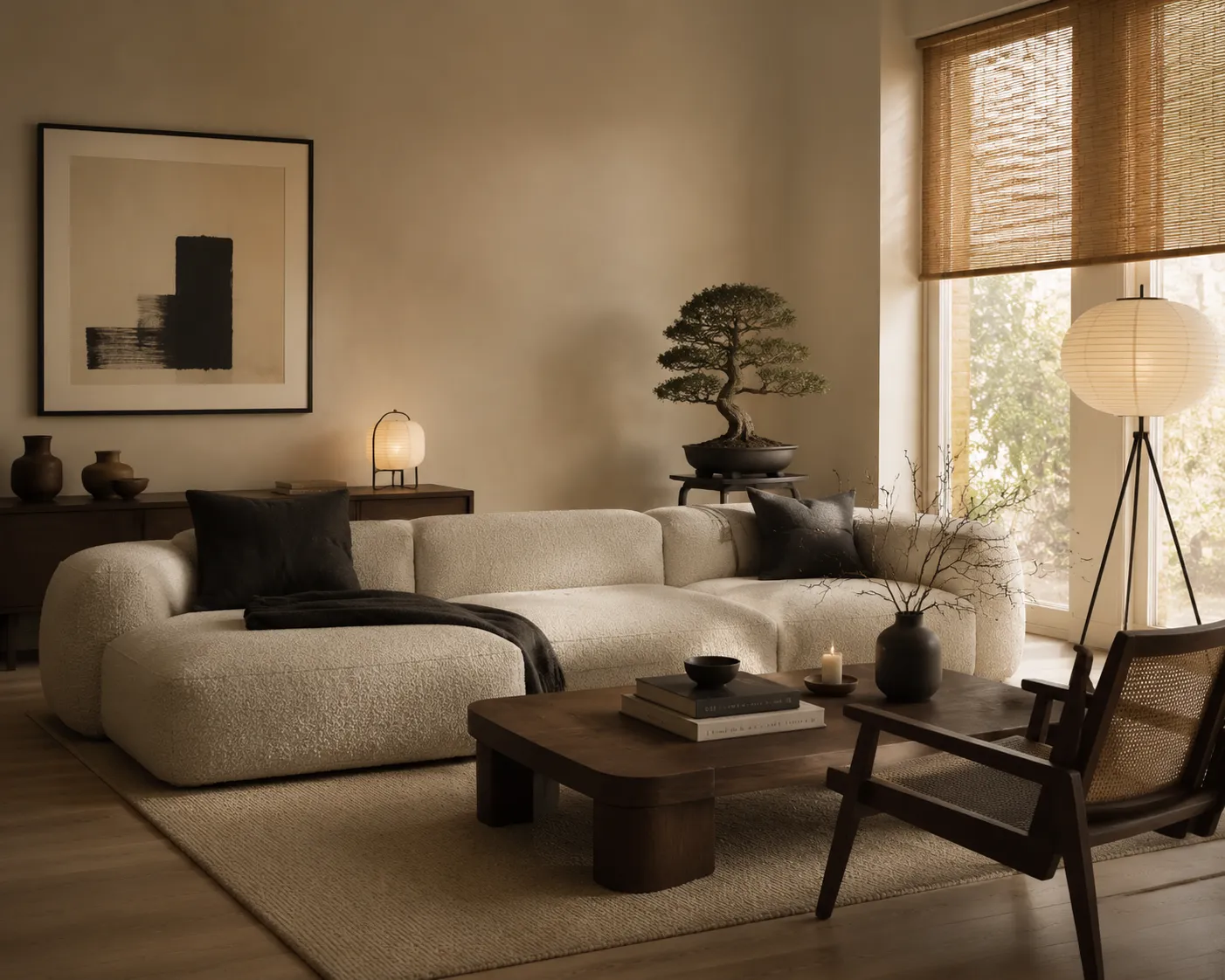
Japandi — a portmanteau of Japan and Scandinavia — blends the aesthetic philosophies of two design cultures that, despite geographical distance, share remarkably similar values. It remains one of the fastest-growing interior trends globally through 2025–2026, with no signs of slowing.
The affinity runs deep. Japan's Wabi-Sabi (the beauty of imperfection and impermanence) and Denmark's Hygge (coziness and intentionality) both advocate for removing excess and focusing on what genuinely matters. Both cultures revere natural materials, value craftsmanship, and treat functional objects as worthy of aesthetic consideration.
- Light natural oak wood
- Cozy textiles (linen, wool)
- Warm-tone artificial lighting
- Function-first furniture
- Candles and soft glow
- Social togetherness
- Darker woods (paulownia, bamboo)
- Clean, linear silhouettes
- Low, floor-hugging furniture
- Negative space (Ma, 間)
- Nature and seasonal awareness
- Solitude and meditation
5 Keys to Creating a Japandi Space
① Low-profile furniture — Low sofa, low bed, floor-level coffee table. This single decision delivers half the Japandi look immediately.
② Off-white + warm beige + charcoal — The signature Japandi palette avoids pure white (too stark) and pure black (too aggressive). Warmer, more nuanced versions of both create exactly the right tension.
③ Embrace negative space — Japanese Ma (間) teaches that empty space is not absence but presence. Leave that shelf section bare. Let the table have room to breathe. Resist the urge to fill every corner.
④ Botanical elements — Bonsai, moss terrariums, bamboo screens, Japanese maple in a ceramic pot — paired with Danish-style open shelving, these create a distinctly Japandi atmosphere.
⑤ Handcrafted ceramics — Both cultures celebrate irregular, hand-thrown pottery. Japanese yakimono (焼き物) ceramics displayed on Danish open shelving: that's the intersection of these two design worlds in physical form.
Practical Guide 💰 — Nordic Interiors on Any Budget
Forget the myth that Danish design requires a designer budget. The principles — intentionality, natural materials, warm light — cost nothing. What you invest in is a strategic selection of quality pieces, introduced gradually. This is exactly how Danes approach it.
🌱 Starter Level (Under $150) — Do This Today
The highest-impact, lowest-cost changes are lighting and textiles. Replace cool white (5000K+) bulbs with warm LED bulbs (2700K) throughout your home — often under $30 total and an instant transformation. Add one floor lamp to a dark corner. Buy two linen cushion covers in an earth tone, a chunky wool throw, and three candle holders. These alone move any room meaningfully toward Nordic territory. For furniture: check resale platforms like Facebook Marketplace, Craigslist, or local vintage stores for oak or walnut side tables — genuine vintage Scandinavian pieces often surface at surprisingly low prices.
🏡 Intermediate Level ($150–$2,000) — Core Investments
At this level, prioritize the rug, pendant light, and coffee table — the three elements with the greatest visual weight in a living room. A sufficiently large wool rug ($150–400), a Danish-inspired pendant (from $80 for quality alternatives, $300+ for originals), and a solid wood coffee table ($200–600) will transform the space completely. In the bedroom: a linen duvet cover set ($80–180) and a low platform bed frame ($300–700) create the quintessential Danish bedroom feeling.
🏆 Full Transformation ($2,000+) — Commit to the Vision
At this level, an authentic HAY sofa ($1,500–3,000), a custom BoConcept dining set ($1,000–3,000), and a Louis Poulsen-era pendant ($400–2,000) become viable. The strategic approach remains the same — prioritize the objects you see most and touch most often. Consider working with a Nordic-trained interior consultant to avoid costly mistakes at this investment level.
❌ The 5 Most Common Danish Interior Mistakes
Community Voices 💬 — Reddit & Global Trends
Danish minimal interior design generates passionate discussion in online communities worldwide. Here's what practitioners of Nordic home design are saying in 2025–2026.
Key Takeaway: The Essence of Danish Interior Design
The most important insight from Danish interior philosophy is this: a beautifully Hygge space begins with subtraction, not addition. Before purchasing anything, edit what you have. Then upgrade your lighting to warm 2700K. Then add one natural-material textile. These three actions, costing almost nothing, will move any space dramatically closer to the Nordic ideal. Hygge cannot be bought — it can only be cultivated.
Closing — Step Through the Window 🕯️
That Copenhagen café window we described at the start — the white wall, the oak table, the candle — turns out not to require extraordinary wealth or a professional designer. It requires a candle, warm light, and the decision to make your space work for the life you actually live, not the life you want to photograph.
Danish minimal interior design is ultimately an answer to the question: how do we want to live? Not perfectly. Not impressively. But genuinely — surrounded by materials we can feel, light that flatters, objects that mean something, and space enough to breathe. Work toward that, one intentional choice at a time, and you'll build a space that makes both you and your guests want to stay just a little bit longer. 🏡