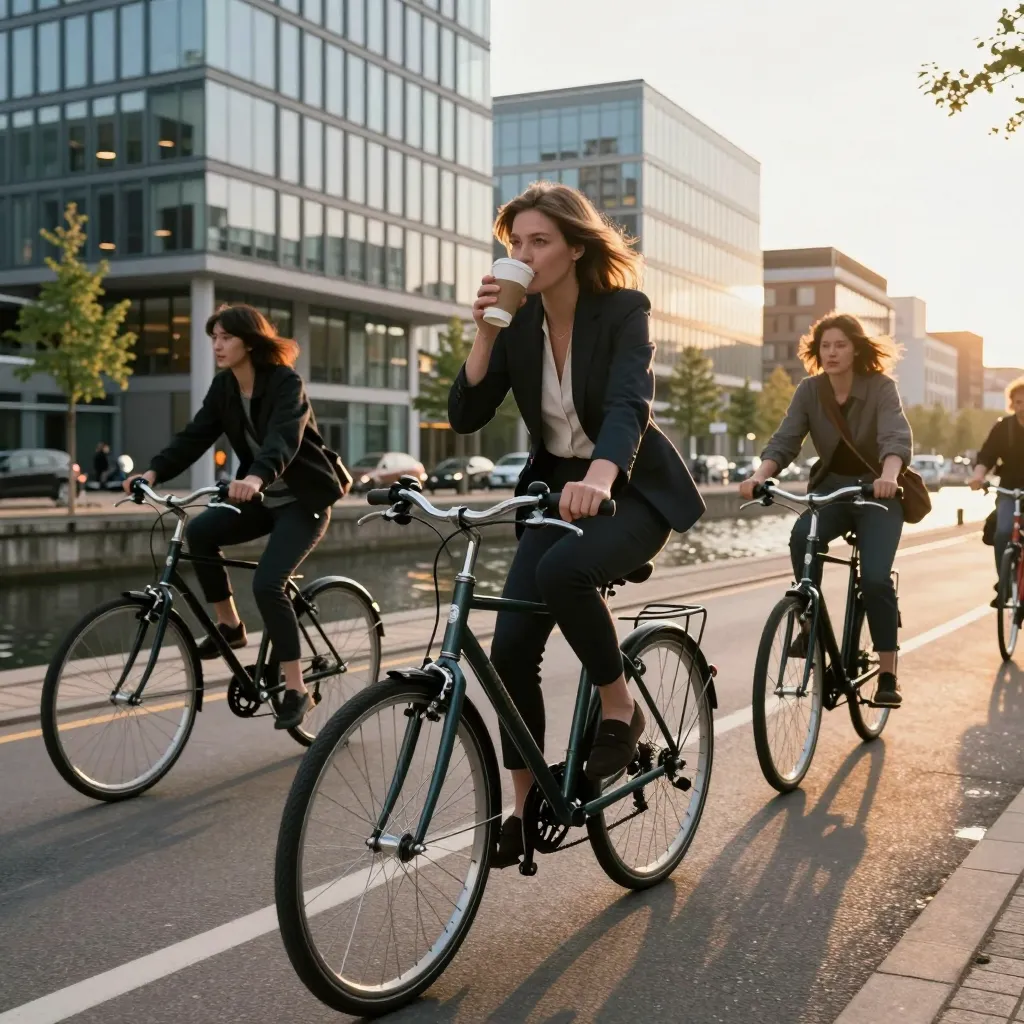
In Denmark, leaving work at 5 p.m. — before your boss — raises no eyebrows. Taking the afternoon off when your child falls sick is completely normal. And if you lose your job, the government pays you up to 90% of your salary for two full years. Denmark isn't just a country with "good welfare." Beneath the surface lies a system that has been meticulously engineered over decades, built on a philosophy of work and life that is fundamentally different from most of the world. How can Danes work fewer hours and still outperform much of the global economy — and why are they so consistently, stubbornly happy?
(2025 UN Report)
(among OECD's lowest)
rate (up to 2 years)
(both parents combined)
(global ranking)
+ 10 public holidays
Flexicurity: The Secret of the Golden Triangle 🔺
When people discuss Denmark's work-life balance, one word comes up first: flexicurity. A portmanteau of "flexibility" and "security," this concept is Denmark's unique labor market model — one that economists around the world have studied and envied for decades.
Most labor markets make a binary choice. You either have a hyper-flexible system like the United States, where employers can hire and fire freely but workers are left vulnerable, or a heavily regulated system like France, where dismissal is almost impossible but companies are terrified to hire. The Danes simply refused to make this trade-off. Instead, they built what's called the "Golden Triangle."
When all three corners work together, something remarkable happens. Companies can adapt quickly to economic changes without destroying workers' lives, and employees can take risks, explore new careers, and innovate — because the fear of destitution simply isn't there. This psychological safety is the invisible engine of the Danish economy.
💡 The Key Difference from Other Countries
In most countries, unemployment benefits are a temporary band-aid — often covering 50-60% of your previous salary for less than a year. In Denmark, up to 90% for two full years. The difference isn't just financial. It changes behavior. Danes can say, "Let me take a moment to figure out what I really want to do next." Workers elsewhere say, "I need to take the first job I can find." That difference transforms the quality of an entire life.
How Flexicurity Was Built
Hygge: A Survival Strategy, Not a Lifestyle Trend 🕯️
"Hygge" swept the global internet around 2016. There's no precise English translation — it lands somewhere between "coziness," "togetherness," and "the pleasure of simple pleasures." Instagram flooded with candles, knit sweaters, and hot cocoa under the hashtag. But those images are just hygge's surface appearance.
Meik Wiking, director of the Happiness Research Institute in Copenhagen, calls hygge a "survival strategy." Denmark is a country of long, dark winters — from November through February, the sun rises late and sets early, and temperatures hover near freezing. Hygge developed as a way for people to psychologically endure this environment, to create warmth and safety in the cold.
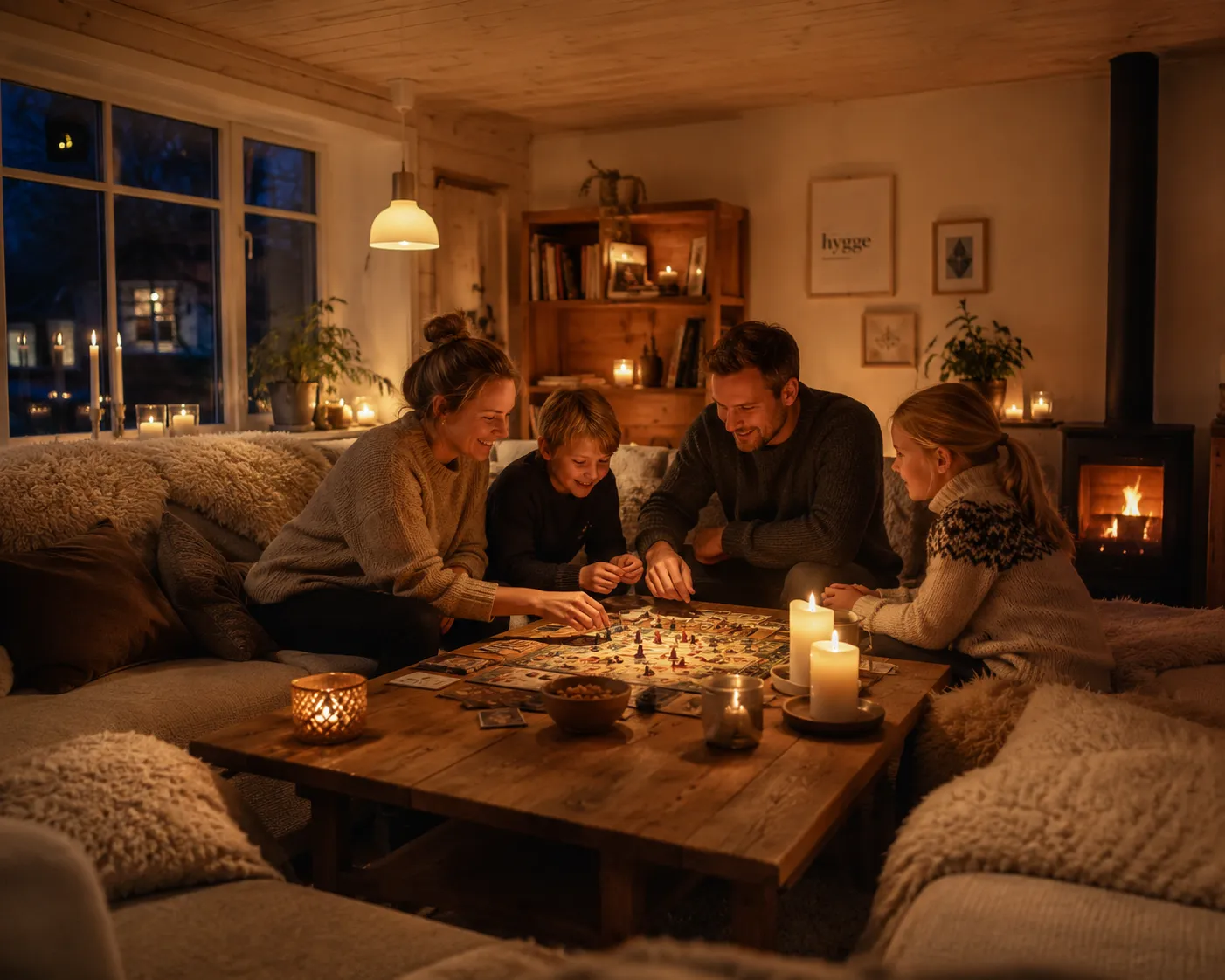
In the workplace, hygge's effects are real and measurable. Most Danish offices are empty by 4 or 5 p.m. Sharing dinner with family is not a nice-to-have — it's an unwritten social rule. Emailing a colleague about work over the weekend is considered odd at best, inconsiderate at worst. As one British expat famously put it: "Danish offices are morgues after 5 p.m. If you work on the weekend, Danes suspect you are a madman working on some secret project."
"Happiness = Reality minus Expectations. Lowering your expectations mathematically increases happiness. Danes know this instinctively." – Meik Wiking, Director, Happiness Research Institute Copenhagen
Hygge shapes office culture physically too. Danish workplaces typically have shared kitchens where colleagues gather for "kaffepauser" — coffee breaks that are anything but trivial. These are moments without hierarchy, where an intern talks to a senior manager like an equal, ideas get shared, and human bonds are formed. This is the soil from which flat organizational culture grows.
The Productivity Paradox: Working Less, Achieving More ⚡
Danish workers put in some of the shortest hours among all OECD nations — an average of 32.5 to 37.2 hours per week, depending on measurement. Yet Denmark ranks among the top 10 countries globally for GDP per hour worked. How?
Average Weekly Working Hours: Key Countries (OECD)
The answer isn't laziness in reverse — it's a culture of working with full focus when you're at work. There are no performative late nights, no sitting at your desk past 6 p.m. just to look dedicated. Goals are clear and evaluation is results-based. You do the work, you leave.
Meeting culture is also radically efficient. Danish meetings exist to make decisions, not to perform authority or show up in the minutes. "Why does this meeting need to happen?" is a question Danes genuinely ask themselves. The result: fewer, shorter, more effective meetings.
🏭 An Expat's Take
Fabrizio Moroni, originally from Milan and now living in Skanderborg, Denmark, put it perfectly: "I have been really surprised by the fact that things are more relaxed compared to what I am used to, but still very productive. Here I work less, but more focused. That is a big difference in work culture."
There's also the matter of burnout prevention. Denmark doesn't need laws capping weekly hours at 52, because cultural norms already discourage overwork. Someone who consistently puts in excessive hours is often viewed not as a hero but as someone who can't manage their time. This cultural pressure keeps burnout rates low, and keeps high-performing people performing longer.
Many Danish companies also invest in employee wellness as a serious business expense — "wellness allowances" for gym memberships, massage, mindfulness programs. The philosophy is simple: a happy, healthy employee is a more productive one. That logic, acted upon consistently, produces extraordinary results.
Cradle to Grave: The Safety Net That Changes Everything 🛡️
Denmark's welfare state is sometimes caricatured as high taxes buying government handouts. The first part is accurate — top marginal income tax rates approach 55%, and VAT is 25%. But citizens don't resent these taxes as much as you might expect, because they can clearly see where the money goes.
Universal, tax-funded, free at the point of use for all residents. No insurance gatekeeping, no bankruptcy-inducing hospital bills.
Free from kindergarten through postgraduate study. University students actually receive a monthly living stipend (SU) of around $1,000 from the government.
Up to 75% of daycare costs subsidized by the state. By law, every child is guaranteed a place in public childcare within 3-4 months.
Pay about $63/month into an unemployment insurance fund and receive up to 90% of your previous salary for up to two years if you lose your job.
The government provides free counseling, education, and job placement support to unemployed workers. Losing a job can be the beginning of a new career.
All families with children receive quarterly child benefit payments (børnecheck), regardless of income. Having a child doesn't have to mean financial crisis.
What matters most about this system isn't the specific dollar amounts — it's the trust it creates. When you know the state will catch you if you fall, you're far more willing to take risks. Danes launch startups, change careers at 40, take sabbaticals to recover from burnout, and retrain for completely different fields — because the downside of failure isn't catastrophic.
Christina Konig Koehrsen, a Danish woman who left her advertising career because it wasn't making her happy, is now studying to become a painter — supported by a government educational stipend of about $1,000 a month. This is the system working exactly as designed: enabling human beings to find work that is genuinely meaningful, not just survivable.
Key Insight: Welfare as Investment, Not Cost
Denmark's paradox is that the more you invest in your citizens' security, the better the economy performs. A safety net doesn't make people lazy — it makes them bold. People who aren't terrified of failure innovate more, collaborate better, and stay in the workforce longer. This is human capital investment, not a social spending line item.
Flat Hierarchies: Your Boss Is Just a Colleague 🤝
One of the first things expats notice about Danish workplaces is that they address their boss by first name — and that this is not considered audacious but completely natural. CEOs sit in open-plan offices alongside their teams. Dissenting in a meeting isn't career suicide; it's expected.

This flat culture has deep roots in the Scandinavian social philosophy of "Jante's Law" (Janteloven) — an unspoken norm that says "Don't think you're better or more important than anyone else." Displays of status or pulling rank are socially frowned upon. A senior manager who flaunts authority is seen as insecure, not powerful.
Portuguese engineer Cristina Ferreira described it this way: "The organization is very flat. You can talk with all the workers, and all workers can give suggestions and come to the chief and say, 'we should improve that.'" German geoscientist Hannes Koopmann added: "If you want responsibility, then you're going to get it. You can talk to any boss above your level face to face."
This flatness has practical business benefits. Decision-making is faster when it doesn't require navigating layers of hierarchy. Good ideas surface regardless of who has them. Front-line employees' insights reach leadership without distortion. Horizontal culture isn't just pleasant — it's a competitive advantage.
Work and Parenthood Together: World-Class Family Support 👶
In many countries, having a child creates an impossible tension with a career — especially for mothers. Denmark treats this as a solvable engineering problem, and has largely solved it.
- 52 weeks of paid parental leave: Including 4 weeks of prenatal leave for the mother, both parents together are entitled to 52 weeks of paid parental leave under Danish law, with portions allocated to each parent individually to encourage fathers to take leave.
- Guaranteed childcare placement: By law, every child in Denmark is guaranteed a place in public childcare within 3 to 4 months of application. No waiting list anxiety, no career sacrificed waiting for a daycare spot.
- 90%+ of children in subsidized care: Over 90% of Danish children aged 1 to 5 attend government-subsidized daycare or kindergarten. Working parents can actually work, knowing their children are well cared for.
- After-school care (SFO): School-age children have access to structured after-school programs (SFO/fritidshjem), eliminating the childcare gap that traps many dual-income families.
- Father's cultural participation: Fatherhood is culturally normalized. Seeing fathers pushing strollers in Copenhagen parks on a weekday afternoon is completely unremarkable.
The outcome: Denmark ranks in the top 5 for female labor force participation in the OECD. Having children doesn't end careers in Denmark — it just requires planning. For comparison, South Korea's female labor force participation crashes dramatically after childbirth, and its birth rate hit a record low of 0.72 in 2023. The connection isn't coincidental.
⚖️ An Honest Caveat
Even Denmark's family system has room to grow. Despite generous policies, fathers still take dramatically less parental leave than mothers — an average of about 30 days versus mothers' 300 days. Male managers average only 14 days. The law is there; the cultural barrier remains. Real equality in parenting is still a work in progress.
The Cycling City: Urban Design as Well-Being 🚲
Work-life balance depends not only on what happens in the office but also on the commute. In cities where workers spend two or three hours daily in traffic or on crowded trains, even a perfectly structured workday leaves little life left to live. Copenhagen solved this problem by building the city around people, not cars.
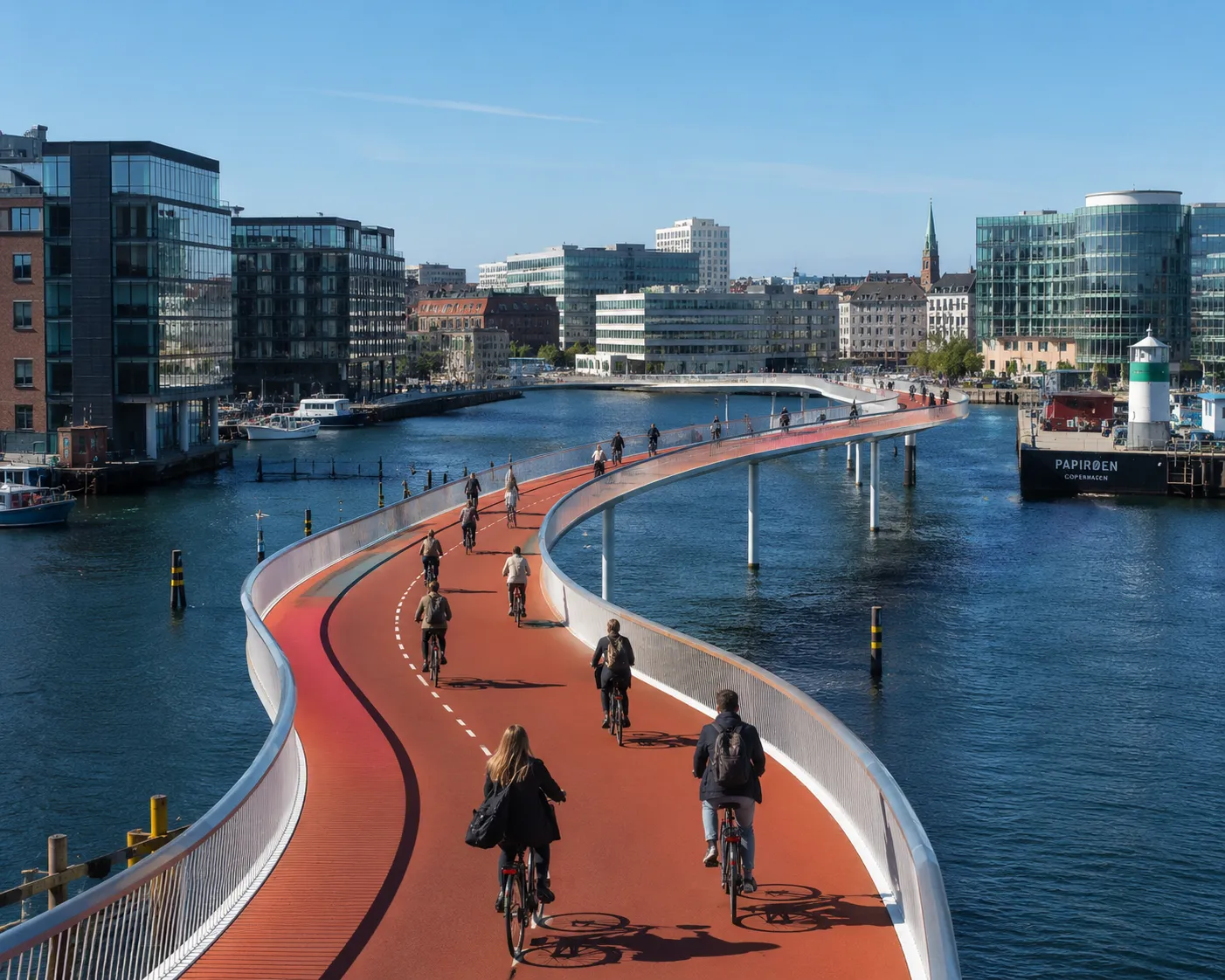
About 62% of Copenhageners cycle to work every day. This isn't a cycling trend; it's the product of over 390 kilometers of dedicated, well-maintained cycling infrastructure, cycling-specific traffic signals, and even cycling superhighways like the Cykelslangen (the "Cycling Snake") — a serpentine elevated bike bridge over the harbor. Spanish physician Maria Perez put the personal impact simply: "I went from a three-hour commute to a ten-minute bike ride. It completely transformed my family's life."
The health dividend is built-in. The average Copenhagen commuter gets 20-30 minutes of aerobic exercise daily just by going to and from work. No gym membership required, no special time carved out. This passive fitness contribution is part of why Danish health indicators are strong.
City scale matters too. Copenhagen has a population of around 700,000 — small enough that most people can reach work by bicycle within 30 minutes. Denmark's overall urban philosophy favors distributed cities over mega-city concentration, which reduces commute times and spreads quality of life more evenly across the country.
Denmark vs. the World: The Numbers 📊
Arguments about work-life balance are clearest when quantified. Here's how Denmark compares across key dimensions.
| Metric | 🇩🇰 Denmark | 🇺🇸 USA | 🇰🇷 S. Korea |
|---|---|---|---|
| World Happiness Rank | #2 (2025) | #23 (2025) | #52 (2025) |
| Avg. Weekly Hours Worked | ~32.5h | ~38.8h | ~44.7h |
| Statutory Paid Vacation | 5 weeks + 10 holidays | No federal minimum | 11–25 days (by tenure) |
| Unemployment Benefits | Up to 90%, up to 2 years | Varies by state, ~26 wks max | 50–60%, up to 270 days |
| Paid Parental Leave | 52 weeks (both parents) | 12 wks unpaid (FMLA) | 52 wks (low take-up rate) |
| Childcare Enrollment (0-5) | 90%+ | ~45% | ~73% |
| GDP per Hour (Global Rank) | Top 7 | Top 5 | ~37th (OECD) |
| Total Fertility Rate | 1.72 (2023) | 1.62 (2023) | 0.72 (2023, world's lowest) |
| Power Distance Index | 18 (very flat) | 40 (moderate) | 60 (hierarchical) |
A pattern emerges. Denmark works fewer hours, rests more, faces less risk from unemployment — and yet outperforms on productivity, leads on happiness, and maintains a replacement-level fertility rate. Countries with the opposite structure — long hours, minimal safety nets, steep hierarchies — consistently report lower life satisfaction, lower productivity per hour, and, increasingly, collapsing birth rates. This is not coincidence; it's cause and effect.
Expats Speak: Real Voices from the Happiest Country 💬
Statistics tell one story. Real people living in Denmark tell another — often more viscerally.
"In Korea, leaving at 6 p.m. made you feel like you were doing something wrong. In Denmark, I leave at 5 and actually get praised for it. It took me months to stop feeling guilty. Eventually I realized — I'd been measuring the wrong thing my whole career."
"I turned down offers from Google and Facebook multiple times. I didn't want just a career. I wanted a life. The social welfare system in Denmark — there really is nothing like it anywhere else in the world."
"We might have earned more in London, but we had far less time. You have a fundamentally different approach to time here. You value that families have time to eat together, every day."
"For many expats, the greatest change is the shift in work-life balance. They describe Danish offices as being like morgues after five p.m. If you work on the weekend, Danes suspect you are working on some secret project."
"Here I work less, but more focused. The atmosphere is relaxed compared to Italy, but productivity is actually higher. That's the big revelation for me — relaxation and productivity aren't opposites."
"I left advertising because it wasn't making me happy. Now I'm studying to become a painter and the government gives me about $1,000 a month. My home country would never allow this kind of pivot."
"Ask a Dane, 'What do you do for work?' and many of them will pause and ask, 'What do you mean, exactly?' They don't define themselves by their job title. In most countries, that question is a greeting. In Denmark, it's a category error." – Long-term expat in Copenhagen
What the Rest of the World Can Actually Learn 🌍
Copying Denmark wholesale is impossible. Population size, history, geopolitics, industrial composition — none of it transfers directly. But the directional lessons from Denmark's model are clear and applicable.
Stop measuring seat time. Evaluate what was accomplished, not how many hours were logged. This single cultural shift, genuinely implemented, can reduce overwork and raise productivity simultaneously.
When losing your job means genuine financial devastation, workers cling to bad jobs, resist career pivots, and can't contribute fully to an innovation-based economy. Expanding unemployment benefits pays for itself.
Flexible hiring only works if laid-off workers can reliably find new work. That requires real investment in retraining, career counseling, and job placement — not just token programs.
Birth rates correlate directly with available childcare. Countries facing demographic collapse must treat universal childcare as infrastructure investment, not social spending.
Laws can't mandate culture, but companies can redesign performance review systems, org structures, and management training to reward horizontal collaboration over hierarchical deference.
This is the hardest one. Societies need to expand their definition of success beyond income and title to include life satisfaction, health, and meaningful relationships. Policy helps, but ultimately it's a cultural shift.
One critical warning from economists: you can't selectively import the "flexibility" part of flexicurity and leave the "security" part behind. Doing so just gives you easy layoffs with no safety net — which is the opposite of what makes the Danish system work. The Golden Triangle only functions when all three corners are in place.
🏁 Bottom Line: Danish Happiness Is Engineered
Danes aren't happy because they're naturally cheerful people. They're happy because over a century, through consistent negotiation between labor, employers, and government, they built systems that treat human beings as the point of the economy — not the fuel. The takeaway isn't "be more Danish." It's: happiness at scale doesn't happen by accident. It's designed. And design can always be improved.
Final Thoughts: Denmark Isn't a Special Case
Every time Denmark comes up, someone says: "But they only have 5.9 million people." True. Or: "They have oil." Also true (though Norway has more, and Denmark's model predates its oil wealth). Or: "Their culture is different." Fair enough.
But Denmark has proven something universal: an economy designed around human flourishing also performs. Happiness and productivity are not trade-offs. Done right, they reinforce each other. The lights going off at 5 p.m. in a Danish office isn't a sign of laziness. It's a sign that the system is working — that people can trust tomorrow will be okay, so they can fully live today. 🇩🇰