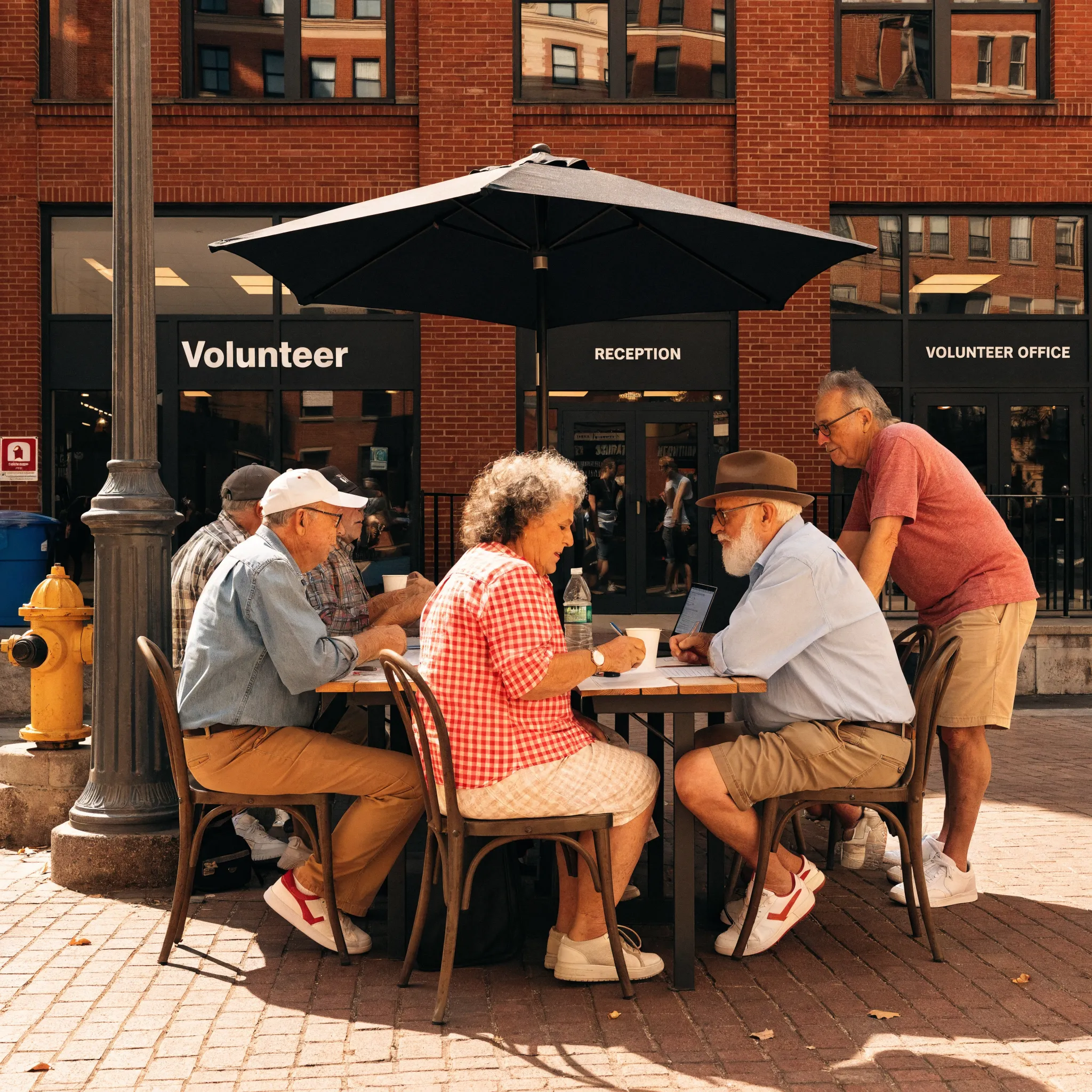
"Retirement isn't the end — it's a pivot." In December 2024, South Korea officially joined the ranks of super-aged societies, with people over 65 making up more than 20% of the population. In response, the government has rolled out a record-breaking 1.152 million senior jobs in 2026, backed by roughly ₩5 trillion (about $3.7 billion USD). These aren't just supplemental income gigs — they're becoming genuine channels for purpose, health, and social connection. This guide breaks it all down.
Korea's Aging Workforce
by the Numbers
Official data from Ministry of Health & Welfare and Korea Senior Human Resources Development Institute
The Big Picture — Korea's Super-Aged Society 🌏
South Korea's demographic shift is one of the steepest in the world. The country moved through the stages of aging society (7% elderly in 2000) and aged society (14% in 2018) at record speed, reaching super-aged status (20.3%) in December 2024. According to the National Data Agency's 2025 Senior Population Statistics, that figure is projected to surpass 30% by 2036 and 40% by 2050 — meaning roughly one in two Koreans will be over 65 within three decades.
This shift is already reshaping the labor market dramatically. Korea Employment Information Service's 2026 Employment Outlook report shows that workers aged 60 and older grew by 354,000 in 2025, reaching 6.877 million total — a figure that actually exceeds the net employment growth for all age groups combined (196,000). Meanwhile, youth employment (ages 15–29) fell by 184,000 over the same period. In short, Korea's senior workforce is now the primary engine of employment growth.

What's also changing is the nature of senior work. The image of an elderly person doing a low-stakes community chore to pass the time is giving way to what researchers call the "Active Senior" — someone who wants to apply their accumulated expertise, stay socially connected, and maintain their health through meaningful work. The government has explicitly acknowledged this shift, committing to transform the program from a simple income supplement into a value-creating, expertise-driven employment system.
"Senior employment is not a welfare program — it is a population policy. The experience and skills that older workers hold are an irreplaceable social asset. If we fail to harness them, our national competitiveness will erode."
— Korea Senior Human Resources Development Institute spokesperson (Bravo My Life, January 2026)The program has come a long way since its launch in 2004, when just 30,000 positions were offered. By 2026 — its 22nd year — it spans 1.152 million jobs, supported by a combined national and local government budget of approximately ₩5 trillion, distributed through 1,328 regional agencies nationwide. By any measure, it is one of the most ambitious senior employment programs in the world.
Five Types of Senior Jobs: A Complete Breakdown 🔍
Korea's senior job program is divided into public-sector and private-sector tracks. Understanding which type fits your situation — age, health, skills, and income needs — is the first and most important step.
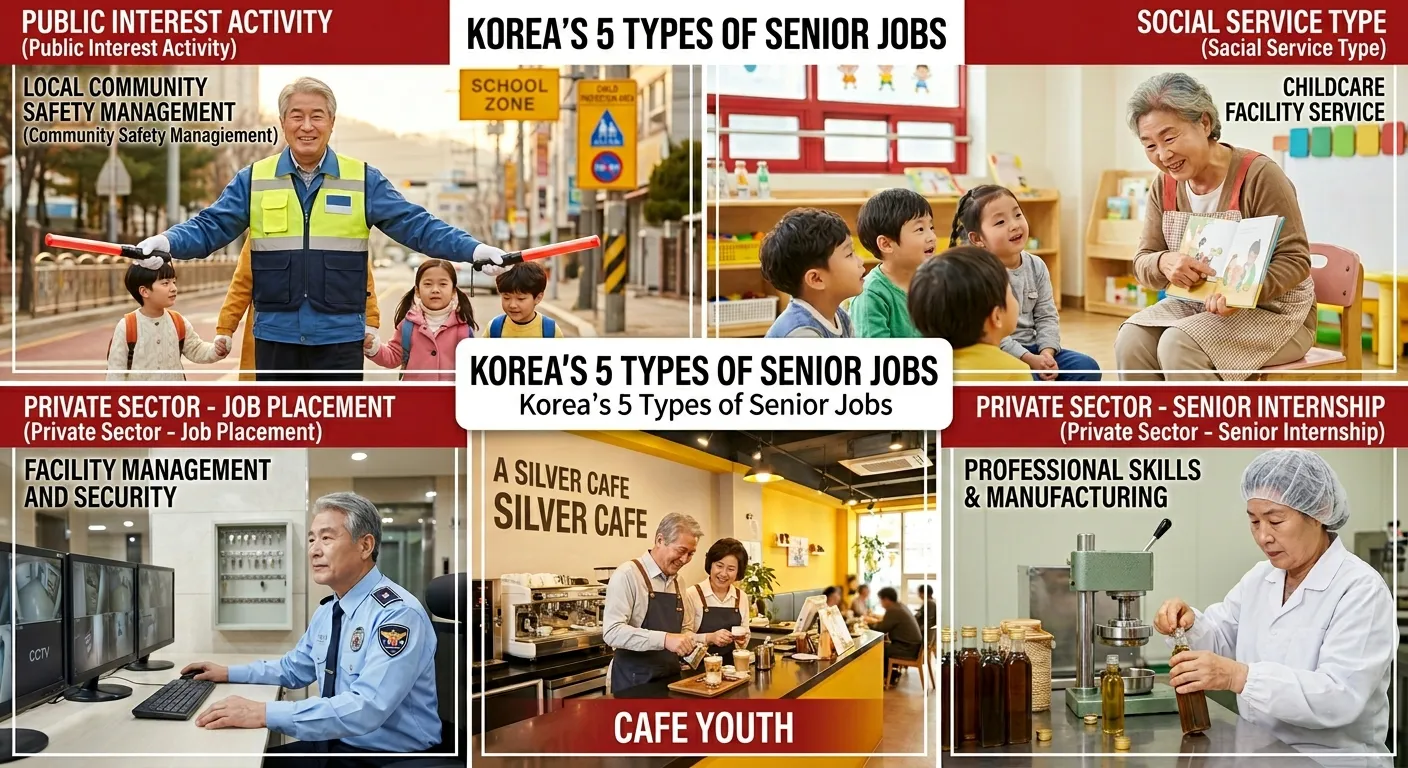
Public Benefit Activities (공익활동형)
The largest category by volume. Participants age 65+ who receive the Basic Pension can join with no special credentials — just good health and willingness to serve. Work includes elder-care visits (노노케어), school zone crossing guards, park cleanup, and meal delivery at senior centers. A "Priority Designated" category since 2026.
Social Service Jobs (사회서비스형)
Leverages seniors' professional experience in areas where community support is needed: childcare assistance, library support, public administration aid. The big 2026 addition is the "Kindergarten Senior Care" pilot — 500 positions for seniors who complete a 30-hour specialized training, deployed for morning and after-school care.
Market-Type / Community Enterprises (시장형)
Groups of seniors collectively run small businesses — silver cafes, laundry services, handicraft production, food manufacturing. Government funding seeds the venture; ongoing revenue sustains it. Age 60+ eligible. Pay varies with business performance, but successful operations can be quite lucrative.
Senior Internship (시니어인턴십)
The highest-paying option. The government subsidizes wages for private companies to hire seniors as formal employees. In 2026, 246,000 slots are available — about 21% of all positions — and 78% of seniors aged 60–69 (the "New Senior" generation) favor this track. It functions as a genuine re-employment bridge into the private sector.
Job Referral Track (취업알선형)
For seniors with specific certifications or prior work skills, regional agencies match them directly with private-sector employers. The process involves a 1:1 consultation, career assessment, and targeted placement. It takes longer than direct application but yields better-quality matches for skilled workers.
Watch These New 2026 Roles
Brand-new positions added this year include: Integrated Care Assistant, Food Bank "Just Give It" Manager, Safe Walk-Home Companion, and Kindergarten Senior Care Specialist (500 positions). The Kindergarten role is especially competitive — 30 hours of specialized training leads to compensation higher than the standard social service track, making it one of the most sought-after new positions.
Salary & Working Conditions Compared 📊
The question everyone wants answered first: how much do these jobs actually pay? The range is vast — from a modest ₩290,000 "activity stipend" to a ₩2.1M+ monthly salary in the private sector. Here is a clear side-by-side comparison reflecting 2026 minimum wage updates.
| Type | Monthly Hours | Monthly Pay | Social Insurance | Minimum Age | Notes |
|---|---|---|---|---|---|
| Public Benefit | 30 hrs | ~₩290,000 | Not enrolled | 65+ | Activity stipend (not wages) |
| Social Service | 60 hrs | ~₩761,000 | Enrolled | 65+ (60+ for some) | Includes weekly holiday pay |
| Market-Type | Year-round | Profit share | Enrolled | 60+ | Performance-linked |
| Senior Internship | Full / Part | ₩2.1M+ | Enrolled | 60+ | Private company employment |
| Job Referral | Varies | Negotiated | Enrolled | 60+ | Certification holders favored |
Important for Basic Pension recipients: The Public Benefit Activities stipend (~₩290,000) is classified as an "activity allowance," not employment income, so it has no impact on your Basic Pension amount. However, Social Service and Private Sector wages are treated as earned income and may trigger a partial reduction in your pension. Before enrolling, ask your local community welfare center to run a simulation for your specific household situation.
Who Can Apply — Eligibility & Priority Criteria 🎯
Applications are open to virtually everyone over 60 or 65 depending on the track. But selection is competitive — final spots are awarded based on a scoring matrix, so knowing where you rank matters.
Income & Assets
For Public Benefit Activities, lower "recognized income" scores give higher priority. Basic Pension recipient status directly affects selection ranking.
Household Composition
Bonus points are awarded for single-person elderly households and elderly couples living alone — reflecting the policy goal of fighting social isolation.
Training & Certifications
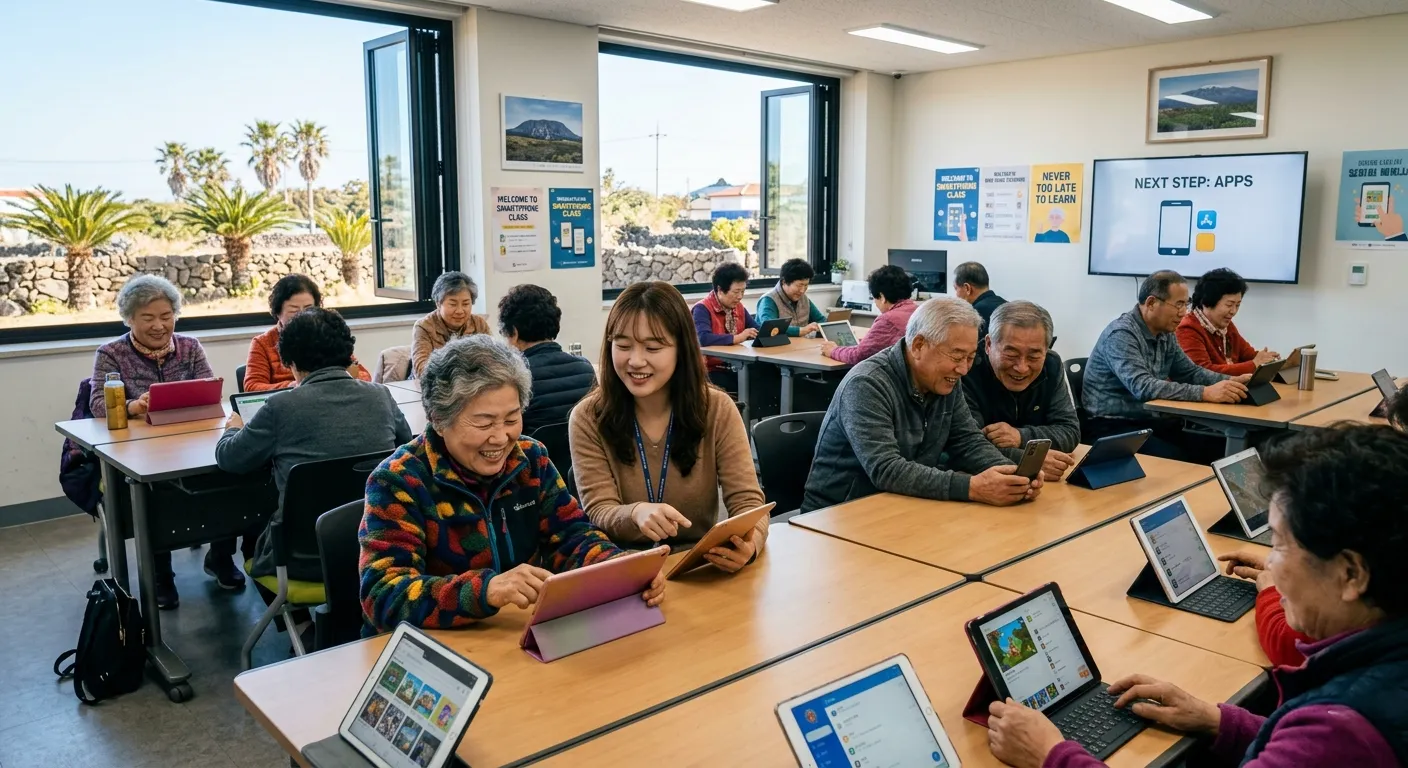
Completion of training courses from Korea Senior Human Resources Development Institute gives priority points. In 2026, digital literacy (smartphone, kiosk usage) has been added as a key scoring variable for social service and private-sector tracks.
Interview Performance
Social service and market-type positions weigh interview performance heavily. Demonstrated motivation, relevant experience, and physical readiness matter.
📋 Core Eligibility At a Glance
✅ Age Requirements & General Rules
- Public Benefit: age 65+ & Basic Pension recipient
- Social Service: age 65+ (some roles 60+)
- Market-Type / Community: age 60+
- Senior Internship / Job Referral: age 60+
- Non-pension recipients can still apply to private-sector tracks
- Multiple applications allowed; only one program at a time
- Double enrollment (active in two programs simultaneously) is prohibited
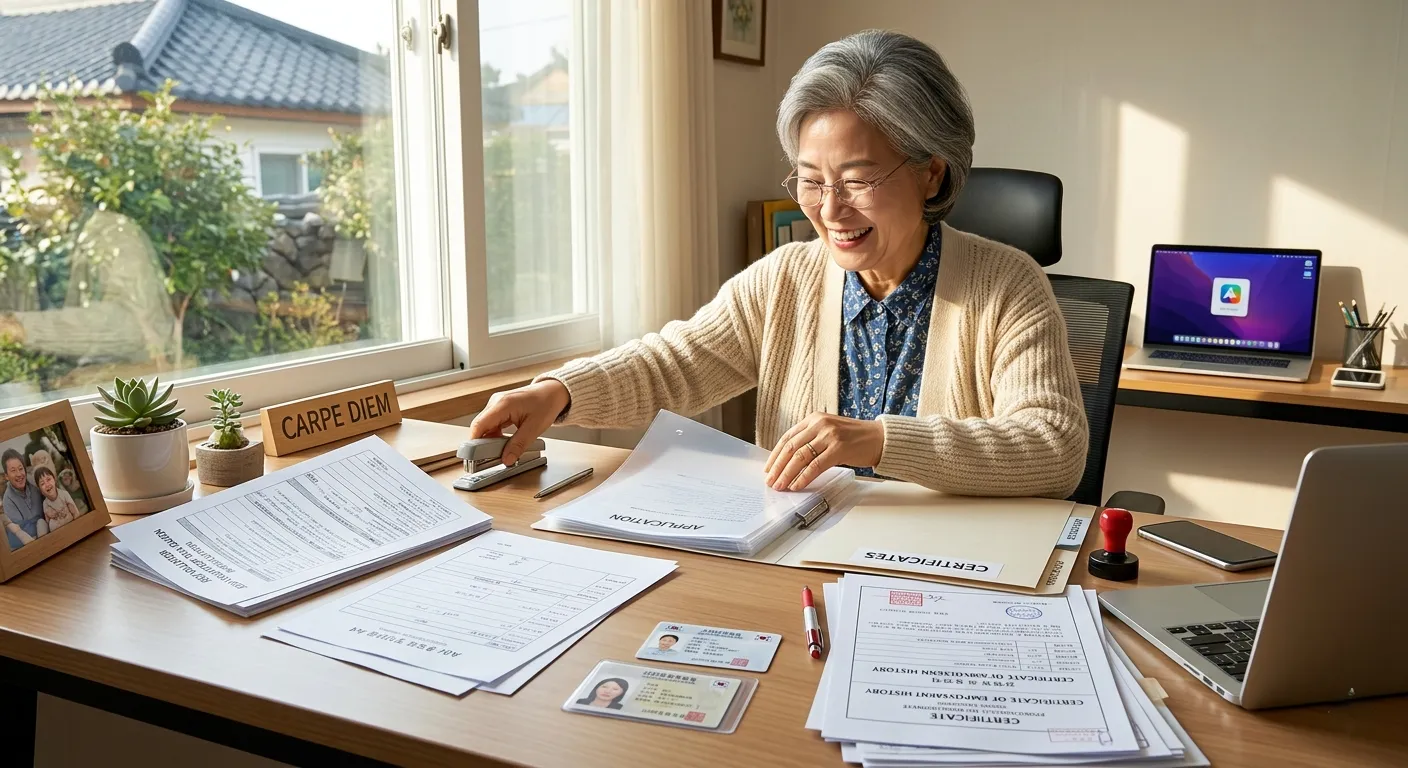
- ID card, resident registration, and relevant certificates required
From 2026, the "Priority Designated Jobs" — Senior Center meal service, Community Integrated Care support, and Elder-Elder Care (老老케어) — operate under the dedicated Senior Jobs Act with separate legal protections. Even if you miss the main recruitment window, these positions recruit continuously when vacancies arise.
How to Apply Step by Step 🖥️🚶
The main recruitment drive happens in November–December each year. If you miss it, private-sector tracks (Senior Internship, Job Referral) recruit year-round. Here's exactly how the process works, whether you prefer online or in-person.
-
1
Identify Your Track
Based on your age, health, Basic Pension status, certifications, and income needs, determine which of the five types suits you best. If uncertain, call the Senior Jobs hotline (☏ 1544-3388) and you'll be automatically connected to the nearest agency.
-
2
Check Listings on the Official Portal
Go to www.seniorro.or.kr (Senior Jobs Here portal). Enter your region and job type to see all current openings. The portal is also linked from bokjiro.go.kr (Welfare Gate) and government24. Note: the site is sometimes misspelled as "seniorro.or.kr여기요" in searches — both variants work.
-
3
Prepare Your Documents
Gather: resident registration certificate, photo ID, Basic Pension recipient certificate (if applicable), copies of relevant certificates, and health insurance card. For Senior Internship/Job Referral, also prepare a simple resume and self-introduction to speed up the matching session.
-
4
Submit Your Application
Apply either online through the Senior Jobs portal, or visit in person at your local Community Welfare Center (주민센터), Senior Club, Senior Welfare Center, or Korea Senior Association office. For Senior Internship, book a consultation appointment and attend a 1:1 session where an advisor matches you with employer candidates.
-
5
Selection Review & Notification
For the main recruitment cycle, candidates are ranked by the scoring matrix and notified individually by mid-December to early January. Private-sector tracks (Senior Internship) hold separate interviews; successful candidates sign a formal employment contract to start work.
-
6
Training & Placement
Selected participants complete safety, orientation, and job-specific training before being placed at a location that reflects their career background and preferences. Regional agency supervisors conduct periodic check-ins throughout the program.
📞 Ready to Start? Contact Information
Call the national Senior Jobs hotline and you'll be connected directly to the closest regional agency. Representatives can guide you through eligibility, documents, and available openings — all in one call.
Certifications & Training to Improve Selection Odds 🏆
When age, location, and Basic Pension status are equal among applicants, certifications and completed training make the difference. Since 2026, digital literacy training has become a major differentiator for social service and private-sector positions — applicants who can confidently use smartphones, kiosks, and basic office software score measurably higher.
Care Worker certificate + Family Care System = double benefit. Obtaining a Care Worker (요양보호사) license lets you care for your own family member (spouse, parent) while receiving government compensation under the "Family Care Program." The standard training curriculum was updated for 2026 — check the latest schedule before enrolling.
📱 Where to Access Free Training (2026)
🎓 Free & Low-Cost Training Resources
- Korea Senior Human Resources Development Institute (kordi.or.kr)
- Digital Village Training Centers (government-run)
- Local Senior Club vocational programs
- Senior Welfare Center continuing education
- Municipal Lifelong Learning Centers
- Ministry of Employment's National Learning Card (60+)
- Seoul 50+ Campus (Seoul residents)
- Gyeonggi Second-Life Support Centers
Real-World Reviews & Frequently Asked Questions 🗣️
Here's what actual participants across Korean online communities — senior café boards, open KakaoTalk chat rooms, and community forums — are saying about the program in 2026.
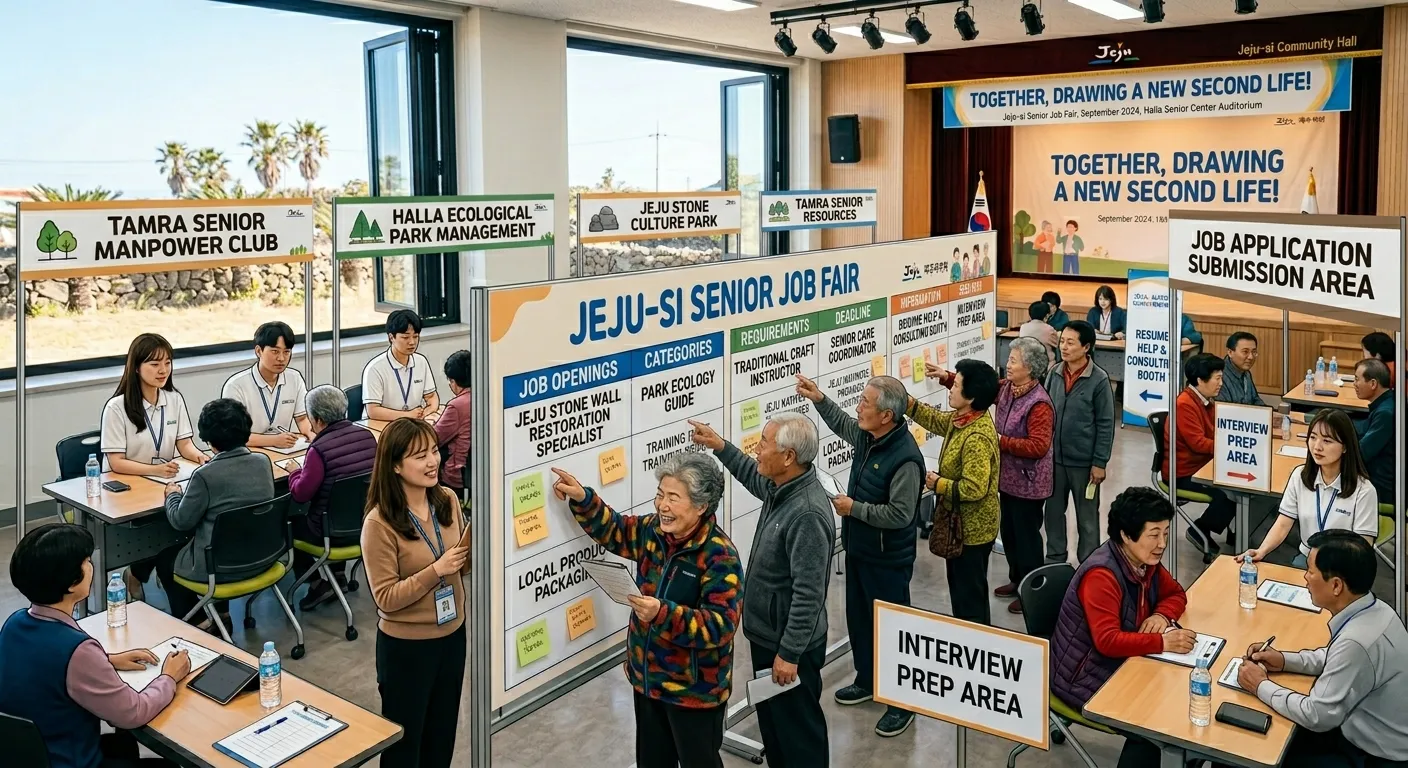
❓ Frequently Asked Questions
Your First Step Toward an Active Retirement 👣
Korea's senior job landscape in 2026 has moved far beyond "government handouts." 1.15 million positions — backed by ₩5 trillion and administered through 1,328 agencies — represent a genuine national commitment to recognizing that older Koreans have decades of expertise, community knowledge, and human warmth that younger society genuinely needs.
Whether it's the modest ₩290,000 monthly stipend from community service or the ₩2.1M+ salary from a private-sector Senior Internship, the real value isn't just financial. Research consistently shows that senior job participants report meaningfully better physical and mental health outcomes compared to non-participants. Having somewhere to go in the morning, people to talk to, and a task that matters — these things are hard to put a price on.
"Retirement wasn't the end. At 65, I got my Care Worker certificate. At 70, I still work four hours a day and I feel alive. Having somewhere to be every morning is the greatest gift I never expected."
— Social Service track participant interview, 2026 Senior Job Fair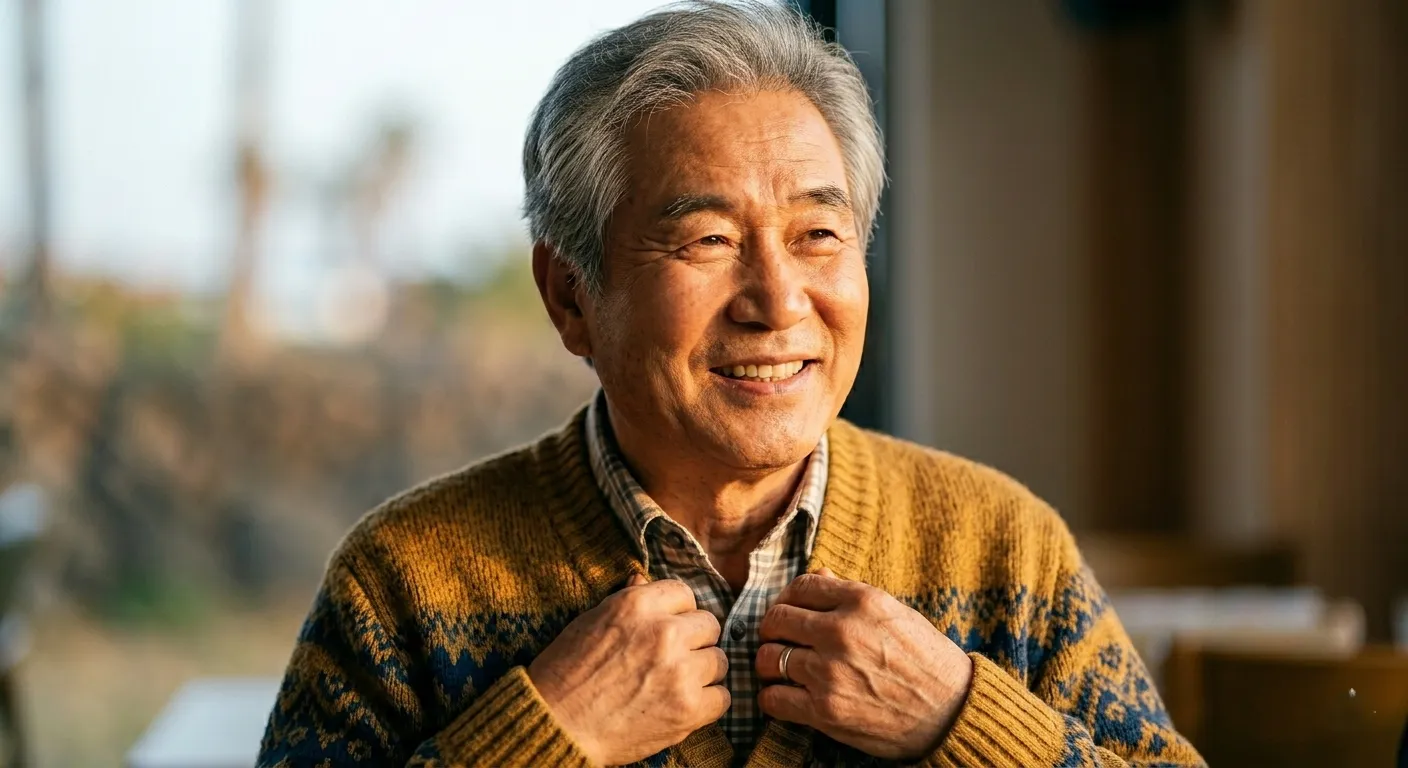
Key Takeaways from This Guide
① Korea's 2026 senior jobs: record 1.152 million positions, ~₩5 trillion budget.
② Pay ranges from ₩290K (Public Benefit) → ₩761K (Social Service) → ₩2.1M+ (Senior Internship).
③ To apply: visit seniorro.or.kr or call ☎ 1544-3388 to connect with your nearest agency.
④ A Care Worker certificate or completed digital literacy training boosts selection scores significantly.
⑤ Missed the main window? Private-sector tracks recruit year-round — 246,000 positions available continuously.
If you're 60 or older and wondering whether it's worth trying — it absolutely is. Call your nearest Senior Club or Community Welfare Center, take 20 minutes for a conversation, and let a counselor find something that fits. The program handles far more complexity than most people expect, and the right match is usually closer than you think. 💪