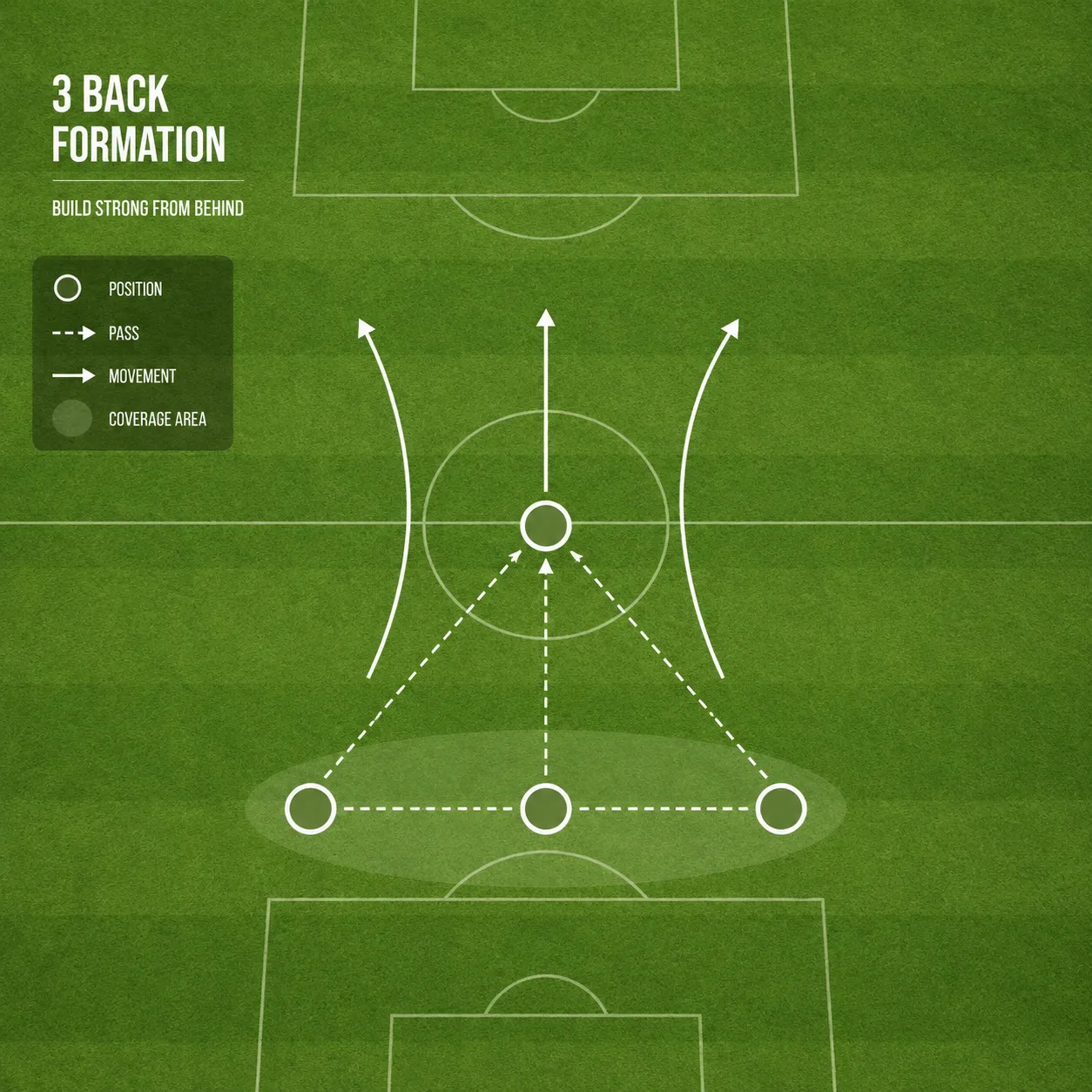
In our last post we covered Korea's shock loss to South Africa and the three-back controversy that followed — and it turned out a lot of readers had the same follow-up question: "wait, what exactly is a three-back?" It's one of those terms everyone in the comments throws around like it's obvious, but ask someone to actually explain it and most go quiet. So this post breaks down exactly what a three-back formation is, its real pros and cons, and the managers and nations who turned it into an art form. We'll cover everything from reading formation numbers to spotting a three-back falling apart in real time, and we'll close with a brief update on how Korea's World Cup run ultimately ended at the Round of 32 door. ⚽
DefinitionWhat Exactly Is a Three-Back?
A three-back (back three) lines up three central defenders directly in front of the goalkeeper, with two wing-backs handling the width by pushing up and down the flanks. The biggest difference from a standard back four is that "extra" defender. In a back four, the left and right fullbacks have to juggle defense and attack at the same time; in a three-back, the extra central defender frees up both wing-backs to push forward more freely and more often. The end result is a flexible structure where defending effectively uses five players, while attacking effectively recruits the wing-backs into the front line too. On paper it looks like simply adding one more defender, but in practice it's closer to rebalancing the entire team's attacking and defensive shape.
Spotting a three-back as a casual viewer is fairly straightforward. If the back line has three players standing shoulder to shoulder instead of four, and the two players at either end of that line cover an unusually large amount of ground, you're probably looking at a three-back. If those wide players sprint almost all the way to the touchline during attacks, looking more like wingers than defenders, that's a near-certain sign wing-backs are in play.
3-4-3
Wing-backs push almost as high as wingers — the most attacking variant.
3-4-2-1
One striker plus two attacking midfielders underneath — Korea's preferred shape.
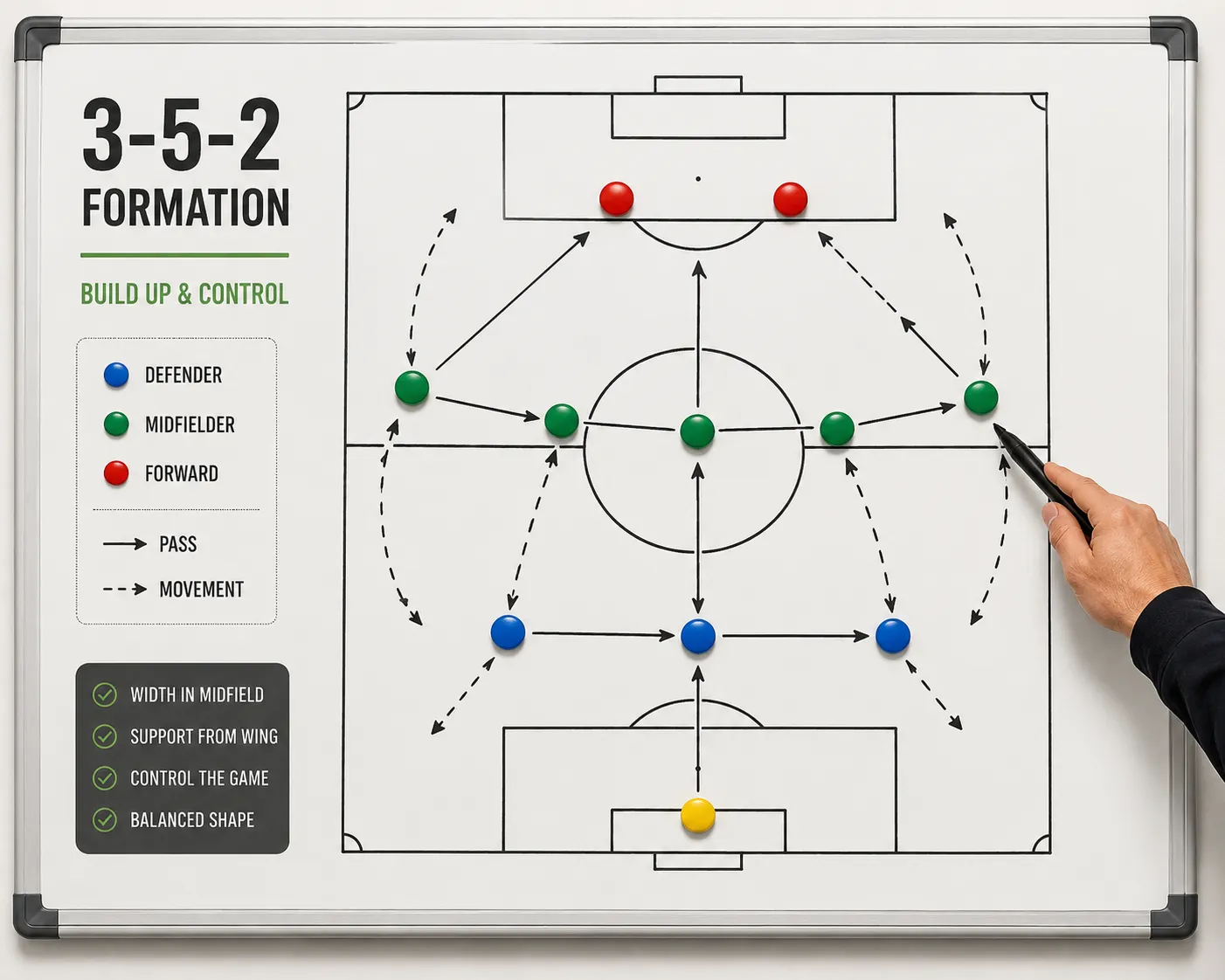
3-5-2
Conte's favorite — three central midfielders to control possession and defense at once.
5-3-2
Wing-backs sit almost as deep as fullbacks — the most defensive variant.
A good tactic isn't defined by the numbers on the team sheet, but by how the players actually move within them. – A common refrain among tactical analysts
The roots of the three-back go back further than you might think. Italy's "catenaccio" system, which dominated the 1960s and '70s, featured a "libero" (sweeper) stationed behind the back line, free to roam and cover gaps without a direct marking assignment — widely seen as the distant ancestor of today's three-back. West Germany's Franz Beckenbauer, around the same era, reinvented the libero from a purely defensive role into an "attacking libero" who pushed forward and joined the attack himself, elevating the position's status in the process. Over time, the libero role evolved further and the wing-back position properly emerged, eventually producing the shape we recognize as a three-back today. For what it's worth, "three-back" and "back three" are used interchangeably — you'll see both in tactical writing.
The three central defenders within a back three don't all play identical roles. Typically, the middle defender takes the most purely defensive "cover" role, scanning side to side, while the two on either side act more as man-marking "stoppers." Many teams also designate one of the three as a "ball-playing center-back" who drives the build-up — in which case that player's passing range effectively becomes the starting point for the whole team's attack. Antonio Conte's famous "BBC line" at Juventus (Barzagli–Bonucci–Chiellini) is often cited as the textbook example of this division of labor: Bonucci handled build-up and passing, Chiellini handled physicality and cover, and Barzagli handled pace and one-on-one marking — together forming a single, complete defensive unit. Interestingly, these three roles aren't fixed in stone; depending on the opponent's attacking pattern, marking assignments shift mid-game, and the stopper/cover roles often swap fluidly as a result. That's why the best back-three trios tend to be made up of defenders who can all cover for each other to some degree.
Reading Formation Numbers
Worth a quick detour here on how to read formation numbers. "3-4-2-1" groups the ten outfield players (everyone except the goalkeeper) starting from the back line forward. The first 3 is the three central defenders; the 4 that follows is the two wing-backs plus two central midfielders combined; the 2 after that is two attacking midfielders; and the final 1 is the lone striker up front. Just from the numbers, you can roughly guess whether a team stacks the midfield or the front line. The reason 3-4-3 and 5-3-2 look so different despite both technically being "three-back" systems comes down to exactly this — where those same ten players are distributed. As a rule of thumb, 3-5-2 packs five players into midfield for a possession edge, while 3-4-3 commits three players up front for more direct attacking threat — the numbers alone hint at a team's intentions.
Three-back hasn't always been equally popular. From the 1990s through the mid-2000s, back-four systems like the 4-4-2 and 4-3-3 dominated world football, and the three-back was largely dismissed as old-fashioned. The tide turned in the early 2010s, when Antonio Conte papered over the aging Bonucci-Chiellini partnership at Juventus by activating his wing-backs, riding it to an unbeaten Serie A title. From there, even Pep Guardiola began borrowing variations of back-three build-up shapes at Manchester City, and clubs across Europe started developing wing-back talent again, elevating the three-back from "outdated" to "a sophisticated option for the right situation." A system that not long ago looked museum-bound came roaring back to lift trophies again within a single generation.
| Position | Core Responsibility |
|---|---|
| Central Center-Back (Cover) | Final line of defense, scanning side to side to fill gaps |
| Left/Right Stopper | Direct man-marking on opposing forwards |
| Ball-Playing Center-Back | Often one of the three; the starting point of build-up |
| Wing-Back | Covers the flank defensively, provides winger-like width in attack |
| Central Midfielders (2-3) | Balances possession and defensive transitions |
Wing-Back vs. Fullback: What's the Difference?
These two positions get mixed up constantly, but the center of gravity for each role is genuinely different. A fullback in a back four is primarily a defender, with attacking contribution as a bonus. A wing-back in a three-back, by contrast, typically starts from a higher position and carries roughly the same attacking weight as a winger. That's exactly why so many wing-backs are converted ex-wingers. Their defensive ground to cover is wider than a fullback's, but the attacking threat they generate is correspondingly bigger too — that trade-off is the whole point of the position. The "back" in the name makes it sound purely defensive, but in practice, "half-winger" might be the more accurate label.
Shape-Shifting Mid-Match
Three-back teams don't necessarily hold the same shape for all 90 minutes either. A common pattern: when leading, wing-backs drop into something closer to a back five to shut the game down; when chasing an equalizer or winner late on, a center-back gets pushed into midfield or subbed off entirely, converting to a back four or even a back two to add attacking numbers. Teams that execute this switch smoothly are praised for being able to change outfits with the same group of players depending on the situation. Teams that never attempt the switch, even once, leave viewers wondering "why didn't they change anything?" — and that question, once it piles up, turns straight into criticism.
| Term | Meaning |
|---|---|
| Libero / Sweeper | Traditional free role behind the back line, covering open space |
| Inverted Wing-Back | A wing-back who tucks into central half-spaces instead of staying wide |
| Hybrid Back Three | Nominally a back four that forms a temporary back three during build-up |
| Sweeper-Keeper | A goalkeeper who actively joins build-up play with their feet |
| Half-Space | The pocket between center and flank, prime real estate for receiving passes |
ProsFour Advantages of a Three-Back
The three-back's staying power comes down to one thing: run properly, it creates more options than a back four on both sides of the ball.
Stronger Central Defense
Against a lone striker, it's a 3-on-1; against two forwards, a 3-on-2. That cushion is especially valuable against tall, physical target men.
Wide Overloads
When wing-backs push high, they effectively double as wingers, creating numerical superiority out wide and more crossing opportunities.
More Build-Up Options
The extra center-back means more passing lanes under pressure, freeing one player to focus purely on progressive passing.
Better Counter-Attack Cover
More bodies centrally means more cover behind the ball when possession is lost, reducing exposure to fast transitions.
Put all four together and it boils down to one idea: a three-back almost always wins the numbers game. You get a 3-on-2 edge centrally while still pushing two wing-backs forward to cross from positions a fullback could never reach. In build-up, even against a pressing front two, one center-back is always left free, keeping the ball moving forward without interruption. Chelsea's 2016-17 season under Conte is the textbook case — Kanté and Matić controlling the middle while Moses and Alonso relentlessly bombed up and down the flanks, all four advantages firing at once.
Attacking Three-Back
- Wing-backs used almost as wingers (3-4-3 family)
- Center-backs push forward into build-up too
- Example: Conte's Chelsea, Inter Milan
Defensive Three-Back (Back Five)
- Wing-backs stay close to the back line (5-3-2 family)
- Minimizing goals conceded is priority one
- Example: Underdogs grinding out a knockout run
When a Three-Back Shines Brightest
Not every match suits a three-back equally. It pays off most clearly against a lone-striker opponent, where the 3-on-1 edge is guaranteed. Against two or three forwards, that edge shrinks, putting more weight on midfield numbers and how quickly wing-backs recover defensively. It's also a smart time-management tool once you're already a goal or more ahead — shifting into a back five to lock the game down. The opposite situation — holding the same shape while behind — is exactly the dangerous pattern this whole article keeps coming back to.
ConsFour Disadvantages of a Three-Back
None of those advantages come free, of course. The three-back carries clear weaknesses of its own — and Korea's South Africa match, covered in our last post, was a case where every single one of them surfaced at once.
Brutal Wing-Back Workload
Covering both ends of the pitch solo demands far more running than a standard fullback role. Once stamina fades, the whole system wobbles.
Exposed Wide Channels
If a wing-back is caught upfield during a fast counter, the space between center-back and touchline opens up completely.
Demands High Tactical IQ
Wing-backs need to read attack and defense simultaneously. Without the right player, the entire formation loses its point.
Dangerous Without Flexibility
Holding the shape while behind turns it into the least efficient formation possible: plenty of defenders, but no goals.
Dig into these and they all trace back to a single root problem: asking one player — the wing-back — to do far too much. Once a tired wing-back stops pushing forward late in a match, width disappears out wide, and that same player now has to recover at fullback speed on defense, a speed they no longer have. Worse, if possession is lost exactly while a wing-back is caught high up the pitch, a lone center-back is left to handle the entire vacated flank alone — about as bad as it gets. Korea's match against South Africa followed this exact pattern: as the wing-backs' work rate dropped in the second half, width on the flanks vanished, and with an equalizer desperately needed, nobody pushed to change shape, and the team simply got dragged along by events. In a single match, all four weaknesses of the three-back showed up in almost textbook fashion.
This weakness shows up as a real cost in the transfer market too. Genuine wing-back talent — players who can defend and attack at a high level simultaneously — is rare. That's why so many clubs, following Conte's lead, experiment with converting existing wingers or wide midfielders into wing-backs, and that conversion doesn't always work. A player with great attacking instincts but shaky defensive positioning can end up making the flank even leakier as a wing-back than he would as a winger. Wanting to play a three-back and actually being able to run one well are two very different things — finding and developing the right personnel takes real time and money.
Spotting a three-back coming apart in real time is easier than it sounds. If a wing-back keeps tucking inward during attacks, playing almost like a midfielder, that's usually a sign of fatigue and a quiet surrender of the flank. If a single center-back keeps getting dragged all the way to his own touchline on the counter, flailing to recover, that's a clear sign the formation's weakness is already being exposed. Once you know what to look for, you start reading the flow of a match in a much richer way than just watching for goals.
Back Four
- Fullbacks juggle defense and attack
- Generally easier to keep balanced
- Lower dependency on any single player
Back Three
- Extra center-back, dedicated wing-backs out wide
- Done well, wins on both ends; done poorly, loses on both
- Heavy reliance on wing-back quality and tactical IQ
Key Takeaway
A three-back isn't inherently good or bad. It only shows its true power as an "advanced" tactic when a team has enough capable wing-backs and the flexibility to change shape depending on the situation.
ManagersThe Managers Who Turned It Into Art
A three-back isn't a system just any manager can pick up and succeed with. It demands an eye for spotting wing-back talent, precise design of how the center-backs divide labor, and above all, the flexibility to change shape depending on the situation. Historically, only a handful of managers have truly mastered it.
The name synonymous with the three-back. Won an unbeaten Serie A title at Juventus with a 3-5-2, then converted former winger Victor Moses into a wing-back at Chelsea on the way to a Premier League title, and repeated the trick to win Serie A again with Inter Milan. His signature move is loading the wing-back slot with attacking talent rather than defensive specialists to maximize the flanks. It's said that wherever Conte goes, the first job is always "find the wing-back" — his three-back effectively starts with discovering that one player.
Pulled out a 3-5-2 at the 2018 Russia World Cup and dragged England to a semifinal for the first time in 28 years. He followed up with a 3-4-3 at Euro 2020, reaching the nation's first-ever major tournament final. Widely cited as the case study for using a three-back to bring structure to a team overloaded with attacking stars. He was also known for using the extra center-backs as additional attacking weapons on set pieces.
Ran a near-5-3-2 at the 2014 Brazil World Cup and rode it to third place. At the 2022 Qatar World Cup, a 3-4-1-2 carried the Dutch to the quarterfinals. Both runs are credited to using the three-back's defensive stability to paper over gaps in the squad — a case of a veteran manager's pragmatism pairing well with a fundamentally conservative system.
Immediately flipped Chelsea's back four into a 3-4-2-1 upon arrival, stabilized the team, and rode it all the way to the 2021 Champions League title. He inherited the wing-back framework Conte had built and added a faster transition tempo on top of it.
Belgium had a golden generation — De Bruyne, Hazard, and more — but struggled to find balance until Martínez introduced a 3-4-3, which delivered the nation's best-ever World Cup finish, third place in 2018. A clear example of how a three-back can unlock an already talent-rich squad.
Took a host nation widely written off as overmatched and armed them with a pragmatic near-5-2-3, riding it to the 2018 World Cup quarterfinals. A go-to example of an "underdog" three-back built on organization rather than star power.
Interestingly, even Conte doesn't always reach for a three-back. At Napoli more recently, he leaned on a deep central-midfield pool to run a back-four-based 4-3-3 instead, and still won the league. What ties these managers together isn't "insisting on a three-back" — it's accurately judging whether their available personnel calls for one in the first place. Southgate and Martínez reached for it to organize too many stars; Van Gaal and Cherchesov reached for it to paper over a thinner squad. Same tactic, completely different motivations depending on the team.
Conte vs. Southgate: Same Numbers, Different Philosophy
Both Conte and Southgate favored 3-5-2-style systems, but the underlying philosophy couldn't have been more different. Conte loaded the wing-back slots with attacking talent to win individual battles out wide — an "attacking three-back." Southgate, by contrast, prioritized keeping his glut of attacking stars from stepping on each other's toes, running a more cautious, balance-first version. Same formation on paper, completely different team identity depending on the manager's philosophy. If you want a rough metaphor: Conte's three-back is closer to a spear, Southgate's closer to a shield.
A Three-Back Highlight Reel Moment: 2018 Russia Semifinal
One of the three-back's most dramatic showcases is widely considered England's run to the 2018 Russia World Cup semifinal — their first in 28 years, since 1990 — built on Southgate's 3-5-2. Build-up starting from the goalkeeper, center-backs driving forward with the ball, and wing-backs joining in on set pieces for a genuinely three-dimensional attack: that England side is often held up as a near-perfect demonstration of everything a three-back can offer.
Stacked together, a pattern emerges in how these managers actually used the three-back. Almost every one of them reached for it first to paper over a weakness in their existing squad — Conte for a shaky Juventus defense, Southgate for an unorganized galaxy of stars, Van Gaal and Cherchesov for squads that were simply short on talent. And in each case, once that cover-up stopped being a stopgap and became the team's actual identity, it turned into a result that made history. What started as a way to hide a weakness ended up becoming the strength itself.
TrendsThree-Back and Modern Football Trends
One reason the three-back has come back into vogue lately is "press resistance." When an opponent presses hard with two forwards, having three center-backs guarantees that at least one of them is always left unmarked. That free center-back driving forward with the ball, like an auxiliary midfielder, has become a routine sight in modern football. As analytics has pushed possession and pass-completion data to the forefront, the structural advantage a three-back offers under pressure — simply having more passing lanes available — has been reassessed and rehabilitated. Even when an opponent's front two pin down both outer center-backs, the middle one is almost always left unmarked, turning that player into a built-in cheat code for build-up.
Goalkeeping has evolved in lockstep with the three-back's revival. The rise of "sweeper-keepers" — goalkeepers who join build-up play with genuine footwork rather than just shot-stopping — means a back three plus keeper can now function as four real passing options together. Once the keeper joins the build-up, an opponent's two-man press effectively has to account for four players at once, and the back-three side nearly always wins that numbers battle. Several Bundesliga clubs have been particularly aggressive in experimenting with this approach. A goalkeeper acting as a virtual fourth center-back in the passing triangle would have looked bizarre a decade ago; today it's a fairly familiar sight.
Youth development has shifted accordingly. Where wingers and fullbacks were once developed as entirely separate tracks, more clubs are now raising "hybrid" wide players from the start who can handle both roles. The growing consensus is that for a three-back to remain a viable option whenever a club needs it, having a pool of these multi-positional wide players is really what determines whether it's possible at all.
In PracticeThree-Back Build-Up, Step by Step
It sounds complicated described in the abstract, but break down how a three-back team actually moves the ball forward and it's simpler than it seems. Follow this sequence and three-back matches become much easier to read.
- Step 1 (Start): The goalkeeper and central center-back exchange passes at the deepest line, scanning the opponent's first press.
- Step 2 (Distribution): The stopper or ball-playing center-back on the side with less pressure picks up the ball and looks for space to advance.
- Step 3 (Creating Width): The wing-back spreads wide near the touchline to create space, while a central midfielder positions in the half-space to receive.
- Step 4 (Finish): A wing-back's cross or a central midfielder's through-ball connects with the striker for a clear chance.
If any single step breaks down, the whole sequence stalls. If the center-back gets stuck under pressure at Step 2, the three-back's biggest advantage — extra passing options — disappears. If the wing-back is exhausted by Step 4, even a flawless build-up goes nowhere. Whether a three-back is "working" or "not working" in a given match basically comes down to how many of these four steps connect smoothly.
The most common breakdown in practice happens at Step 3. A wing-back pushes forward too early to create width, and by the time the center-back is ready to pass, the wing-back is either too far away or has lost the right angle to receive. The best three-back teams sync the wing-back's forward run with the center-back's passing window almost perfectly — which is exactly why club teams, who train together every week, tend to run a three-back far more reliably than national teams do.
NationsNations That Use It Well
Just as in club football, the three-back shows up consistently at the international level. Unlike clubs, though, national teams have drastically less time to train together, so running a three-back without chaos requires a squad that already understands it deeply, with personnel suited to the system.
- Italy: The birthplace of catenaccio carries the deepest three-back tradition of all. Under Conte, Italy used it to knock out strong opponents en route to the Euro 2016 quarterfinals. Serie A itself is widely regarded as the European league most likely to feature a three-back on any given matchday, meaning Italian defenders often grow up steeped in the system from a young age.
- England: Under Gareth Southgate, England rotated between 3-5-2 and 3-4-3 to reach a World Cup semifinal and a Euro final. A textbook example of using a three-back to bring balance to a squad overloaded with stars.
- Netherlands: A departure from the Total Football tradition, but Van Gaal's pragmatic three-back delivered consistent World Cup results.
- Belgium: A golden generation that couldn't find balance, until Martínez's 3-4-3 unlocked the nation's best-ever World Cup finish (third place, 2018).
- Germany: Traditionally back-four territory, but Löw experimented with a 3-4-3 in select matches, and Flick and Nagelsmann have both pulled out back-three variants situationally since.
- Croatia: A deep, well-organized midfield lets them shift between three-back and four-back as needed — a big reason a country this small punches consistently above its weight at World Cups.
- Korea: Hong Myung-bo's side leaned on a 3-4-3 as its primary shape at this World Cup too. As covered in our last post, though, holding a shape and actually managing it situationally turned out to be two very different things.
It's worth examining why the three-back shows up more often as "the underdog's weapon" at international level than at club level. Clubs have the luxury of training together weekly, fine-tuning intricate patterns; national teams, with their short camps, struggle to teach complex positional play from scratch. A three-back becomes an efficient way to instill a relatively simple, stable defensive structure quickly. Russia's Cherchesov and the Netherlands' Van Gaal share exactly this in common — both reached for the three-back as the fastest way to unify a squad under serious time pressure.
Club football often reaches for the three-back for the opposite reason. With weekly training, there's room to layer in far more intricate positional rotations than a national team ever could, which is why managers like Conte or Gasperini can pack a level of detail into their three-back that simply isn't feasible on a national-team timeline. The interesting upshot: the same formation tends to function as "a quick, simple fix" at international level, and as "an elaborate, attacking weapon" at club level.
Ultimately, what the nations that run a three-back well have in common comes down to one thing: they give wing-backs a clearly defined role in training, and they actually rehearse switching to a back four or back five mid-match depending on the scoreline. The hand running the system matters far more than the numbers on the formation sheet.
CountersHow Do Opponents Attack a Three-Back?
Teams that face a three-back have their own playbook for attacking it. The most common approach is running two forwards to drag one of the stoppers out of position, then sending a winger or attacking midfielder into the space he vacates. Another is timing a fast counter-attack for exactly the moment a wing-back is caught upfield, exploiting the open channel behind him — precisely the pattern that beat Korea against South Africa. A third option is simply pressing the wing-back one-on-one to deny him the chance to advance at all; without forward movement from the wing-back, a three-back instantly collapses into a cramped, toothless back five.
More sophisticated teams run an "overload one side" strategy: pile players onto one flank to drag the entire back-three line over, then switch the play rapidly to attack the now-empty opposite flank. Three-backs, with their numbers advantage centrally, tend to take slightly longer to shift the whole line side to side compared to a back four, making them especially vulnerable to these switches of play. Some teams also use a "false winger" to pull a wing-back inward, then send an overlapping fullback into the vacated space — a positional swap designed purely to confuse a three-back's coverage.
Three-back teams have their own counters to all of this. The most basic is a habit where a central midfielder temporarily covers the space a forward-pushing wing-back leaves behind — a kind of defensive "shift." Goalkeepers can also help by operating from a slightly higher starting position to cover the space behind the back line, meaningfully reducing the risk of a single fast break ending the match. In the end, the real battle in a three-back matchup usually isn't decided by flashy attacking sequences, but by which side executes these small, unglamorous covering movements more consistently.
Three-backs also carry a distinct edge on set pieces. Having one extra central defender on the pitch at all times means one extra body available to compete for headers when defending an opponent's corner or free kick. Flip it around, and when the three-back team wins a set piece of its own, that same extra defender becomes an extra attacking body in the box, creating a numbers edge in the scramble. Part of why Southgate's England became so well known for scoring off set pieces is widely credited to making full use of exactly this "spare man" effect that comes naturally with a three-back structure.
Would a Three-Back Suit Your Team? A 3-Second Checklist
① Do you have at least two players — ideally converted wingers — with the stamina and two-way skill set to play wing-back? ② Can at least one of your center-backs reliably start attacks with their passing? ③ Has the team actually practiced switching to a back four the moment the scoreline changes? If you can't confidently answer yes to all three, a three-back is probably premature.
FAQFrequently Asked Questions
Q. Is a three-back basically the same thing as a back five?
The personnel on the pitch can look similar, but the intent differs. A three-back assumes the wing-backs will push forward and join the attack; a back five is set up from the start to sit deeper and minimize goals conceded. Same five bodies defensively, but you can tell the difference by how high the line sits and how aggressively those wide players move during normal play.
Q. Does a three-back require a specific type of player?
Yes. Wing-backs are the most critical piece — players need real stamina and a genuine two-way football brain, which is why converted former wingers (Conte's Moses and Perišić are classic examples) show up so often in the role. Center-backs need more than just defending ability too; at least one of the three needs comfortable enough passing to anchor the build-up, or the whole system falls flat.
Q. Will Korea keep using a three-back going forward?
Nothing has been officially confirmed. Given how much criticism centered on the failure to adapt the shape in-game rather than the formation choice itself, there's speculation that the next cycle could bring changes to how the system is run, even if the formation stays the same.
Q. Do club football and international football use the three-back differently?
Yes. Clubs can train weekly and fine-tune elaborate patterns; national teams, with short camps, tend to run simpler, more immediately applicable versions of a three-back. That's why an international team's three-back may look less flashy than a club's, but can still be highly effective purely through organization and discipline.
Q. Does running a three-back automatically mean more defensive football?
Not at all. Used aggressively through the wing-backs, it can actually produce more attacking football than a back four. Conte's and Martínez's examples show a three-back is more often a balanced system that pairs defensive solidity with maximized wide attacking threat. The defensive reputation really only applies when a team drops the wing-backs into a back-five shape.
Q. Can a team switch between a three-back and a back four within the same match?
Yes, and plenty of top managers do exactly that. A center-back drops to fullback position or pushes into midfield depending on the situation, letting the same group of players move between a back three and back four as the match flow demands. That kind of flexibility is, frankly, the single point this entire article keeps circling back to.
Q. Can a back-four team look like a three-back sometimes?
Yes — Pep Guardiola's Manchester City is the prime example. Nominally a back four, but during build-up one fullback tucks inside to stand almost like a midfielder, and the two center-backs plus that fullback momentarily form a back-three-like line. This "hybrid back three" starts life as a back four but borrows the three-back's advantages purely during the ball-progression phase — a thoroughly modern compromise.
Q. Can youth or amateur teams use a three-back too?
In theory yes, but with caution. The stamina and decision-making demanded of a wing-back is difficult even for experienced professionals, so introducing it before players have solid fundamentals can backfire badly, leaving the flanks completely exposed. It's usually safer to get comfortable running a back four first, then introduce a three-back gradually once a genuine wing-back candidate — with the stamina and judgment to match — emerges.
UpdateToday's Three-Back Watch: The Round of 32 Begins
As of today, June 30, the 2026 World Cup has already moved into the Round of 32, which kicked off yesterday, June 29. Unlike the group stage, everything from here is single-elimination — lose, and you go home. That makes the in-game flexibility this entire article has emphasized more important than ever. The opening fixture was a fitting one: co-host Canada against South Africa, the two nations both reaching a World Cup knockout stage for the first time in their history.
One fixture today lines up almost perfectly with this article's subject: the Netherlands face Morocco in the Round of 32. As covered earlier in the nations section, the Netherlands have a long pedigree of pragmatic back-three and back-five systems dating back to the Van Gaal era, consistently squeezing results out of World Cup tournaments with it. Whether they can show the same situational flexibility in a single-elimination setting is one of the things worth watching closely today. Brazil and Japan also meet on the same day, making for a stacked opening slate of Round of 32 fixtures.
From here on, the pros and cons covered throughout this piece are likely to show up in far more dramatic fashion. In the group stage, a bad performance could still be salvaged in the next match; from the Round of 32 onward, that safety net disappears entirely. Any team running a three-back system is about to face its most unforgiving test yet of whether to hold the shape — or change it.
UpdateSo What Happened to Korea? A Brief Update
Following the South Africa match covered in our last post, Korea's tournament has now officially ended. Having dropped to third in their group, Korea was waiting on a wildcard spot reserved for the top 8 of the 12 group third-place finishers — but on June 28, Democratic Republic of the Congo's come-from-behind 3-1 win over Uzbekistan in the deciding Group K match eliminated any remaining path to the Round of 32. Korea closed the tournament at 1 win, 2 losses (3 points, -1 goal difference), finishing 34th overall among all 48 participating nations once the third-place rankings settled, with the group-stage exit now officially confirmed.
| Final Record | 3rd in Group A (1W-0D-2L, 3 points) |
| Elimination Confirmed | June 28, 2026 |
| Final Overall Ranking (of 48) | 34th |
| Group-Stage Exits, All-Time | 9th in history; first since 2018 Russia |
| Hong Myung-bo | His second group-stage exit, after 2014 Brazil |
It's Korea's first group-stage exit since the 2018 Russia World Cup, eight years ago, and the second time Hong Myung-bo himself has overseen this exact outcome, having also presided over the 2014 Brazil exit. Former captain Park Ji-sung called the result a miserable outcome, arguing that a decade's worth of lessons had simply been forgotten all over again. For many fans, the quiet ending to what's widely seen as Son Heung-min's last World Cup added an extra layer of disappointment. The elimination has also reignited broader calls to re-examine how the national team — and the federation overseeing it — is run going forward.
Final Word: There's No Single Right Answer
Three-back or back four, there's no absolute right answer in tactics. Conte's three-back and Korea's three-back produced opposite outcomes for exactly the same reason: whether the choice fit the available personnel, and whether it was managed with enough flexibility once the match was underway.
| Category | Summary |
|---|---|
| Basic Structure | 3 center-backs + 2 wing-backs + midfield/attack |
| Common Variants | 3-4-3, 3-4-2-1, 3-5-2, 5-3-2 |
| Key Advantages | Central solidity, wide overloads, build-up options, counter cover |
| Key Disadvantages | Wing-back fatigue, exposed flanks, high IQ demands, danger without flexibility |
| Notable Managers | Conte, Southgate, Van Gaal, Tuchel, Martínez, Cherchesov |
| Notable Nations | Italy, England, Netherlands, Belgium, Croatia |
Next time you see a team trot out a three-back, it's worth recalling the pros, cons, and case studies covered here. Watch how high the wing-backs are positioned, which center-back is driving the build-up, and — above all — whether the team shows any willingness to change shape once it falls behind. Pay attention to those details and the match will almost certainly become more interesting to watch. Once you realize the exact same formation can look like a completely different team depending on the opponent, the scoreline, and squad fitness on a given day, you'll find your eye for the game has sharpened a notch. Thanks for reading, and we'll see you in the next breakdown! 🙌