Tuesday morning, May 13, 2026. Microsoft sent layoff notices to 6,000 employees across the globe. In Washington State alone, 2,000 people packed their desks — and a startling 40% of them were software engineers. That same day, CEO Satya Nadella told the world that AI now writes up to 30% of code on some internal projects. The developer community went quiet. Two questions remain: Are you one of the 30% being displaced — or are you the one directing the AI?
1. Seismic Shift: The Cold Hard Numbers 📊
It's tempting to treat "AI will replace developers" as distant speculation. The data from 2026, however, makes it uncomfortably clear that the future is already underway. Let's set aside emotion for a moment and look at what the numbers actually say.
Microsoft isn't the only one. Amazon eliminated 14,000 corporate roles in late 2026, and Salesforce CEO Marc Benioff declared AI now handles half the company's work — backing it up by cutting 4,000 customer support roles. Challenger, Gray & Christmas tallied nearly 55,000 job cuts in 2026 directly attributed to AI, out of 1.17 million total layoffs — the highest since the 2020 pandemic.
Even more striking: SignalFire's report — analyzing career data from over 650 million LinkedIn profiles — found a 25% decline in new-graduate hiring at major tech firms including Meta, Microsoft, and Google. Stanford's Digital Economy Lab, using ADP payroll data, confirmed early-career developer employment fell nearly 20% from its late-2022 peak by mid-2026.
Anthropic CEO Dario Amodei went further, warning that AI could eliminate half of all entry-level white-collar jobs within one to five years, potentially pushing unemployment to 10–20%. In a development that would have been unthinkable five years ago, computer science graduates are now facing higher unemployment rates than philosophy majors.
But is this pure doom? Not entirely. In the same quarter Microsoft laid off 6,000, it was aggressively hiring for Azure AI infrastructure, GitHub Copilot product teams, and Enterprise AI sales engineering roles. Total headcount ended approximately flat — the composition shifted, not the total count. Reading the direction of that shift is the most important skill a developer can develop in 2026.
Software engineers writing code are the canary in the coal mine for AI job disruption. Every other industry will follow the same path.
— Paul Roetzer, Marketing AI Institute (May 2026)2. Which Developer Are You? At-Risk vs. AI-Proof 🔍
As the AI tide rises, the developer population splits sharply into two camps. Dropping the comforting illusions and honestly assessing where you stand is survival step one. The comparison below reflects real trends being observed across the industry right now.
🔴 High AI-Replacement Risk
- Repetitive CRUD API development
- Boilerplate code generation
- Basic UI component assembly
- Writing simple unit tests
- Implementing predefined specs verbatim
- Simple data pipeline connections
- Language-to-language porting
- Documentation and code comments
- Drafting code review feedback
- Single-stack specialists with no breadth
🟢 Durable Value in the AI Era
- Full system architecture design
- Complex domain business logic
- Legacy system integration & migration
- AI-generated code audit and security review
- Interpreting ambiguous requirements
- Performance bottleneck diagnosis
- Technical leadership across teams
- Communicating technical trade-offs to stakeholders
- AI agent orchestration
- Domain expertise fused with coding
Notice the pattern? The survivable work shares a common thread: human judgment that AI cannot yet replicate. Interpreting vague requirements, understanding team dynamics, making technology decisions anchored to business value. AI is remarkable at responding to "write this code" — but "how should we technically solve this business problem?" still absolutely requires a human in the loop.
A word on the junior developer crisis narrative: some observers argue that if AI eliminates entry-level roles, there will be no path to growing senior engineers, ultimately collapsing the whole pipeline. It's a fair concern. Even GitHub Copilot power users advise: "treat Copilot like a junior pair programmer — review its logic, edge cases, and security assumptions." Using AI well requires understanding code. Blindly deploying AI-generated code you don't understand is planting a time bomb.
Key Insight
AI is replacing the ability to type code. It has not replaced the ability to decide what to build and why. Your value lies not in how fast you type but in how clearly you think. Cultivating that judgment is the core of survival.
3. The 2026 Essential AI Coding Tool Breakdown 🛠️
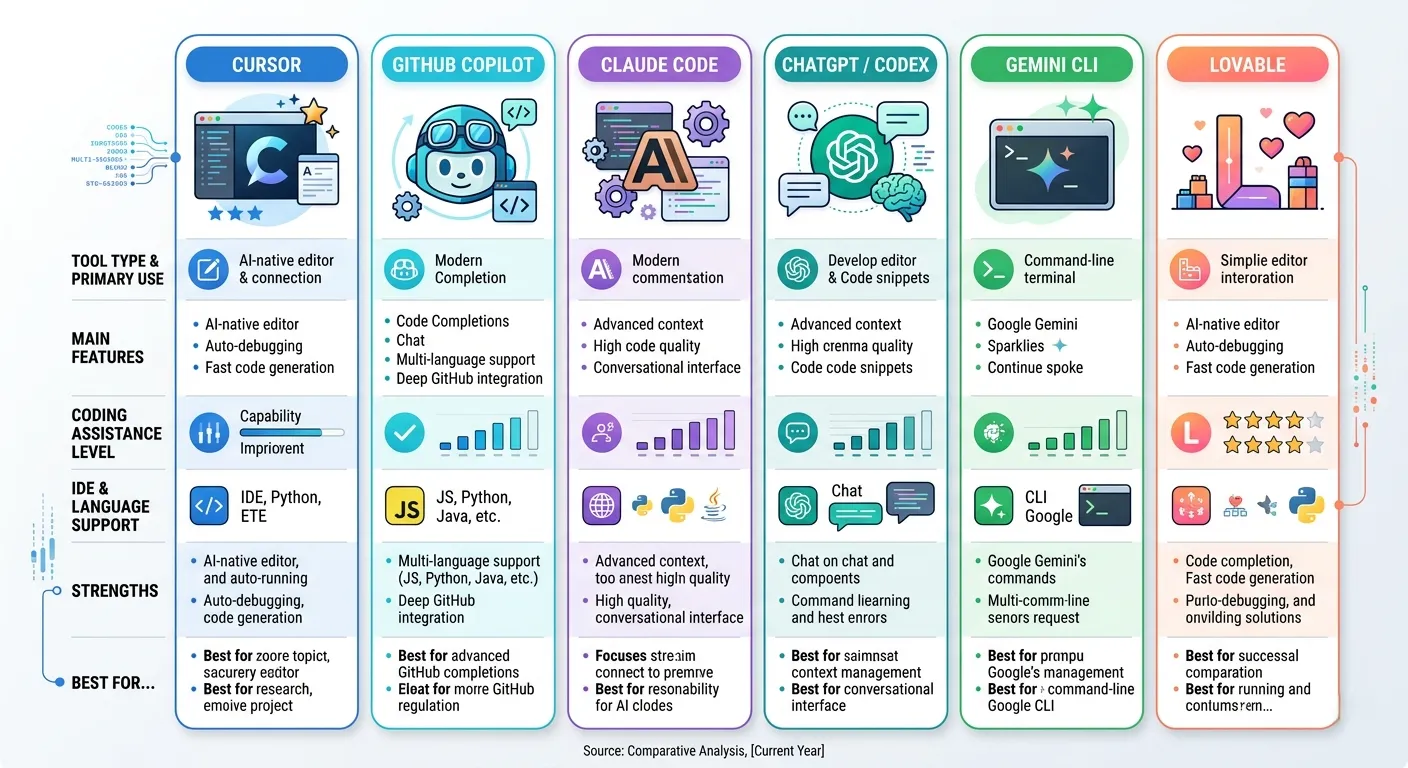
Survival requires the right weapons. Here's a thorough breakdown of the AI coding tools making the biggest dent in developer productivity in 2026 — not just what they are, but when and why to use each one.
🗂️ Side-by-Side Comparison
| Tool | Primary Use | Pricing | Learning Curve | Best For | Rating |
|---|---|---|---|---|---|
| Cursor | Code editing & generation | Freemium | ⭐⭐⭐ | All developers | ★★★★★ |
| GitHub Copilot | Autocomplete & PR review | Freemium | ⭐⭐ | All developers | ★★★★★ |
| Claude Code | Agentic & multi-file | Paid | ⭐⭐⭐⭐ | Senior devs | ★★★★★ |
| OpenAI Codex | General code generation | Freemium | ⭐⭐ | Beginners & learning | ★★★★☆ |
| Lovable | Full-stack app generation | Freemium | ⭐ | Non-devs & PMs | ★★★★☆ |
| Gemini CLI | Terminal & GCP integration | Free | ⭐⭐⭐⭐ | Google ecosystem | ★★★★☆ |
The crucial distinction is knowing about a tool vs. orchestrating it. In 2026, almost no developer is unaware of GitHub Copilot. But the productivity gap between someone using it purely as an autocomplete enhancer and someone who weaves it together with Cursor, Claude Code, and automated testing into a coherent workflow is easily threefold. Knowing tools is table stakes. Orchestrating them is the competitive edge.
4. The Truth About Vibe Coding and Agentic Engineering ⚠️
Vibe coding entered the lexicon in early 2026, sparked by a single post from Andrej Karpathy (ex-Tesla AI chief, OpenAI co-founder): "I increasingly just vibe code these days." The idea: describe what you want in plain English, let the AI write all the code. A declaration that the feeling-first era of development had arrived.
The numbers confirm the wave is real. By late 2026, 84% of developers were already using AI coding tools or planning to, and 51% used them daily. Perhaps most strikingly, an estimated 41% of all code written in 2026 was AI-generated.
Then came the cracks. The subreddit r/VibecodeFail was born — a steady stream of stories about AI-generated code failing in production, leaking security vulnerabilities, and crumbling under edge cases nobody had thought to check.
⚠️ 5 Critical Vibe Coding Traps
- Code you don't understand is a time bomb: If you can't debug what the AI wrote, you can't fix it when it breaks. "The code works but I have no idea why" is a recurring confession on r/VibecodeFail.
- Security vulnerabilities by default: AI generates code that works — not necessarily code that's safe. SQL injection, XSS, and broken auth logic have been found in AI-generated codebases shipped to production.
- Technical debt that compounds fast: Quickly generated code often has low test coverage and inconsistent style, silently destroying the team's long-term velocity.
- Context blindness: AI sees the file, not the system. It writes code that fits the prompt — but doesn't know your auth architecture, your data model constraints, or your service contracts.
- Skill atrophy: Over-reliance on AI erodes fundamental problem-solving muscles. The developer who can't work without AI assistance has a single point of failure: the API rate limit.
🚀 Agentic Engineering: The Evolution Beyond Vibe Coding
As 2026 arrived, Karpathy went further, introducing the concept of Agentic Engineering: developers spending 99% of their time not writing code, but orchestrating fleets of AI agents — designing the system, assigning tasks, verifying outputs, integrating results. The developer as conductor of an AI orchestra.
What separates beginners from professionals at this isn't prompt engineering cleverness — it's systematic workflow design and tool mastery. Here's what that difference looks like in practice:
# Vibe Coder vs. Agentic Engineer

## ❌ Beginner approach: "Just ask and ship"
User: "Build me an e-commerce store"
AI: (generates wall of code)
Result: Mostly works, but payment logic broken,
        no inventory management, auth vulnerabilities

## ✅ Agentic Engineer approach: "Design, delegate, verify"

PHASE 1 — Design (human-led)
  - Write requirements spec document
  - Draw user flow diagrams
  - Decide tech stack (with documented reasoning)
  - Design data model

PHASE 2 — Decompose into AI-executable units
  - "User authentication module" → Claude Code, separate context
  - "Payment API integration" → isolated task with test harness
  - "Inventory logic" → TDD: write tests first, then delegate

PHASE 3 — Verification gate (human-led)
  - Security review (OWASP checklist)
  - Performance profiling
  - Code coverage confirmation

PHASE 4 — Integration (human-led)
  - Architectural coherence check
  - Coding convention audit
  - Documentation pass
Vibe coding is an on-ramp, not a destination. The real value comes from understanding, controlling, and orchestrating AI — and that capability is only available to developers who retain deep technical foundations. The floor of knowledge required actually rises in the agentic era, not falls.
5. What the Developer Community Actually Says: Reddit & Blind 💬
Data and analysis can only capture so much. Here's the raw, unfiltered reaction from developers on the front lines of this shift — fear, frustration, resignation, and some surprising optimism.
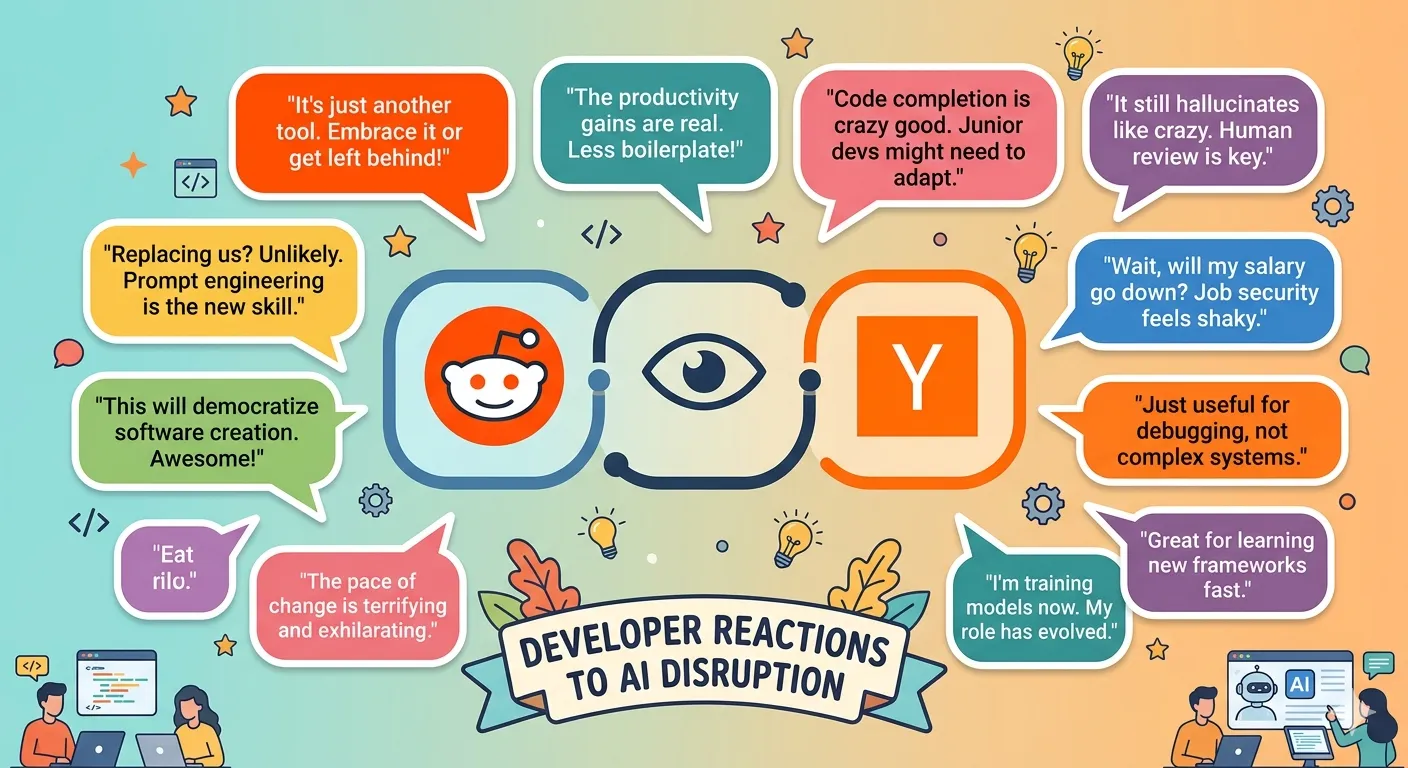
"AI doesn't code by itself, it needs a developer to operate it. Anyone who's full stack is safe, for the most part. Maybe for basic web devs, I'd say…"
"If you are replaceable by AI you should not even have TC. If you can't tell what good code looks like, how are you going to use Copilot well? It's just a tool."
"I ran into PRs where vibe coders summarized commits with 2 different AI tools and had 4 different AI tools review the PR plus 1 human. The code was still garbage. Vibe coding needs a vibe debugger."
"Thanks to AI I delivered 3 projects solo this month. Three years ago that would've taken a team of 4 and six months. AI didn't steal my job — it tripled my income."
"Just graduated and job hunting — interviews keep getting harder. It used to be LeetCode. Now it's 'design this system' and 'explain your architectural decisions.' They're testing judgment, not typing."
"AI doesn't know what to build. My 20 years of domain knowledge, stakeholder awareness, and technical debt management are still entirely mine. AI isn't taking my job — it's handling the chores."
Two camps emerge clearly. The fearful are predominantly junior developers, single-stack specialists, and those whose work consists mainly of repetitive implementation tasks. The optimistic are developers with domain depth, those actively leveraging AI to multiply their output, and senior engineers whose system-level thinking is irreplaceable. The dividing line isn't years of experience — it's how you work.
Your job isn't coding anymore. It's managing the AI that codes.
— Developia's Substack, one of 2026's most-shared developer posts6. 7 Survival Strategies for the AI Era 🚀
The crisis is mapped. The tools are catalogued. The community pulse is taken. Now: what do you actually do? Here are seven actionable strategies — not motivational platitudes, but specific things you can start today.
The gap between using Copilot for autocomplete and building a workflow where Cursor scaffolds, Claude Code handles complex logic, and Copilot reviews PRs is enormous. Learn the specific strengths of each tool and connect them like a pipeline. Practical start: pick one new AI tool feature each week and apply it to real work. In a month, you'll be unrecognizable.
🔧 Tool Mastery 📈 Immediately ActionableAI can write a function perfectly. It cannot decide how a system serving a million users should be structured, how to manage service dependencies, or how to guarantee data consistency. Read the classics: Alex Xu's System Design Interview, Martin Fowler's Patterns of Enterprise Application Architecture, Kleppmann's Designing Data-Intensive Applications. Architecture ability is slow to build but impossible to automate away once it's yours.
🏗️ Long-Term Asset 🛡️ AI-Proof SkillOne of the highest-value developer roles going forward is verifying AI-generated code: catching security vulnerabilities, identifying edge cases, analyzing performance implications, confirming business logic correctness. Learn OWASP Top 10, STRIDE threat modeling, performance profiling. Companies want someone they can trust to ship AI-written code safely. That's a rare skill right now — own it.
🔍 Code Review 🔒 SecurityThe T-shaped developer (one deep skill, broad general knowledge) was once the ideal. The AI era demands the π-shape: two depths. Examples that work: backend engineering depth + ML/AI pipeline operations. Frontend mastery + DevOps/infra. Full-stack + deep domain knowledge in finance, healthcare, or logistics. AI steadily erodes the value of single-stack expertise. Two intersecting depths create a value that AI cannot replicate at their crossroads.
📐 Career Architecture 🎯 DifferentiationA developer who understands medical records, one who knows financial regulation, one who grasps manufacturing constraints — their value is exploding. AI can write code; it cannot tell you why a specific FHIR data field matters in an EMR system, or which edge case in a trading algorithm violates Reg NMS. Invest in deeply understanding the industry you're working in: its language, its regulations, its business model. The fusion of technical skill and domain knowledge is still the one combination AI can't counterfeit. Action: attend one industry conference per year outside pure tech; befriend people in non-technical departments.
🧠 Domain Knowledge 💡 High-Value ComboAs AI handles more of the coding, what's left for human developers is communication and judgment: explaining technical trade-offs to non-technical stakeholders, reading between the lines of requirements, leading technical direction conversations, resolving conflict and building consensus. ChatGPT cannot do these things for you. Start now: speak up in every sprint review. Write a technical blog. Mentor a junior engineer. The ability to write clearly is the ability to think clearly, and the ability to think clearly is the ability to persuade.
🤝 Communication 👥 LeadershipAI technology fundamentally reshapes every six months. Accumulating knowledge matters less than building a system that keeps you learning automatically. A system that works: ① Read 5 Hacker News articles weekly, summarize each in one sentence ② Apply one new AI tool to a side project monthly ③ Run a bi-weekly "AI experiment results" sharing session with your team ④ Update your personal technology map quarterly — identify gaps. The principle: not "a lot at once" but "a little, every day, forever." The pace of change will only accelerate. Build the learning muscle now, or you will never catch up later.
📚 Continuous Learning ⚙️ Systemize It7. New Roles and Opportunities: 2026–2030 💼
The story isn't all contraction. AI is generating entirely new job categories at a rapid pace. Just as Microsoft was laying off legacy engineers, it was hiring aggressively for AI-adjacent roles. Doors are closing and opening simultaneously. Here are the roles seeing explosive growth between now and 2030.
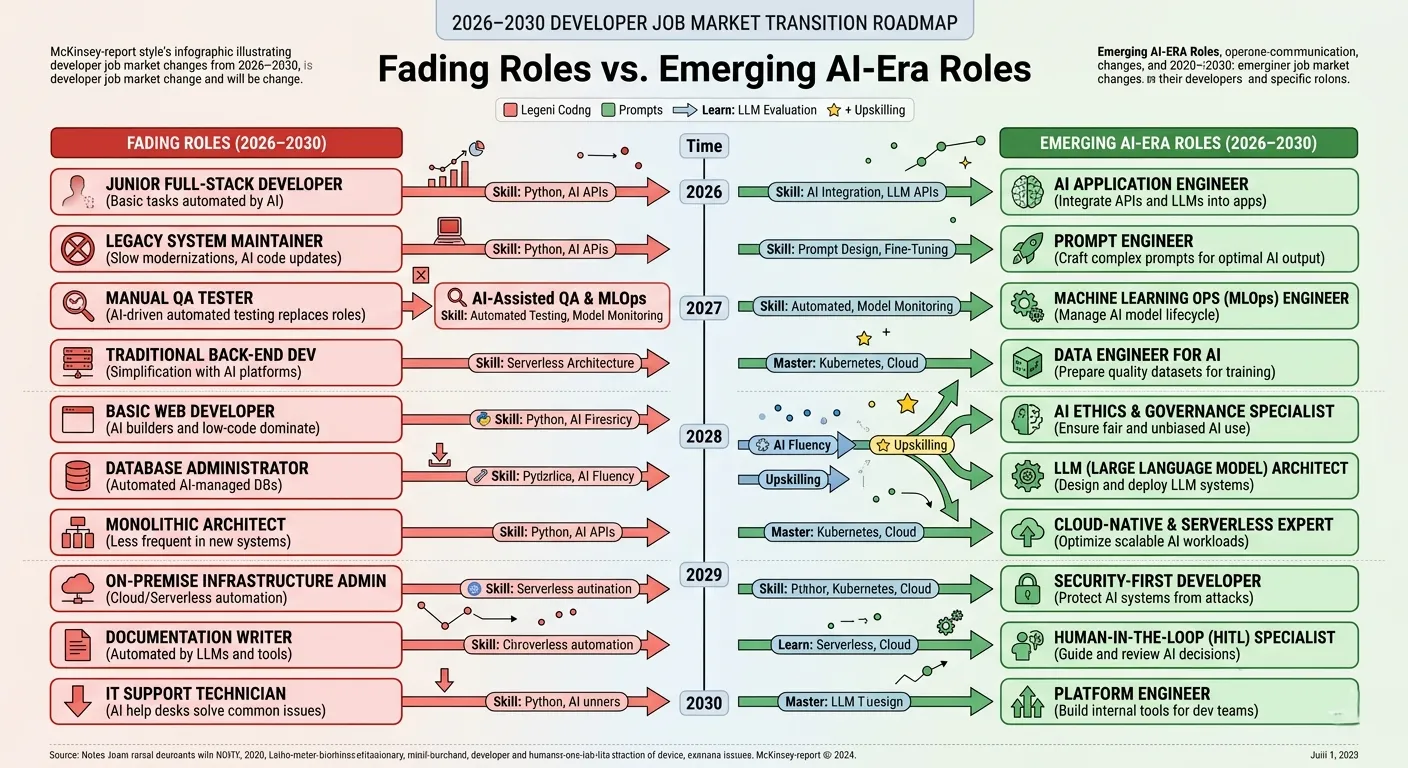
The pattern across all these new roles: people who build AI, control AI, sell AI, and prevent AI from failing. Every role combines coding ability with something else — security expertise, domain knowledge, communication skills, or product intuition. Pure coding alone is no longer the ticket.
📋 Portfolio Strategy for the New Market
Hiring managers in 2026 aren't asking whether you can memorize data structures. Here's what they're actually evaluating:
# The 2026 Portfolio That Gets You Hired

## 1. AI-Assisted Project (Non-Negotiable)
- A project built with Cursor / Claude Code, with the process documented
- Show how AI collaboration actually worked — blog post or GitHub writeup
- Quantify the productivity improvement with real numbers

## 2. Proven Systems Design Thinking
- README includes Architecture Decision Records (ADRs)
- Clear answers to "why this tech stack?" documented
- Scalability, performance, and security considerations written out

## 3. AI Code Verification in Action
- Public code review history showing where AI was wrong
- Security audit performed and documented
- Test coverage + edge case handling visible

## 4. Domain Understanding Demonstrated
- Writing that explains the business problem beyond the technical solution
- Decision-making in the context of your industry's constraints

## 5. Continuous Learning Evidence
- Technical blog (at least monthly)
- Open source contributions
- Conference talks or attendance documented
On compensation: AI-adjacent roles saw average salaries rise 35–50% between 2023 and 2026, while routine coding-heavy roles plateaued or declined. The direction you move is entirely your choice to make.
8. Conclusion: Build Your Future by Design, Not Fear ✅
After reading this far, here's what needs to be said plainly: the disruption is real. Microsoft's 6,000 layoffs, 41% of code being AI-generated, Stanford's 20% drop in junior developer employment — these aren't hypotheticals. Feeling unsettled is a healthy response. Staying unsettled is a choice.
History's pattern is consistent: every technology revolution has destroyed categories of work while creating new ones. When the internet arrived, "web developer" didn't exist as a job title. When smartphones launched, mobile engineering wasn't a discipline. Some of the highest-demand roles in 2030 don't have names yet. The question isn't whether disruption is happening — it's which side of it you'll be on.
🧭 Start These Today
- Install Cursor or activate GitHub Copilot's free plan and integrate it into your daily workflow. Two weeks to fluency.
- Make an honest list: which parts of your work could AI do? Which require uniquely human judgment?
- Order a systems design book today. Designing Data-Intensive Applications is the canonical first choice.
- Ship an AI-assisted side project to GitHub before the end of this month.
- Start learning the non-technical language of your industry: domain terms, regulations, business metrics.
- Start a technical blog. "My honest first impression of vibe coding" is a perfectly valid first post.
- Connect with a community. The compounding effect of learning alongside others dwarfs solo study.
AI isn't replacing developers. Developers who use AI are replacing developers who don't. Which side of that sentence you're on starts with decisions made right now.