On June 13, 2026, at 5:21 AM (local time), Z.ai — the AI lab formerly known as Zhipu AI — quietly dropped something that sent the developer community into a frenzy. The model is called GLM 5.2. A 1-million-token context window. A drop-in Claude Code replacement via an Anthropic-compatible API. MIT open-source weights promised for the following week. While closed-source labs navigate turbulent headlines, the open-source camp is having, in the words of one prominent developer on X, "one of the best weeks of all time." GLM 5.2 is not just a model update — it's a statement about who frontier AI belongs to.
Who Is Z.ai (Zhipu AI)?
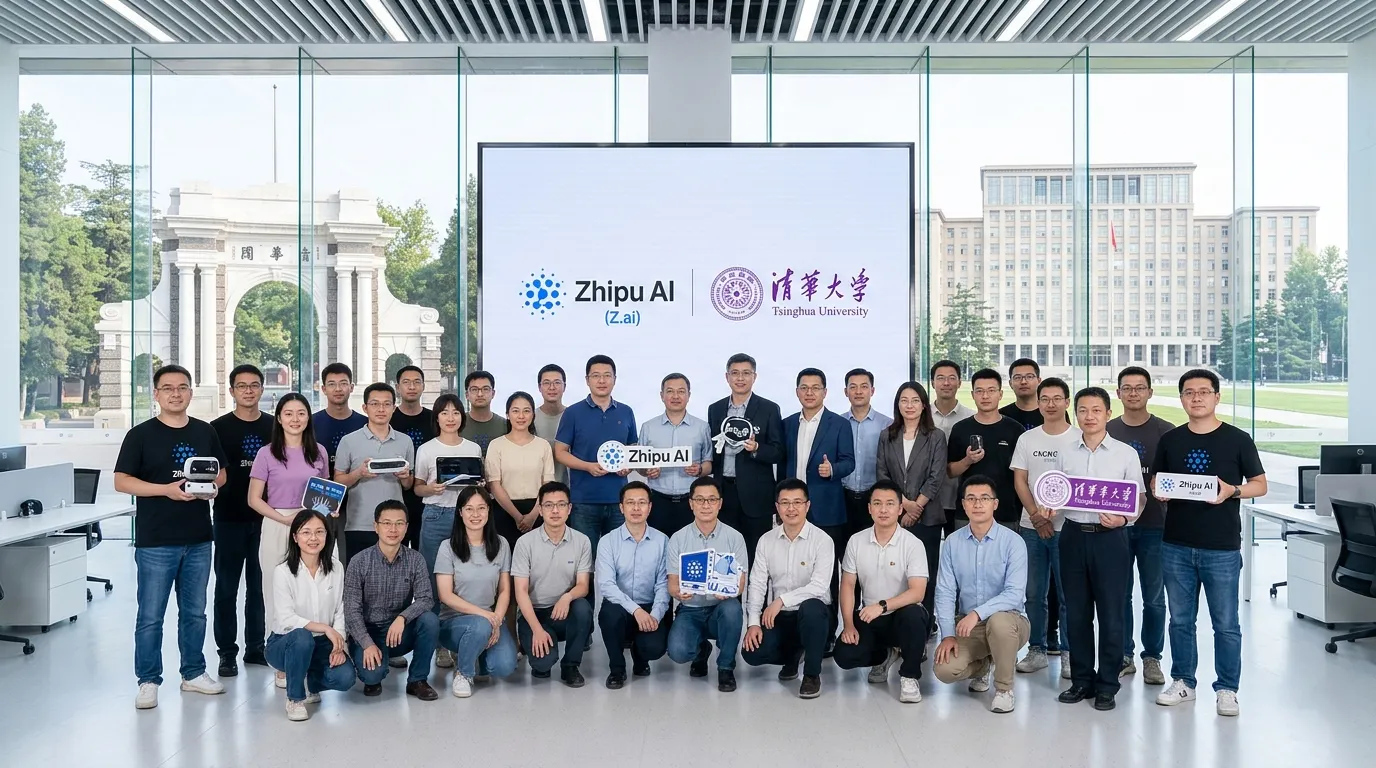
Z.ai, formerly known as Zhipu AI (智谱AI), is a Beijing-based AI research company with deep ties to Tsinghua University. Founded in 2019 and incubated within Tsinghua's Knowledge Engineering Group (KEG) lab, the company has grown into one of China's most prominent NLP research teams.
What sets Z.ai apart from many Chinese AI labs is not just technical capability but a clearly articulated philosophy: frontier AI should be open, accessible, and not monopolized by a handful of gatekeepers. This commitment has been backed by consistent action — the GLM model series has been released under the MIT license since its earliest iterations.
When restrictions on certain Western frontier models began tightening in early 2026 for non-technical reasons, Z.ai's CEO Tang Jie responded not with complaint but with an open manifesto that became one of the most shared AI posts of the year.
"The path to AGI must never be enclosed by high walls. We have always believed that AGI should be the cornerstone for all of humanity to collaboratively explore the boundaries of intelligence — not a privilege monopolized by a few, subject to revocation at any moment. In the face of external blockades and restrictions, our attitude is one of radical openness." — Tang Jie, Zhipu AI CEO, June 13, 2026
That statement was not mere marketing. GLM 5.2 shipped the same night, available to every GLM Coding Plan subscriber immediately — with open-source weights to follow the next week.
The GLM Model Family: A Four-Release Sprint
To understand GLM 5.2, you need to appreciate the pace at which Z.ai has been shipping. In just four months, the company released four flagship-tier models in the GLM-5 line — a cadence that rivals even the most aggressive labs in the field.
Commenting on the pace, AI analyst @teortaxesTex noted: "GLM and Kimi are on the third iteration of their flagships. They too are in the fast update cycle." That velocity matters: every two months, a meaningfully improved model lands in developers' hands at the same price.
Key Insight: Why MoE Architecture Matters
The Mixture-of-Experts (MoE) design behind GLM-5 activates only 40B of its 744B total parameters per token. This dramatically cuts inference cost while maintaining performance comparable to much larger dense models. DeepSeek showed the world how powerful this approach can be — GLM is on the same path, applied specifically to agentic coding workflows.
GLM 5.2 Core Specs — Full Breakdown
The official announcement was brief, but every data point carries weight. Let's go through each one systematically.
| Attribute | GLM 5.2 NEW | GLM 5.1 | GLM 5 |
|---|---|---|---|
| Released | June 13, 2026 | April 7, 2026 | February 11, 2026 |
| Context Window | 1,000,000 tokens | ~200,000 tokens | 200,000 tokens |
| Max Output Tokens | 131,072 | Not disclosed | 128,000 |
| Reasoning Modes | High, Max (2-tier) | Single mode | Single mode |
| Architecture | 744B MoE (unconfirmed) | 744B MoE, 40B active | 744B MoE, 40B active |
| License | MIT (weights next week) | MIT (released) | MIT (released) |
| Launch Benchmarks | None published | SWE-Bench Pro 45.3 | SWE-Bench 77.8% |
| Access at Launch | GLM Coding Plan (all tiers) | Coding Plan, API, weights | API, weights |
| Model ID | glm-5.2 / glm-5.2[1m] | glm-5.1 | glm-5 |
High vs Max: Choosing Your Thinking Effort Level
GLM 5.2 introduces a two-tier reasoning system. The choice directly affects output quality and latency.
| Mode | High | Max ⭐ Recommended |
|---|---|---|
| Best For | Medium-complexity coding tasks | Complex, multi-step coding |
| Speed | Faster responses | Slower but more reliable |
| Claude Code Mapping | /effort xhigh | /effort max, ultracode |
| Z.ai Recommendation | General tasks | All coding work ✓ |
Z.ai's official guidance is clear: for anything coding-related, default to Max. The caveat from community testing is that Max can feel like overkill for trivial queries — something to keep in mind if you're using it for quick lookups alongside deep refactors.
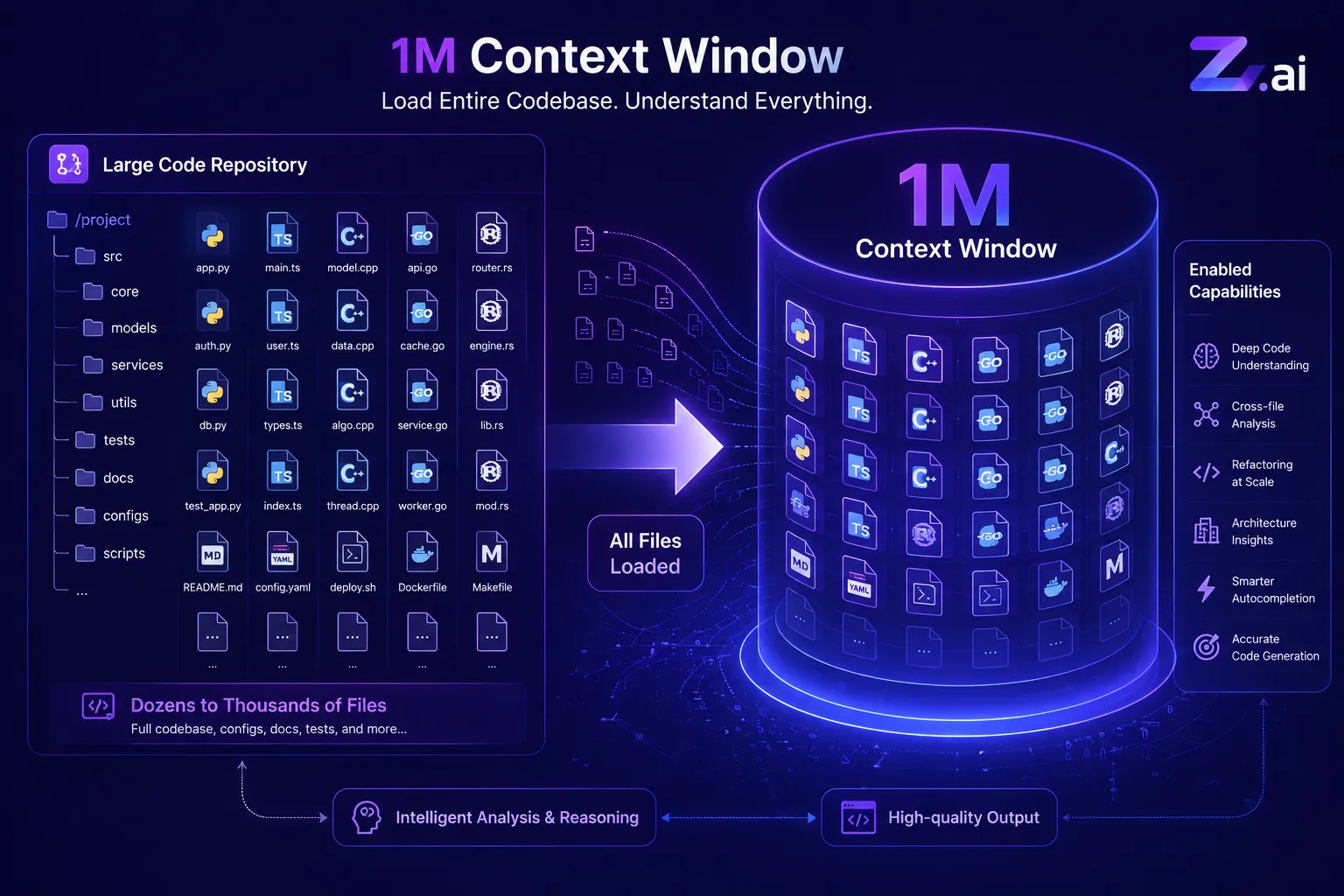
What 1 Million Tokens Actually Means in Practice 🧠
The 1M token headline is striking, but what does it mean for daily work? Let's put it in real terms rather than abstract numbers.
| What You Can Fit | Approximate Tokens | GLM 5.2 Handles It? |
|---|---|---|
| One full novel (~250K words) | ~333K tokens | ✅ Fit 3 novels at once |
| Mid-size Python project (40 files) | ~150K–400K tokens | ✅ Entire repo in one window |
| Large codebase + tests + configs | ~700K–900K tokens | ✅ Cross-file dependency tracking |
| Entire conversation + code history | ~1M tokens | ✅ Single session, no truncation |
| GLM 5.1 maximum | 200K tokens | ❌ Context lost beyond this limit |
Context Window Comparison
The practical wins are significant. With GLM 5.1's 200K window, teams working on mid-sized codebases frequently hit the limit — forcing the agent to re-summarize, re-fetch, and sometimes lose context. GLM 5.2's 1M window eliminates that ceiling for the vast majority of real-world repositories. The highlighted use cases from Z.ai and community testing include:
- Whole-repo refactors: Load a 40-file Python data pipeline into a single context window. The agent tracks cross-file dependencies without re-fetching anything.
- Long-horizon agent runs: GLM-5.1 already demonstrated autonomous loops running for up to 8 hours and 1,700+ agent steps. GLM 5.2 carries that capability forward with a much larger working memory.
- Large document analysis: Feed specs, logs, or transcripts exceeding 200K tokens without losing any content to truncation.
- Full PR-scale diffs: The 131K output cap is wide enough to return complete pull-request diffs and long execution traces in a single response.
GLM Coding Plan: Pricing Tiers Explained 💰
At launch, GLM 5.2 is exclusively available through the GLM Coding Plan subscription. The standalone API and open-source weights were announced for the following week. Crucially, existing subscribers get GLM 5.2 at no extra cost — just update your model identifier and start using it today.
- ✓ ~400 prompts / week
- ✓ Immediate GLM 5.2 access
- ✓ Full 1M context window
- ✓ Claude Code & Cline support
- ✓ Best entry point for solo developers
During promotional periods, pricing has dipped as low as $3–$10/month. Even at the standard rate, this is a remarkably low entry price for 1M-token context access.
- ✓ ~2,000 prompts / week
- ✓ Immediate GLM 5.2 access
- ✓ Full 1M context window
- ✓ All supported agent tools
- ✓ Ideal for active freelancers and startups
Community consensus: "3x the Claude Max volume at $30/month." If you're regularly using a coding agent for real projects, this tier delivers compelling value per prompt.
- ✓ ~8,000 prompts / week
- ✓ Immediate GLM 5.2 access
- ✓ Full 1M context window
- ✓ Best for sustained coding sessions
- ✓ Large-project agentic automation
This is the tier for developers who push models hard — running overnight agent loops, full-stack refactors, or intensive multi-session workflows. If you're running the model 8+ hours a day, this is where you live.
- ✓ Per-seat organizational pricing
- ✓ Immediate GLM 5.2 access
- ✓ Enterprise-grade management
- ✓ Priority support and SLA
- ✓ Best for dev teams of 5+
Contact Z.ai sales for custom enterprise quotes. If your team is already using Coding Plan individually, Team pricing can simplify billing and add admin controls.
For API-level access (available after the initial week), GLM-5's baseline pricing was approximately $1.00/M input tokens and $3.20/M output tokens — roughly 5x cheaper than Claude Opus 4.6. Expect similar or lower pricing for GLM 5.2 when the standalone API opens.
- GLM 5.1 delivered 94.6% of Claude Opus 4.6's coding performance at ~20% of the price. If GLM 5.2 maintains or improves that ratio, the value proposition is hard to ignore.
- For creative writing, nuanced reasoning, or the absolute best quality on complex analytical tasks, top-tier closed-source models still hold an edge.
- Without benchmarks, you cannot know the exact performance delta from 5.1 to 5.2. The honest answer: try it on your own workloads before committing.
How to Connect GLM 5.2 to Claude Code 🔧
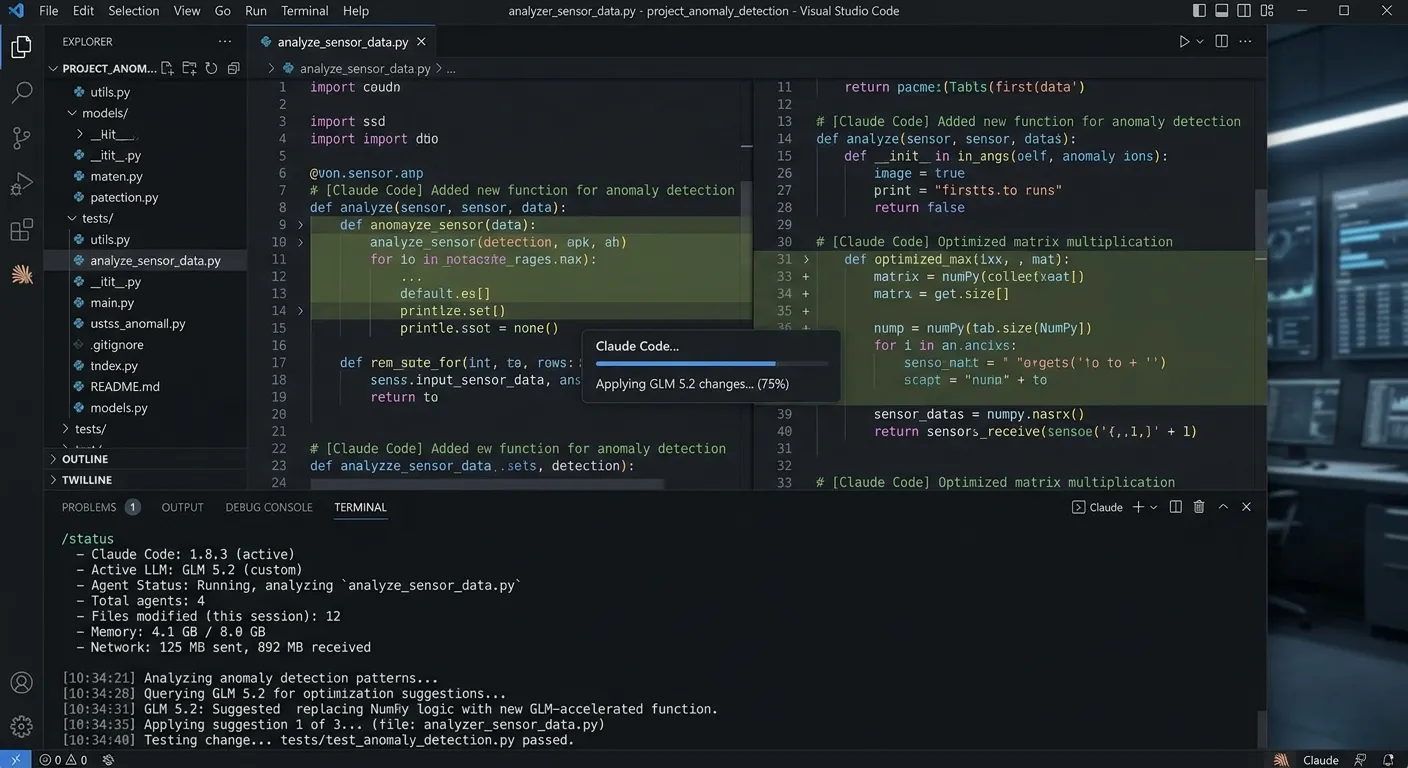
The single most developer-friendly feature of GLM 5.2 is its Anthropic-compatible API endpoint. If you're a Claude Code user, the migration path requires exactly two things: swap the base URL and change the model identifier. Your existing tools, prompts, and agentic workflows stay exactly as-is.
// ~/.claude/settings.json
{
  "env": {
    "ANTHROPIC_AUTH_TOKEN": "your-zai-api-key",
    "ANTHROPIC_BASE_URL": "https://api.z.ai/api/anthropic",
    "CLAUDE_CODE_AUTO_COMPACT_WINDOW": "1000000",
    "ANTHROPIC_DEFAULT_HAIKU_MODEL": "glm-4.5-air",
    "ANTHROPIC_DEFAULT_SONNET_MODEL": "glm-5.2[1m]",
    "ANTHROPIC_DEFAULT_OPUS_MODEL": "glm-5.2[1m]"
  }
}export ANTHROPIC_AUTH_TOKEN="your-zai-api-key"
export ANTHROPIC_BASE_URL="https://api.z.ai/api/anthropic"
export ANTHROPIC_DEFAULT_OPUS_MODEL="glm-5.2[1m]"
export ANTHROPIC_DEFAULT_SONNET_MODEL="glm-5.2[1m]"
export ANTHROPIC_DEFAULT_HAIKU_MODEL="glm-4.5-air"
claude/effort max to activate Max thinking mode. Then run /status to confirm GLM 5.2 is active and the context window is set correctly.# Inside your Claude Code session
/effort max # Activate Max reasoning mode (recommended for coding)
/status # Confirm GLM 5.2 is activeX user @konfuai called this out precisely: "The move nobody's talking about: GLM-5.2 ships an Anthropic-compatible API endpoint. Swap one env var in Claude Code, keep your entire workflow. Zhipu isn't just open-sourcing a model — they're building a frictionless migration path off Western APIs."
Setting Up Cline, OpenCode & Other Agent Tools
GLM 5.2 ships day-one compatibility with eight agentic coding tools. Pick the one you use and follow the appropriate setup.
Supported Tools at Launch
Cline Setup
In Cline, choose "OpenAI Compatible" as the provider and enter the following settings:
// Cline Configuration
{
  "provider": "OpenAI Compatible",
  "baseURL": "https://api.z.ai/api/coding/paas/v4",
  "model": "glm-5.2",
  "contextWindow": 1000000,
  "apiKey": "your-zai-api-key"
}
OpenClaw Setup
# OpenClaw environment variables
export OPENAI_BASE_URL="https://api.z.ai/api/coding/paas/v4"
export OPENAI_API_KEY="your-zai-api-key"
export OPENAI_MODEL="glm-5.2[1m]"
For all other OpenAI-compatible tools, the pattern is the same: set the base URL to https://api.z.ai/api/coding/paas/v4, select glm-5.2 or glm-5.2[1m] as the model, and configure the context window to 1,000,000.
Community Reaction: Praise, Criticism & the Debate 📢
The GLM 5.2 announcement exploded across X and Digg within hours of the midnight release. The reaction was emphatic — but split.
Overall Sentiment (Across 414 Analyzed Comments)
Source: Digg sentiment aggregation across X posts, June 13–15, 2026
The Three Legitimate Criticisms
- Over-thinking on simple tasks: Multiple users reported the model taking far too long on trivial queries in Max mode. The caveat is real — use High mode for quick lookups.
- Access before evidence: Shipping to subscribers before publishing a single benchmark is unusual. Z.ai prioritized developers-in-hand over proof-on-paper. Some appreciate the trust; others are skeptical.
- Local execution barrier: At ~40GB VRAM for a 4-bit KV cache at 1M context, running GLM 5.2 locally is effectively impossible for most developers. The "open" in open-source still has hardware prerequisites attached.
No Benchmarks at Launch — What We Know About Performance 📊
The absence of benchmark scores at GLM 5.2's launch is the single most unusual aspect of the release. No SWE-bench Verified. No LiveCodeBench. No HumanEval. Just vendor claims of "powerful coding capabilities" and "strong long-horizon task performance."
This is not negligence — it's a deliberate sequencing decision. Z.ai shipped the distribution channel first and the proof second. The release was designed for existing GLM Coding Plan subscribers who can simply update their model key and run it on real projects immediately. Their feedback — not aggregate benchmark scores — is the initial signal.
In the absence of GLM 5.2-specific numbers, here's what we can lean on from the GLM-5 lineage:
| Benchmark | GLM-5.1 | Claude Opus 4.6 | GLM-5 |
|---|---|---|---|
| SWE-Bench Pro (coding eval, Claude Code) | 45.3 | 47.9 | 35.4 |
| SWE-Bench Verified | — | — | 77.8% |
| BrowseComp | — | — | 75.9% |
| GPQA Diamond (PhD-level science) | — | — | 82.0% |
| Generation-over-generation improvement | +28% vs GLM-5 | — | baseline |
If GLM 5.2 continues the ~28% improvement trajectory of 5.1 over 5.0, you'd expect SWE-Bench Pro scores pushing past 55 — potentially above Claude Opus 4.6. One community member noted: "There's almost no question in my mind GLM 5.2 is much better than M3... and it's going to give DSV4P some serious competition." These are early impressions, not data. The independent benchmark wave will come once the open weights are available.
- As of writing, no independent benchmark exists for GLM 5.2. "Powerful coding capabilities" is an unverified claim.
- Community first impressions from actual API use are largely positive — but impressions are not benchmarks.
- Once the MIT weights land, the open-source community will run proper evals. That data will tell the real story. Watch r/LocalLLaMA and Hugging Face for the first independent numbers.
Who Should Use GLM 5.2 (and Who Shouldn't)
| Profile | Fit Score | Reason |
|---|---|---|
| Claude Code users seeking cost savings | ⭐⭐⭐⭐⭐ | Zero workflow change, ~5x cheaper, comparable performance |
| Teams refactoring large monorepos | ⭐⭐⭐⭐⭐ | 1M context eliminates the truncation problem |
| Open-source / privacy-first developers | ⭐⭐⭐⭐⭐ | MIT weights enable self-hosting once released |
| Long-horizon agentic automation builders | ⭐⭐⭐⭐ | Proven 8-hour autonomous loop capability in GLM lineage |
| Highest-precision creative / analytical tasks | ⭐⭐ | Claude Opus 4.8, GPT-5.5 still hold the edge at the frontier |
| Users needing fast simple Q&A | ⭐⭐ | Max mode over-thinks trivial queries; use High or a lighter model |
| Enterprises with strict data sovereignty requirements | ⭐ | Requires legal/compliance review of Chinese data processing |
The Open-Source AI Wars: What Comes Next 🌍
GLM 5.2 did not arrive in isolation. The same week saw Minimax M3 and Kimi K2.7 Code also ship significant updates. The developer community was buzzing about an "open-source renaissance" happening in real time, coinciding with a period of friction for certain closed Western models.
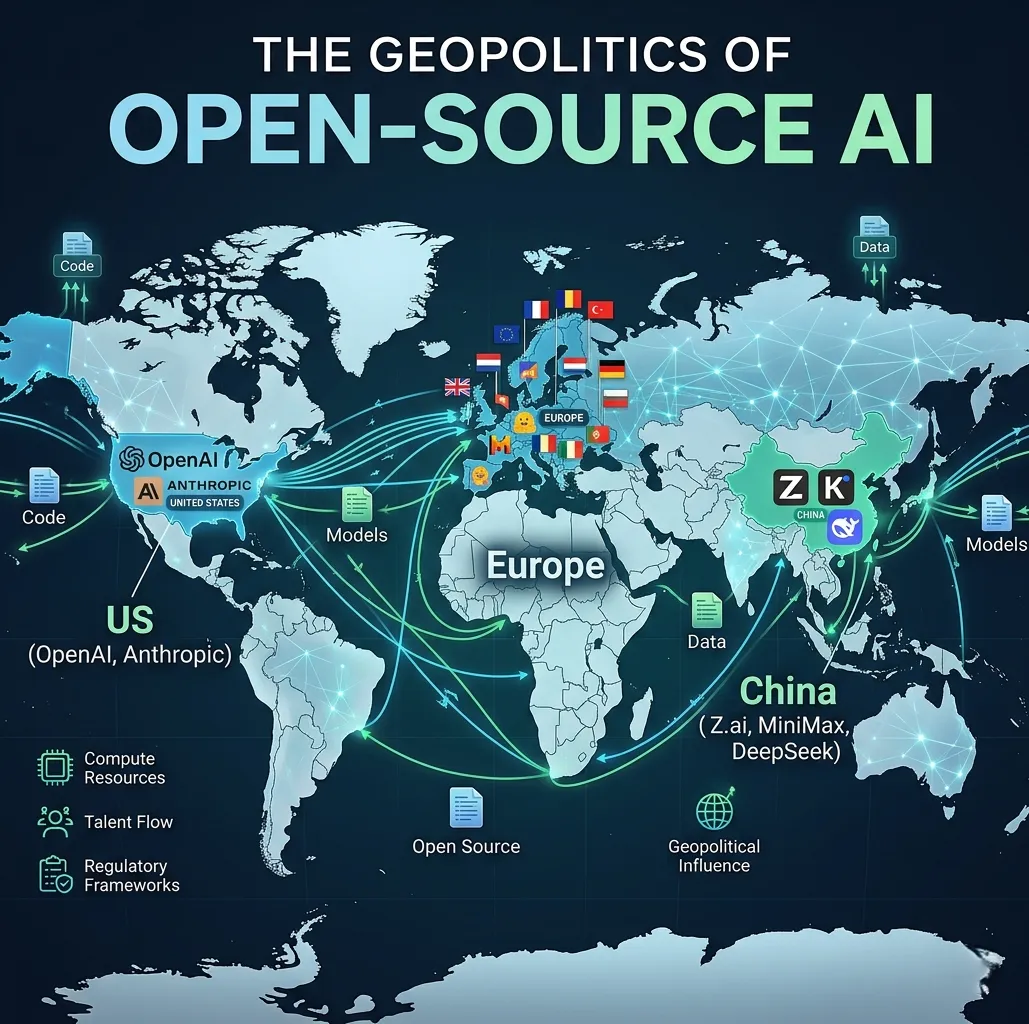
The geopolitical backdrop is impossible to ignore. As access to some frontier Western models has been restricted on non-technical grounds in 2026, Chinese open-source labs have responded with a counter-move: radical openness. The GLM manifesto is both a philosophical statement and a strategic positioning — "we will be the open option when others close."
Looking ahead:
- Near-term (1–3 months): GLM 5.2 MIT weights trigger a wave of community benchmarks, fine-tunes, and local deployment guides. Platforms like Together.ai and OpenRouter likely add GLM 5.2 API access at competitive prices.
- Medium-term (3–6 months): GLM 5.3 or equivalent. At the current two-month cadence, a next release would land around August 2026. The 1M context competition is set to intensify across all providers.
- Long-term: The model providers that win developer trust will be those that deliver consistent improvement, honest evaluation, and genuinely usable context windows at prices that include rather than exclude. GLM is betting that "open + capable + cheap" beats "proprietary + opaque + expensive."
Final Thoughts: The Freedom to Choose 🗝️
GLM 5.2 is not a perfect model. There are no benchmarks. Running it locally requires serious hardware. Max mode can be frustratingly slow on simple queries. And for a model calling itself "open," spending a week as subscription-only is a contradiction that even supporters acknowledged.
But the statement it makes — and the practical capabilities it delivers — are hard to dismiss. A 1-million-token context window. A frictionless Claude Code migration path. MIT weights. A price point that puts frontier-class coding assistance within reach of developers who couldn't justify the top-tier subscriptions before.
Tang Jie put it simply: "The future of AI is open, and it belongs to the people." Whether you believe that as a philosophy or evaluate it purely on technical merit, GLM 5.2 earns its place in your testing queue. Try it on a real refactor, measure what changes, and form your own opinion. That's how open-source is supposed to work.
- Released: June 13, 2026 | Developer: Z.ai (Zhipu AI)
- Context Window: 1,000,000 tokens (Model ID: glm-5.2[1m])
- Max Output: 131,072 tokens per response
- Reasoning Modes: High / Max (Max recommended for coding)
- Compatible Tools: Claude Code, Cline, OpenCode, Roo Code, Goose, Crush, OpenClaw, Kilo Code
- API: Anthropic-compatible (swap base URL only)
- Pricing: Lite ~$18/mo (400 prompts/wk) · Pro ~$30/mo (2K/wk) · Max ~$80/mo (8K/wk)
- License: MIT open-source (weights pending release ~June 20, 2026)
- Benchmarks: None published at launch — test on your own workloads