
"Do I need to bring cash to Denmark?" — it's one of the first questions anyone asks before booking a trip to the Nordic kingdom. The short answer: as of 2025, you can handle nearly every payment in Denmark without a single banknote. But the keyword is "nearly." This guide breaks down exactly which situations still call for cash, what cards work best for foreign visitors, what MobilePay is all about, and everything else you need to know before you land in Copenhagen.
How Denmark Became the World's Most Cashless Society 🏆
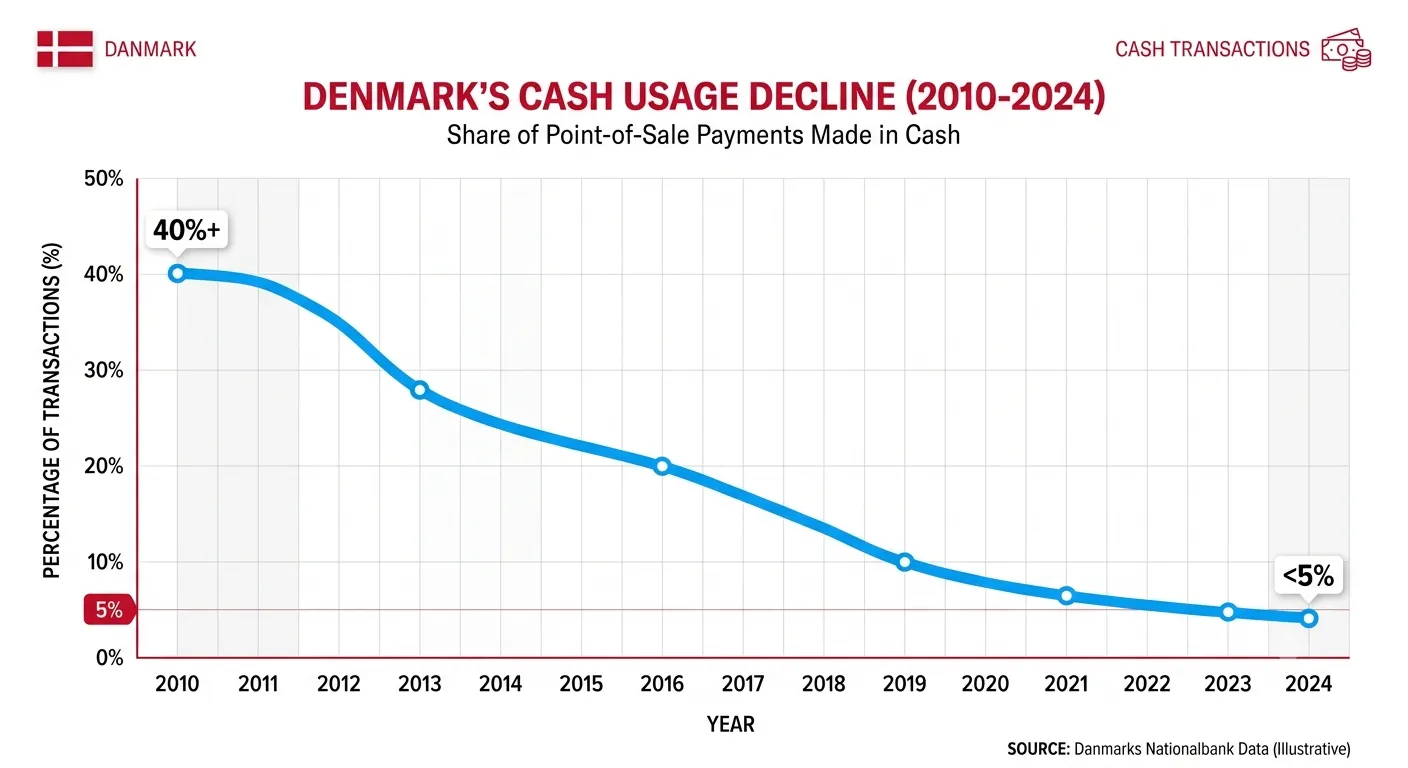
Denmark's shift away from physical money isn't just a tech story — it's the result of deliberate collaboration between the government, banks, and businesses over more than four decades. Back in 2010, more than 40% of Danes used cash for everyday purchases. By 2023, that figure had collapsed to just 6%. Here's what drove that dramatic change.
(was 40%+ in 2010)
(population of 5.9M)
(2× the EU average)
Denmark's cashless transformation rests on three pillars.
Pillar 1 — Dankort (1983). Denmark introduced its own national debit card scheme, Dankort, in 1983. Early transactions used paper imprinters, but electronic POS terminals arrived in 1985 and triggered rapid adoption. Today roughly 5 million Dankort cards are in circulation — essentially one per adult — making it the backbone of domestic payments.
Pillar 2 — Real-Time 24/7 Payments (2014). In 2014, Denmark launched an instant payment infrastructure that allowed transfers around the clock, every day of the year. This was the rocket fuel behind MobilePay's explosive growth. From that moment, sending money between phones became as fast and natural as sending a text message.
Pillar 3 — Phasing Out the 1,000-Krone Note (2023–2025). Danmarks Nationalbank (the Danish central bank) began recalling the 1,000-krone note in late 2023. From June 2025, the banknote is no longer legal tender. The result? Cash in circulation dropped by more than DKK 15 billion (roughly USD 2.1 billion). High-value cash transactions are effectively finished.
Dankort Is Born
Denmark launches its own national debit card scheme. Paper-imprint transactions at launch.
Electronic POS Terminals Arrive
Electronic payment terminals roll out nationwide, accelerating Dankort adoption in shops.
MobilePay Launches
Danske Bank releases MobilePay for peer-to-peer mobile transfers. Immediate mass adoption.
24/7 Instant Payment Infrastructure
Real-time settlement rails unlock round-the-clock transfers, fueling MobilePay's explosion.
Apple Pay, Google Pay, Samsung Pay Enter
International mobile wallets launch in Denmark in sequence, expanding contactless options.
MobilePay Merges with Vipps
Norway's Vipps and MobilePay merge, creating the Nordic region's largest mobile payment platform.
1,000-Krone Note Phased Out
Recall and invalidation of Denmark's largest banknote removes DKK 15B+ from circulation. High-value cash effectively ends.
"In Denmark, cash is turning from a choice into a memory. Carrying banknotes in your wallet feels a bit like carrying a pager." – Jonas Hedman, Professor of Digitalization, Copenhagen Business School (CBS)
The Four Payment Methods Dominating Denmark 💳
There are four main payment channels in Denmark today. Understanding what each one is — and how they interact with foreign cards — is essential for a stress-free trip.
Dankort
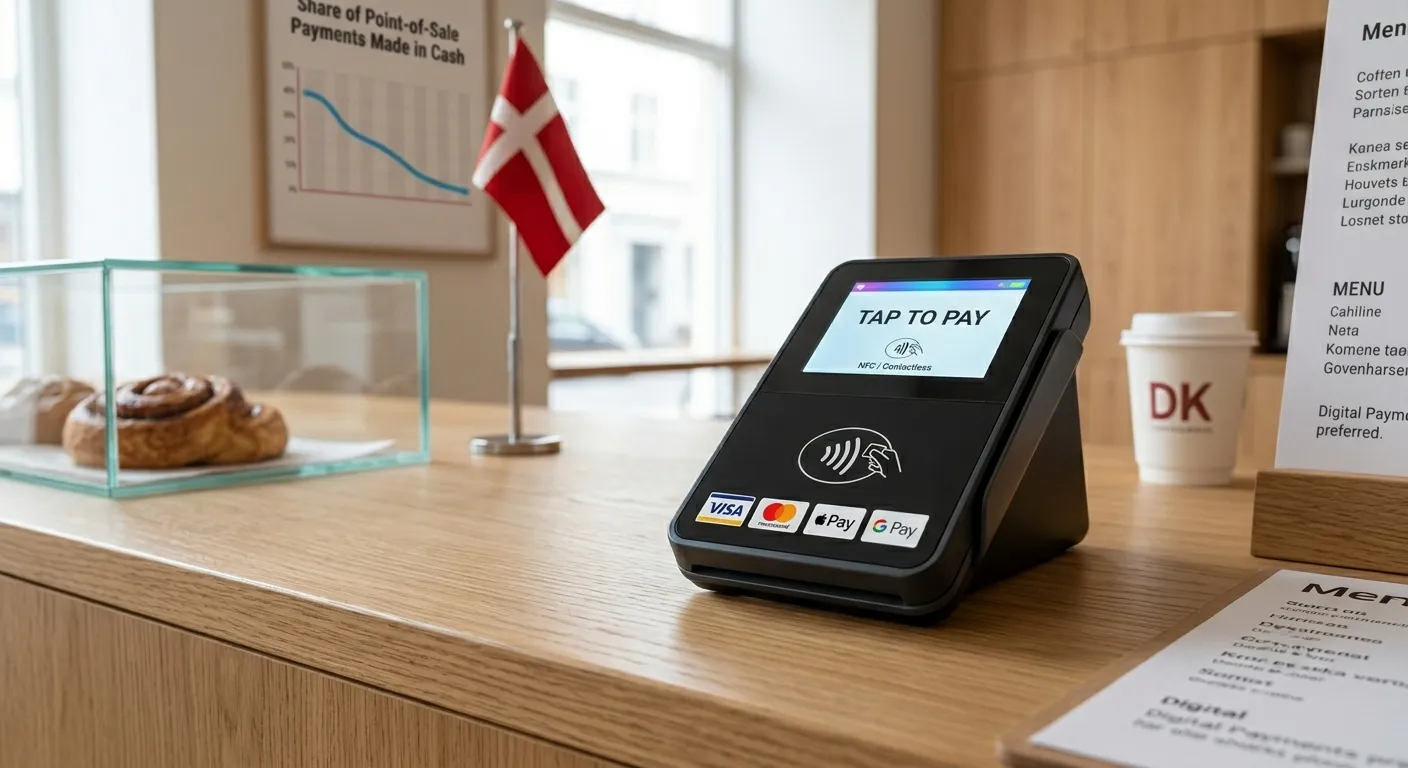
Denmark's national debit card since 1983. ~5 million cards in circulation. Almost always co-issued with Visa (Visa/Dankort) or Mastercard. Widely accepted everywhere in Denmark — but only available to those with a Danish bank account. Foreign visitors cannot obtain one.
Visa / Mastercard
Accepted across the vast majority of shops, restaurants, and hotels in Denmark. Visa is most widely recognized; Mastercard follows closely. Contactless works for any transaction size. The single most practical option for tourists and expats.
MobilePay
Used by 76% of the Danish population. Works for P2P transfers, in-store payments, e-commerce, and even flea markets. Foreign visitors can register with an international number but face feature limitations without a Danish bank account.
Apple Pay / Google Pay
Apple Pay launched in 2017, Google Pay in 2018. About 30% of Danes can now pay with Apple Pay. Foreign travelers can link their existing cards to these wallets — a seamless upgrade to contactless. NFC compatibility continues to improve.
Key Point: Dankort vs. Visa — What's the Difference?
When Danes say "my dankort," they almost always mean a Visa/Dankort combo card. In most shops, the terminal automatically routes through the cheaper Dankort network. A small number of shops with older terminals only accept the Dankort network — meaning they may decline a foreign-issued Visa card. This is rare in Copenhagen but more common in rural areas. Always carry a Visa card when visiting Denmark.
Payment Method by Situation
| Payment Method | Supermarket | Restaurant | Small Café | Public Transport | Outdoor Market | For Foreigners |
|---|---|---|---|---|---|---|
| Dankort | ✅ Perfect | ✅ Perfect | ✅ Perfect | ✅ | ⚠️ Some | ❌ Locals only |
| Visa/Mastercard | ✅ Perfect | ✅ Perfect | ⚠️ Usually OK | ✅ | ⚠️ ~70% | ✅ Best Choice |
| MobilePay | ✅ Perfect | ✅ Perfect | ✅ Perfect | ⚠️ Some | ✅ Widespread | ⚠️ Limited |
| Apple/Google Pay | ✅ | ✅ | ⚠️ Depends on terminal | ✅ | ❌ Rare | ✅ Convenient |
| Cash | ⚠️ Possible | ⚠️ Most places | ⚠️ Some refuse | ❌ Usually impossible | ⚠️ Some only | ⚠️ Not recommended |
Practical Card Guide for Foreign Travelers ✈️
For foreign visitors, the most important question is simple: will my card actually work? Denmark technically accepts all Visa and Mastercard payments, but a few real-world variables can catch you off guard.
🔑 Understanding the Fee Structure
The core reason Danish merchants prefer Dankort is transaction fees. When a customer pays with Dankort domestically, merchants pay very low fees. Accepting a foreign-issued Visa or Mastercard, however, triggers additional interchange fees from the issuing bank's network. This is why some smaller shops have historically been reluctant to accept foreign cards — and in rare cases, will outright decline them. (Note: Charging extra fees for this reason is illegal under EU law.)
Card Preparation Tips Before You Fly
The best preparation is to bring a travel card with zero or minimal foreign transaction fees. Options like Wise (formerly TransferWise) debit card, Revolut, or a no-FX-fee travel credit card give you excellent exchange rates with low overhead. Bring both a Visa and a Mastercard for backup. Notify your bank of your travel dates to prevent security blocks on overseas transactions.
Common Card-Related Situations Foreigners Encounter in Denmark
- Major supermarkets (Netto, Lidl, Føtex, Bilka): All major international cards, Apple Pay, Google Pay fully accepted. A single piece of chocolate for 5 DKK? Card is fine — nobody bats an eye.
- Restaurants & cafés: Close to 100% card acceptance in Copenhagen. Even small neighbourhood cafés have terminals accepting Visa and Mastercard.
- Museums & tourist attractions: Online booking or on-site card payment works everywhere. The Copenhagen Card can be purchased in advance by card.
- Taxis & Uber: App-based payments (Bolt, Cabify) or in-car card terminals are standard. Cash requests are extremely rare.
- Old-terminal small shops: Rare, but some rural or very small shops still run Dankort-only terminals. In those cases you'll need cash or an alternative method.
- ID requests: Some retailers may ask for photo ID (passport) before approving a credit card transaction. Always carry your passport.
⚠️ American Express Warning
American Express works in upscale hotels, some duty-free shops, and select restaurants in Denmark — but is frequently rejected at regular supermarkets and smaller shops. Always carry a Visa or Mastercard as your primary card.
MobilePay: The Heartbeat of Danish Payments 📱
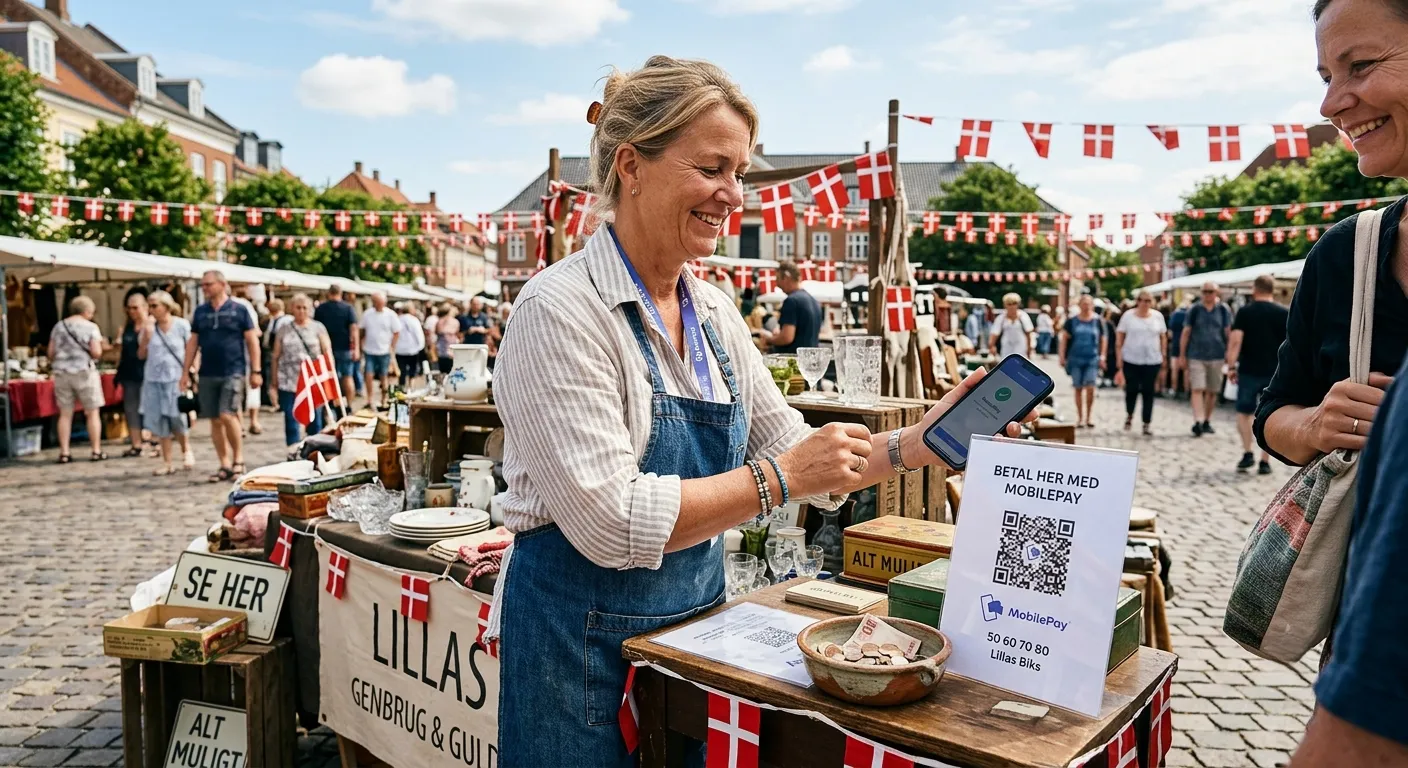
To understand Denmark, you need to understand MobilePay. It's not just a payment app — it's woven into the fabric of daily Danish life. Friends split a dinner bill through it. The local bakery uses it. Flea market vendors put a printed QR code next to their old LPs. It's everywhere.
MobilePay works on phone numbers. You type in someone's number or scan a QR code, and the transfer or payment is instant. In stores, NFC or QR code tap completes the checkout. It has become so embedded in Danish culture that you'll find MobilePay QR codes on church collection plates and charity donation boxes.
Can Foreign Visitors Use MobilePay?
This is the most common question from travelers. Officially, MobilePay offers full functionality to users with Danish, Norwegian, or Finnish phone numbers. Registration is technically possible with a foreign number, but without a linked Danish bank account, P2P receiving functions and some payment features are restricted. For long-term expats (students, working holiday visa holders), opening a Danish bank account and setting up MobilePay is strongly recommended.
Short-Term Traveler? Stick with Apple Pay + Visa
MobilePay setup is complex for tourists. The simplest approach is to link your existing foreign card to Apple Pay or Google Pay before you leave home. Nearly all NFC-capable terminals in Denmark will work seamlessly. In central Copenhagen, you'll rarely need anything more. That said, having a physical card as a backup is still wise in case a terminal has connectivity issues or doesn't support NFC.
How MobilePay Has Reshaped Danish Life
MobilePay isn't just a feature of Danish society — it's infrastructure. A few telling examples:
🏪 Weekend Flea Markets: On a Saturday morning at Copenhagen's Islands Brygge market, sellers are almost universally equipped with a printed MobilePay QR code taped to their stall. Buying a vintage paperback for 20 DKK? QR code scan — done.
🍺 Bars and Nightlife: Copenhagen's bar scene runs on MobilePay's splitting culture. One person pays the tab; everyone else instantly MobilePays their share. This frictionless splitting is a social norm.
🏠 Rent and Utilities: Many Danish landlords collect rent through MobilePay. Utility bills and subscriptions can be set to auto-debit through a MobilePay linkage — essentially replacing traditional standing orders for younger generations.
👨👩👧 Children's Allowances: Danish parents routinely send weekly pocket money to their kids via MobilePay. It's common for children as young as 10 to have their own MobilePay account tied to a parent-monitored wallet.
7 Situations Where Cash Is Still Useful 💶
Traveling cashless through Denmark is genuinely possible — but "possible" isn't the same as "100% risk-free." Here are seven situations where having some cash on hand saves the day.
-
1️⃣ Old-Terminal Rural Shops
Remote areas like Bornholm island or Western Jutland harbour a small number of shops with outdated Dankort-only terminals. According to the Confederation of Danish Industry (DI), only about 25% of businesses in these outlying regions consistently accept card payments. If your itinerary includes rural cycling or island hopping, carry DKK 300–500 in cash.
-
2️⃣ ATM Shortages in Rural Areas
The number of ATMs in Denmark fell by 18% between 2020 and 2023, with rural areas hit hardest. If your card suddenly gets blocked or a terminal fails, finding an ATM outside major cities can be a challenge. Withdraw a small cash reserve while you're still in Copenhagen.
-
3️⃣ Some Outdoor Events and Markets
MobilePay has dramatically reduced cash-only stalls at markets, but very small, informal pop-up events or farm-direct produce stands may still be cash-preferred. Major indoor markets like Torvehallerne are fully card-friendly; tiny temporary outdoor setups may not be.
-
4️⃣ Tipping in Cash
Tipping isn't mandatory in Denmark, but 5–10% is a warm gesture for excellent service. Many terminals now offer a tip prompt, but some servers still prefer a physical cash tip handed directly to them.
-
5️⃣ Coin-Operated Parking Meters
Copenhagen city parking uses EasyPark and ParkMan apps or card readers, but older coin meters still exist in some districts. If you're renting a car, a handful of DKK coins in the centre console is practical insurance.
-
6️⃣ Some Pay-Per-Use Public Toilets
Certain tourist-area and train station restrooms charge a coin fee. Copenhagen's Central Station (Hovedbanegård) has coin-operated facilities. A few 2–5 DKK coins in your pocket sidesteps any awkward moments.
-
7️⃣ Cyber Incidents or Power Outages
Danmarks Nationalbank explicitly notes that "cash remains the payment method of last resort in the event of a cyberattack or power failure." Keeping a small cash reserve is prudent in any country with a digital-first economy — and Denmark is no exception.
Transport, Accommodation & Dining — Payments Explained 🚇🏨🍽️
Let's walk through the day-to-day travel scenarios that matter most.
🚌 Public Transport
Copenhagen's metro, S-tog suburban rail, and city buses have embraced contactless payments. Visa and Mastercard contactless cards work directly at metro gates. Buses accept card terminals onboard. From 2025, the contactless fare integration across the Greater Copenhagen region has been further expanded, making tap-to-ride universally available on any modern card.
Copenhagen Card vs. Contactless Card
Rejsekort (the local transit card with slightly discounted fares) is ideal for residents staying more than three years. Short-term visitors have two better options: (1) the Copenhagen Card (24/48/72/120-hour unlimited transport + free admission to 80+ attractions), purchased online with any card; or (2) direct tap-and-go with your contactless credit card. Both eliminate the need for Rejsekort setup or cash entirely.
🏨 Accommodation
Hotels, hostels, and Airbnbs in Copenhagen accept card payments without exception. Most properties take a card imprint at check-in and charge automatically at checkout — no cash handling needed at all. For rural B&Bs or very small country guesthouses, it's worth emailing ahead to confirm payment options.
🍽️ Restaurants and Cafés
Dining in Denmark is gloriously uncomplicated from a payment perspective. The waiter brings a handheld wireless terminal to your table; you tap or insert your card and it's done. Tipping is added on the terminal or given as cash. Everything from a Michelin-starred tasting menu to a street hot dog from a pølsevogn can be paid by card.
A telling detail: at Danish supermarkets, no cashier raises an eyebrow if you pay for a single piece of candy worth 3 DKK by card. The infrastructure is built for it, and so is the cultural expectation.
⛽ Petrol Stations & Convenience Stores
Denmark's major petrol chains (Circle K, Q8, OK) run on automated card-pay pumps. Insert card, select fuel grade, fill up — payment is automatic. Convenience stores (7-Eleven, Meny) accept all major cards without issue.
🛍️ Shopping
Copenhagen's Strøget pedestrian shopping street, major department stores (Magasin du Nord), and outlet centres accept all major international cards. For VAT refunds (available on purchases of DKK 300+), you can claim at the airport in cash or by card credit back to your account.

Real Community Reactions: "I Went Cash-Free in Denmark" 🗣️
What do actual travelers and expats say about navigating Denmark without cash? Here's a curated selection from Reddit (r/Denmark, r/copenhagen, r/solotravel) and travel review platforms.
"Spent 10 days in Copenhagen and literally never touched an ATM. Hotels, restaurants, transport, even a random street vendor — all accepted card. I'd been nervous about going cashless but the whole thing was seamless. Sweden and Norway felt the same way."
✅ Completely cashless trip — success"I cycled through northern Jutland and only once hit a wall — a farm shop selling apples that only had an old Dankort terminal. I smiled, shrugged, and moved on. Everywhere else? Visa card handled everything, no questions asked."
⚠️ Rural areas need attention"I usually take cash whenever I travel, and I took some to Denmark too — but there was really no need. Payment by card or phone is way more common here. I barely broke out the banknotes at all."
✅ Card is the default, cash is the exception"Brought my Revolut card and that was literally all I needed. No DKK exchange at the airport. The card just converted at the live rate every time. MobilePay is tricky as a foreigner without a local bank account, so I just skipped it and used Apple Pay instead — worked perfectly at every NFC terminal."
✅ Travel card + Apple Pay = perfect combo"I took out 300 DKK at the airport ATM when I arrived and didn't spend it for four months. The cafeteria, the gym, the corner store — all card. Eventually I just kept the notes as a souvenir. The one thing I noticed: cashiers seem mildly inconvenienced when you pay with cash, because counting change disrupts their flow."
✅ Long-term stay fully manageable without cash"I genuinely don't own any DKK notes. Paying cash here feels weird and slightly anachronistic. That said, I do think the speed of this transition has created a real accessibility issue — elderly people and recent immigrants who don't have local bank accounts get left behind, and that's a serious conversation we need to keep having."
⚠️ Digital inclusion gap remains a concernYour Pre-Trip Denmark Payment Checklist ✅
Based on everything covered above, here's the definitive checklist to prepare before you fly to Denmark.
| Item | Priority | Details |
|---|---|---|
| Visa or Mastercard with low FX fees | Essential | Wise, Revolut, or a no-FX-fee travel credit card. Avoids paying 1.5–3.5% on every transaction. |
| Bring at least 2 cards | Essential | In case one is blocked, declined, or lost. Ideal combo: Visa + Mastercard. |
| Enable contactless on your card | Essential | Confirm with your bank that overseas contactless (NFC tap) is active before departure. |
| Register Apple Pay / Google Pay | Strongly Recommended | Link your travel card to your phone wallet before you leave. NFC compatibility in Denmark is excellent. |
| Carry DKK 300–500 in cash | Recommended | Emergency fund for rural shops, coin parking, restroom fees, cash-only stalls. Withdraw from a low-fee ATM in Copenhagen. |
| Buy Copenhagen Card online (if applicable) | If relevant | Best value for Copenhagen-focused trips. Purchased by card online — zero cash needed. |
| Check travel insurance on your card | Recommended | Many travel credit cards include automatic travel insurance for purchases made on the card. Read the fine print. |
| Set up MobilePay (long-term stays only) | Expats only | For 3-month+ stays, open a Danish bank account (Revolut DK or Lunar are expat-friendly) and register MobilePay. |
💱 Understanding the Danish Krone (DKK)
Denmark uses the Danish Krone (DKK) — not the euro, even as an EU member. However, the DKK is pegged closely to the euro, which makes exchange rates extremely stable. As of 2025–2026: 1 EUR ≈ 7.46 DKK, 1 USD ≈ 6.7–6.9 DKK. Because card payments are so universal, there's genuinely little reason to carry large amounts of DKK cash.
Best Way to Get DKK Cash If You Need It
If you need a small cash reserve, the best options in order of value are: (1) Wise or Revolut card withdrawal from a Copenhagen ATM at the live mid-market rate; (2) Use a no-FX-fee debit card at any major bank ATM; (3) Exchange at your home bank before travel. Avoid airport exchange bureaux — their spreads are notoriously unfavorable. And remember: for most of your Denmark trip, your card will handle everything.
🔐 Card Security in Denmark
Denmark has one of the lowest card fraud rates in Europe. In 2024, total card fraud amounted to just 0.36 per thousand of card turnover — the equivalent of DKK 360 for every million kroner spent. That said, standard card hygiene applies:
- Always insert, tap, or hold your card at the terminal yourself — you rarely need to hand it to a cashier.
- Check your receipts and enable real-time transaction alerts in your bank's app.
- Avoid using internet banking on public Wi-Fi, or use a VPN.
- Immediately call your bank if a charge looks unfamiliar.
If you've been stressing about "how much cash to bring to Denmark" — you can relax. The far better question to spend time on is "which travel card has the lowest foreign transaction fees?" Denmark has arrived in the future of payments. One card and a smartphone are genuinely all you need to explore this extraordinary Scandinavian country without ever touching a banknote. Enjoy your trip! 🌟