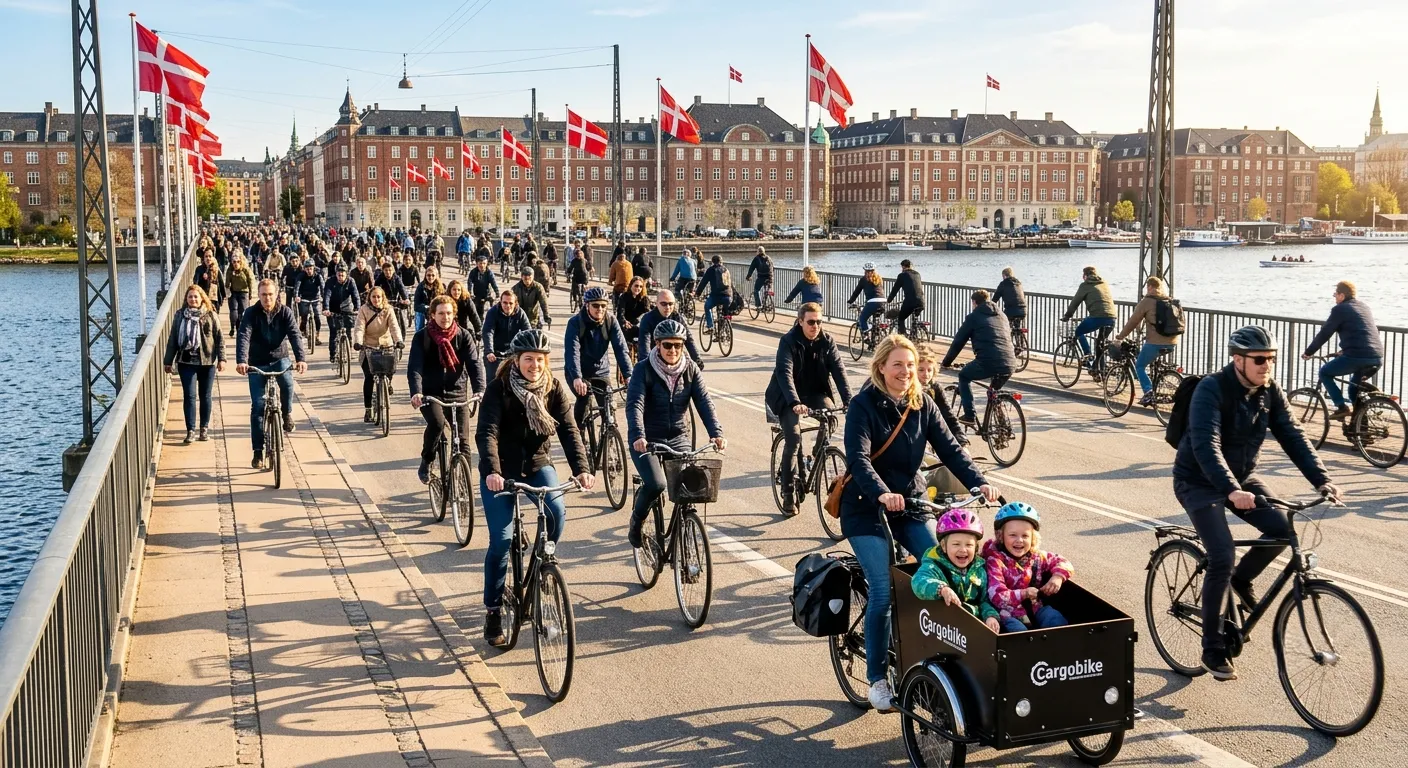
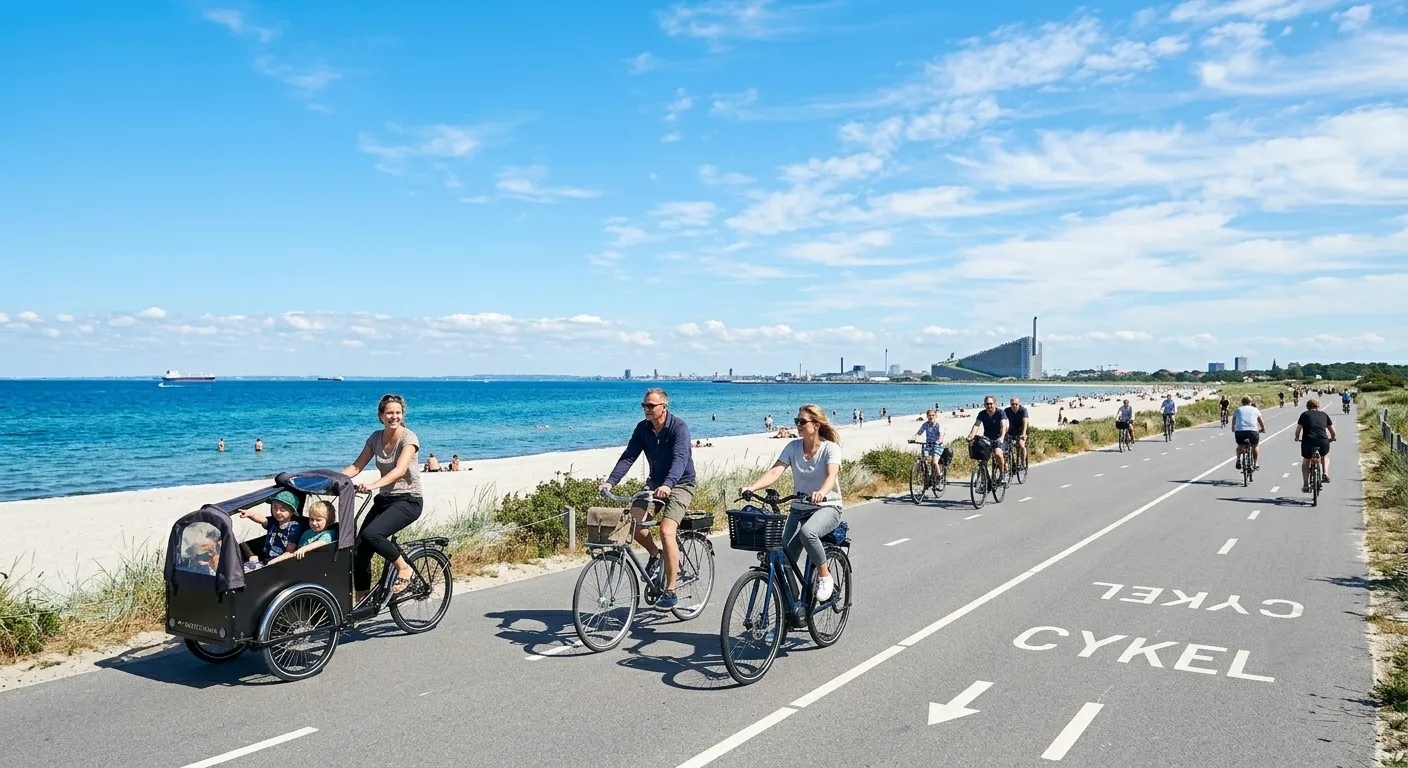
When you land at Copenhagen Airport and make your way into the city for the first time, something catches your eye immediately — and it's not a famous landmark. It's bikes. An absolute flood of them. Commuters in business suits, parents pedaling cargo bikes loaded with children, grandmothers with grocery-filled baskets. When the light turns green, they all surge forward together. It's nothing like the morning rush you know from back home. Denmark isn't just a country where people happen to ride bikes. It's a country where the bike is literally a way of life.
ownership rate
commute rate
bike lane network
Queen Louise's Bridge
infrastructure budget
cycling city
How Denmark Became a Cycling Paradise — 50 Years in the Making
Denmark's relationship with the bicycle didn't happen overnight. It's a story that stretches back over 140 years, to when the first bikes arrived in the 1880s. By the 1920s and 30s, cycling had evolved from a hobby of the wealthy into a genuine symbol of equality. Royalty and factory workers alike pedaled side by side down the same streets. The bike was democratic before democracy was fashionable.
Then came the 1950s boom. As prosperity spread, Danes began swapping saddles for steering wheels. Urban planners, like their counterparts everywhere, believed the future belonged to the automobile. Wider roads, more parking, car-first everything. It looked like the bike might be relegated to a recreational curiosity. But in 1973, the Middle East oil crisis changed everything. As fuel prices skyrocketed, the Danish government declared "Car-Free Sundays," encouraging citizens to leave their cars at home. Families who dusted off their bikes that autumn never really put them away again.
By the 1980s, another chapter of Danish cycling folklore was being written. Inside the unconventional commune of Christiania, craftspeople invented the cargo bike — a three-wheeled contraption with a large wooden box at the front, originally designed for hauling goods. It quickly found a second vocation as a family vehicle. Today, the Christiania Bike is as recognizable a symbol of Copenhagen as the Little Mermaid statue.
"Our nation wasn't built on the car industry. That's why we had no reason to give up the bike. For Danes, cycling isn't just transportation — it's a way of life." — Eveliina Peltokoski, Copenhagen cyclist
Copenhagen's Jaw-Dropping Cycling Infrastructure
Cycling culture doesn't build itself. Behind every commuter who rides through a Copenhagen winter lies decades of deliberate urban planning and serious public investment. Today, Copenhagen's cycling infrastructure centers on 397km of dedicated bike lanes — a network that no other city on earth has yet matched in completeness or quality.
🛣️ Curb-Separated Bike Tracks
Copenhagen's bike lanes are not just lines painted on the edge of a road. They are physically separated from car traffic by raised curbing, creating a space where cyclists can ride without fear of being hit from behind. Each intersection has its own dedicated cycling traffic lights. At many junctions you'll find a "bike box" — a waiting zone for cyclists positioned in front of car traffic, giving bikes a head start when the light turns green. The total cycling infrastructure spans 397km inside Copenhagen alone and an extraordinary 12,000km across the whole of Denmark.
🚦 The Green Wave — Traffic Lights Synchronized for Bikes
Copenhagen's secret weapon for cycling commuters is the "Green Wave" system. During morning rush hour (7–9am) and afternoon rush hour (3–5pm), traffic signals along major cycling corridors are timed so that a cyclist traveling at roughly 20km/h will hit green lights continuously. While motorists queue at red lights, cyclists glide through uninterrupted. Once you've experienced it, sitting in a car starts to feel genuinely absurd.
🌉 Cycling Bridges and Elevated Paths
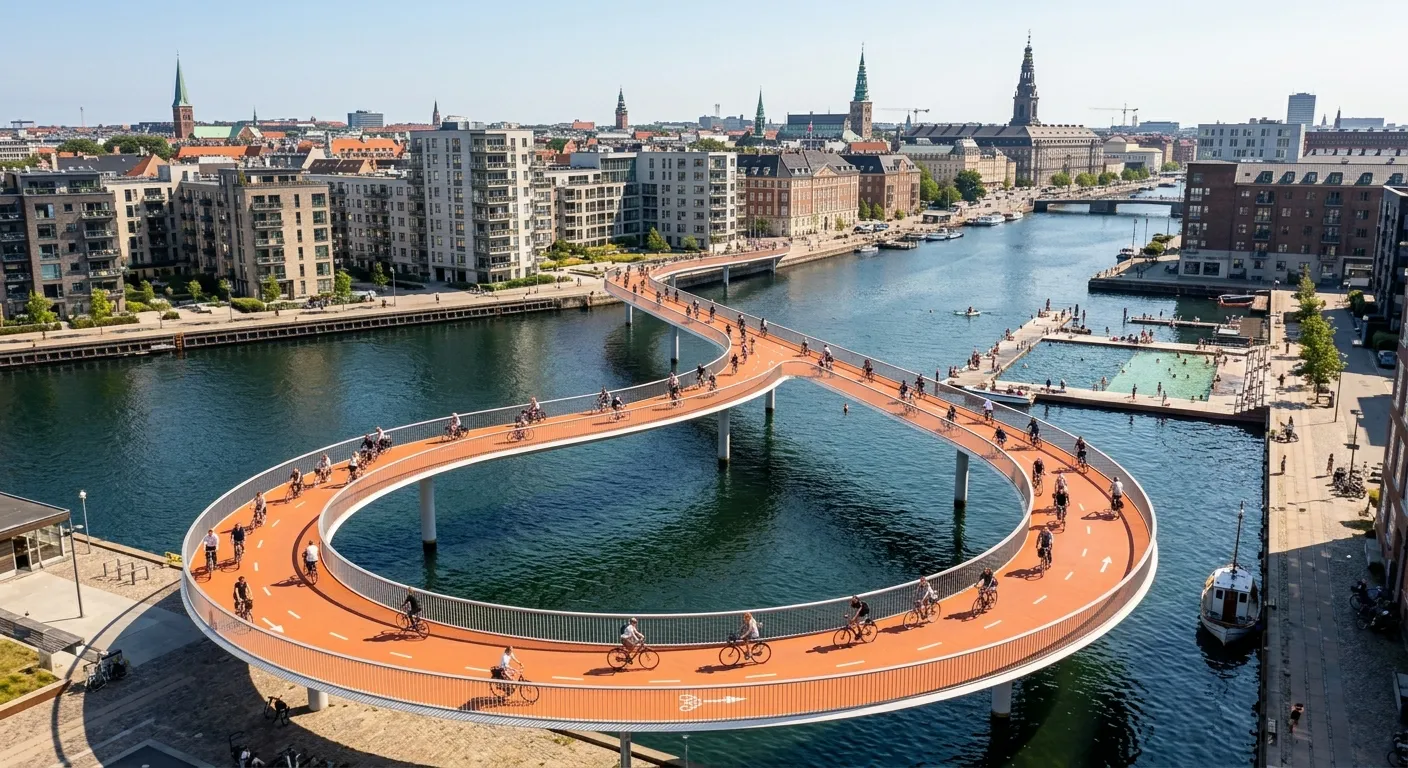
Some of Copenhagen's most striking infrastructure is built exclusively for cyclists. The most famous example is Cykelslangen ("The Bicycle Snake") — a swooping orange S-shaped elevated cycle highway that arcs over the harbour, connecting Vesterbro to Islands Brygge. It has won international architecture awards and is simultaneously one of the city's most-used daily commuting routes. On the opposite end of the scale, Dronning Louises Bro (Queen Louise's Bridge) is an older, flat canal bridge that sees over 40,000 cyclists every single day, making it the most trafficked cycling stretch in Denmark.
🛤️ The Cycle Superhighways
For those living in Copenhagen's suburbs, the Cycle Superhighways connect outlying towns to the city center — some reaching up to 15km. Launched in 2012, the network currently covers 18 routes totaling 286.6km, with plans to expand to over 850km by 2045. Following the opening of the first superhighways, bike traffic on those corridors rose by an average of 36%. The lesson is straightforward: build the infrastructure, and riders will come.
The Economics Behind the Investment
Copenhagen's record DKK 600M+ cycling budget in 2025 wasn't generosity — it was cold calculation. Every kilometer cycled generates 7.11 DKK of social benefit (health savings, reduced congestion, lower emissions), while every kilometer driven by car costs society 0.69 DKK in externalities. Cycling generates an estimated €2.3 billion in annual social value across Denmark. It's simply good economics.
🚉 Seamless Integration with Public Transport
Copenhagen's cycling network doesn't stop at the train station — it flows directly into it. Every metro and rail station has dedicated, high-capacity bike parking. In 2021, Denmark installed secure bike sheds at 70 public transport stations nationwide, accessible by registered users via an app. You can also bring your bike onto trains, provided you use the designated bike carriage (look for the bike symbol on the exterior of the train).
Choosing the Right Bike for Your Danish Lifestyle
Walking into a Danish bike shop for the first time can be overwhelming if you're used to the mountain bike vs road bike binary. Denmark has its own cycling typology, shaped by decades of practical urban riding. Here's what you'll actually encounter.
City Bike / Omafiets
The Danish workhorse. Upright riding position, internal gear hub, robust frame, integrated lock. Designed for comfort over long distances in a city context. Many come with front and rear racks as standard.
Used: 1,500–5,000 DKKCargo Bike (Ladcykel)
The icon of Danish family life. Large box at the front fits 2–3 children or substantial cargo. "Taking your kids to school in a cargo bike is cooler than an SUV." 1 in 4 Copenhagen families with two+ kids owns one.
New: 15,000–50,000 DKKE-Bike (Electric)
Growing rapidly in popularity. Especially valued by older riders, long-distance commuters, and those battling Denmark's frequent headwinds. Electric cargo bikes are also booming. Synergizes perfectly with the Cycle Superhighways.
New: 15,000–35,000 DKKRoad / Gravel Bike
For sport and leisure riding. Denmark's passion for road cycling exploded when the country hosted the Tour de France in 2022 and Jonas Vingegaard won the whole thing at just 25. Weekend riding clubs and gran fondos are now everywhere.
New: 5,000–30,000+ DKK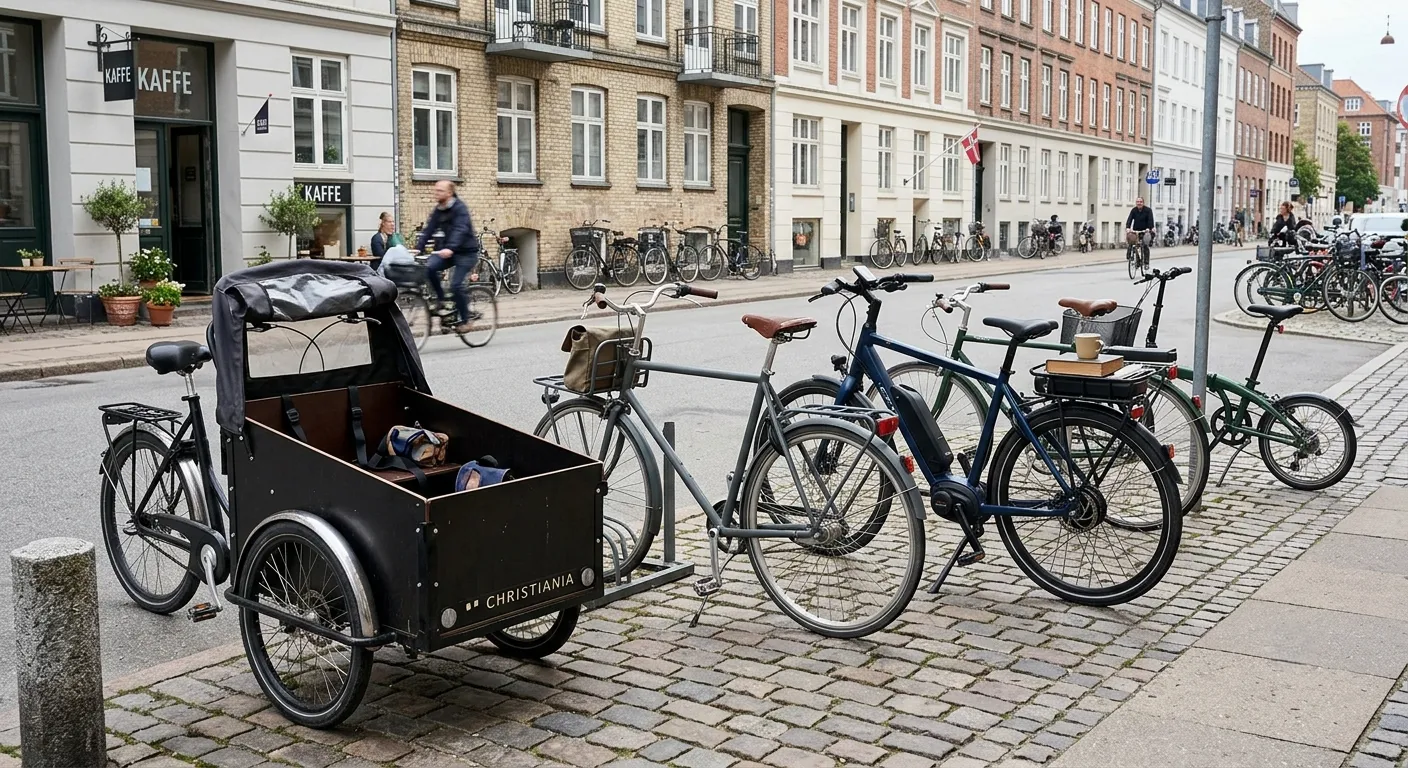
🍼 The Cargo Bike — Rethinking Family Transport
The cargo bike deserves a deeper look, because it really does represent a fundamentally different relationship between cities and families. It originated in Christiania in 1972 (Christiania Bikes, still making hand-crafted cargo bikes today) and has since spawned a world-class industry. Danish brands like Larry vs Harry (the sporty Bullitt), Triobike, and Winther are sold globally and regularly win design awards. A quarter of Copenhagen families with two or more children own one — using it for school runs, grocery trips, and family days out. In Denmark, a cargo bike has genuinely replaced the second car for many households.
💡 Try Before You Buy
If you're considering a cargo bike, rent one first. Donkey Republic and Baisikeli both offer family cargo bike rentals in Copenhagen. Handling a cargo bike is different from a regular bicycle — the turning radius alone takes some getting used to. A few test rides before committing to a DKK 20,000+ purchase is time very well spent.
🚲 Bike-Share Options for Visitors
Visiting Copenhagen and don't want to buy? Two solid options cover most needs. Donkey Republic operates a dockless bike-share where you find bikes via app and unlock them with a QR code — available in Copenhagen and several other cities. Bycyklen is the city's official public bike system, offering electric bikes at roughly 29 DKK per hour from stations scattered across the city center. Both are genuinely good ways to experience cycling in Copenhagen before committing to ownership.
Rules of the Road and Unwritten Etiquette
When you enter a Copenhagen bike lane, you're entering a social contract. There are legal rules — enforceable with fines ranging from 500 to 1,500 DKK — and there are unwritten rules that are just as important to know if you want to avoid glares, near-misses, and the quiet disapproval of Copenhageners who take their cycling very seriously.
⚖️ The Legal Rules — Non-Negotiable
| Rule | Detail | Fine if Broken |
|---|---|---|
| Ride on the right | Always keep to the right. If a bike lane exists, you must use it. | 500–1,000 DKK |
| Hand signals | Signal before turning or stopping. Arm straight out for turns, hand raised for stopping. | 500 DKK |
| Lights after dark | White light at front, red light at rear. Reflectors alone are not sufficient at night. | 500–1,000 DKK |
| Reflectors | White front reflector, red rear reflector, yellow reflectors on pedals and wheels. Bikes sold in Denmark come standard with these. | 500 DKK |
| Bell | A working bell is legally required on all bikes. | 500 DKK |
| Red lights | Stop at red. No right-on-red unless there's a specific signal permitting it. | 1,000–1,500 DKK |
| Helmet | Not mandatory for adults. Strongly recommended — but your call. | — |
| Phone use | No holding your phone while cycling. Stop and check the map if you need to. | 1,000 DKK |
| Carrying children | Riders over 15 may carry up to 2 children under 8 in approved seats or cargo bikes. | Warning / fine |
🤝 The Unwritten Rules — Cycle Like a Copenhagener
Knowing the law gets you legal. Knowing the culture gets you respect. Here's what no signage will tell you:
- Ring your bell before overtaking: Standard practice and considered polite. Don't ghost-pass someone; a quick ring is the courtesy signal.
- Slow riders keep right: The left side of a bike lane is the fast lane. If you're dawdling, move right and let commuters pass.
- Stop for buses: If a bus is stopped and its doors open onto the bike lane, you must stop to let passengers board and alight. Many locals ignore this. Don't be that person.
- Maintain pace during rush hour: The 7–9am and 3–5pm windows are serious business. If you're exploring leisurely, do it outside these hours.
- Signal before you stop: Check behind you, then raise your hand before slowing. The cyclist behind you needs that warning.
- No salmon cycling: Going the wrong way in a bike lane is not just illegal — it's genuinely dangerous and will earn you a chorus of bells and stares.
⚠️ The Door Zone — A Common Tourist Mistake
The most dangerous moment in Copenhagen cycling isn't a fast intersection — it's parked cars. Opening a car door into the bike lane ("dooring") is a leading cause of cyclist injury. Give parked cars a wider berth than you think you need. Similarly, never walk in the bike lane. In Copenhagen, a painted bike symbol on the road means it's a no-go zone for pedestrians — and cyclists will ring at you.
Cycling Through Winter — Yes, Danes Really Do It
"Do people actually cycle in winter?" It's the first question most visitors ask. The answer from Danes is an almost bored "yes, of course." Sub-zero temperatures, driving rain, wind, darkness by 4pm — none of it stops them. Copenhagen's year-round cycling rate stays above 80%, not because Danes are hardier than the rest of us, but because the system is designed to make winter cycling viable.
🧥 The Winter Cycling Kit — What Danes Actually Wear
The Nordic weather motto — "there's no such thing as bad weather, only bad clothing" — is taken seriously by Danish cyclists. Here's what a proper winter kit looks like:
- Waterproof jacket: Not water-resistant — waterproof. Look for one with reflective strips. This is your most important purchase.
- Waterproof trousers: Regular jeans become miserable within minutes in rain. Waterproof overpants are standard gear.
- Waterproof gloves: Cold hands affect your ability to signal and brake. Don't compromise here.
- Saddle cover: If you lock your bike outside, a waterproof saddle cover keeps the seat dry. Essential and cheap.
- Winter tires: Wider tread with more grip for wet and icy surfaces. Worth changing over as autumn arrives.
- Powerful rechargeable lights: Darkness hits by 4pm in December. Bright, long-lasting lights are legally and practically essential.
- Chain lubricant: Road salt and rain destroy chains. A wet-weather chain oil applied regularly prevents expensive damage.
🏛️ Infrastructure That Makes Winter Cycling Possible
Individual gear is only half the story. Copenhagen's infrastructure is explicitly designed for year-round use. By law and by practice, the city's snow clearance priority order puts bike lanes ahead of car roads. It's not uncommon to see the bike lane freshly salted while the adjacent car lane still has snow on it. The message is unmistakable: cyclists are not an afterthought in this city.
Buying a Bike in Denmark — Budget Guide for Every Wallet
If you're settling in Denmark, buying a bike isn't a purchase — it's an investment in your daily quality of life. The question isn't whether to buy, but how much to spend and where to shop. Danish prices are high, but there are smart approaches at every budget level.
🛍️ Where to Shop
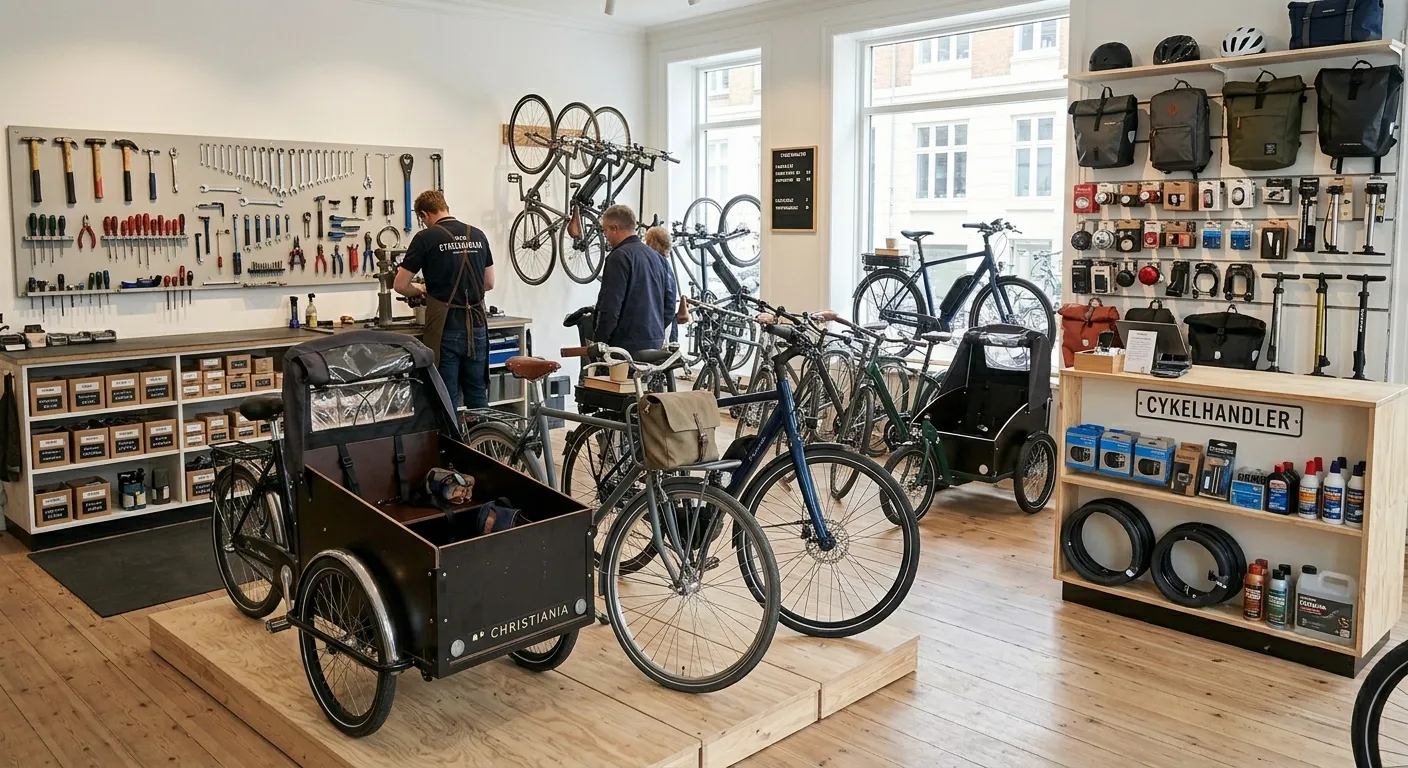
- Cykelhandler (specialist bike shops): The gold standard. Staff who know their products, proper assembly, fit service, and after-sale support. Worth paying slightly more for.
- Den Blå Avis: Denmark's leading second-hand marketplace — the local equivalent of Craigslist. The largest selection of used bikes. Prices are negotiable.
- Facebook Marketplace: Particularly useful for English-speaking expats buying from other expats. Active communities in Copenhagen and Aarhus.
- Aldi / Lidl: Both supermarket chains run periodic bike sales. Very low prices, basic quality — viable for absolute beginners or very short stays.
🔒 Theft Prevention — A Serious Copenhagen Reality
Bike theft in Copenhagen is common. The city is trying hard to address it, but reality is reality. Here's how to protect your investment:
💡 Theft Prevention Essentials
Two locks minimum: A quality U-lock plus a chain lock together. Thieves will move to an easier target. Lock to fixed objects: Always secure to a bike rack, lamppost, or other immovable structure. Register with Politi: Register your bike's serial number with Danish police. Recovery rates are higher for registered bikes. Check your home insurance: Most Danish home insurance policies (Indboforsikring) include bike theft coverage — verify yours does before assuming it doesn't.
Top 5 Must-Ride Copenhagen Cycling Routes
Copenhagen has hundreds of mapped cycling routes, but these five offer the best combination of scenery, practicality, and genuine Copenhagen experience. Whether you're commuting, exploring, or simply riding for pleasure, start here.
💡 Best Navigation Apps for Cycling in Denmark
Google Maps works well for cycling directions in Denmark. For a more local experience, try Naviki (combines cycling routes with accommodation, food, and attraction info across Denmark) or Komoot (excellent for detailed route planning with terrain profiles). Both are free with optional premium features.
How Cycling Transforms Your Life — Health, Happiness & Hygge
Denmark consistently places near the top of global happiness rankings. There are many reasons for this, but cycling is more than a footnote. The daily act of cycling to work, school, or the supermarket connects directly to the Danish concept of hygge — a quality of everyday coziness, contentment, and social connection that's difficult to translate but immediately felt when you're riding through Copenhagen on an autumn morning.
💪 The Health Data Is Unambiguous
premature death
report being happy
per km cycled
from Danish cycling
Cyclists in Copenhagen are 28% less likely to die prematurely — and those who cycle daily are 52% more likely to report being happy than inactive peers. This isn't just about cardiovascular fitness. The commute itself becomes the exercise, stripping away the guilt of a missed gym session. And the incidental social interactions — with neighbors, colleagues who happen to share your route, the stranger who helps you fix a flat — quietly build a sense of community that other modes of transport simply don't generate.
💰 The Financial Logic Is Compelling
Owning a car in Denmark is deliberately expensive. New vehicle purchases incur registration tax that can exceed 85% of the car's value. Annual insurance, road tax, fuel, and parking add thousands more DKK per year. Contrast this with a bicycle: a quality city bike costs a few thousand DKK once, annual maintenance runs to a few hundred, and parking is free everywhere. For anyone living within cycling distance of work — which in a compact city like Copenhagen means most people — the financial case for ditching the car is overwhelming.
🌱 Copenhagen's Carbon Neutral Ambition
Copenhagen has declared its intention to become the world's first carbon-neutral capital. Cycling is central to that plan. Every kilometer cycled instead of driven removes a chunk of CO₂ from the city's atmospheric ledger. The city's investment in cycling infrastructure is simultaneously an investment in its climate commitments — which is why the economics of cycling spend are calculated so rigorously. Cycling doesn't just help you; it helps the city keep a promise it's made to the planet.
What Expats Really Think About Cycling in Denmark
The best perspective on Danish cycling culture often comes from those who arrived from somewhere else. Here's what people living in Denmark from around the world have shared on Reddit, Quora, and expat forums.
r/Copenhagen · r/Denmark · Community Voices
Cycling in Denmark — Answered
Lessons the World Can Learn from Denmark
It's tempting to look at Copenhagen and conclude that cycling success is a uniquely Danish cultural trait — that it works there because Danes are simply different. This is exactly wrong. In 1960, Copenhagen was a car city with declining cycling rates and urban planners actively removing bike lanes to make room for automobiles. The transformation happened because of choices: political choices, infrastructure choices, and funding choices made over five decades.
Three things made the difference. First, physical separation: bike lanes that are genuinely protected from car traffic, not just painted lines on the road. Second, network continuity: a system where you can cycle from anywhere to anywhere without the lane disappearing mid-route. Third, cultural normalization: consistent messaging that cycling is what sensible, modern people do — not something only hobbyists, students, or the carless do.
Cities that have followed this formula — Amsterdam, Utrecht, Seville, parts of Paris and Oslo — have seen cycling rates rise dramatically within a decade. The technology already exists. The examples are abundant. What's required is the political will to prioritize the person on the bike over the person in the car.
💡 The Core Lesson from Denmark
Denmark didn't start with a cycling culture and build infrastructure to match. It built the infrastructure first, and the culture followed. The lesson for any city looking to increase cycling rates: don't wait for people to choose bikes before you build the lanes. Build the lanes first — and people will choose bikes.
🏁 Final Thoughts — What Two Wheels Taught Me About Denmark
I want to close with a scene. A Copenhagen intersection, on a grey Tuesday morning in November. At the red light, there's a cargo bike with two bundled-up children in the box, a man in a suit and tie, a woman with a stack of files balanced on her rear rack, a student with headphones in, and an elderly gentleman in a rain cape. The light turns green. They all go, at their own speeds, in the same direction.
That's the thing about Copenhagen's cycling culture that no statistic quite captures. It's genuinely equalizing. Your income, your status, your destination — none of it is visible from a bike. You're just another person moving through the city at human speed, breathing the same air, sharing the same lane. It's a small thing. But in a world of increasing separation and stratification, there's something quietly radical about a system that puts the finance minister and the student in the same traffic light queue.
If you get the chance to visit Denmark, rent a bike. Don't take the bus or the metro for the first few days. Get on a bike, find Queen Louise's Bridge at morning rush hour, and let the city move around you. You'll understand, in a way no guidebook can explain, exactly what the fuss is about. And you might go home with an uncomfortable question: why doesn't my city look like this?
"Copenhagen is a city that invites you to cycle. It is simply our way of life, and if you want to experience it the local way, you have to jump in the saddle." — Visit Copenhagen