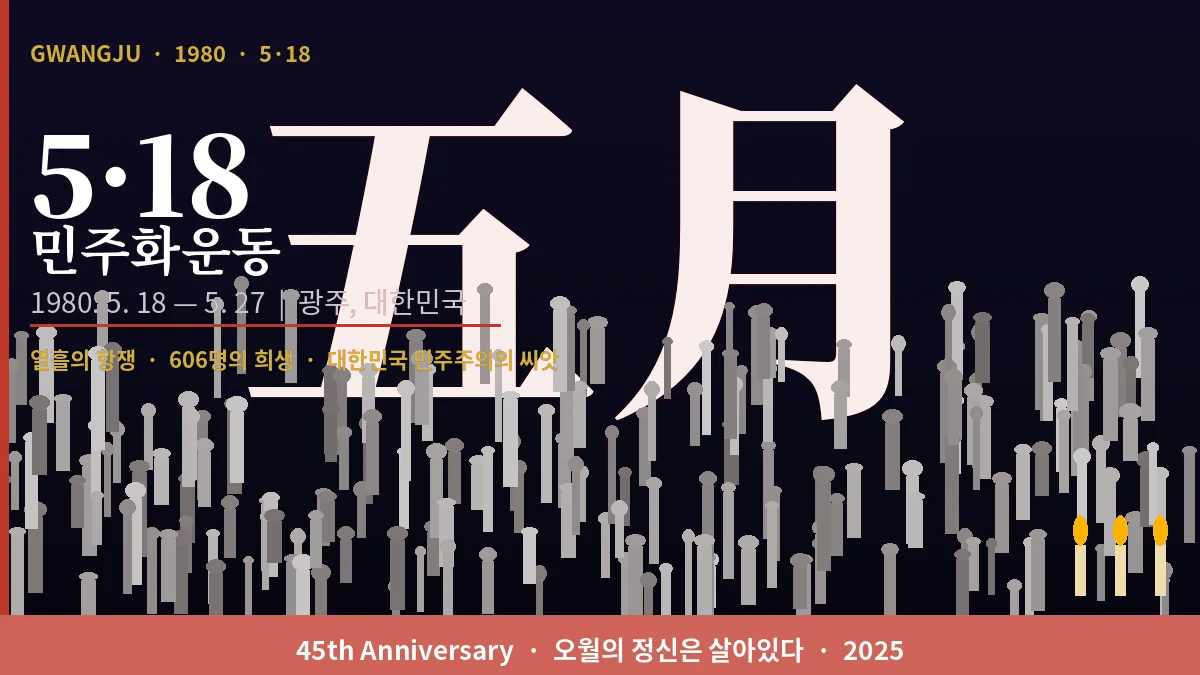
In May 1980, in the southern city of Gwangju, South Korea, history turned on a dime. Ten days of gunfire, solidarity, and extraordinary civic courage would become the foundation of Korean democracy — and spark a flame that spread across Asia. Forty-five years on, here is the complete story of the May 18 Democracy Movement: where it began, how it unfolded, why it still matters today, and what the world thinks of it now.
What Is the May 18 Movement? — Overview
The May 18 Democracy Movement (5·18 민주화운동, also known as the Gwangju Uprising or Gwangju Democratization Movement) refers to a massive civilian uprising that took place from May 18 to May 27, 1980, in Gwangju, South Korea (then Gwangju City, South Jeolla Province) and surrounding areas.
In essence, the movement was a direct response to the seizure of power by a group of military figures known as the New Military Faction (신군부), led by General Chun Doo-hwan. When the faction imposed martial law nationwide and arrested pro-democracy leaders, the citizens of Gwangju rose up, demanding the lifting of martial law, the resignation of Chun Doo-hwan, and the release of opposition figure Kim Dae-jung. The military's brutal response turned a protest into an uprising — and ultimately, a massacre.
(May 18 – 27)
victims (killed + missing)
including injured
of the World listing
in 2025
The three slogans that echoed through Gwangju's streets captured the political reality of the moment: "Lift martial law immediately," "Chun Doo-hwan, step down," and "Release Kim Dae-jung." These demands were not revolutionary fantasies — they were the basic prerequisites of constitutional democracy, which the military had just dismantled overnight.
The Fuse — Historical Background
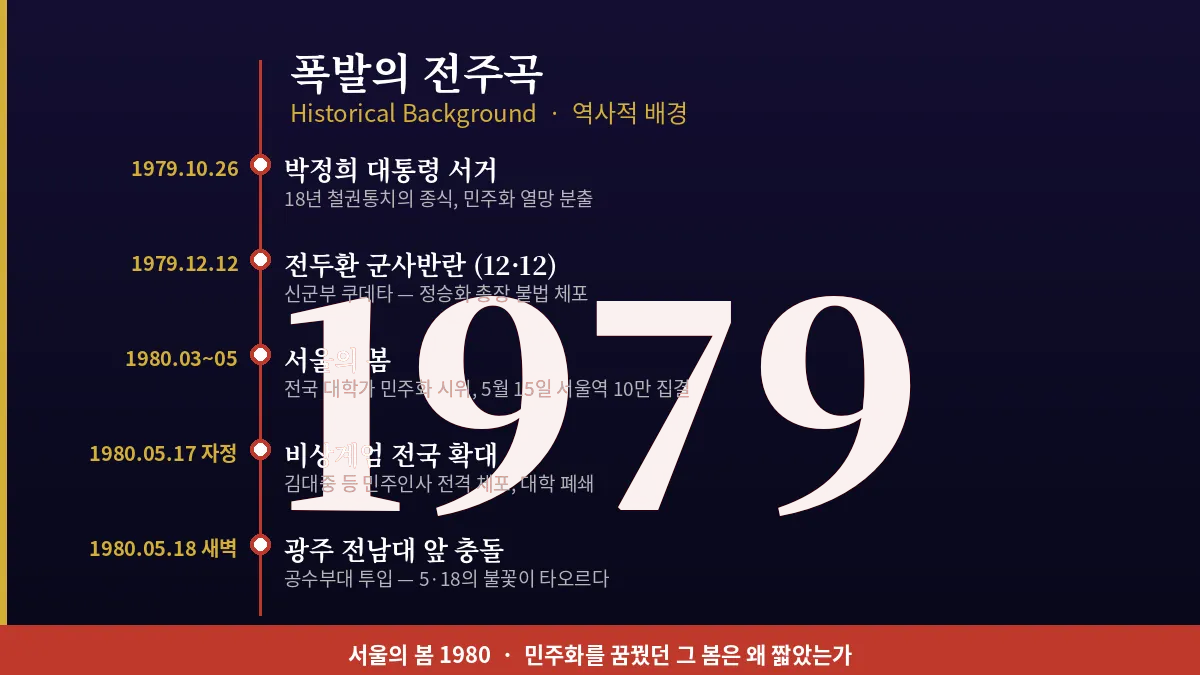
To understand May 18, you must go back to October 26, 1979. On that evening, President Park Chung-hee — who had ruled South Korea with an iron fist for 18 years — was assassinated by his own intelligence chief, Kim Jae-gyu. The country held its breath. The pent-up demand for democracy exploded in what became known as the "Seoul Spring": rallies, labor strikes, and calls for a new democratic constitution filled the streets from winter through the following spring.
But the window slammed shut. On December 12, 1979, General Chun Doo-hwan and his ally Roh Tae-woo staged an internal military coup known as the December Twelfth Incident (12·12 쿠데타). They illegally seized the army chief of staff and took control of the military chain of command. From that point, the path to martial law and eventually dictatorship was set.
On May 15, 1980, an estimated 100,000 students gathered at Seoul Station, demanding an end to martial law and the restoration of democracy. It was one of the largest demonstrations since the 1960 April Revolution — and it frightened the New Military Faction into action.
— Korean History Database, May 18 ChronologyBy early May 1980, labor disputes and student protests were escalating rapidly. Students poured out of campuses on May 13 demanding "end martial law, restore democracy." The junta's answer came swiftly: at midnight on May 17, a nationwide expansion of martial law was declared, universities were closed, and key democratic leaders — including Kim Dae-jung, Kim Young-sam, and Kim Jong-pil — were arrested or put under house arrest.
Ten Days That Shook Gwangju — Day-by-Day Timeline
What unfolded over those ten days in Gwangju is a story of extraordinary brutality — and extraordinary humanity. Here is how it happened, day by day.
The Human Cost — Numbers That Tell the Truth
The official death toll and the true count of those who died in Gwangju have never fully converged. Decades of suppression, missing records, and undiscovered remains mean the full scale of the tragedy may never be known.
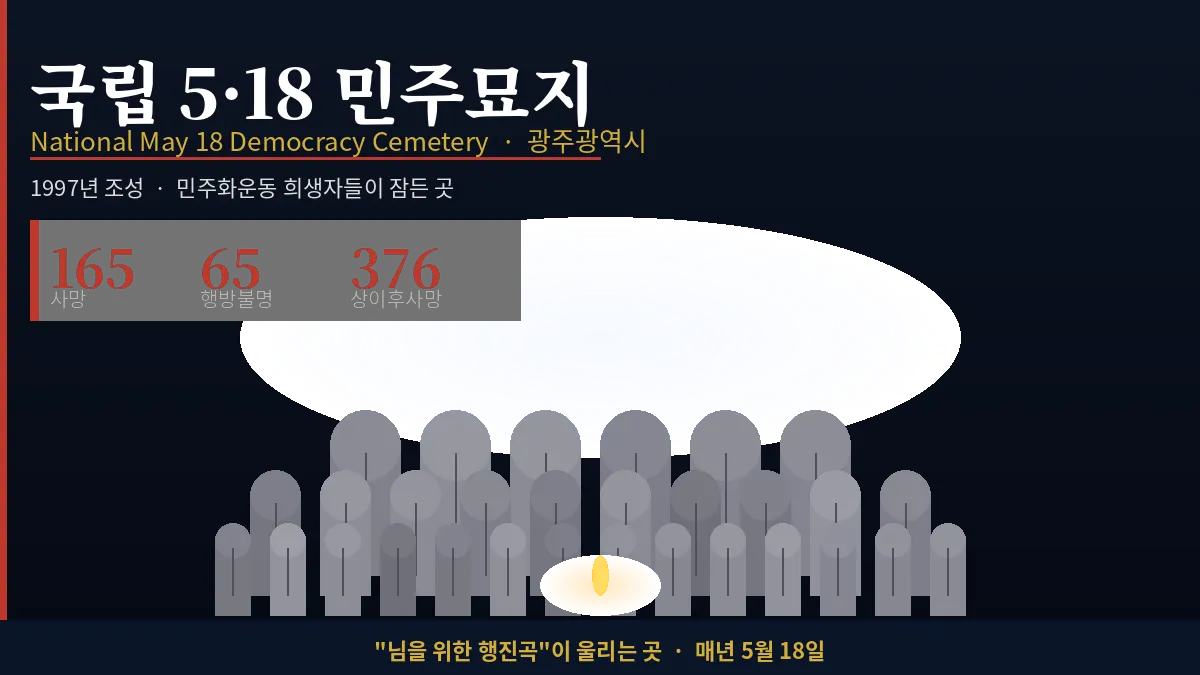
| Category | Official Figure | Notes |
|---|---|---|
| Confirmed deaths | 165 | Identified victims |
| Missing persons | 65 | Including secret burials |
| Died from injuries later | 376 | Long-term complications |
| Total official victims | 606 | Government-recognized figure |
| Total incl. injured | ~4,300+ | 2009 Gwangju City Survey |
Behind these numbers lie stories that statistics cannot capture: a 10-year-old boy shot by a stray bullet on his way home; women and pregnant civilians subjected to sexual violence (documented in 2010s investigations); survivors carrying decades of PTSD; families who never learned where their loved ones were buried.
⚠️ Key Documented Atrocities by Martial Law Forces
- Indiscriminate beating of civilians regardless of involvement in protests
- Mass shooting on May 21 at South Jeolla Provincial Hall; final assault fired over 10,000 rounds on May 27
- Sexual violence against women including minors and pregnant women (confirmed by survivor testimony and investigations in the 2010s)
- Complete blockade of all roads and communications into and out of Gwangju for nearly a week
- Indiscriminate civilian shootings in outlying areas after May 22
The World Watches — UNESCO Memory of the World
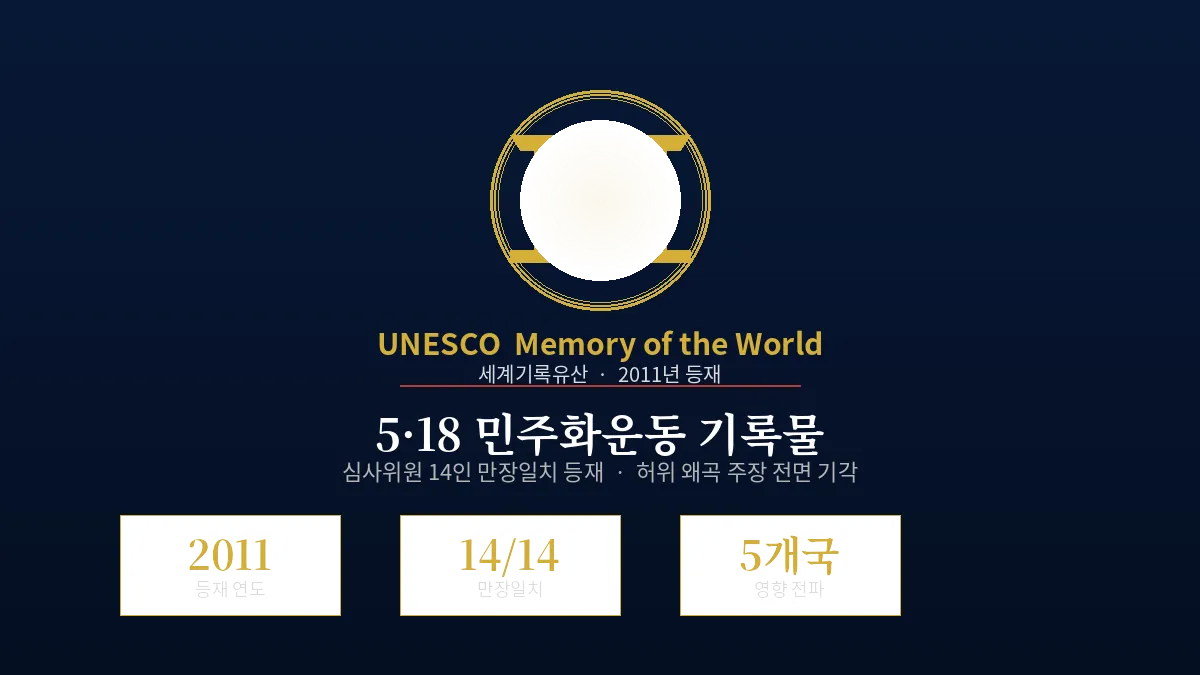
The international recognition that validated what Gwangju's citizens had long known came in May 2011. UNESCO's Memory of the World Committee voted unanimously — all 14 members — to inscribe the May 18 Democracy Movement Archives onto the Memory of the World Register.
UNESCO concluded that the May 18 Democracy Movement was not only a watershed moment for democracy and human rights in South Korea, but also contributed to the democratization of other East Asian countries and helped dismantle the Cold War structure.
— UNESCO, Memory of the World Registration Statement, 2011Crucially, the inscription came after UNESCO's rigorous review process dismissed claims by apologists of the military government that the uprising had involved North Korean agents or was a "communist riot." The international body's verdict was unambiguous: May 18 was a legitimate democratic uprising, not a subversive plot.
🌏 May 18's Ripple Effect Across Asia
- Philippines (1986) — The People Power Revolution drew inspiration from Gwangju's model of peaceful civic solidarity combined with courageous resistance.
- China (1989) — Tiananmen Square protesters and Chinese intellectuals were directly influenced by the Gwangju Citizens' Army's organizational model.
- Thailand, Indonesia, Taiwan — The 1990s democratization movements repeatedly cited Gwangju as a precedent for civilian resistance to military power.
- Myanmar (2021) — After the February 2021 military coup, Myanmar protesters explicitly invoked the Gwangju Uprising as their model of resistance against junta rule.
Perhaps most remarkable is the global policy impact. The five principles developed to address the aftermath of May 18 — investigation of truth, punishment of perpetrators, restoration of honor, compensation, and commemoration — were adopted by the UN Human Rights Committee as a model framework for addressing human rights violations worldwide. Gwangju's grief shaped international law.
Justice and Accountability — History's Verdict
For years after the uprising, the military government controlled the narrative. The events were officially labeled the "Gwangju Incident" (광주사태) — a disturbance caused by subversive elements — and any other characterization was suppressed. It was only after the June 1987 Democracy Movement, which forced the military government to accept a new constitution and direct presidential elections, that truth-seeking could begin in earnest.
In 1988, the newly elected Roh Tae-woo government officially recognized May 18 as a pro-democracy movement. The 13th National Assembly established a special investigation committee. The TV hearings were broadcast nationwide — the first time many South Koreans heard the full story directly from survivors and witnesses.
Criminal accountability took longer. In 1995, prosecutors initially declined to indict Chun Doo-hwan and Roh Tae-woo, arguing that "a successful coup cannot be prosecuted." The Constitutional Court overruled this in December 1995, ruling that "even a successful coup can be prosecuted," and Chun Doo-hwan was arrested.
Roh: 22.5 years (first trial)
Chun — life imprisonment
pardon — both released
Chun Doo-hwan died in November 2021 without ever issuing a sincere public apology to the victims of Gwangju. To the end, he denied key facts of the massacre. His death without remorse remains a painful chapter for survivors and bereaved families alike.
| Year | Key Development |
|---|---|
| 1988 | Roh Tae-woo government officially recognizes May 18 as a democratic movement |
| 1993 | Kim Young-sam's "civilian government" launches "correcting history" campaign |
| 1995 | Prosecutors decline to indict → Constitutional Court overrules |
| 1996 | Chun sentenced to death; Roh to 22.5 years in first-instance trial |
| 1997 | Supreme Court: Chun life sentence confirmed → special amnesty granted year-end |
| 2002 | May 18 designated National Memorial Day by law |
| 2011 | UNESCO Memory of the World inscription |
| 2018 | Truth Commission on the May 18 Democracy Movement established |
| 2021 | Chun Doo-hwan dies — no public apology issued |
| 2025 | 45th Anniversary: "Oh May, May We Meet Again" theme |
Key Point: Truth-Finding Is Still Incomplete
The May 18 Truth Commission established in 2018 continues to investigate helicopter gunfire, sexual violence, secret burials, and the full chain of command. Bullet holes found in the Jeonnildong Building and undated skeletal remains unearthed near historic sites are reminders that the complete truth has not yet been told.
Gwangju Today — 45th Anniversary & Constitutional Recognition
On May 18, 2025, South Korea held the 45th Anniversary Commemoration at the National May 18 Democracy Cemetery in Gwangju. The theme chosen for this year's ceremony was "Oh May, May We Meet Again" — an invocation of courage, grief, and renewed solidarity.
The 2025 commemorations carried an extraordinarily charged historical backdrop. In December 2024, then-President Yoon Suk-yeol declared a state of emergency martial law — the first such declaration in 45 years, since the very martial law that triggered the Gwangju Uprising. The National Assembly voted within hours to override the declaration, and Yoon was ultimately impeached and removed from office in April 2025. For May 18 survivors and bereaved families, the episode was a visceral confirmation: history does not stay in the past.
When martial law — the very act that caused May 18 — was declared again after 45 years, it felt like a brutal reminder that democracy is not self-sustaining. Memory is prevention.
— May 18 Memorial Foundation, 2025 StatementA debate that has long simmered — the formal inclusion of the May 18 spirit in the preamble of the South Korean Constitution — gained fresh momentum in 2025. South Korea's constitution already names the March 1 Independence Movement and the April 19 Revolution of 1960 in its preamble. Advocates argue that May 18, which fundamentally reshaped Korean democracy, deserves equal recognition. A 2022 national survey found that 88.7% of South Koreans knew about May 18; strong majorities supported constitutional enshrinement.
Progress on Key May 18 Agenda Items
May 18 in Culture — Han Kang, Film & Beyond 🏅
May 18 has never been confined to history textbooks. It has flowed into literature, film, music, and art — and nowhere more powerfully than in the fiction of Han Kang.
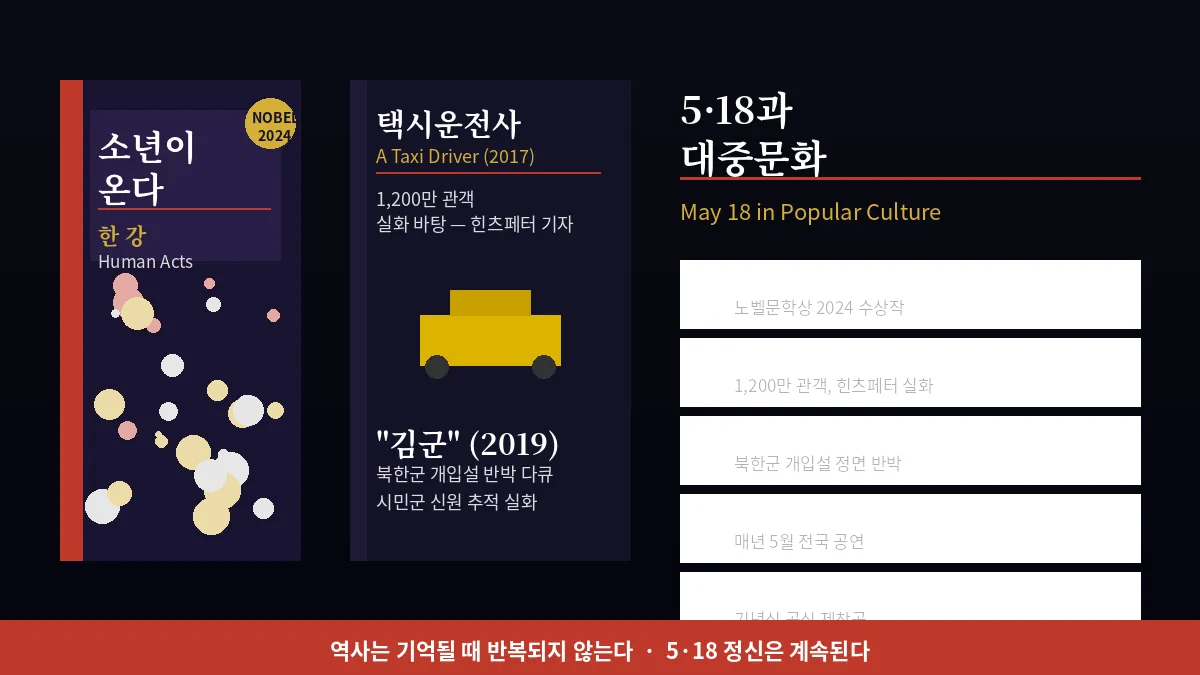
Published in 2014, Han Kang's novel Human Acts (한국어: 소년이 온다) centers on the final days of a young boy at Gwangju's Provincial Hall during the uprising and traces the long aftermath of the massacre through the lives of survivors. Written in an intimate second-person voice — "you" — the novel draws readers into an almost unbearable proximity with violence, grief, and the guilt of those who lived. When Han Kang became the first Korean writer to win the Nobel Prize in Literature in 2024, Human Acts shot onto bestseller lists worldwide, introducing Gwangju's story to millions of new readers who had never heard of it.
"What is death? What are the things human beings are capable of doing to one another? Gwangju in May was a story I had to write to try to answer those questions."
— Han Kang, on writing Human ActsIn cinema, A Taxi Driver (2017) — based on the real story of German journalist Jürgen Hinzpeter and taxi driver Kim Sa-bok, who smuggled footage of the massacre out of blockaded Gwangju — drew more than 12 million viewers in South Korea alone. It played a major role in educating a younger generation who grew up after the events. The annual Hinzpeter International Reporting Award, named in his honor, continues to be presented in Gwangju.
The documentary Kim-gun (2019) tracked down the identities of Citizens' Army members photographed during the uprising, directly countering the right-wing claim that North Korean special forces infiltrated Gwangju — a claim UNESCO had already dismissed in 2011.
Global Community Reactions 🌐
Han Kang's Nobel Prize opened a global conversation about Gwangju that had long been limited to Korean-speaking communities. On Reddit, Twitter/X, Quora, and international news comment sections, reactions ranged from astonishment to outrage to profound respect.
Internationally, the most consistent theme in online discussions is surprise — surprise that an event of this magnitude, with this level of international consequence, remains largely unknown outside Korea and specialist academic circles. The UNESCO inscription, the UN human rights framework it generated, and the documented influence on Asian democratization movements make May 18 a story of genuinely global importance that deserves far wider recognition.
Why We Must Remember 🕯️
The most powerful lesson of May 18 is one that requires no special historical knowledge to grasp: democracy is not self-sustaining. It must be actively defended, generation after generation, by citizens who understand what it cost to build.
In Gwangju, the cost was blood. A boy shot on his way home from school. A taxi driver who risked everything to drive a foreign journalist through a military blockade. Thousands of citizens who stood in line to donate blood for strangers. Hundreds of people who chose to stay in a burning provincial building rather than abandon their fellow citizens to face the military alone.
The December 2024 martial law incident in South Korea was a stark reminder that the threats May 18 was fought against do not disappear — they evolve, they adapt, they test each new generation. The fact that South Korean citizens and institutions responded swiftly and constitutionally to that test is, in no small measure, a product of what Gwangju taught the country about the cost of passivity.
🕯️ The Legacy of May 18
- Foundation of Korean Democracy — Seed of the 1987 June Uprising and direct presidential elections
- Asia's Democratic Flame — Inspiration for the Philippines, Thailand, Taiwan, Myanmar
- International Human Rights Standard — The UN's template for addressing mass atrocity
- The Daedong Spirit — A model of civic solidarity: rice-ball solidarity, blood donation, self-governance
- The Legitimacy of Resistance — Upheld by both Korea's Supreme Court and Constitutional Court as a legitimate exercise of the right to resist unconstitutional power
Every May 18, flowers are laid at the National Cemetery in Gwangju. The song March for the Beloved (님을 위한 행진곡) is sung — a song of mourning that is also a vow. The words are not a lament for the past; they are a promise about the future.
"Leaving behind love, honor and a name, / you went forward with your burning vow. / Your comrades have gone, only the flag waves on. / Until the new day comes, let us not waver."
— "March for the Beloved" (님을 위한 행진곡), the anthem of May 18 commemorationsTo know Gwangju is to understand something essential about modern South Korea — and something essential about what human beings are capable of, both in violence and in courage. The story of May 18 belongs not just to Korea, but to every society that has ever had to ask how much a person is willing to risk for the right to be free. 🕯️