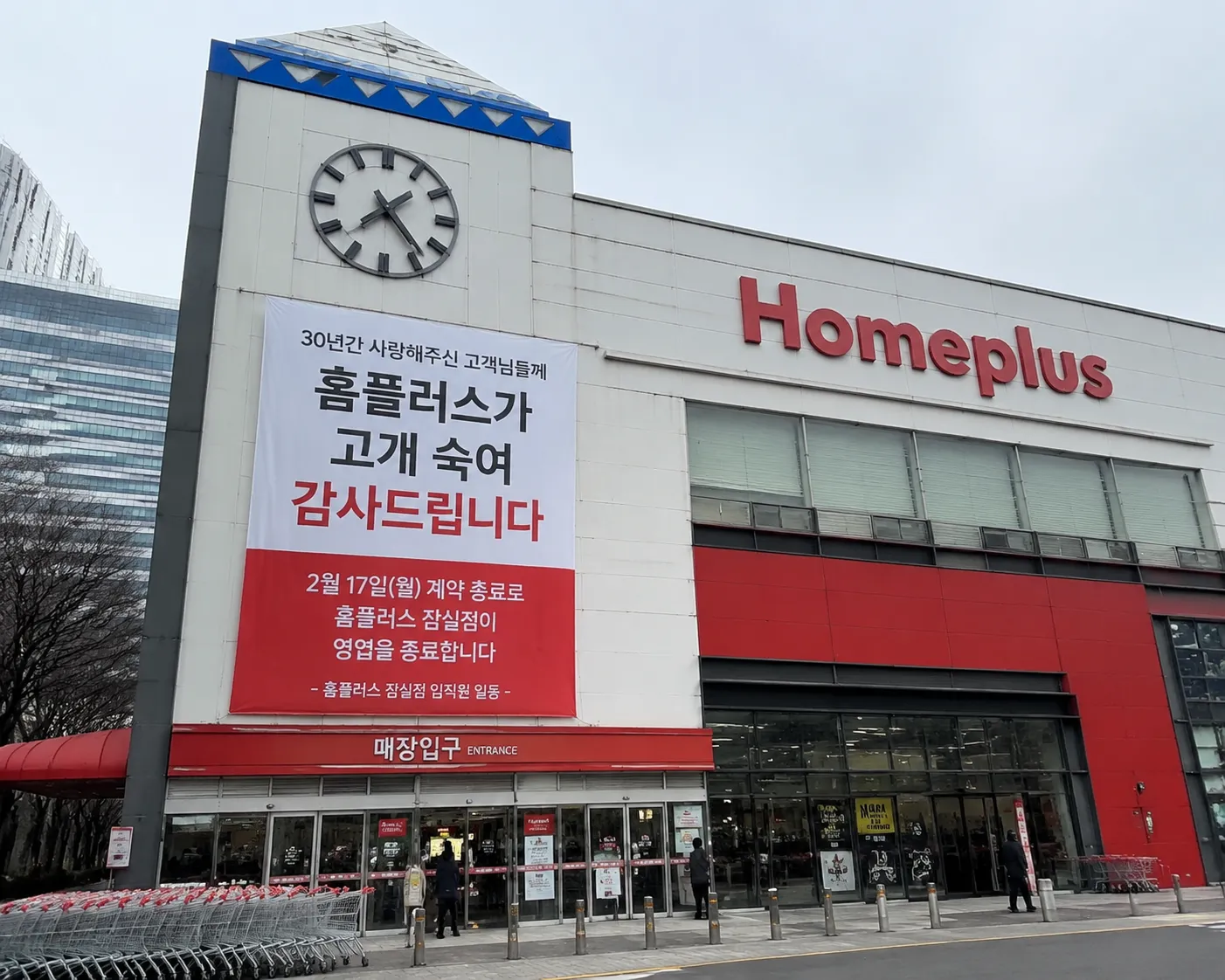
Picture this: it's a Saturday afternoon and you're heading to your local Homeplus for the weekly grocery run — only to find the shutters down and a padlock on the front door. That scene is now a reality for millions of South Koreans. On June 4, 2026, Homeplus officially confirmed the permanent closure of 37 out of its 104 large-format stores. For a chain that once dominated weekend family shopping trips and stood as Korea's No. 2 hypermarket operator, this is a jaw-dropping fall from grace. Let's unpack exactly how we got here.
Homeplus: A 30-Year History — Samsung → Tesco → MBK
Homeplus traces its roots back to September 1997, when Samsung C&T's retail division opened its first discount store in Daegu. The timing could hardly have been worse: less than two months later, South Korea was engulfed by the Asian financial crisis. Samsung, staggering under the weight of IMF bailout conditions, needed to offload non-core assets fast. By 1999, Britain's largest supermarket chain, Tesco, had stepped in to take a controlling stake.
Under Tesco's stewardship, Homeplus grew rapidly. By the mid-2000s it had cemented its position as Korea's No. 2 hypermarket operator behind E-Mart (Shinsegae), with well over 100 stores nationwide. In 2011, Samsung C&T sold its remaining stake, making Homeplus a wholly-owned Tesco subsidiary.
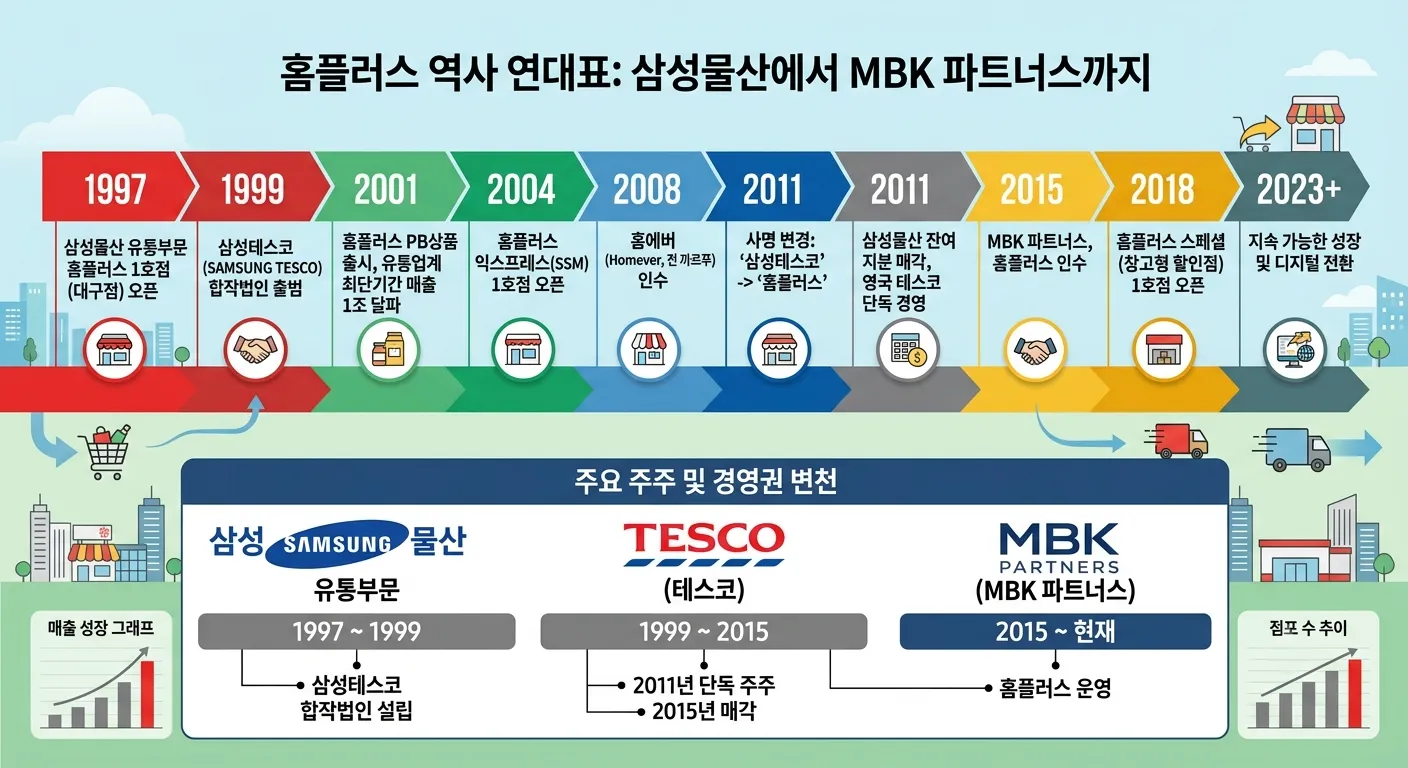
Then came Tesco's own troubles at home. A massive accounting scandal in 2014 forced the British grocer to raise cash by selling international assets. Korea was top of the list. Despite executives having promised as recently as 2013 that Korea was "the second most important market after the UK," the sale went ahead anyway — for a staggering ₩7.68 trillion (approximately $7 billion USD at the time).
"The Homeplus crisis is not just the collapse of a single company. The livelihoods of roughly 20,000 employees, 100,000 supplier workers, and thousands of in-store vendors are all on the line." — Homeplus Labor Union Statement
The MBK Leveraged Buyout — Seeds of Collapse 💸
In September 2015, MBK Partners — Northeast Asia's largest private equity firm — acquired Homeplus for ₩7.2 trillion in what was at the time the largest M&A transaction in Korean history. MBK reportedly swooped in overnight to outbid rival consortium KKR & Affinity with a last-minute higher offer, catching the competition off guard at dawn in a Hong Kong hotel.
The vehicle was a classic leveraged buyout (LBO): MBK borrowed heavily against Homeplus's own assets to fund the purchase, meaning the company itself effectively had to service the debt incurred to buy it. To generate cash quickly, MBK executed a sale-and-leaseback strategy — selling Homeplus's prime real estate to REITs and then renting it back. Short-term cash in, long-term pain out.
Meanwhile, the competitive landscape was shifting dramatically beneath Homeplus's feet. Coupang, backed by SoftBank's deep pockets, was burning cash to offer next-day and same-day delivery on almost everything. Then COVID-19 arrived, turbocharged e-commerce adoption, and cemented offline retail's decline. Homeplus, already cash-strapped from servicing its debt load, had nothing left to invest in a digital pivot. Reports suggest the company spent roughly ₩15 billion on McKinsey consulting engagements — and wound up with years of strategic analysis and little meaningful transformation to show for it.
📊 Homeplus Financial Snapshot — March 2025 (at time of filing)
Corporate Rehabilitation: What Triggered the Crisis ⚖️
March 4, 2025. Without prior warning to suppliers, staff, or creditors, Homeplus filed for corporate rehabilitation with the Seoul Rehabilitation Court. Within just 11 hours of the filing, the court approved the commencement of proceedings — a sign of how dire the situation truly was. Cardboard notices went up inside stores; vendors found their corporate cards cut off same-day by three major credit card companies.
Court-appointed auditors at Samil PricewaterhouseCoopers later delivered a sobering verdict: Homeplus's liquidation value exceeded its going-concern value by approximately ₩1.2 trillion. In plain terms, the company is worth more dead than alive to creditors. Despite this, Samil recommended seeking a new buyer via M&A rather than immediate liquidation — on the theory that a successful sale could ultimately yield a better outcome for all parties.
"MBK owned Homeplus for 10 years. In that time they sold off all the real estate, loaded it with debt, and now they want everyone else to clean up the mess? The workers had nothing to do with any of this."
Closure Timeline at a Glance 📅
What started as a handful of stores shutting over lease disputes has snowballed into the closure of more than a third of all Homeplus locations within a single year of the rehabilitation filing. Here's how it unfolded:
-
March 4, 2025
🚨 Corporate Rehabilitation FiledHomeplus files with Seoul Rehabilitation Court. Approved in 11 hours. Debt-to-equity ratio: 1,408%. Total debt including leases: ₩5.46 trillion.
-
August 13, 2025
🔴 First Closure Plan: 15 StoresHomeplus announces closures of 15 stores over failed lease renegotiations, including Siheung, Gayang, Ilsan, and others.
-
September 19, 2025
⏸️ Closure Plan Temporarily ReversedAfter meetings between the ruling Democratic Party, government ministries, and MBK chairman Kim Byung-ju, closure plans are officially withdrawn. A promise is made to hold the line.
-
December 28, 2025
🔴 Wave 1 — 5 Stores CloseGayang, Jangnim, Ilsan, Woncheon, and Ulsan Bukgu branches shut. The September promise lasts exactly three months before being broken.
-
January 14, 2026
🔴 Wave 2 — 7 More Stores AnnouncedMunhwa, Busan Gamman, Ulsan Namgu, Jeonju Wansan, Hwaseong Dongtan, Cheonan, and Jochiwon join the closure list. Staff salaries are put on indefinite hold.
-
April 30, 2026
🤝 Homeplus Express Sold to Harim GroupNS Home Shopping (Harim Group) signs sale and purchase agreement (SPA) for Homeplus Express. Transaction structured as ₩1.8 trillion debt assumption deal.
-
May 10, 2026
⏸️ Wave 3 — 37 Stores Suspended"Second structural reform" plan announced: 37 stores suspended through July 3, 2026. Merchandise supply has dropped by 50%+ at affected stores due to unpaid supplier bills.
-
June 4, 2026
🔒 37 Stores Confirmed Permanently ClosedLess than four weeks after suspension, Homeplus confirms all 37 stores will close permanently. Network shrinks from 104 to 67 locations. 3,500 jobs in jeopardy.
Key Takeaway
What politicians publicly promised to prevent happened anyway — just delayed by 90 days. The court-approved rehabilitation deadline of July 3, 2026 is now a hard wall. If no buyer materialises and no fresh capital is secured, liquidation proceedings become a real possibility.
Full List of Closing Locations by Region 🗺️
The 37 stores confirmed for permanent closure as of June 2026 span the entire country, though more than half are concentrated in the greater Seoul metro area (Seoul, Incheon, Gyeonggi).
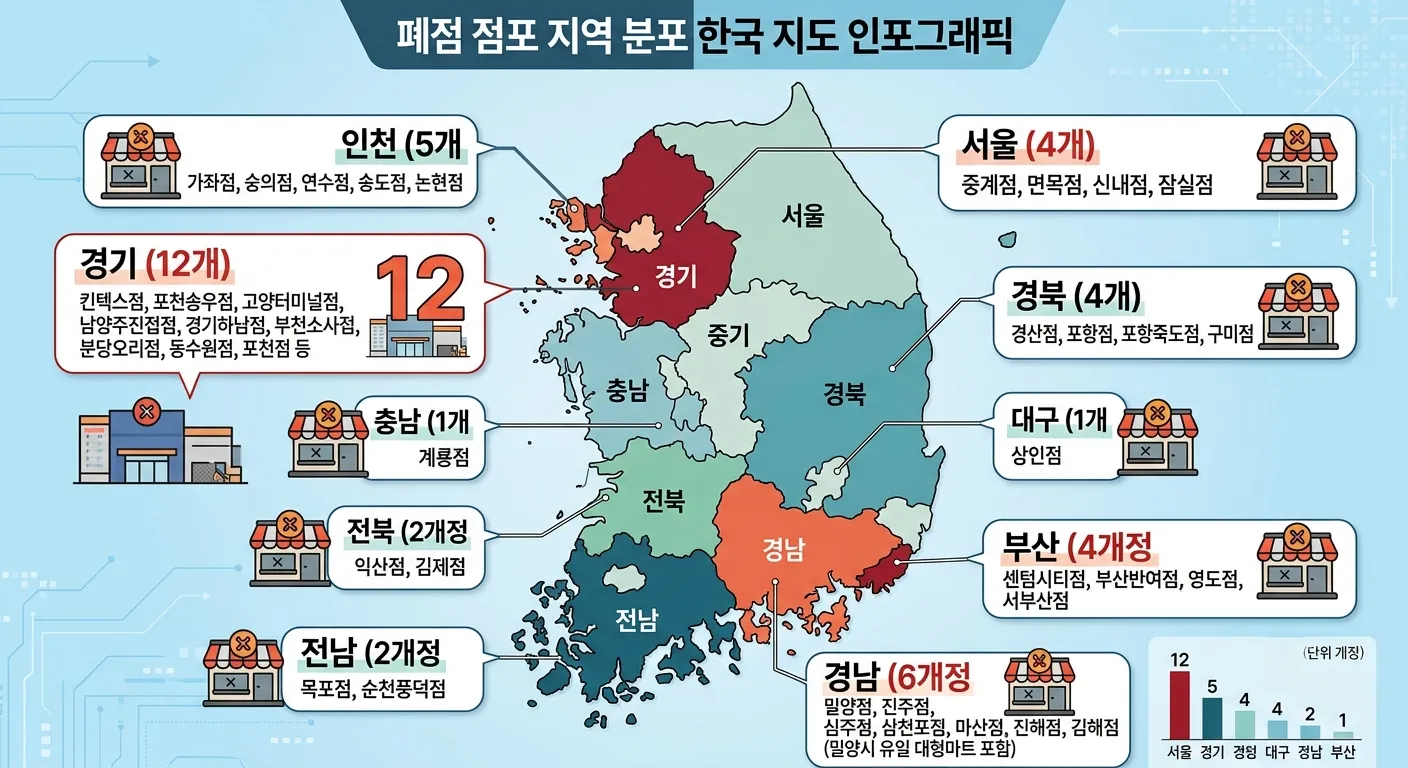
| Region | Closing Locations | Count |
|---|---|---|
| Seoul | Jungye, Myeonmok, Sinnae, Jamsil | 4 |
| Busan | Centum City, Busan Banyeo, Yeongdo, West Busan | 4 |
| Daegu | Sangin | 1 |
| Incheon | Gajwa, Sungui, Yeonsu, Songdo, Nonhyeon | 5 |
| Gyeonggi | Kintex, Pocheon Songu, Goyang Terminal, Namyangju Jinjeop, Gyeonggi Hanam, Bucheon Sosa, Bundang Ori, East Suwon, Pocheon, etc. | 12 |
| Chungnam | Gyeryong | 1 |
| Jeonbuk | Iksan, Gimje | 2 |
| Jeonnam | Mokpo, Suncheon Pungdeok | 2 |
| Gyeongbuk | Gyeongsan, Pohang, Pohang Jukdo, Gumi | 4 |
| Gyeongnam | Miryang, Jinju, Samcheonpo, Masan, Jinhae, Gimhae | 6 (Miryang: only hypermarket in city) |
The Goyang city situation is particularly stark: the Ilsan, Kintex, and Goyang Terminal branches all closed, meaning a city that once had three Homeplus locations now has zero. Miryang is arguably worse — Homeplus was the only large-format grocery store in the entire city. Residents there now have no local hypermarket alternative.
3,500 Workers, Zero Severance 😢
Behind the cold arithmetic of 37 closures are real people. Before the rehabilitation filing, Homeplus employed roughly 20,000 staff. That number has already fallen to around 15,000 — and the 37 closures threaten another 3,500 of those jobs. At peak, a single Homeplus location employed roughly 100–200 workers; close 37 at once and you've got a regional unemployment crisis.
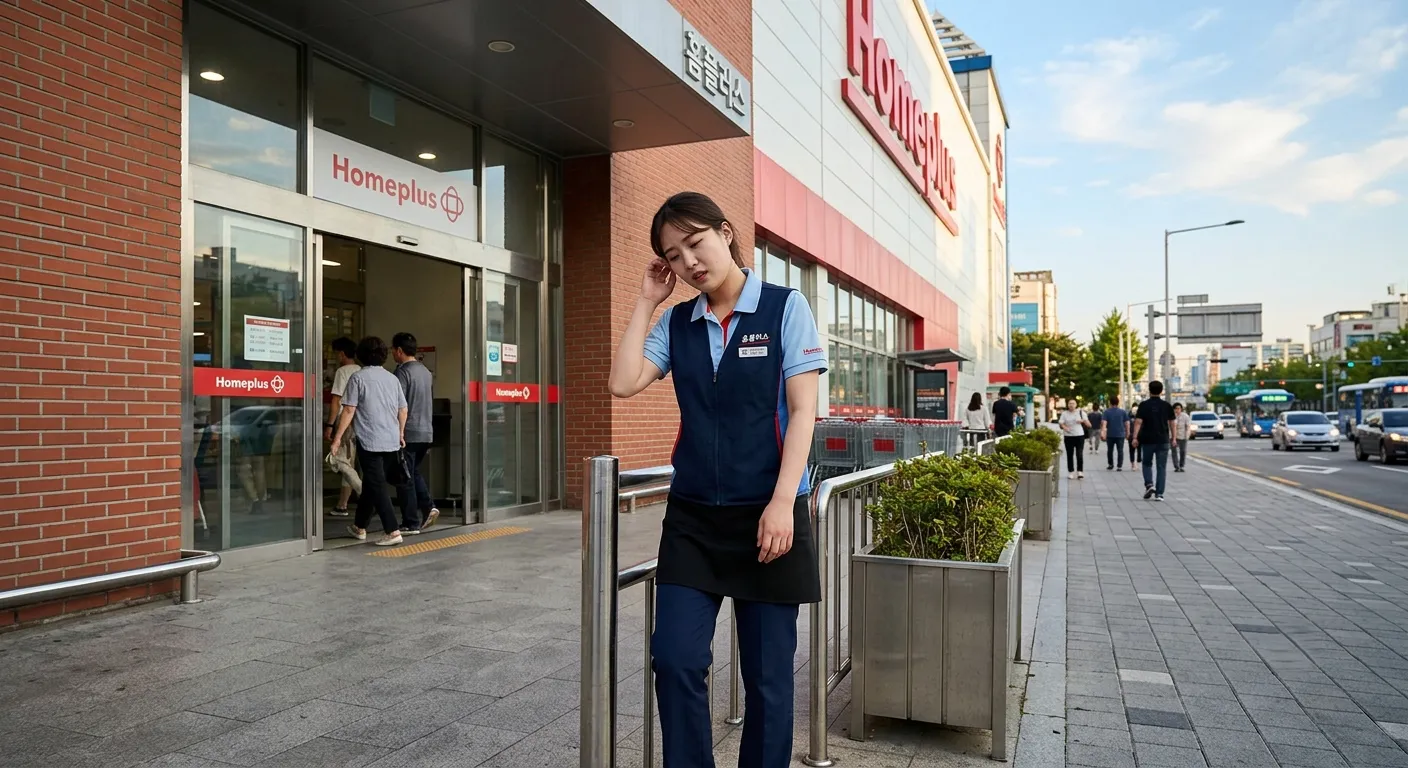
Homeplus's official support plan for affected workers:
- Managerial-level employees: voluntary redundancy available, with 3 months' base pay as exit package
- Non-management staff: employment stabilisation allowance under existing collective agreement
- Willing to be redeployed: transfer to one of the 67 remaining stores (subject to capacity)
- During suspension period: 70% of average wage as furlough pay
"I've been here 12 years. Now I don't know if I'll get my retirement payout. MBK chairman is worth ₩13 trillion according to Forbes but our severance is conditional on the bank agreeing to lend more money. How does that even make sense?"
The union went on a hunger strike for over three weeks. One faction — the general union — even passed a resolution declaring they were willing to forgo wages if it meant keeping stores open. It is, by any measure, extraordinary: workers at a company embroiled in a multi-trillion-won financial dispute volunteering to work without pay so that the business survives.
Homeplus Express Sold to Harim Group 🍗
Alongside the store closures, Homeplus completed the sale of its convenience-supermarket arm — Homeplus Express — to Harim Group's subsidiary NS Home Shopping on May 7, 2026. The business was valued at approximately ₩300 billion, but the transaction was structured as a debt-assumption deal: Harim took on roughly ₩180 billion of Homeplus Express liabilities, with net cash proceeds to Homeplus of approximately ₩120.6 billion.
The ₩120.6 billion in cash from the Express sale was earmarked to cover urgent payroll and supplier payments — essentially band-aid money for a much larger wound. The core Homeplus hypermarket business and online shopping platform are now separately up for sale as part of the rehabilitation plan.
What Shoppers Need to Know Right Now 🛒
If you've been a regular Homeplus customer, here are the practical things you should sort out without delay.
📌 Homeplus Shopper Action Guide
- Gift Vouchers: Cannot be used at closing stores. Redeem at one of the 67 open locations or on the Homeplus online mall. If in-store use is not possible, contact Homeplus customer service to inquire about refund procedures.
- Membership Points: Still valid at open locations, but monitor for policy changes depending on the outcome of the rehabilitation proceedings.
- Online Orders: Homeplus's online mall continues to operate. Check that delivery coverage for your area has not been reduced.
- In-Store Vendors: Homeplus has waived penalty fees and fit-out restoration costs for in-store tenants who exit closing locations early — a small concession, but worth knowing if you're one of them.
- Finding Alternatives: E-Mart, Lotte Mart, and Costco are the primary large-format alternatives. Coupang Rocket Fresh and Baemin B-Mart are the most popular digital alternatives for grocery delivery.
"I've got Homeplus gift vouchers that came as a work bonus. The nearest open store is now 40 minutes away. I'm just going to order everything on their website until I use them all up — or until the website disappears too."
What's Next? Three Possible Scenarios 🔮
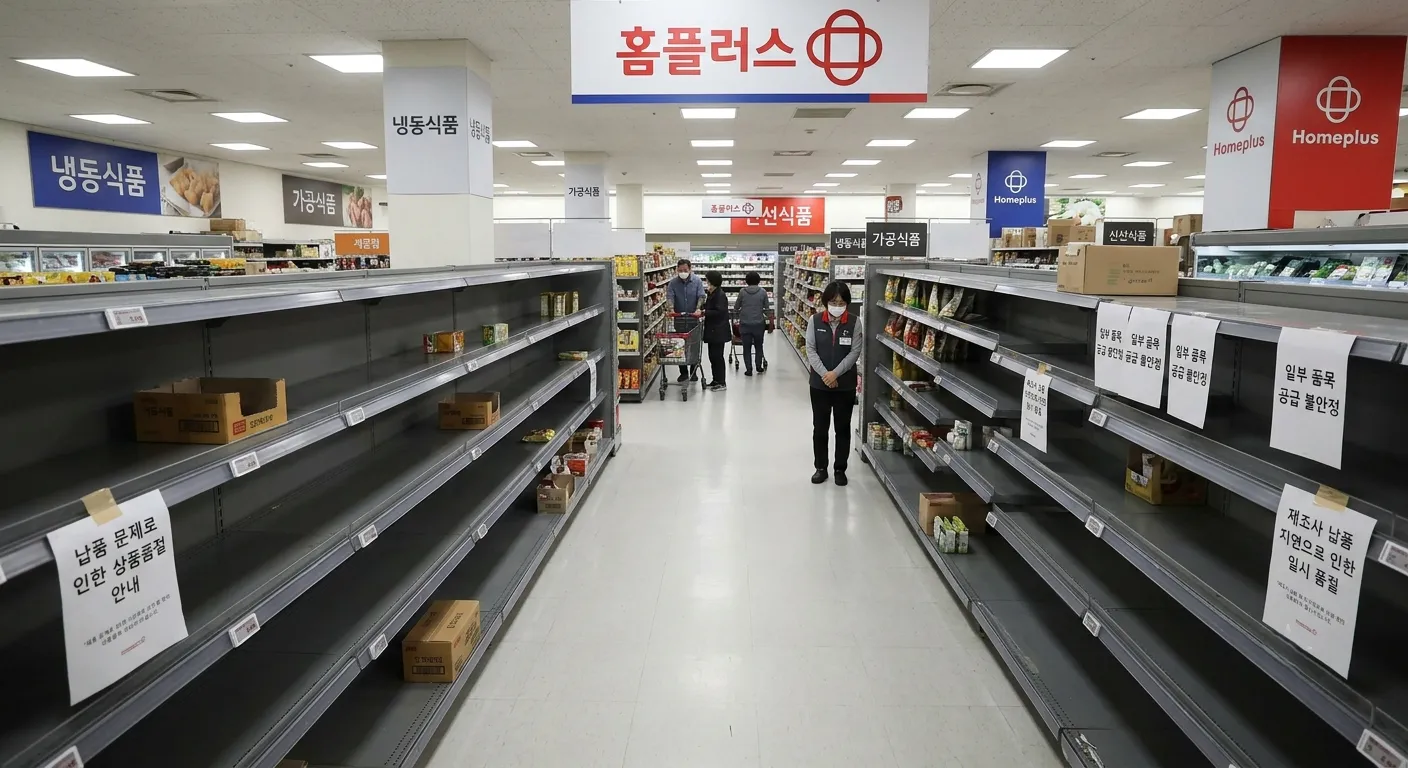
Court-appointed auditors at Samil PricewaterhouseCoopers have already confirmed that the business is worth more liquidated (by ₩1.2 trillion) than as a going concern. And yet the recommendation is to find a buyer. That tells you everything about how difficult the situation is: even the people who ran the numbers say liquidation is the rational call, but the social and human cost is too enormous to simply execute it cold.
The key deadline is July 3, 2026 — when the rehabilitation plan must be formally approved by creditors. Here are the three realistic scenarios heading into that date:
| Scenario | What It Means | Likelihood |
|---|---|---|
| M&A Success | A buyer acquires the remaining 67-store Homeplus network and online business. Estimated sale price ~₩3.7 trillion. Creditors take haircuts; employees keep jobs. Chain survives under new ownership. | Uncertain — no confirmed bidder as of late June 2026 |
| Partial Rehabilitation (Slim-Down & Stabilise) | 67 remaining stores continue operating under tighter cost controls. Online channel strengthened. A more modest buyer or investor eventually found at a lower price. | Most realistic near-term path |
| Liquidation | No buyer, no fresh capital. Court orders dissolution. All stores close. Suppliers and individual bondholders suffer maximum losses. Worst-case outcome for workers. | Possible if July 3 deadline passes without resolution |
- Meritz Financial Group's decision on DIP loan participation is the single most important variable
- MBK's willingness to contribute further personal funds (₩100B already committed by chairman)
- Whether a credible M&A buyer emerges before July 3, 2026
- Korea Development Bank (KDB) participation — still under discussion
The Homeplus collapse is simultaneously a story about private equity hubris, the structural decline of brick-and-mortar retail in the e-commerce era, and the very human cost of corporate financial engineering gone wrong. MBK Partners built a debt-fuelled house of cards on top of a business that was already struggling to compete against Coupang. The lease-back deals that generated quick returns for the fund left the underlying retailer with expenses it could never outgrow.
"The Homeplus situation shows how a private equity success story can transform into a massive financial system risk, wiping out individual investors' savings and destroying workers' livelihoods." — Le Monde Diplomatique Korea
Whether you're an investor, a Homeplus employee, a nearby vendor, or simply someone who grew up pushing a cart through its aisles on Saturday mornings — the July 3rd deadline looms large. The end of that story is still being written. And whichever chapter comes next, it will not be a light one. 🏪