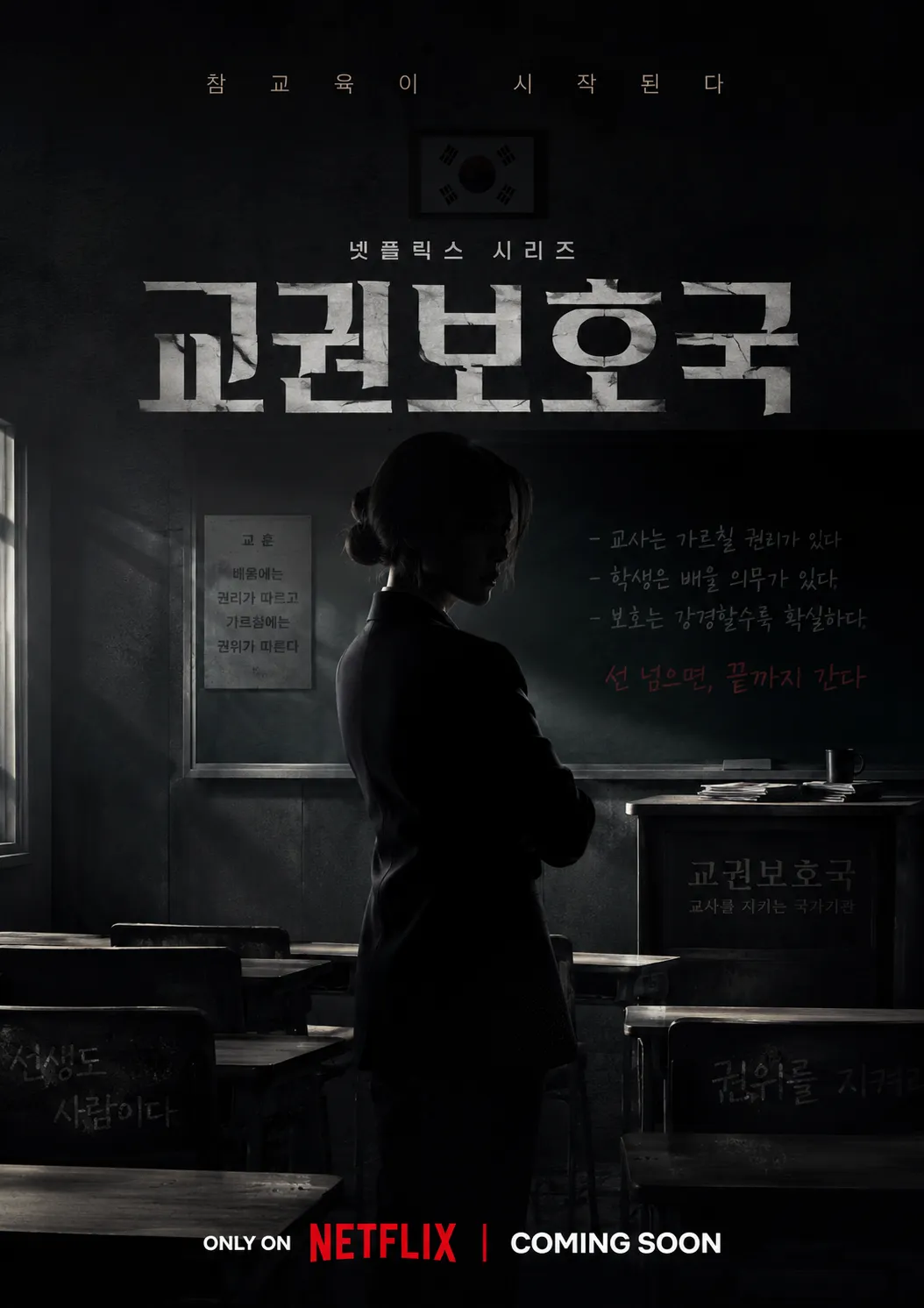
On June 5, 2026, a Netflix series rattled South Korea's entire teaching community. The 10-episode original "Teach You a Lesson" (참교육) racked up 6.4 million views in its first three days and hit #1 in 45 countries within a week—making it a genuine global phenomenon. Yet the very people at the center of its story, Korea's working teachers, were split: some called it cathartic, others called it horrifying. Why did a drama built around a fantasy government agency trigger such a raw nerve worldwide—and what does the data say about the real state of Korean classrooms? We dig in.
"Teach You a Lesson" adapts a hit Naver webtoon of the same name (story by Chae Yong-taek, art by Han Ga-ram), brought to screen by director Hong Jong-chan—best known for Netflix's "Juvenile Justice." Lead actor Kim Mu-yeol plays Na Hwa-jin, a former Special Forces soldier turned inspector of the fictional Teacher Rights Bureau, deployed to schools where bullying, drug abuse, predatory parents, and teenage crime have run amok. Veteran actor Lee Sung-min plays the Education Minister who backs the Bureau; Jin Ki-joo and Pyo Ji-hoon round out the team as fellow inspectors.
What makes the series stand out is its unflinching engagement with real headlines: the 2023 Seo-i Elementary teacher suicide, ADHD drug abuse in Daechi-dong tutoring hotspot neighborhoods, juvenile offenders exploiting legal loopholes, and social-media campaigns to destroy teachers' reputations. The drama wraps these events in fiction, but viewers across Korea—and around the world—recognized them immediately.
The original webtoon had drawn criticism for racist and misogynistic scenes in some episodes, leading to a service suspension overseas. The TV adaptation scrubbed all of those scenes, replacing them with episodes about abusive parent complaints, academic fraud, and cyberbullying—reportedly after consultations with 300 serving teachers.
"Teach You a Lesson" is not just another K-drama success story. By Netflix's official count, it reached 6.4 million views in three days and topped the non-English TV chart globally for the week of June 1–7, 2026. By Day 7, it held the #1 Netflix TV spot in 45 countries—from South Korea and Japan to the Middle East and Latin America.
3 days (global)
on Netflix (Day 7)
weekly global chart
All dropped at once
The South China Morning Post called it "state-sanctioned violence," while Forbes described it as a drama that "gives victims a voice, builds righteous anger at a broken system, and delivers a catharsis when justice finally arrives." Both reactions make sense, because the show speaks to a crisis that isn't uniquely Korean.
By June 2026, more than 300 schools across South Korea had adopted the drama as a topic for classroom debate, and courses focused on the balance between teacher authority and student rights increased by 45%. Whatever critics say about its methods, the series has succeeded in doing what most policy papers cannot: turning an abstract systemic crisis into a dinner-table conversation.
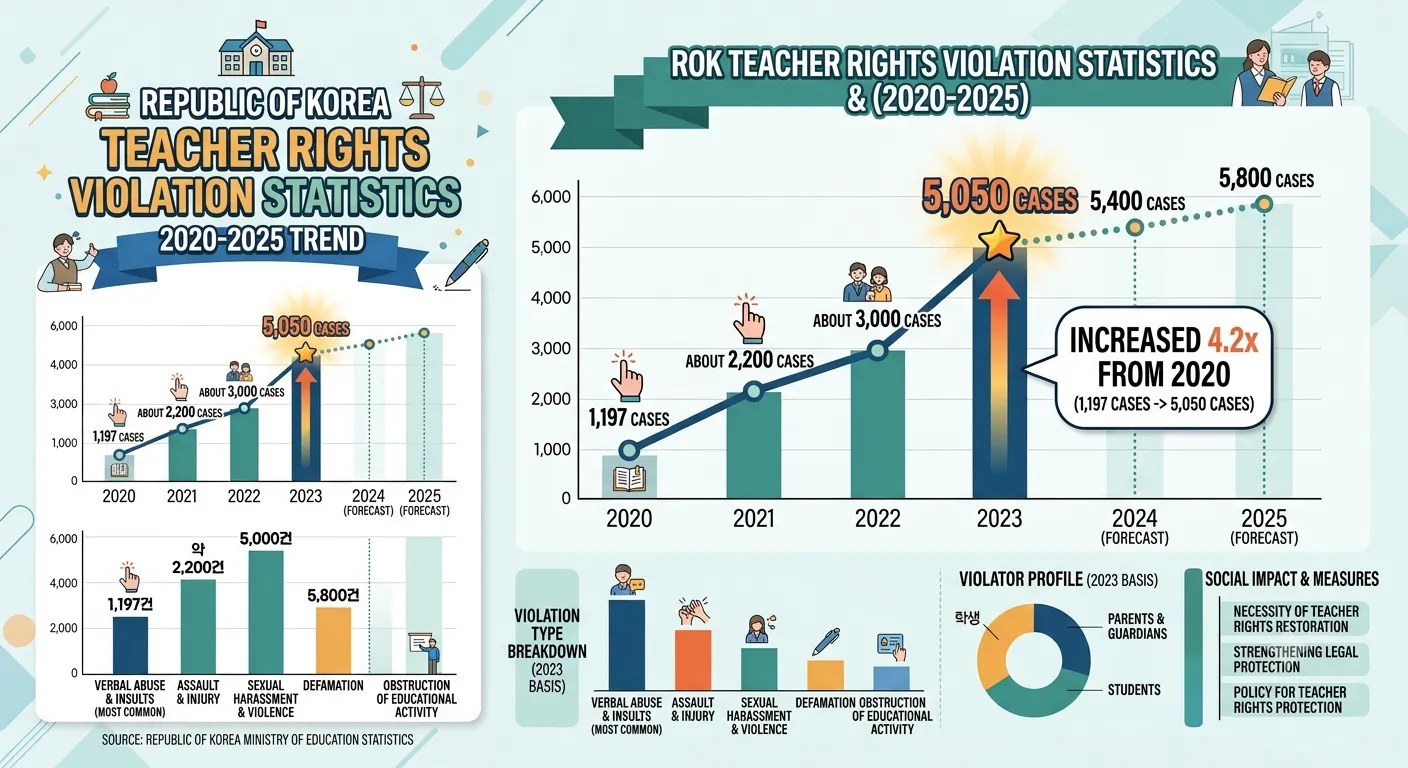
The drama's premise may be fictional, but the statistics behind it are not. Here is what official data from Korea's Ministry of Education and the National Assembly Library tell us.
Reported Education Activity Violations by Year
* Source: Ministry of Education / National Assembly Library Data & Law 2025-13
Physical violence against teachers tells a starker story. Cases classified as assault, battery, or sexual violence against educators jumped from 144 in 2020 to 675 in 2024—a 4.7-fold increase. Teacher unions note that official counts likely understate the true scale, since many incidents go unreported out of fear of retaliation or procedural futility.
| Indicator | Figure | Source / Note |
|---|---|---|
| Teachers reporting declining job pride | 49.2% | KFTA survey, May 2026 (n=8,900) |
| Top source of helplessness | Rights violations (67.9%) | Distrust from students & parents |
| #1 reason cited for leaving/avoiding teaching | Abuse complaints & parent harassment (28.9%) | 2nd: low pay (28.1%) |
| Teachers experiencing depression (2023) | 63.2% | ~4× the rate of general public |
| Teachers who experienced suicidal ideation | 16% | With specific plans: 4.5% |
| Average teacher tenure | 12.3 years | Ministry of Education, May 2026 |
| Teacher Protection Center visits (2024) | 124,000 | Double the 2022 figure |
| Child abuse reports against teachers ruled "legitimate guidance" | 71% | Of 1,439 superintendent opinions issued |
That depression statistic deserves a pause. Nearly two-thirds of Korean teachers surveyed in 2023 reported depressive symptoms—roughly four times the rate found in the general population. One in six had experienced suicidal ideation. These are not abstract policy numbers; they are the human cost of a system that has stripped teachers of practical authority without replacing it with institutional protection.
"Please don't mark wrong answers with a slash. It hurts my child's self-esteem." — Actual parent complaint received by a 25-year veteran elementary teacher (MBC News interview)
That quote might sound like a joke, but the teacher explaining it was not laughing: "If a student says 'I feel bad' when I tell them to do their homework, that can now be classified as child abuse. Who is going to actively engage in education under those conditions?"
Within hours of the premiere, teacher forums on Blind (Korea's anonymous workplace community app) and other educator platforms were flooded with reactions. The overwhelming tone was one of bittersweet recognition: "The drama gets the problem right, but the solution is a fantasy."
"What non-teachers misunderstand is that they think we're just dying to hit students. We're not. We're asking for the authority to guide students properly—not for corporal punishment to come back."
— Serving teacher, online community post"My family watched it and said, 'The teachers must find this so satisfying!' I told them: absolutely not. It's horrifying. What we need isn't a superhero agency—it's a legal framework that stops one angry parent complaint from destroying a teacher's 30-year career."
— Serving teacher, Blind teacher forumEpisode 5—where a predatory parent files a "psychological child abuse" report against a dedicated elementary teacher—generated the most engagement. The drama's line, "Parents have been handed a gun called 'child abuse reporting,' and teachers have no shield against the bullets," was shared thousands of times across educator networks.
The Korean Teachers' Union Federation (교사노조연맹) issued a formal statement in response:
"The drama starts in reality and ends in fantasy. The scenes where a teacher is brought down by a child abuse report are real; the scenes where the state steps in to protect the teacher exist only in the drama."
— Korean Teachers' Union Federation statement, June 8, 2026Indeed: of the 1,439 child-abuse complaints filed against teachers and reviewed by educational superintendents between 2023 and August 2025, 71% were judged to be "legitimate guidance activity." Yet from the moment a complaint is filed to the moment a ruling comes down, a teacher can face suspension and criminal investigation—a limbo that destroys careers and mental health regardless of the eventual verdict.
The drama drew sharply divided reactions across different groups: teachers, parents, students, global viewers, and educator unions.
"Monday morning I walk back into school and the drama's catharsis evaporates. The abusive parent is still calling, and the school still tells me to handle it alone. Give us legal shields, not TV superheroes."
"They show a parent getting a teacher suspended for marking a wrong answer wrong. I thought it was an exaggeration—until I heard my neighbor actually did something like that. I wish a real Teacher Rights Bureau existed."
"At first I thought it was just an action show, but the episode about juvenile offenders gaming the system—I recognized kids from the news. Uncomfortable and necessary at the same time."
"Watching this as an American teacher is surreal. The specific complaints are different but the core experience—a system that protects everyone except the teacher—is universal. More devastating than any crime drama."
"By framing complex school problems as villains to be punished, the drama normalizes physical coercion as a solution. It is an insult to every teacher who fought to end corporal punishment, and it erases decades of progress."
"The drama is more heartbreaking than satisfying. It reflects the real collapse of classrooms teachers live through daily—but it gives us a TV fantasy where we needed actual legal protection."
Key Takeaway
The consensus among Korean teachers is this: the drama diagnoses the disease correctly but prescribes the wrong medicine. Teachers are not asking for a special-ops task force or a return to corporal punishment. They are asking for a system in which a vexatious parent complaint goes to a state body—not straight to a teacher's doorstep.
The show's impact didn't stop at water-cooler conversation. On June 12, 2026, the Democratic Research Institute—the think tank of Korea's ruling Democratic Party—proposed creating a real "Education Activity Protection Bureau" inside the Ministry of Education. The idea: route all parent complaints, lawsuits, and harassment cases through a dedicated state agency instead of leaving individual teachers to fight alone.
Gyeonggi Governor-elect Ahn Min-seok went further, announcing he would hold a public debate on establishing a "Gyeonggi-style Teacher Rights Bureau." The Ministry of Education offered only a boilerplate statement that no formal review was underway—but the political pressure is mounting.
| Position | Arguments For | Arguments Against / Concerns |
|---|---|---|
| Who | Democratic Research Institute, Gov.-elect Ahn, some teacher groups | KTU, Practical Education Teachers' Association, some academics |
| Core argument | State takes complaints off teachers' backs; dedicated agency responds to litigation | New bureaucracy risks adding reporting burdens without fixing root causes |
| Expected benefit | Minimal personal legal exposure; teachers can focus on teaching | Severing it from existing administration makes coordination harder |
| Expert view | KFTA: "State litigation responsibility + mandatory counter-complaints are urgently needed" | Prof. Park Ju-hyeong (KNUE): "Fix the existing system first; don't just add an org chart" |
The Practical Education Teachers' Association struck a careful balance: "Teachers must stop being left alone at the front line of disputes—schools, education offices, and the state all need to share that responsibility. But if the new institution just creates another reporting chain and piles on paperwork, the burden grows, not shrinks."
Existing Protections (as of June 2026)
- Revised Teacher Status Act (Sept. 2023) — Superintendent must submit an opinion whenever a teacher is reported for child abuse during normal guidance activity
- Five-piece teacher protection legislation package — Mandatory school records notation for serious rights violations
- Classroom phone ban law (effective 2026)
- 55 nationwide Teacher Protection Centers — Counseling, legal support (53,000+ visits in first half of 2025)
- Special leave and psychological support provisions for affected teachers
The KFTA's chairman outlined seven additional reforms the federation is demanding:
- State liability for all education-activity-related lawsuits
- Mandatory counter-complaint obligation on education superintendents against bad-faith parents
- Mandatory school record notation for serious rights violations
- Amendment of the Child Welfare Act to clarify ambiguous "emotional abuse" clauses
- Police non-referral to prosecutors where no grounds for child-abuse charge are found
- Full institutionalization of abuse-complaint response at district education offices
- Legal obligation on parents to fulfill their own educational responsibilities
"Teach You a Lesson" asks one clear question: Who is responsible for a broken school? The world answered with 6.4 million views. But the drama also has limits that its critics are right to flag.
The series leans heavily on "cathartic punishment" storytelling. Villains get their comeuppance in satisfying ways; the structural reforms that might prevent the next villain from emerging receive far less attention. Korea's Kyunghyang Shinmun noted the show "offers the audience emotional release through an unrealistic fantasy while remaining silent on systemic fixes—and risks legitimizing violence as the solution."
"The teacher in the drama stayed beside the students, protected by the state. The teacher in reality left us in the summer of 2023."
— Jeonbuk Future Education News, June 2026International research is consistent: the key to restoring teacher authority is not stronger punishment but systems that do not leave teachers to fight alone. Whether Korea's policymakers can translate a Netflix hit into genuine reform—rather than a policy soundbite timed to the election cycle—will determine whether "Teach You a Lesson" is remembered as a turning point or just very good television.
📌 Key Facts to Remember
- Korea's teacher rights violations rose roughly 4.2× between 2020 and 2023; physical assaults on teachers rose 4.7×.
- 49.2% of Korean teachers say their professional pride has declined; 16% have experienced suicidal ideation.
- 71% of child-abuse reports against teachers are ruled "legitimate guidance"—but the process still destroys careers.
- "Teach You a Lesson" exposed the problem globally; the solution must come from outside the drama.
- Teacher Protection Center visits doubled in two years—a signal that the pain is not easing on its own.
📺 The Drama Ends. The Classroom Continues.
At the close of each episode, the Teacher Rights Bureau agents restore order and move on. Real teachers don't get that exit. They return to the same room on Monday morning—more often than not, alone. If "Teach You a Lesson" accomplishes anything lasting, it should be the spark that forces governments to build the legal shield the drama only pretended to provide. Teacher protection is not a genre trope. It is the prerequisite for every student's future. 🎬