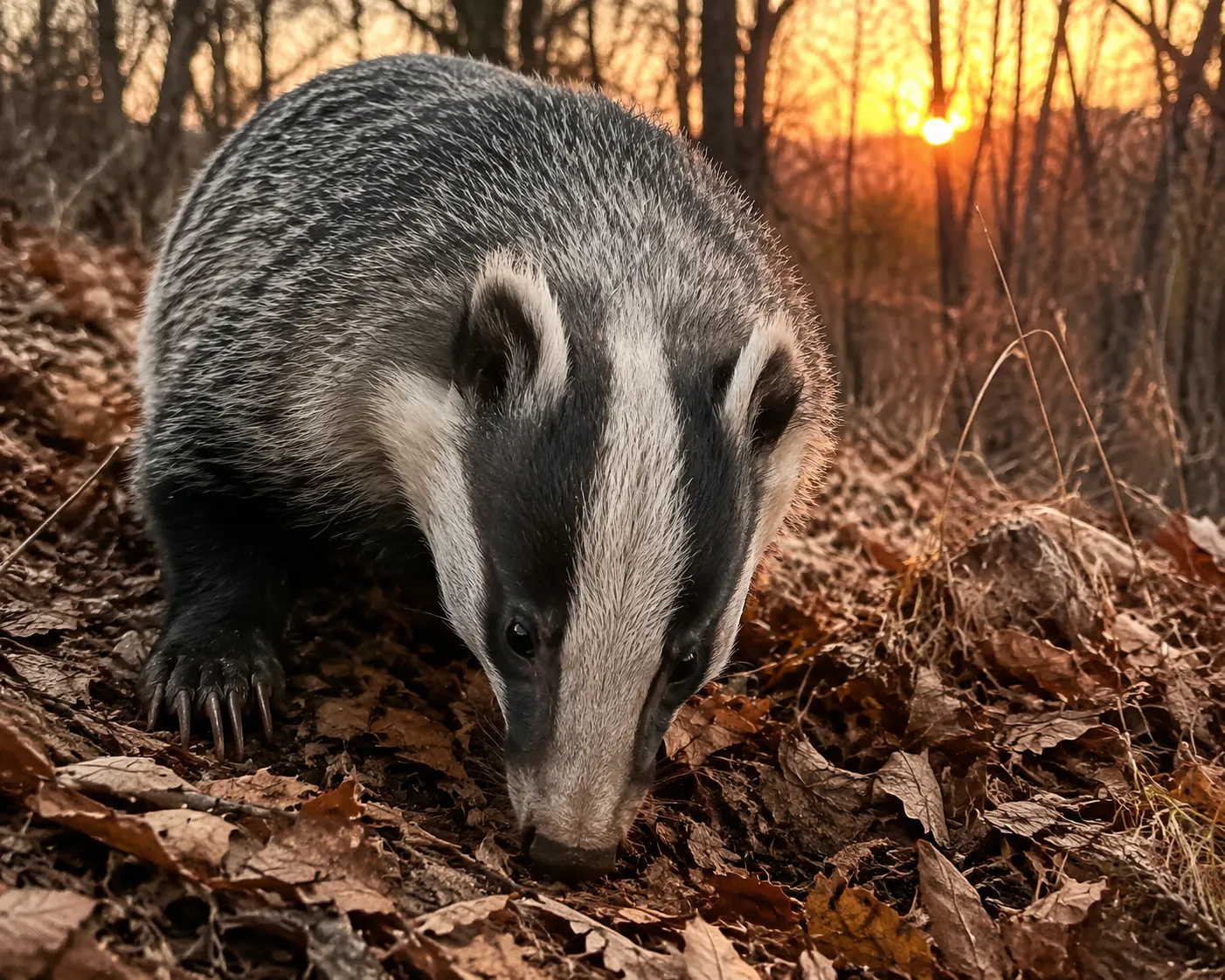
A few nights ago on an early morning walk, I heard rustling in the brush beside a hiking trail. When I flashed my headlamp over, a stout animal with a striped face glanced back at me before waddling calmly into a burrow. It was a badger. Plenty of people mix it up with the raccoon dog, but the two look and behave nothing alike once you know what to look for. In this guide, I've pulled together what a Korean badger actually is, why sightings near cities seem to be rising, and what roadkill statistics and online community reactions tell us about how this animal and people are sharing the same hillsides.
What Exactly Is a Korean Badger?
The Korean badger (Meles leucurus) is a small-to-medium mammal in the weasel family, order Carnivora. In English it's called the Asian badger, and the population found on the Korean peninsula is endemic to Northeast Asia. What's surprising is that "badger" isn't a strict single taxonomic unit. Until the late 20th century, badgers across Eurasia were treated as one species, but genetic research later split them into three independent species — European, Asian, and Japanese badgers — that today make up a single genus spread across the Eurasian continent.
It's worth noting that these three species look subtly different despite their shared name. The European badger tends to be larger with broader facial stripes, while the Asian badger — the one found in Korea, China, and Mongolia — is comparatively smaller with narrower stripes. The Japanese badger is the smallest of the three, with stripes faint enough that it can be hard to recognize as a badger at first glance. These small differences are thought to have emerged as each population adapted to its own regional climate and habitat over a long stretch of time.
Body length runs from about 50 to 70cm from head to torso, with a tail no longer than 20cm. The front paws are larger than the hind paws, and the claws — built for digging — are notably long. It's often said the pads of a badger's hind foot bear an uncanny resemblance to a newborn baby's footprint. A thick layer of subcutaneous fat, similar to a bear's, also lets the badger hibernate through winter — an unusual trait for an animal its size.
Badgers are true omnivores, eating birds, snakes, frogs, earthworms, insects, fruit, tree roots, mushrooms, rodents such as mice and squirrels, and even rabbits. They're especially fond of insects, and use a peculiar trick to draw them in: they dig a small pit — roughly 30 to 50cm wide and 30cm deep — along a regular path within their territory, defecate in it, and then return to eat the beetles that gather to break down the waste. This routine repeats daily from spring through fall as the badger builds up the fat reserves it'll need to survive winter.
As is typical for weasel-family animals, badgers punch well above their weight in a fight. Pound for pound, they rank among the toughest animals in the forest, flexible enough to twist around and bite an attacker's face even if it's just bitten their rear end. Beneath that round, unhurried exterior is an animal armed with several genuinely effective defenses for surviving in the wild.
A badger's senses tell a similar story. Its eyesight is unremarkable, but its sense of smell and hearing are sharp. As a nocturnal animal, it can locate prey and detect danger in a pitch-dark forest using scent and sound alone. Its nose is sensitive enough to sniff out earthworms and grubs buried deep underground, which it then digs up with its front claws — a scene that shows up often in wildlife documentaries.
Its range is broader than you might expect. Badgers turn up not only in deep mountain forests like Jirisan or Seoraksan, but also in hills close to villages and farmland. They favor gently sloped hillsides with plenty of insects and fruit, and well-drained soil — conditions that happen to overlap with where people tend to build hiking trails and greenways. That overlap, more than anything else, explains why badger sightings near urban hillsides have become more common in recent years: it's not that badgers are moving closer to people, but that the habitat they've always preferred was close to us to begin with.
Lifespan in the wild averages around ten years, with captive individuals sometimes living longer. In practice, roadkill, habitat loss, and disease often cut that shorter. Adult badgers don't have many natural predators, thanks largely to their strength and defensive ability — which makes roads and cars, ironically, the single biggest threat they now face.
"A badger will let other animals move into its burrow, but it never gives up the best room. When danger comes close, it's the tenants near the entrance who draw the predator's attention first." – from a domestic wildlife researcher's field notes
A Master Digger's Daily Life
No discussion of badgers is complete without their burrow system — known as a "sett." These aren't simple holes. Badgers dig tunnels ranging from 2 to 8 meters long, sloping the entrance so rainwater can't pool inside. They add secondary exits for emergencies and divide the interior into distinct rooms for sleeping and for waste, a level of planning that wouldn't look out of place in an architectural blueprint.
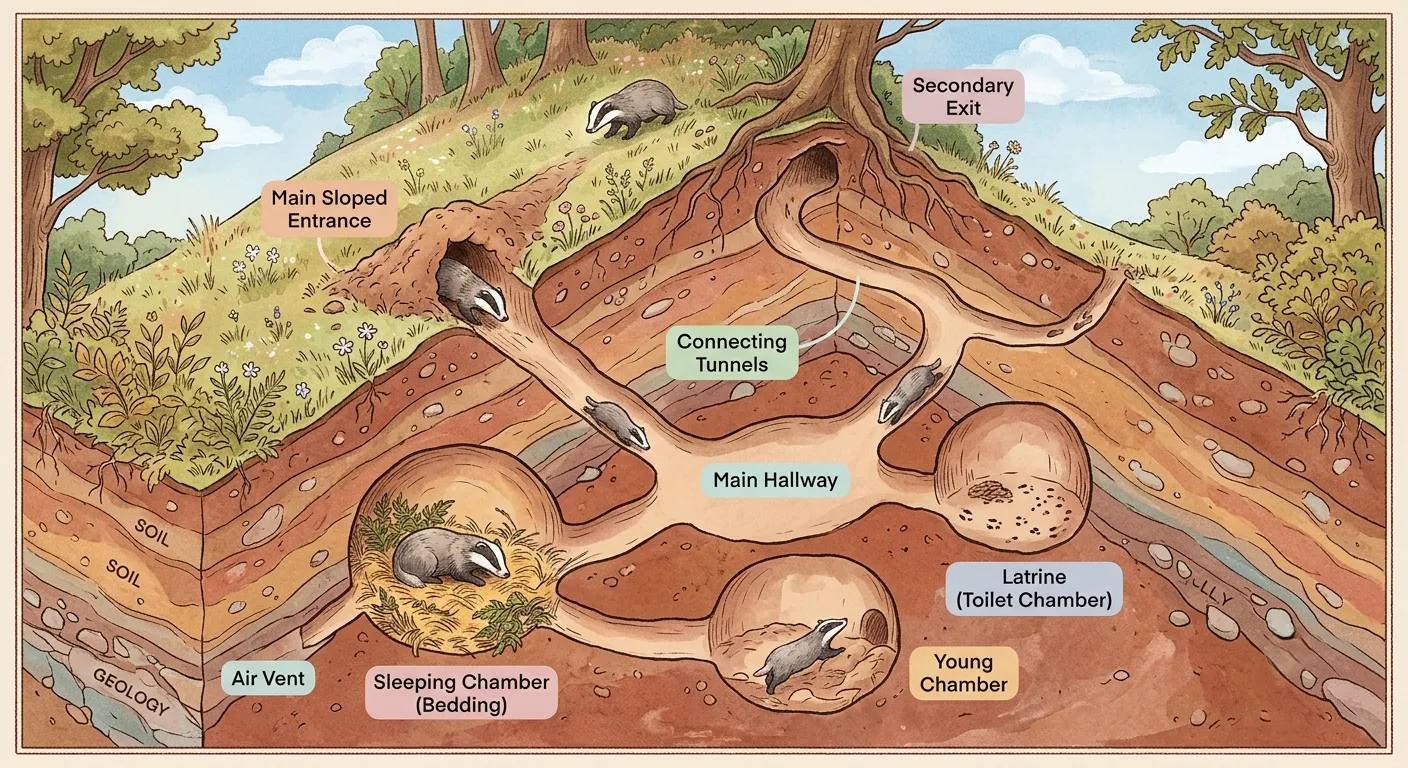
Badgers also take cleanliness seriously, always using a designated toilet chamber rather than fouling their living space. That habit puts them at odds with less tidy neighbors: rabbits that defecate wherever they happen to be, raccoon dogs that pile waste in one favorite spot, and red foxes that deliberately soil a burrow with waste in an attempt to drive the badger out and claim the den for themselves. When the mess becomes too much, the badger sometimes simply relocates, leaving the burrow — and all that careful engineering — to whoever wants it.
So why does a badger tolerate these messy squatters at all? There's a survival logic to it. A badger's multi-room sett places roommates in chambers near the entrance, while the family's own warm, safe inner chamber stays off-limits to anyone else. When a predator with a sharp nose — a wolf, say — approaches the burrow, it's the entrance chambers, thick with mixed animal scents, that draw attention first. The badger's actual living space, further inside, ends up shielded. In effect, the cohabiting animals function as decoys, or living buffers, for the badger.
The reverse also happens: badgers sometimes take over a raccoon dog's or fox's burrow instead of building their own, and it's common for multiple badger families to share a single sett. Badgers that share a den often move together when relocating, which occasionally means pups from different litters end up traveling together, losing their parents along the way, and banding into a mixed group. Scent glands near the tail let badgers recognize each other and identify young pups, which helps make this tangled social arrangement work.
Following a badger's day hour by hour is its own kind of interesting. Once the sun is fully down, it starts by lingering at the burrow entrance, sniffing the air to check for predators or unfamiliar scents. Only once the coast seems clear does it emerge. Over the next several hours it patrols its territory, foraging as it goes and stopping periodically at its latrine pits. As dawn approaches, it heads back underground to rest. This rhythm shifts with the seasons — in late autumn especially, badgers spend far longer foraging than usual, building up fat reserves ahead of winter.
Their hibernation differs somewhat from a bear's. Rather than falling into deep, unbroken sleep, badgers scale activity down to a minimum during the coldest stretches, curling up inside the burrow, but will briefly emerge on unusually mild days. Researchers sometimes describe this as "shallow hibernation" or torpor rather than true dormancy — which is why fresh badger tracks occasionally turn up in the snow even in January or February during a mild winter.
Raising young reveals another layer of this animal's behavior. Newborn badgers are born blind and spend their first weeks entirely dependent on their mother inside the burrow. During this period the mother is extremely sensitive to disturbance — if the den is disrupted within the first 20 days after birth, she may, in an extreme response, kill or crush the pups herself rather than risk exposing them to a predator. Unsettling as it sounds, this is understood as an instinctive move to prevent the litter's location from being given away. Pups reach sexual maturity around age two, and until then stay close to their mother, picking up digging and foraging skills along the way.
Key Takeaway
A badger isn't just a burrow-digger — it's closer to an architect, with a tidy lifestyle that separates sleeping and toilet chambers and a survival strategy that uses cohabiting animals as decoys. Mating happens in late autumn before hibernation, and litters of 2 to 8 pups are born inside the burrow around March.
Badgers and People: From Poaching to Roadkill Data
The relationship between badgers and people goes back further than you'd think. Like bears, badgers carry a thick layer of subcutaneous fat, and "badger oil" rendered from that fat was long believed to help regenerate burned skin. In Russia, badger-oil ointment is still sold in pharmacies today, and in Korea, a recent belief that it benefits skin has led to soap products marketed around it.
The trouble is that demand for this oil drove serious poaching up until the mid-1990s. Populations dropped sharply enough that badgers became a rare sight in hills near villages for a time. Roughly two decades of anti-poaching enforcement since then have allowed numbers to recover, and today badgers are relatively easy to find across the country's mountains and hillsides — a recovery that likely explains at least part of the recent uptick in sightings near hiking trails.
That recovery isn't an unqualified good, though. As roads multiply, more badgers are getting killed while moving between habitats. National Ecological Institute roadkill data shows badgers aren't anywhere near the top of the list the way cats or water deer are, but they're consistently represented among the species affected each year.
| Species | Cumulative roadkill, 2019–2022 | Notes |
|---|---|---|
| Cats | 57,076 | Concentrated in dense urban/residential areas |
| Water deer | 45,424 | #1 wild animal in national roadkill data |
| Raccoon dogs | 8,790 | Increasingly found near urban areas |
| Dogs | 5,532 | Includes strays |
| Roe deer | 3,006 | Frequent near forest-adjacent roads |
| Badgers | 898 | Concentrated at night and pre-dawn |
| Wild boar | 709 | Rises during autumn foraging season |
As the table shows, badger roadkill numbers are relatively low compared to water deer or raccoon dogs. Experts believe the real figure is considerably higher than the official count, though, since data collection is split across the Ministry of Land, the Korea Expressway Corporation, and individual municipalities, and many incidents in the wild simply go unnoticed. A separate Korea Expressway Corporation study found that around 45% of roadkill incidents cluster in May and June, when spring travel picks up, and 63% occur between midnight and 8am. Given that badgers are a classically nocturnal species, it's a sobering overlap with their peak activity hours.
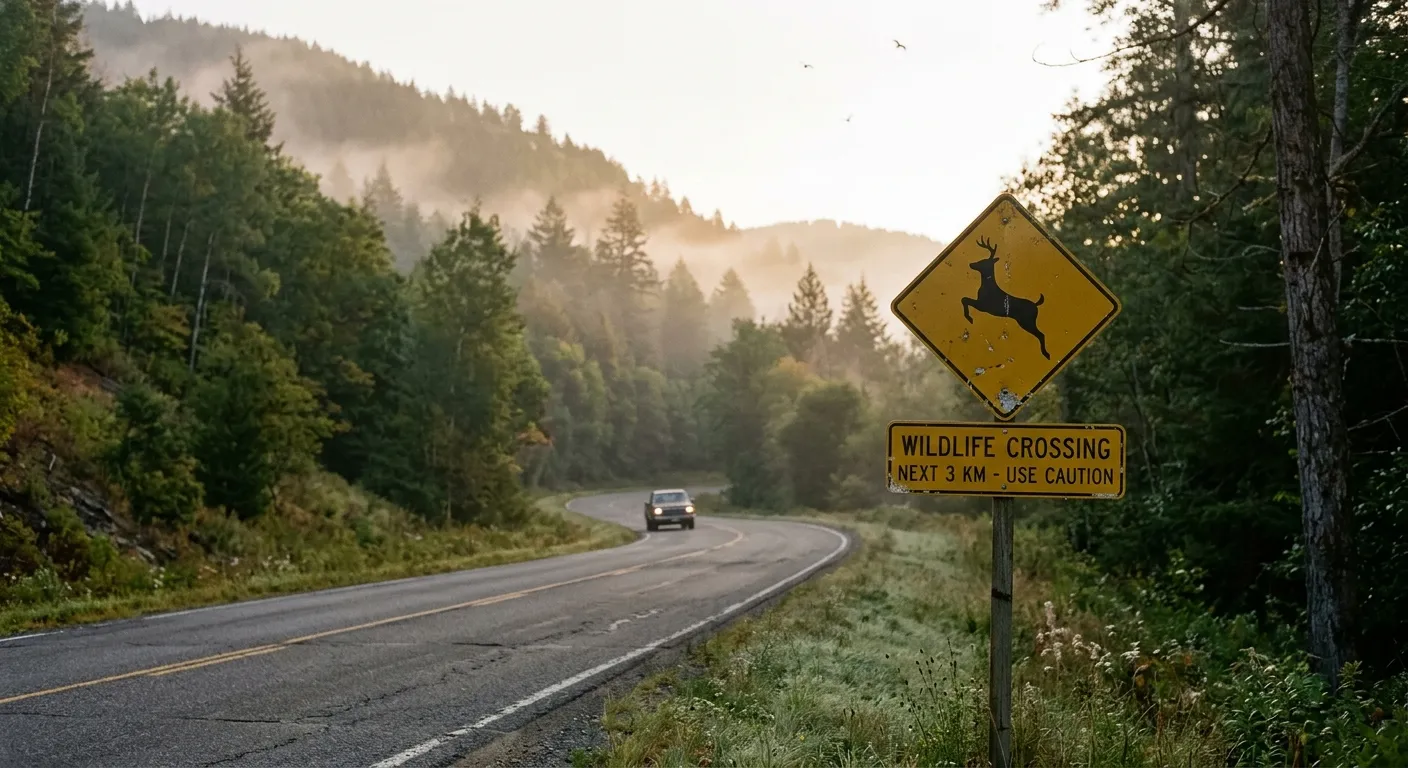
In the end, the most realistic way to cut down on badger roadkill starts with small habits behind the wheel. Sticking to the speed limit on roads near hills and farmland, and paying extra attention where wildlife-crossing signs appear, go a long way. Sections fitted with guide fencing have reportedly seen roadkill drop by more than 85%, which suggests the solution needs both better infrastructure and more careful driving.
It's also worth understanding the legal status here. Badgers aren't currently listed as an endangered species in Korea, but they are protected under the Wildlife Protection and Management Act, meaning capturing or harming one without a permit is a clear violation of the law. Unlike the poaching era, anyone caught hunting badgers for their fat today faces real penalties — and with growing skepticism about whether badger oil actually does anything scientifically, there's less incentive than ever to harm a wild animal over it.
Regionally, badger density tends to be highest in areas with dense forest and minimal human disturbance — national parks like Jirisan and Seoraksan, the mountainous parts of Gangwon province, and the Demilitarized Zone, where public access has been restricted for over sixty years. That long absence of human activity has left the DMZ's ecosystem remarkably intact, making it an important stronghold for the badger population. Hillsides closer to cities, by contrast, hold lower densities but see far more human contact, which is why sightings and roadkill reports cluster there instead.
Citizen science has also become more active lately. Wildlife-sighting reporting channels run by local governments and environmental groups let people log where and when they've spotted a badger, and that data feeds into decisions about where roadkill is concentrated and where wildlife crossings should go. A single photo a hiker or camper posts almost casually can end up being genuinely useful for understanding a region's wildlife activity. If you're interested in badgers, reporting a sighting to the relevant agency — not just posting it online — is a small but meaningful way to help.
Badger vs. Raccoon Dog: What's the Difference?
Spot a dark shape on a trail at night, and the first question is almost always: raccoon dog, or badger? The two are similar enough in size and habitat that people mix them up constantly, but they're taxonomically unrelated. Raccoon dogs belong to the dog family (Canidae), while badgers belong to the weasel family (Mustelidae) — meaning a badger is, biologically speaking, closer to a marten or otter than to a raccoon dog.
| Trait | Badger | Raccoon Dog |
|---|---|---|
| Family | Mustelidae (weasel family) | Canidae (dog family) |
| Facial pattern | Vertical black-and-white stripes running down the face | Dark "mask" pattern around the eyes |
| Snout | Long and pointed, prominent nose | Shorter, rounder impression |
| Legs | Short and stocky, low-slung body | Slightly longer legs than a badger |
| Winter | True hibernation, builds up fat | Reduced activity, not full hibernation |
| Signature habit | Builds elaborate multi-chamber setts | Reuses existing burrows or shallow shelters |
The most reliable tell is the face. A badger's vertical black-and-white stripes running from forehead to nose give it a look somewhat like a miniature Asiatic black bear. A raccoon dog, by contrast, has a dark, donut-shaped mask around its eyes, giving it a bandit-like appearance. Their silhouettes differ too — a badger's short legs and low-slung body produce a heavy, waddling gait, while a raccoon dog's slightly longer legs give it a lighter, quicker step.
Interestingly, the two species really do share burrows, as mentioned earlier, so it's not unusual for a trail camera to catch both a badger and a raccoon dog using the same den entrance on different nights. That "mystery animal" you glimpsed on a hike might not belong to a single family at all — it could be two entirely different species sharing one roof, happily or otherwise.
Tracks offer another clue. A badger's front paw prints are larger than its hind prints, with deep, distinct claw marks ahead of the toe pads. A raccoon dog's prints, being canid, show shallower claw marks and a somewhat narrower paw shape. If you spot fresh tracks in light snow, checking claw depth and the size difference between front and hind prints can tell you a fair amount about which animal passed through.
Sound and behavior are further indicators. A threatened badger tends to growl low and rough, while a raccoon dog's alarm call runs higher-pitched, closer to a bark. Gait tells a similar story at night: a badger's low, side-to-side waddle versus a raccoon dog's lighter, quicker trot. If a silhouette looks low to the ground and rocks side to side as it moves, it's probably a badger; something lighter and quicker on its feet is more likely a raccoon dog.
Diet offers a subtler clue too. Badgers have a strong preference for earthworms and insects, so they're especially active on wet nights after rain. Raccoon dogs are even more broadly omnivorous, readily eating fruit or scavenging food waste near trash cans, which is part of why they show up more often near residential neighborhoods and restaurant districts. So: a dirt trail deep in the hills points toward badger, while an alley near houses points toward raccoon dog.
What Online Communities Are Saying
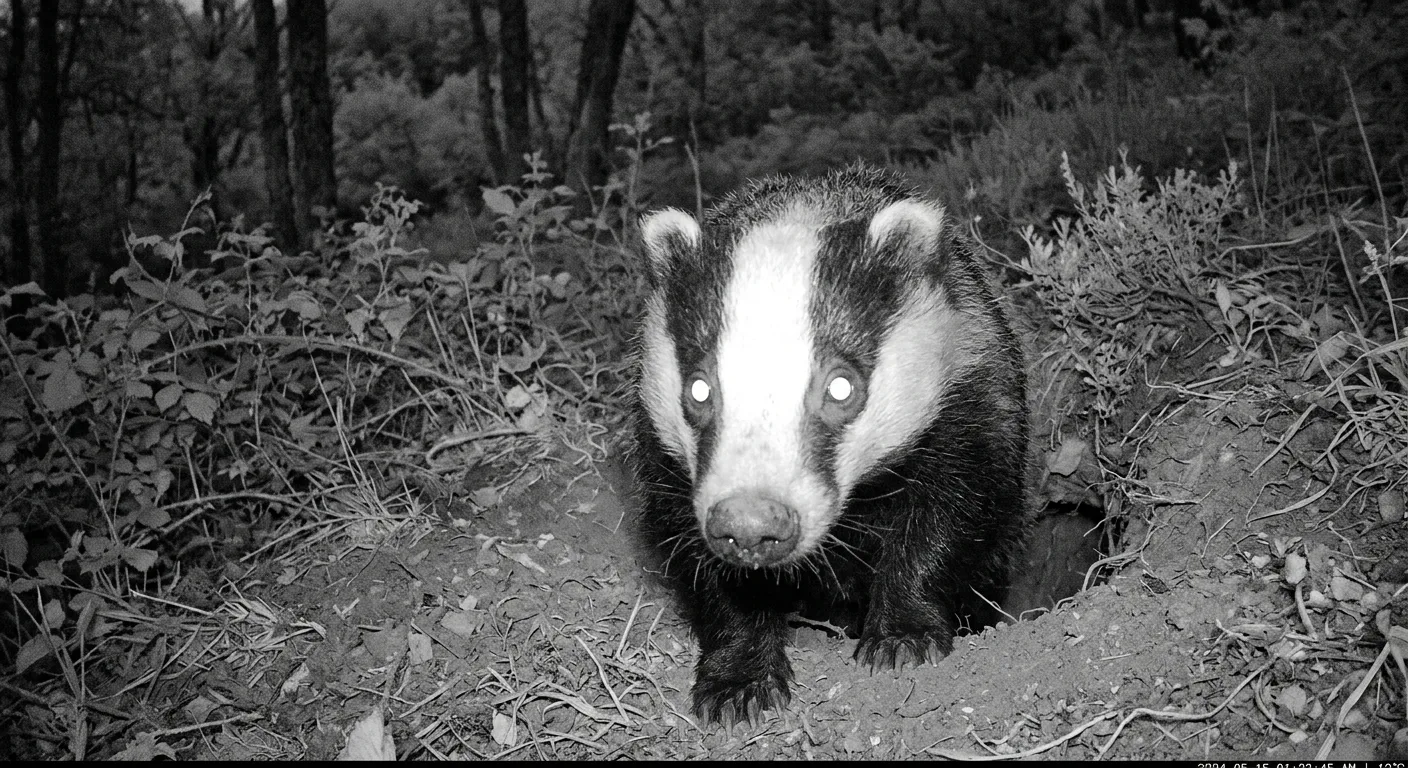
Reactions to badgers across online communities and social media turn out to be more varied than you'd expect. Hiking club forums and neighborhood parenting cafes regularly feature posts about pre-dawn badger sightings, most along the lines of "thought it was a bear cub at first" or "moved way too heavily for a raccoon dog — something was off." Among people who run trail cameras as a hobby, footage of a badger scratching itself at a burrow entrance or digging a latrine pit tends to circulate widely.
A clip of a badger pressing its nose right up to a trail camera lens drew comments like "cuter than expected" and "clearly not scared of people at all."
A post about mixing up a badger and a raccoon dog drew agreement from many readers who admitted they still can't tell the two apart, with a comparison chart or image often shared in the replies.
A resident of a rural house who posted that "something ate all our dog's food overnight" got a follow-up comment identifying the culprit as a badger rather than a raccoon dog — the reader noted "they're bolder than you'd think" and advised bringing outdoor food inside.
Taken together, these reactions suggest people tend toward curiosity and fondness rather than fear when it comes to badgers. The novelty of seeing a wild animal you'd rarely encounter in the city, plus the sheer charm of that waddling gait, come up again and again. At the same time, roadkill-related posts consistently carry a note of sadness alongside calls to expand protected zones or add more guide fencing — a sign that public interest in badgers is turning into real conversations about coexistence, not just curiosity.
Better smartphone cameras have also played a role. Casual footage that hikers capture by chance now circulates as short clips, giving more people a look at animals like badgers that used to be nearly impossible to catch on camera without specialized equipment. That visibility seems to be chipping away at vague fear of wildlife and feeding into more concrete discussions about habitat protection and roadkill prevention.
What to Do If You Meet One on a Trail
Badgers aren't animals that go out of their way to attack people. That said, they're strong for their size and will fight back fiercely if cornered, so a few basic guidelines make for a safer encounter on both sides.
- Keep your distance. Most badgers move off on their own once they sense a person nearby. If you want a photo, stay at least a few meters back.
- Don't feed it. An animal that gets used to handouts starts loitering near trails or villages more often, which is riskier for both the badger and for people.
- Be extra careful around pups. A mother is likely close by, and protective instincts can make her more reactive than usual.
- Slow down when driving at night. Between midnight and dawn — a badger's peak activity window — ease off the gas on roads near hillsides and stay alert for sudden movement.
- Don't touch an injured badger yourself. Report it to your local wildlife rescue center or environmental office instead.
Most human-badger friction actually comes down to a startled, unplanned encounter on both sides. A badger being wary of people, and a person being startled by a sudden wild animal, are both perfectly natural reactions. As long as that surprise doesn't escalate into aggressive posturing, most run-ins end with both parties quietly going their separate ways.
If you hike or camp often, it's worth knowing how to handle a large hole that looks like it might be a badger burrow. An entrance 20–30cm or wider, with freshly disturbed dirt nearby, is a good sign it's currently occupied. Avoid pitching a tent or lingering near a spot like that. Late spring through early summer overlaps with the pup-rearing season, so badgers tend to be especially sensitive to noise or unfamiliar scents near the den during that window.
Badgers in Korean Language and Culture
Badgers turn up in everyday Korean expressions more often than you'd guess. A person hunched up defensively, or moving cautiously while glancing around, might be described as acting "like a badger" — a casual, spoken comparison rather than a formal dictionary idiom, shaped more by region and generation than by any standardized usage.
The animal's image also shows up in pop culture, usually as inspiration for character design rather than a literal reference. Its round, sturdy build and distinctive striped face make it a useful visual shorthand in games and animation for a character who reads as friendly but surprisingly tough underneath. That dual impression — easygoing on the surface, formidable when it matters — happens to translate well into character writing, which is likely why the badger's look keeps getting borrowed.
In folk stories and proverbs, badgers often appear as a package deal with raccoon dogs and foxes, caught up in the same recurring plot: squabbling over den space, or using cunning to edge a rival out of its spot. That's not a coincidence — it mirrors the real cohabiting behavior between these three species discussed earlier, suggesting these tales grew out of genuine observation by people who crossed paths with these animals on mountain trails long before wildlife biology had a name for what they were seeing.
A Season-by-Season Watching Guide
If you'd like to actually observe a badger, it helps to know how its activity shifts through the year. Right after hibernation ends in March and April, you have a decent chance of spotting a mother with pups near the burrow, though this is also when she's most defensive, so keep well back and stay quiet. From May through September, as food becomes more plentiful, badgers range further and your odds of a trailside encounter rise — the evening after a rainfall is especially good, since earthworms surface closer to the ground and foraging picks up. October and November bring a final push before hibernation, when badgers forage unusually hard to build fat reserves, so dusk near the edge of a hillside is your best bet during these months.
On equipment: a red-filtered light or an infrared trail camera tends to be far less disruptive than shining a plain white flashlight directly at a badger, which will often send it straight back underground. Staying quiet and keeping a generous distance is really the core etiquette for watching any nocturnal animal, badgers included.
Frequently Asked Questions ❓
Q. Will a badger attack a person?
Badgers generally avoid people and retreat once they sense someone nearby. That said, a cornered badger or a mother protecting her pups can put up a serious fight, so avoid approaching or trying to touch one.
Q. Can you keep a badger as a pet?
No. Badgers are protected under Korea's Wildlife Protection and Management Act, and capturing or keeping one without a permit is illegal. Even if you find an apparently abandoned pup, the right move is to contact a wildlife rescue center rather than take it home yourself.
Q. Do badgers and raccoon dogs really share burrows?
Yes — there are numerous documented cases, in Korea and elsewhere, of raccoon dogs or foxes cohabiting in a badger-built sett. It's less a friendly arrangement than a mutually convenient one, driven by survival advantages on both sides.
Q. Does badger oil actually work?
It's been used in folk remedies for a long time, but solid scientific evidence for benefits like burn treatment remains thin. Given the poaching risk involved, it's safer to rely on proven medical treatments instead.
Q. Should I report a badger sighting?
A routine sighting on a trail or in the hills doesn't need to be reported. But if you find an injured badger, or one in a genuinely risky spot like a residential street or the middle of a road, contact your local government or a wildlife rescue center.
Q. Are badgers ever active during the day?
They're primarily nocturnal, but in deep forest with little human traffic, or during lean food periods, brief daytime activity does happen. Daytime sightings are rare near urban areas, though.
Q. If I see a badger in winter, is something wrong with it?
Not necessarily. As covered above, badger hibernation is closer to torpor than deep sleep, so on a mild winter day it's entirely normal for one to briefly emerge and move around. If it looks visibly unsteady or sluggish, though, it may be injured or exhausted, and it's worth contacting a rescue center.
Closing Thoughts: A Neighbor We Rarely Notice
Badgers once saw their numbers collapse under poaching pressure, and only recovered after decades of protection — enough that they're now a fairly common sight across the country's mountains again. They're architects who build meticulous burrows, survival strategists managing an uneasy coexistence with other animals, and still, on our roads, creatures very much at risk. It's easy to confuse them with raccoon dogs, but once you know they belong to an entirely different family — and that they live surprisingly tidy, well-organized lives underground — they become a lot more interesting to think about.
Putting this piece together was a reminder of how much intricate ecology sits quietly in the hillsides we walk past without a second thought. Once you know that a single badger burrow can end up hosting raccoon dogs and foxes too, even a small mound of disturbed dirt beside a trail starts to look different. Next time you spot an unfamiliar hole in the ground or a waddling set of tracks on a hike, it might be worth imagining the small world of a badger family living just beneath your feet.
Next time you spot a round, waddling animal on a hillside or trail, take a moment to stop and watch quietly — that badger has probably called that mountain home a lot longer than you have. Have you spotted a badger or a raccoon dog recently? I'd genuinely love to hear about it in the comments. 🦡
A hiker described spotting a stout gray animal waddling ahead of them around 5am on a ridge trail, not realizing it was a badger until they noticed the striped face and rocking gait. Most replies said it was more fascinating than frightening.