That faint smell when you take your shoes off, the itch you can't quite ignore, and skin that keeps peeling between your toes — if you're wondering whether it's athlete's foot, it's worth taking seriously. Athlete's foot isn't a condition that only affects certain people; it's one of the most common skin infections encountered worldwide, especially during warm, humid months. The trouble is that many people reach for whatever cream is on hand, without understanding the cause, and either see the problem worsen or watch it return again and again after seeming to clear up. This guide walks through what actually causes athlete's foot, the types of over-the-counter and prescription medications used around the world, and how to use them correctly so you're not treating the same infection over and over.
What Is Athlete's Foot? Causes and Why It Happens
Athlete's foot, medically known as tinea pedis, is a skin infection caused not by bacteria but by a group of fungi called dermatophytes. These organisms feed on keratin, the protein that makes up the outer layer of skin, which is why the thick skin between the toes and on the soles of the feet is such a common site of infection.
Public health data from dermatology associations around the world consistently show that tinea pedis is among the most frequently diagnosed skin conditions in adults, with a noticeable spike during summer and in humid climates. Dermatophytes thrive in warm, moist conditions, typically between 25°C and 35°C (77–95°F), and a closed shoe worn all day over sweaty feet creates almost exactly that environment.
What's often misunderstood is that simply coming into contact with the fungus doesn't guarantee infection. Feet that are kept dry and have an intact skin barrier can often shed the fungus before it takes hold. But when skin is broken, feet sweat heavily, or shoes trap moisture for hours at a time, the fungus finds it far easier to establish itself. In other words, athlete's foot has less to do with personal hygiene and more to do with environmental conditions that any pair of feet can encounter.
Another common misconception is that athlete's foot runs in families because of genetics. In reality, when several members of a household are affected, it's usually because they share a bathroom, slippers, or towels — allowing the fungus to pass from one person to another. Epidemiological studies published in international dermatology journals have repeatedly noted clusters of infection within the same household, which is why treating just one family member while everyone else keeps sharing the same bath mat often leads to reinfection.
How Is It Actually Diagnosed? The KOH Test
Symptoms alone aren't always enough to confirm athlete's foot, since several other skin conditions can look similar. Clinicians commonly use a simple, quick procedure called a KOH (potassium hydroxide) preparation, in which a small skin scraping is treated with a KOH solution and examined under a microscope to look for fungal filaments. The test is minimally uncomfortable and results are typically available quickly, making it a practical first step whenever symptoms are unclear or an over-the-counter product hasn't helped after a few weeks.
"Because athlete's foot tends to recur, getting an accurate diagnosis early and completing the full course of treatment is the most reliable way to improve long-term outcomes." – Board-certified dermatologist
Types and Symptoms of Athlete's Foot
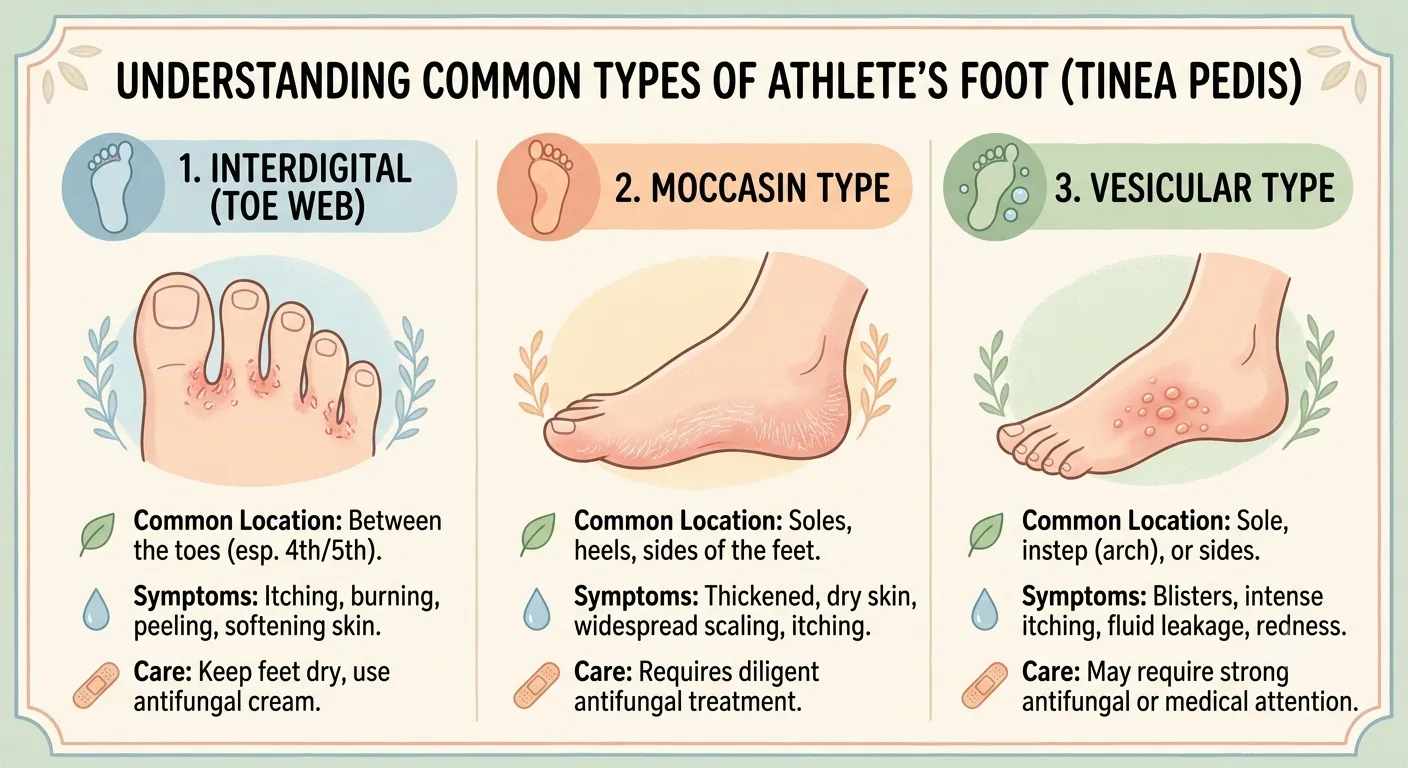
Athlete's foot generally presents in one of three recognizable patterns. Knowing which one best matches your symptoms makes it much easier to choose an appropriate over-the-counter product or describe your situation clearly to a pharmacist or doctor.
| Type | Common Location | Typical Symptoms |
|---|---|---|
| Interdigital | Between the toes (especially 4th–5th) | White, macerated skin, peeling, intense itching, odor |
| Moccasin (hyperkeratotic) | Soles and heels | Thickened, scaling skin; itching is often mild |
| Vesicular | Arch of the foot | Clusters of small blisters; oozing and intense itching if they rupture |
Interdigital: The Most Common, Easiest to Overlook
Interdigital athlete's foot is the most frequently reported form, typically starting in the tight, poorly ventilated space between the fourth and fifth toes. Early on it may just look slightly white and soggy, which is easy to dismiss, but left unmanaged the skin can crack, ooze, and become painful to walk on. Cracked skin also opens the door to secondary bacterial infections such as cellulitis, so addressing it early matters.
Moccasin Type: Easy to Mistake for Simply Dry Skin
Because it rarely itches noticeably, the moccasin (hyperkeratotic) type is often mistaken for ordinary dry skin. The soles and heels thicken and develop diffuse white scaling that doesn't respond to regular moisturizer. Persistent heel cracking in winter is sometimes actually this form of athlete's foot rather than simple dryness.
Vesicular Type: The Itchiest and Most Uncomfortable
The vesicular type produces small blisters clustered on the arch of the foot and tends to cause the most itching and discomfort of the three. When blisters rupture on their own, the oozing fluid can trigger another round of itching. Popping blisters deliberately raises the risk of bacterial infection and should be avoided; keeping the area clean while applying antifungal medication consistently is the priority.
Conditions Often Mistaken for Athlete's Foot
Not every itchy or blistered foot is athlete's foot. Dyshidrotic eczema, which causes recurring small blisters on the hands and feet, looks remarkably similar to the vesicular type and is difficult to distinguish by appearance alone. Contact dermatitis triggered by certain detergents or materials, and psoriasis, which causes thick, silvery scale, are also commonly confused with the moccasin type. Because these conditions require entirely different treatment approaches, if an antifungal product shows no improvement after two to three weeks, it's worth considering that the underlying issue may not be a fungal infection at all, and seeing a dermatologist for a proper diagnosis.
Key Takeaway
Athlete's foot is a common fungal (dermatophyte) skin infection that appears as one of three types — interdigital, moccasin, or vesicular — each with different symptoms. Identifying your pattern is the first step toward choosing the right medication and care routine.
How It Spreads and Who's at Risk
Dermatophyte fungi can survive for a surprisingly long time in shed skin flakes left on damp surfaces, which is why barefoot-friendly public spaces are a leading source of transmission. Wet locker room floors, gym mats, pool decks, and communal shower stalls are all classic transmission points. Within a household, sharing a bath mat, slippers, or towels with someone who has athlete's foot is enough to pass the infection along.
The following factors are commonly associated with a higher likelihood of developing athlete's foot.
- Excessive sweating (hyperhidrosis): Keeps the inside of shoes consistently humid, which is exactly the environment dermatophytes prefer.
- Wearing non-breathable footwear for long hours: Common among people who wear work boots, military boots, or sneakers all day.
- Underlying conditions such as diabetes: Reduced circulation and immune response can make infections both more likely and slower to resolve, with a higher chance of complications.
- Frequent use of shared facilities: Pools, gyms, and communal showers increase exposure, especially when walked through barefoot.
- A history of prior infection: Areas that were previously infected but not fully treated are prone to recurrence, and fungus can persist in shoes and socks.
Having one or more of these risk factors doesn't guarantee infection, but the more that apply, the more worthwhile it is to prioritize keeping feet dry and clean.
| Setting / Occupation | Why the Risk Is Higher |
|---|---|
| Athletes, student athletes | Long hours in sneakers, frequent use of shared locker rooms |
| Military personnel, safety-boot workers | Non-breathable footwear worn all day |
| Kitchen and food-service staff | Rubber boots worn for long shifts in humid environments |
| Swim instructors, gym trainers | Frequent barefoot exposure to damp communal floors |
People in occupations that require long hours in enclosed, sweat-prone footwear — such as athletes and military personnel — may benefit from using an antifungal powder or spray proactively as a preventive measure.
Athlete's Foot Medication Around the World: Ingredients & Formats Compared
Walk into any pharmacy and you'll find creams, sprays, powders, and even lacquers marketed for athlete's foot, which can make choosing one feel overwhelming. Globally, the vast majority of these products rely on an antifungal agent, and they generally fall into two major families.
Allylamines (such as terbinafine) work by directly blocking fungal cell membrane synthesis, giving them a fungicidal (fungus-killing) effect that often allows for shorter treatment courses. Azoles (such as clotrimazole and miconazole) work by inhibiting fungal growth and have a long track record of use across many countries. Butenafine and ciclopirox are two other actives commonly found on pharmacy shelves worldwide.
| Drug Class | Common Active Ingredients | General Characteristics | Typical Labeled Duration |
|---|---|---|---|
| Allylamines | Terbinafine | Fungicidal, often shorter treatment courses | Commonly 1–2 weeks per product labeling |
| Azoles | Clotrimazole, Miconazole | Fungistatic, long history of widespread use | Commonly 2–4 weeks per product labeling |
| Other antifungal actives | Butenafine, Ciclopirox | Widely used for interdigital and moccasin types | Varies by product; check the label |
Note: The durations above reflect typical ranges seen on over-the-counter product labeling. Actual treatment length can vary by severity and individual response, and product instructions along with pharmacist or physician guidance should always take priority.
Choosing a Format: Creams, Sprays, and Powders
Formulation matters as much as the active ingredient. Creams tend to absorb well into thicker, drier skin, making them a good fit for the moccasin type, while sprays and powders suit moist, macerated areas typical of interdigital infections, and are also useful for managing humidity inside shoes. Powders in particular are widely used not just for active treatment but as a preventive measure inside shoes after an infection has cleared. If combining formats, it's worth checking with a pharmacist that the active ingredients don't overlap or conflict.
When OTC Is Enough — and When You Need a Prescription
| Situation | Recommended Approach |
|---|---|
| Limited, early-stage interdigital or moccasin type | OTC cream or spray, self-managed |
| No improvement after 2–4 weeks of OTC use | See a dermatologist for accurate diagnosis |
| Nail discoloration or thickening (suspected onychomycosis) | Antifungal nail lacquer or prescription oral antifungal, as advised |
| Underlying conditions such as diabetes | Prioritize professional care over self-treatment |
Mild, superficial interdigital or early moccasin-type infections often respond well to OTC topical products alone. However, if the fungus has spread widely, or has reached the nails (a condition called onychomycosis, or nail fungus), the picture changes considerably. Nails have a thick keratin structure with no direct blood supply, making it very difficult for topical treatments to penetrate deeply enough. As a result, nail fungus is usually managed with long-term use of a medicated nail lacquer or, when needed, a prescription oral antifungal taken under a physician's supervision. Oral antifungals can affect liver function, so blood testing before and during treatment is often required, which is why they should only be used under proper medical guidance rather than self-directed purchase.
Storing medication in a cool place away from direct sunlight helps preserve the active ingredient, and it's worth checking expiration dates, since older opened products may lose potency over time.
A Word of Caution on Steroid-Combination Creams
Some products on the market combine an antifungal with a topical steroid. The steroid component can rapidly calm itching and redness, which can feel like fast relief, but international dermatology literature has repeatedly cautioned that using such combination products without a confirmed diagnosis can actually help the fungus spread further, a phenomenon sometimes referred to as "tinea incognito." Unless athlete's foot has been clearly diagnosed, a single-ingredient antifungal is generally the safer first choice, and any combination product should be used only under guidance and with attention to how the skin responds.
How to Use Athlete's Foot Medication Correctly (and When to See a Doctor)
Getting results from an antifungal product depends as much on technique as on the active ingredient. The single most common mistake is stopping treatment as soon as itching subsides. Even after visible symptoms fade, fungus can remain in deeper layers of skin, so completing the full course listed on the packaging is essential for reducing the chance of recurrence.
- Before applying: Wash feet thoroughly and dry them completely, paying special attention to drying between the toes with a towel.
- Apply a generous amount: Cover not just the visible lesion but roughly 1–2 cm (about half an inch) of surrounding healthy-looking skin, since fungus can extend beyond what's visible.
- Let it absorb before covering: Putting on socks or shoes immediately after application can reduce absorption; a few minutes of air-drying first is better.
- Complete the full course: Continue for the full duration on the label even if symptoms improve early — this is the single biggest factor in preventing recurrence.
- Keep personal items separate: Wash socks and towels used during treatment separately from those of other household members.
Most OTC antifungal products are considered relatively safe, but some people experience stinging, burning, redness, or, less commonly, contact dermatitis. If irritation persists or worsens after several days of use, it's reasonable to stop and consider switching products or checking in with a pharmacist or doctor. Pregnant or breastfeeding individuals, and parents treating children, should check with a pharmacist or physician before starting any product.
Common Mistakes That Lead to Treatment Failure
Two people can use the exact same product and get very different results, and the difference usually comes down to habits rather than the medication itself.
- Applying only once a day when twice is recommended: If the label calls for twice-daily use, skipping the morning application can allow local concentrations to drop too low between doses.
- Reusing the same socks without washing: Fungus-contaminated socks can reinfect treated skin even mid-treatment.
- Using shared pedicure tools without checking sterilization: It's safer to pause visits to nail salons or shared foot-care services during active treatment.
- Overlooking a household source: Treating your own feet while continuing to share a bath mat or slippers with an infected family member often leads to reinfection within weeks.
Consider seeing a healthcare provider rather than continuing to self-treat if any of the following apply:
- No improvement after 2–4 weeks of consistent OTC use
- Widespread blistering, oozing, pus, swelling, or warmth in the area
- Underlying conditions such as diabetes that slow healing or raise infection risk
- Nail discoloration or thickening suggestive of onychomycosis
- Worsening rash or itching after starting a new product
Preventing Recurrence: Foot Care Habits and Common Myths
Preventing athlete's foot from coming back is just as important as treating it. Consistently practicing the habits below makes it much harder for dermatophytes to establish themselves again.
🧦 Breathable Shoes and Socks
Rotate between two or three pairs of shoes rather than wearing the same pair every day, giving each pair time to fully dry out. Choose moisture-wicking cotton or technical-fabric socks.
💧 Keep Feet Dry
Dry thoroughly between the toes after washing, and consider a foot powder if you sweat heavily.
🩴 Wear Sandals in Shared Spaces
Bringing your own sandals to pools, gym locker rooms, and communal showers significantly lowers your exposure to the fungus.
🏠 Keep Personal Items Personal
If someone in your household has athlete's foot, using separate house slippers, bath mats, and nail clippers helps prevent it from spreading.
🌧️ Extra Care in Humid or Rainy Seasons
Dry wet shoes with newspaper or silica packets, and keep a moisture absorber in your shoe closet to reduce the conditions fungus needs to thrive.
🏃 Wash Feet Right After Exercise
Avoid staying in sweat-soaked socks for long after a workout — wash your feet and change into dry socks as soon as practical.
Choosing Shoe Materials That Help Prevent Recurrence
Even shoes of the same style can trap very different amounts of moisture depending on their material. If recurrence is a concern, breathability is worth factoring into your next shoe purchase.
| Shoe Material | Breathability | Notes |
|---|---|---|
| Genuine leather | Moderate to good | Absorbs sweat and releases it gradually; takes longer to fully dry |
| Mesh / breathable synthetic | Very good | Recommended for summer and exercise; dries quickly after washing |
| Rubber / vinyl (e.g., rain boots) | Low | Traps moisture; needs extra care during extended wear |
Common Myths About Athlete's Foot Medication
Fact Hygiene isn't really the deciding factor — a humid, poorly ventilated environment can affect even meticulously clean feet. In fact, washing often but not drying thoroughly can actually increase risk.
Fact Visible symptoms can clear while fungus remains in deeper skin layers. Stopping before completing the labeled course is one of the most common causes of recurrence.
Fact Ingredients and formulations suit different types of infection differently, and conditions like nail fungus that are hard to penetrate often need more than a standard topical cream.
Fact Itching may ease within days, but fully clearing the fungus takes the full labeled duration. Stopping early out of impatience is one of the leading reasons treatment fails.
Athlete's foot is nothing to feel embarrassed about — it's a common infection that can affect anyone in a warm, humid environment. Understanding what actually causes it, choosing a medication that matches both your symptom type and its ingredients and format, and — above all — completing the full recommended course, makes it far easier to manage. If symptoms persist or worsen, don't hesitate to see a dermatologist for a proper evaluation.
Frequently Asked Questions
Q. Why does my athlete's foot keep coming back even though I use medication?
The most common reason is stopping as soon as symptoms disappear. Fungus that remains in deeper skin layers can regrow, so it's important to complete the full duration listed on the product. Fungus left behind in shoes or socks is another frequent source of reinfection, so treat those, too, during the treatment period.
Q. Should I choose a cream or a spray?
There's no single right answer — it depends on where and how your symptoms show up. Creams tend to suit thicker, drier skin typical of the moccasin type, while sprays or powders are often more comfortable for moist, macerated interdigital symptoms. If you're not sure, describing your symptoms to a pharmacist is the safest way to get a recommendation.
Q. Do I need to disinfect my shoes while treating athlete's foot?
Yes, it helps. Fungal spores can linger inside shoes you've already worn, so using a UV shoe sanitizer or dusting the inside with antifungal powder can reduce the chance of reinfection. Rotating between several pairs of shoes so each has time to fully dry is a good complementary habit.
Q. Is it safe to use athlete's foot medication while pregnant?
Some topical antifungals are considered relatively low-risk during pregnancy, but recommendations vary by ingredient. Rather than choosing a product on your own, let your obstetrician or pharmacist know you're pregnant and get guidance before starting treatment.
Q. Can nail fungus be cured with topical medication alone?
Onychomycosis (nail fungus) is difficult to treat with topical products alone because the thick keratin of the nail blocks deep penetration. Long-term use of a medicated nail lacquer, sometimes combined with a prescription oral antifungal, is often necessary. If you notice nail discoloration or thickening, seeing a dermatologist for an accurate diagnosis is the most reliable path forward.
Q. My skin got more irritated after applying the medication. Should I keep using it?
Mild stinging at the start is common, but if redness or itching gets noticeably worse, it may be a reaction to the product or a sign the underlying issue isn't actually a fungal infection. Stop use, take a photo of the affected area if possible, and have a dermatologist evaluate it.
Q. Should I keep applying medication after the infection has cleared, just in case?
Daily use isn't necessary once you've finished treatment, but during humid seasons or periods of heavy sweating, using an antifungal powder or spray once or twice a week in shoes and on feet can help prevent recurrence. Long-term preventive use without a specific reason is less important than simply keeping shoes and socks dry as a daily habit.