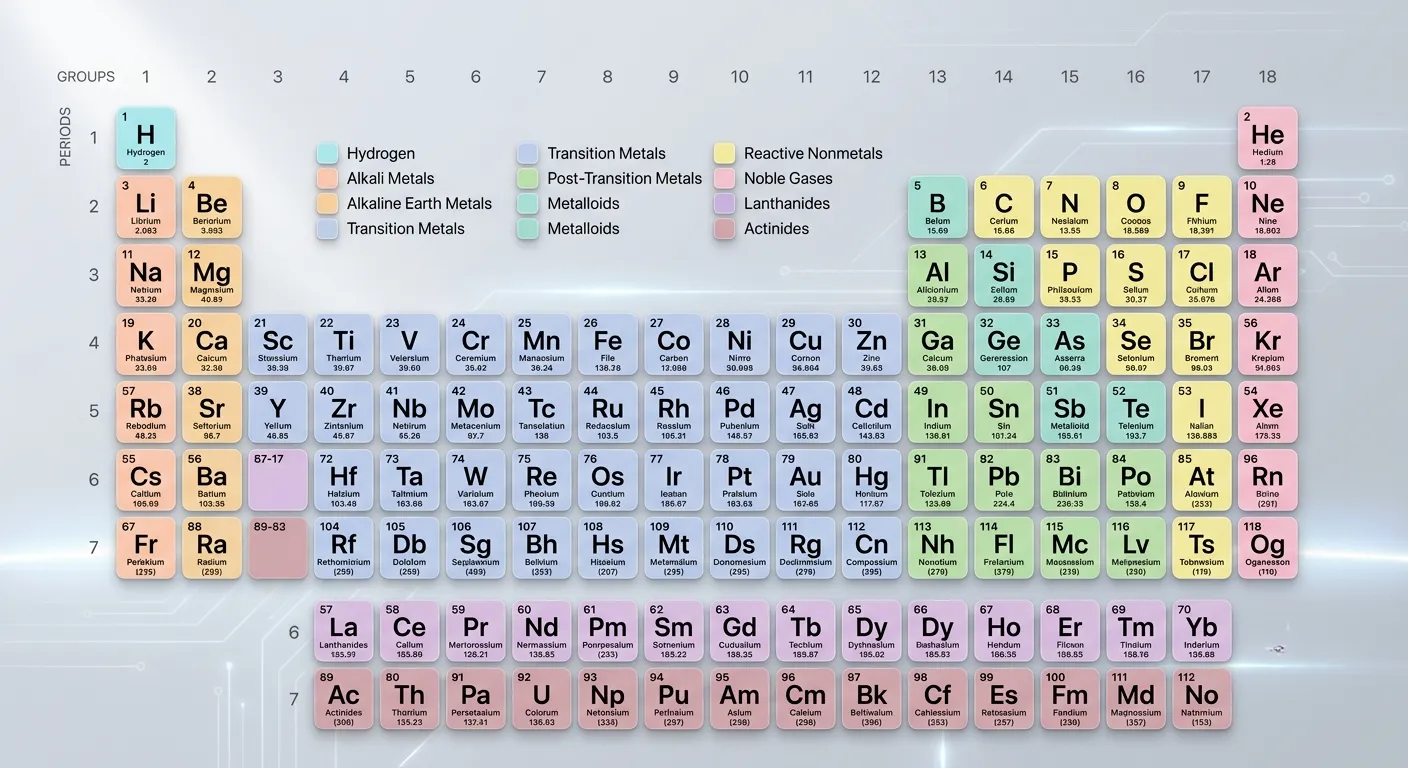
Most of us remember staring at those 118 little boxes in high school chemistry and sighing. But the periodic table isn't really a "table you're forced to memorize" — it's closer to a map of the universe that humanity has been assembling for 156 years and counting. Right now, as you read this, teams in Japan, Russia, and even South Korea are racing to fill in box number 119. This guide covers how to read the table, realistic ways to actually memorize it, where elements show up in everyday life, and the latest news from the frontier of chemistry.
① What Is the Periodic Table? A Russian Chemist's Bold Gamble
Long before Mendeleev, chemists had already been circling the idea. In 1817, German chemist Johann Döbereiner noticed that elements like lithium, sodium, and potassium could be grouped into "triads," where the atomic weight of the middle element was roughly the average of the other two. In 1862, French geologist Alexandre-Émile Béguyer de Chancourtois arranged elements along a spiral, showing that properties repeated periodically — but his diagram was so complicated that almost nobody paid attention.
Then, in 1869, Russian chemist Dmitri Mendeleev wrote each of the 63 known elements on its own card and laid them out in order of atomic weight. Shuffling the cards like a game of solitaire, he noticed that similar properties kept reappearing at regular intervals. Here's the bold part: wherever the pattern didn't fit, he simply left a blank space and declared, with total confidence, that an undiscovered element belonged there.
That prediction turned out to be eerily accurate. The gap Mendeleev called "eka-aluminium," complete with predicted density and melting point, was filled a few years later by the discovery of gallium. "Eka-silicon" turned out to be germanium, and "eka-boron" turned out to be scandium — matching his predictions closely enough that even skeptical chemists had to admit the table was onto something real.
Mendeleev wasn't alone in circling this idea. English chemist John Newlands published his "Law of Octaves" in 1865, noting that properties repeated every eight elements. He was mocked at the time — one critic reportedly asked if he planned to "play music" with the elements next — and Newlands, discouraged, largely stepped back from the field. Twenty-two years later, once Mendeleev's table had been formally recognized, the Chemical Society of London invited Newlands back and honored his early insight. Mendeleev himself was reportedly a strong contender for the 1906 Nobel Prize in Chemistry, losing by a single vote.
The table took a few more rounds of revision to reach its modern form. In 1913, physicist Henry Moseley used X-ray experiments to show that elements should be ordered by atomic number — the number of protons in the nucleus — rather than atomic weight, and that's still the ordering principle used today. Moseley never received a Nobel Prize for this work; he was killed in action during World War I. Then in 1945, American chemist Glenn Seaborg showed that the lanthanides and actinides belonged in two separate rows at the bottom of the table, giving us the shape we recognize on classroom walls today. In other words, the periodic table isn't the product of a single genius — it's a relay race that's been running for more than 150 years. Mendeleev himself was later honored posthumously with element 101, mendelevium.
Marie Curie deserves a mention too. In 1898, working with her husband Pierre, she spent years refining uranium ore and eventually isolated two brand-new elements: polonium and radium. Polonium was named after her homeland, Poland — making it one of the first elements named after a country rather than a person. The work earned her the 1903 Nobel Prize in Physics and, in 1911, the Nobel Prize in Chemistry, making her the first person to win Nobel Prizes in two different sciences.
Seaborg himself is worth a second look, too. Beyond rearranging the table's bottom rows, he personally discovered or co-discovered nearly ten new elements, including plutonium, americium, curium, berkelium, and californium. In 1997, while Seaborg was still alive, element 106 was officially named seaborgium in his honor — putting him in the very small club of scientists who got to see their own name on the periodic table while they were still around to appreciate it.
"The periodic table isn't a finished document — it's a living map whose last row is still being written." – a chemistry teacher, on why the table still matters
② How to Actually Read the Periodic Table
The table feels intimidating mostly because people try to read it as a grid of random symbols. In reality, every row and column carries specific meaning. Rows are called "periods," and elements in the same period share the same number of electron shells — period 1 elements have one shell, period 7 elements have seven. Columns are called "groups," and elements in the same group share the same number of valence (outermost) electrons, which is why they behave similarly.
Color-coding makes this even more intuitive. Here's the basic classification system used throughout this guide.
| Category | Location | Examples | Key Traits |
|---|---|---|---|
| Alkali metals | Group 1 | Sodium, Potassium | Soft, silvery, react violently with water |
| Alkaline earth metals | Group 2 | Magnesium, Calcium | Reactive, but more stable than alkali metals |
| Transition metals | Groups 3–12 | Iron, Copper, Gold | Multiple oxidation states, generally hard and lustrous |
| Metalloids | Metal/nonmetal border | Silicon, Germanium | Properties of both metals and nonmetals; key to semiconductors |
| Halogens | Group 17 | Fluorine, Chlorine | Highly reactive nonmetals, bond readily with other elements |
| Noble gases | Group 18 | Neon, Argon | Full outer electron shell, rarely react with anything |
Since we're already talking electrons: most elements try to fill their outermost shell with eight electrons — the "octet rule." That's exactly why noble gases barely react with anything; their outer shell is already full (or, in helium's case, holds a stable two). Group 1 elements, on the other hand, need to gain or lose just one electron to reach that same stable state, which is exactly why they're so explosively reactive.
There's also a broader trend worth knowing: moving left to right across a period, metallic character decreases and nonmetallic character increases; moving top to bottom within a group, atomic size and metallic character both increase. Once you understand the table this way, you can often predict how an element will behave just from its position. The table is also divided into "blocks" based on which electron orbital is being filled — groups 1–2 form the s-block, the transition metals form the d-block, groups 13–18 form the p-block, and the lanthanides/actinides form the f-block. That's a college-chemistry-level detail, so for now it's enough to just know it exists.
Key Takeaway
Rows (periods) represent electron shell count; columns (groups) represent valence electron count. Once those two ideas click, the periodic table stops being something you memorize and becomes something you can read.
③ Elements All Around You: Everyday Uses
Part of why the periodic table feels abstract is that nobody explains what it's actually for. In reality, you brush up against a dozen of these elements before lunch. Here are a few familiar examples that make the table feel a lot less theoretical.
Silicon
The core material in every smartphone and computer chip — it's literally where "Silicon Valley" gets its name.
Lithium
The key ingredient in the rechargeable batteries powering your phone, laptop, and electric car.
Neon
Glows red when electrified, which is exactly why it lights up neon signs at night.
Helium
Famous for balloons, but it's also essential for cooling the superconducting magnets inside hospital MRI machines.
Titanium
Lightweight and biocompatible, which is why it shows up in eyeglass frames, dental implants, and artificial joints.
Iodine
A wound antiseptic and an essential nutrient for thyroid health, found in abundance in seaweed.
Fluorine
The active ingredient in toothpaste that fights cavities — and also the most reactive element on the entire table.
Silver
Highly antibacterial, and widely used in medical materials, mirrors, and electrical contacts.
Carbon
The same element can be soft graphite or the hardest natural material on Earth — diamond — depending purely on how the atoms are arranged.
Once you connect elements to physical objects like this, the periodic table stops looking like a list to memorize for a test and starts looking like a materials catalog for everything you own. Next, let's put that connection to work with some memorization strategies.
④ A Realistic Way to Memorize the Periodic Table
Trying to memorize all 118 elements in one sitting is a great way to give up by lunchtime. The advice that shows up again and again across chemistry forums and study communities is refreshingly simple: understand the pattern, break it into small chunks, and repeat. Here's a step-by-step version of that advice.
-
1
Master elements 1–20 first
Don't try to learn all 118 at once. Hydrogen through calcium covers the elements you'll actually encounter most often in class and in daily life.
-
2
Chunk it into groups of 4–5 and give it rhythm
Instead of memorizing a whole row at once, break it into short chunks — "H-He-Li-Be, B-C-N-O-F-Ne" — and it starts to feel like song lyrics rather than a list.
-
3
Write it by hand and say it out loud
Writing the symbol while saying the element name out loud engages more of your memory than passive reading — a point that comes up constantly in study advice.
-
4
Anchor elements to real objects
As covered above — lithium is your phone battery, neon is a street sign, titanium is a dental implant. Concrete images stick far better than abstract symbols.
-
5
Turn it into a game
Quiz-style study apps turn tedious memorization into something closer to a five-minute game, which lowers the barrier to actually repeating the material.
-
6
Do a little, often
A poster taped above your desk and four or five new elements a day beats a single marathon cramming session for long-term retention.
Interestingly, the lanthanides and actinides at the bottom of the table look intimidating but are often easier to remember than you'd expect. Many are named after planets (uranium, neptunium, plutonium), famous scientists (einsteinium, mendelevium), or the places where they were discovered (californium, americium) — which makes them feel more like a story than a string of syllables. The transition metals in groups 3–12, on the other hand, tend to trip people up the most, since their names and colors can blur together. Anchoring yourself to familiar ones — iron, copper, zinc, silver, gold — first, then filling in around them, tends to help.
Different Approaches for Different Stages
How you approach the table should shift depending on your level. Younger students benefit more from coloring activities and card games than rote memorization. Middle schoolers should focus on accurately matching elements 1–20 to their symbols, along with a basic sense of the difference between atomic number and atomic mass.
For high schoolers heading into more rigorous chemistry coursework, memorization alone isn't enough — you need to connect the table to moles, electron configuration, and ionization trends. At that stage, the real skill isn't knowing "element 26 is iron," it's being able to look at the table and reason out why an element behaves the way it does. As you advance, the goal quietly shifts from recall to explanation.
⑤ Right Now: The International Race for Element 119
This is where things get genuinely exciting. The periodic table most of us learned in school ends at element 118, oganesson, completing seven full periods. But right now, nuclear physics labs around the world are racing to synthesize element 119 — the element that would open an entirely new eighth period. Since it hasn't been officially discovered yet, it goes by the IUPAC placeholder name "ununennium," with the temporary symbol Uue.
Creating a superheavy element is often compared to winning the lottery. Two heavy atomic nuclei have to be fused together by smashing them together in a particle accelerator, but the more protons involved, the stronger the electrical repulsion pushing them apart — so the odds of a successful fusion drop dramatically as elements get heavier. Research teams routinely run trillions of collisions just to detect a handful of atoms, which gives you a sense of how hard-won every box past element 118 really is.
Despite the odds, researchers keep at it because of a compelling theory called the "island of stability." The idea is that certain combinations of protons and neutrons could produce superheavy elements that are, counterintuitively, more stable and longer-lived than their lighter superheavy neighbors. Recent experimental data has offered some support for this theory, raising hopes that discovering elements 119 and 120 could do more than fill in a blank box — it could reveal something fundamental about how matter holds together.
Interestingly, South Korea has entered this race too. IBS's heavy-ion accelerator RAON, built in Daejeon's Sindong district, is a home-grown facility often nicknamed "the biggest basic-science project in Korean history." Alongside its work on rare isotopes, discovering new superheavy elements is one of its stated research goals — and IBS has floated the idea that if RAON does discover a new element, it would be named "koreanium" (symbol Ko), a detail that's become a minor point of national pride in Korean science circles.
As of 2026, Russia's JINR team is running experiments with new target materials and beams, while Japan's RIKEN continues its search using an upgraded separator system. If either team — or any of the others — succeeds, it would mark the first new element name added to the periodic table in roughly a decade, following the naming of nihonium, moscovium, tennessine, and oganesson back in 2016. It's worth noting that detecting a new element doesn't mean it's instantly official: the claim has to pass joint verification by IUPAC and IUPAP before the discovering team can even propose a name, a process that can take anywhere from a few years to over a decade.
| Element | Number | Primary Lab | Name Origin |
|---|---|---|---|
| Flerovium | 114 | JINR (Russia) | Georgy Flyorov, lab founder |
| Livermorium | 116 | LLNL (US) & JINR | Lawrence Livermore National Laboratory |
| Nihonium | 113 | RIKEN (Japan) | "Nihon," an old name for Japan |
| Tennessine | 117 | ORNL et al. (US) & JINR | The US state of Tennessee |
| Oganesson | 118 | JINR & LLNL | Yuri Oganessian, living scientist |

⑥ Fun Facts You Can Casually Drop in Conversation
None of these will show up on a test, but they're the kind of periodic table trivia that makes for surprisingly good conversation.
The letter J appears nowhere
Not a single one of the 118 element symbols contains the letter "J" — mostly a byproduct of names rooted in Latin and Greek.
Only two elements are liquid at room temperature
Mercury (Hg) and bromine (Br) are the only elements that exist as liquids at standard temperature and pressure. Everything else is solid or gas.
Feynman's "element 137 limit"
Physicist Richard Feynman proposed that beyond atomic number 137, an electron's theoretical orbital speed would need to exceed the speed of light — implying elements simply couldn't exist past that point.
Four ways elements get their names
Mythology (thorium, after Thor), places (nihonium, after Japan), scientists (einsteinium), and observed properties or colors.
Named while still alive — a rare honor
Element 118, oganesson, is named after Russian scientist Yuri Oganessian, one of the very few researchers to see an element named after them during their own lifetime.
Over 700 "alternative" periodic tables
Mathematicians using topological methods have identified more than 700 valid ways to arrange the periodic table depending on what property you want to highlight.
The most common element in the universe
Hydrogen makes up roughly 75% of all the mass in the universe, with helium a distant second. Nuclear fusion inside stars starts with these two elements.
Why gold barely tarnishes
Gold is chemically very unreactive and resists oxidation, which is exactly why ancient gold jewelry can still look shiny thousands of years later.
Mendeleev publishes the first periodic table, ordered by atomic weight with predicted gaps
Moseley establishes atomic-number ordering via X-ray experiments
Seaborg separates the lanthanides and actinides, completing the modern layout
Nihonium, moscovium, tennessine, and oganesson are named, completing period 7
The international race for element 119 is underway, on the verge of opening period 8
⑦ Frequently Asked Questions
As of 2026, 118 elements are officially recognized, filling all seven periods from hydrogen (1) to oganesson (118).
By colliding two heavy atomic nuclei at extremely high speed in a particle accelerator, forcing them to fuse. Nature only produces elements naturally up to roughly plutonium (94); everything heavier is synthesized in a lab.
The discovering team can propose a name only after their claim passes joint verification by IUPAC and IUPAP. The proposed name then goes through a public comment period before IUPAC finalizes it.
Nothing is confirmed yet, but South Korea's Institute for Basic Science, which operates the RAON heavy-ion accelerator, has stated that if it discovers a new element, it intends to name it "koreanium" (Ko).
It depends on your goals. For general chemistry education, knowing elements 1–20 plus the commonly used transition metals, halogens, and noble gases is usually enough.
In theory, yes — but the odds of successful synthesis drop sharply as elements get heavier, so where exactly the table's practical limit lies is still an open scientific question.
Elements are defined by their number of protons (atomic number). Atoms of the same element with different numbers of neutrons are called isotopes — and isotopes aren't shown separately on the standard periodic table.
⑧ How the Internet Feels About the Periodic Table
Public reaction to the periodic table tends to split into two very different camps. Around exam season, student communities fill up with posts along the lines of "when am I ever going to finish memorizing this," and self-deprecating "I gave up on chemistry" jokes circulate as a kind of shared coping mechanism. On the flip side, science YouTube videos that dig into the backstory of individual elements — or set them to a catchy memorization song — reliably draw comments like "I would've actually liked chemistry if it was taught this way."
Posts sharing the advice "don't memorize it all at once — understand the pattern and repeat it in small chunks" consistently perform well and get bookmarked often.
Trivia-driven posts — liquid elements, the origin of element names, and similar oddities — tend to become recurring, evergreen favorites.
Videos that frame elements as stories rather than facts tend to get noticeably more "this actually makes sense now" and "more like this please" comments.
The common thread seems to be that the problem was never the table itself — it was the delivery. Once you know the discovery stories and the human drama behind those 118 stiff little symbols, they start to feel a lot more like old friends than obstacles. Hopefully this guide did a little of that for you, too.
The periodic table isn't a finished artifact sitting in a museum — it's a living map that's still expanding. It started with Mendeleev's audacious blank spaces, was refined by Moseley's atomic-number ordering and Seaborg's structural fix, and today it's being pushed forward by an international race for element 119 that now includes Korean researchers at RAON. Next time you spot a periodic table on a classroom wall or a lab poster, hopefully it won't look like an intimidating list anymore — just an ongoing story that's still being written. 🧪