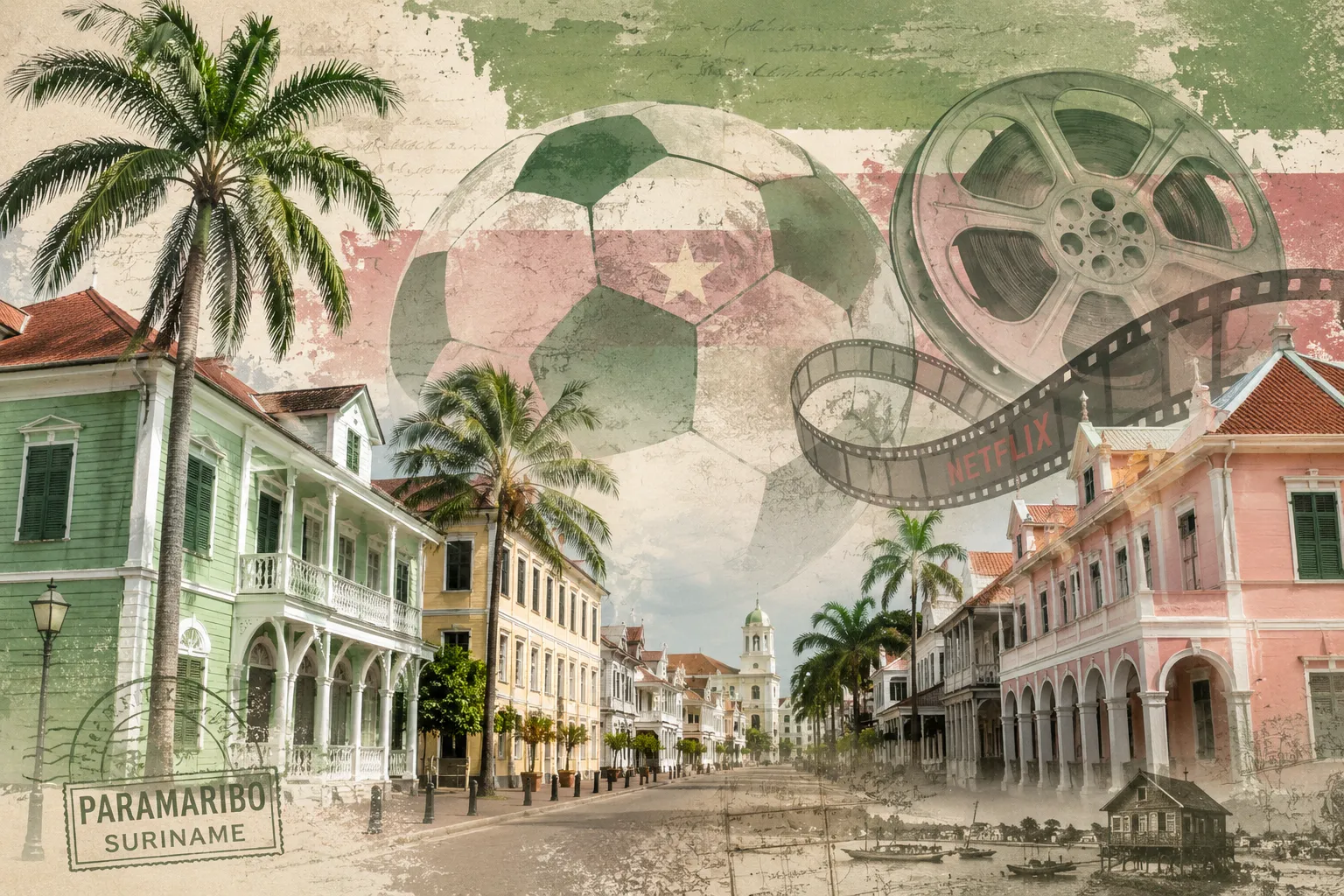
The stripe above is a stylized nod to Suriname's flag: green for agriculture and fertility, white for peace and justice, red for progress and love of country, and the yellow star at the center for the unity of its many ethnic groups.
If you've been watching World Cup coverage lately and paused at a strangely familiar country name, you're not alone. It's Suriname — the same name Netflix etched into millions of minds back in 2022 with Ha Jung-woo and Hwang Jung-min's hit drama. In 2026, that name is trending again, for a completely different reason. What happened? This piece revisits the Netflix drama, unpacks what Suriname is actually like as a country, explains why it's back in the headlines, and rounds up the controversies and community reactions that followed along the way. It's a fun case study in how one piece of content — and later, one football campaign — can put an unfamiliar country on the map twice, in two very different lights. 🌍
Before diving in, here's the shape of this piece: three threads woven into one story. First, the underdog run Suriname put together in the 2026 World Cup qualifiers. Second, the Netflix drama that made the name "Suriname" a household phrase back in 2022. And third, the real country hiding behind both headlines. Let's take them one at a time.
① The World Cup Brought Suriname Back
⚽ 2026 World CupThe 2026 World Cup, co-hosted by Canada, Mexico, and the United States, is the first edition ever to feature 48 teams. With more slots up for grabs, storylines about football's smaller nations — Cape Verde, Curaçao — flooded in this cycle, and Suriname was right in the middle of that wave. With a population of roughly 600,000, this small country pushed CONCACAF powerhouse Panama for top spot in the final qualifying group all the way to the last matchday.
Geographically, Suriname sits in South America, but in football it competes as part of CONCACAF alongside Caribbean nations — which is why it kept getting described as "a South American team pulling off an upset in the North American zone." Entering the final round as the fourth seed and pressuring the top-seeded Panama down to the wire was already a remarkable feat on its own. Suriname ultimately conceded a late goal on the road that cost them top spot, and a subsequent loss to Guatemala sealed their fate — missing direct qualification but earning a place in the intercontinental play-off instead.
Football experts largely saw Suriname's run as a shock. Almost no analyst rated them as genuine qualification contenders before the campaign began, but as they kept pace with Panama into the final stretch, several international outlets rushed out feature pieces on the team. Domestically, some Korean sports commentary even suggested that if a side like Suriname made the World Cup, it could work in South Korea's favor come the group draw.
Suriname wasn't the only small nation turning heads this cycle. Curaçao, with a population of roughly 150,000, became the smallest nation by population ever to qualify for a World Cup, eclipsing the previous record held by Iceland's 2018 squad. Haiti returned to the finals for the first time in 52 years, and Cape Verde marked their World Cup debut with a stunning draw against Spain in the group stage. Against that backdrop, Suriname built its own reputation as "small but fierce" — though, unlike those sides, they fell just short at the very last hurdle.
| Country | 2026 Qualifying Outcome | Why It Made Headlines |
|---|---|---|
| Curaçao | Direct qualification | Smallest population (~150,000) ever to reach a World Cup |
| Haiti | Direct qualification | First finals appearance in 52 years |
| Cape Verde | Qualified | Debut tournament, drew with Spain |
| Suriname | Lost in intercontinental play-off | 4th-seed underdog run through the final round |
In the intercontinental play-offs, Suriname was drawn against the DR Congo, Iraq, Jamaica, Bolivia, and New Caledonia for the last two remaining World Cup berths. As one of the lowest-ranked teams in the pool, they didn't earn a bye and had to start in Round 1 — against Bolivia. In that March 2026 match, Suriname fell 2-1, ending their campaign. As it happens, Bolivia — themselves chasing a first finals appearance in 32 years since 1994 — then lost to Iraq in the next round, meaning Iraq ultimately claimed the final spot. Suriname didn't make it to the tournament, but the mere possibility that "Suriname might play at the World Cup" generated enormous buzz among football fans, and quite naturally spilled over into: "Wait, where is Suriname again? Isn't that the Netflix show country?"
- Sep–Nov 20254th-seeded Suriname emerges as a dark horse, battling top-seed Panama for the final-round group lead
- Nov 2025A late away goal hands the group lead to Panama, sending Suriname to the intercontinental play-off
- Mar 2026Round 1 of the intercontinental play-off pits Suriname against Bolivia
- Mar 2026, final resultA 2-1 loss to Bolivia ends the campaign — a first-ever World Cup berth waits for another cycle
One thread worth pulling on: why did Suriname's squad suddenly get this strong? FIFA's recent "sporting passport" eligibility changes opened a path for Dutch nationals of Surinamese descent to represent Suriname internationally — a meaningful shift, since Suriname has quietly been a talent pipeline for Dutch football since its 1975 independence from the Netherlands. More on that in the next section.
Suriname's own football federation treated this qualifying run as historic in itself. Officials described unprecedented levels of public interest and support, and tickets for a home match against El Salvador reportedly sold out within 30 minutes — a scale of demand the sport had never seen domestically before. It's a reminder of just how much a football campaign can do for a country's global visibility.
Football analysts widely agreed that a side with such a modest FIFA ranking making it all the way to the intercontinental play-offs was, on its own, one of the qualifying cycle's biggest surprises. – aggregated international sports coverage of 2026 World Cup qualifying
② Revisiting Netflix's Narco-Saints
Let's talk about the show itself. Known in Korea as "Suriname" and released internationally as Narco-Saints, this Netflix original dropped on September 9, 2022, the first day of the Chuseok holiday. The timing mattered: just a year earlier, Squid Game had become a global phenomenon and one of Netflix's biggest hits ever, so expectations and investment in Korean content were running unusually high. Narco-Saints landed in that moment and became one more proof point that Korean dramas weren't a one-hit wonder but a repeatable global success formula. Director Yoon Jong-bin — known for Nameless Gangster and The Spy Gone North — helmed the project, with Ha Jung-woo, Hwang Jung-min, Park Hae-soo, Jo Woo-jin, and Yoo Yeon-seok leading the cast, and Taiwanese star Chang Chen in a special appearance. Its six-episode run packed a fast-moving story into a tight, binge-friendly format.
The story follows Kang In-gu (Ha Jung-woo), an ordinary businessman who travels to Suriname to sell skate fish and gets framed for drug trafficking. Cornered and desperate, he's approached by National Intelligence Service agent Choi Chang-ho (Park Hae-soo) and agrees to help take down Jeon Yo-hwan (Hwang Jung-min) — a Korean pastor-turned-drug-lord who runs a cocaine operation out of Suriname in partnership with a Colombian cartel, while maintaining a devout public image through his own church congregation.
This isn't pure fiction — it's loosely inspired by the real case of Jo Bong-haeng, who ran a drug trafficking operation in Suriname in the late 2000s, and the civilian collaborator who helped South Korean authorities capture him in 2009. That said, character names, specific plot beats, and especially the action-heavy final act were substantially fictionalized for dramatic effect. The director has explained in interviews that, since the real events involved almost no women, he chose to keep the story close to that reality rather than force in female characters — a choice that drew both praise and criticism from Korean critics.
Digging a little deeper into the real case: Jo Bong-haeng is reported to have built a large-scale operation moving cocaine to Europe and Asia through a partnership with a Colombian cartel, and to have accumulated significant political influence within Suriname — a detail echoed in Jeon Yo-hwan's near-untouchable power in the show. He was eventually apprehended with the help of a civilian collaborator who cooperated with the National Intelligence Service, and Korean media covered the case back in 2009. Interestingly, the real-life collaborator's identity was never fully disclosed, reportedly for safety reasons, and news coverage referred to them only by an initial. The show borrows the bones of the true story — an ordinary businessman drawn into cooperating with a state agency to catch a major criminal — while inventing much of the connective tissue.
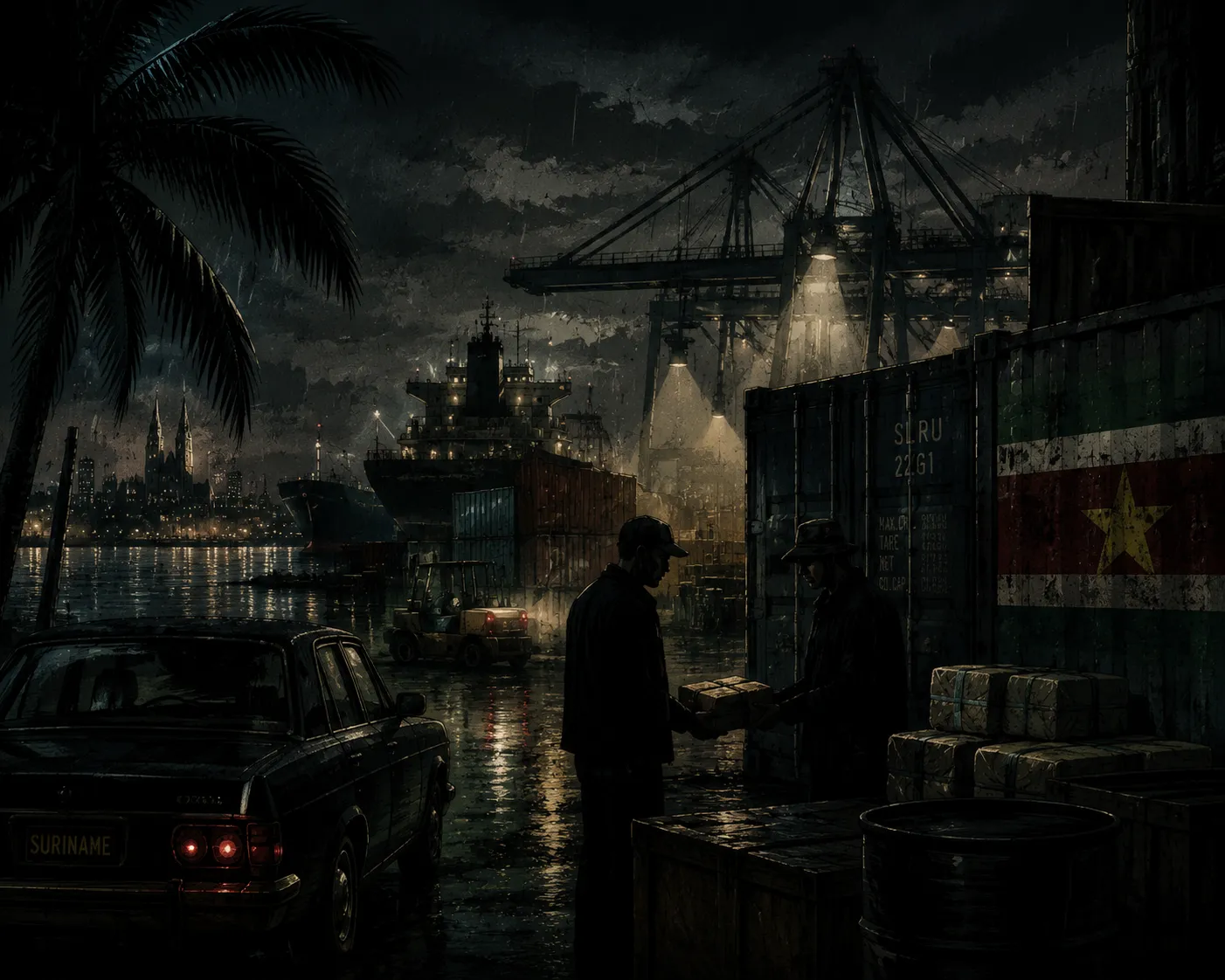
Worth a quick note on the cast: Kang In-gu (Ha Jung-woo) is an ordinary family man swept into a state intelligence operation. Jeon Yo-hwan (Hwang Jung-min) is the show's ultimate antagonist, a man who moves fluidly between pastor and drug lord, using religious language with his congregation while running a ruthless criminal enterprise. NIS agent Choi Chang-ho (Park Hae-soo) drives the operation and pushes Kang In-gu to the edge, while Byun Ki-tae (Jo Woo-jin) operates as Jeon's closest fixer, quietly hedging his bets. Chang Chen's Chen Jin, a Chinese crime boss, rounds out a genuinely multinational cast of characters converging on one South American port city. Packing this many storylines into just six episodes meant the first couple of episodes required some patience to track who's who — but most viewers agreed the tension ratchets up sharply once the character conflicts start colliding.
Reception after release was explosive. Within two days, it entered Netflix's Global Top 10 TV list and hit #1 in Bangladesh, Hong Kong, Saudi Arabia, Singapore, Taiwan, and Vietnam. Domestically, it topped Korea's content rankings for two straight weeks and climbed into the top four on Netflix's global TV chart. Korean dramas typically build momentum in Europe or South America before cracking the US chart — Narco-Saints broke that pattern, entering the US Top 10 unusually early. Within four days it had cracked the Top 10 in France, Germany, and Italy, and its US ranking climbed to No. 5.
Key Takeaway
Narco-Saints is inspired by real events, but it's a drama, not a documentary. Most of its "Paramaribo" scenes were actually filmed in the Dominican Republic and on Korea's Jeju Island, and character names and plot details were substantially fictionalized. Its success also came with a real diplomatic backlash over how the country was portrayed — worth remembering alongside the ratings numbers. In short: ① real case + fictional dramatization, ② filming happened almost entirely outside Suriname, and ③ the show's success triggered actual diplomatic friction — three things worth keeping in mind about this drama.
Two weeks after release, the show topped Netflix's global non-English TV chart, racking up more than 60 million hours of viewing in a single week. That same week, four other Korean titles — Extraordinary Attorney Woo, Little Women, Alchemy of Souls, and Under the Queen's Umbrella — also appeared in the non-English Top 10, a striking snapshot of how dominant Korean content had become on the platform at the time. Narco-Saints later picked up multiple acting-award nominations, a nod to its craft beyond the chart numbers. Hwang Jung-min's dual performance as pastor and drug lord, and Park Hae-soo's icy intelligence officer, were singled out for praise by critics both in Korea and abroad.
Critical and audience reception was largely positive, though the ending drew some criticism. The build-up — the psychological pressure on an ordinary man caught in organized crime, and the tense realism of a covert operation — was widely praised, but the finale's turn toward a more conventional action-hero climax for an otherwise ordinary civilian felt abrupt to some viewers. Given that a true-story adaptation inevitably telegraphs its ending, plenty of others felt it landed reasonably well regardless. Some also pointed out an unresolved subplot involving a group of church followers introduced midway through the show; the director later explained in a behind-the-scenes interview that a rescue scene for those followers was filmed but cut to keep the focus on Kang In-gu's arc.
So, is a second season coming? Nothing has been officially confirmed. Since it was conceived and produced as a self-contained six-episode adaptation of a true story, the creative team likely never planned a sequel to begin with. Still, as the World Cup buzz brought the show back into conversation in 2026, fans in various online communities have started calling for a Season 2 or spin-off again. For now, that remains hopeful fan speculation rather than anything confirmed.
③ What Is Suriname Actually Like?
The name became familiar through the show, but plenty of people still don't know exactly where Suriname is or what kind of country it is. Most people picture Spanish or Portuguese when they think of South America — Suriname is the exception that breaks that assumption entirely. Let's start with the basics.
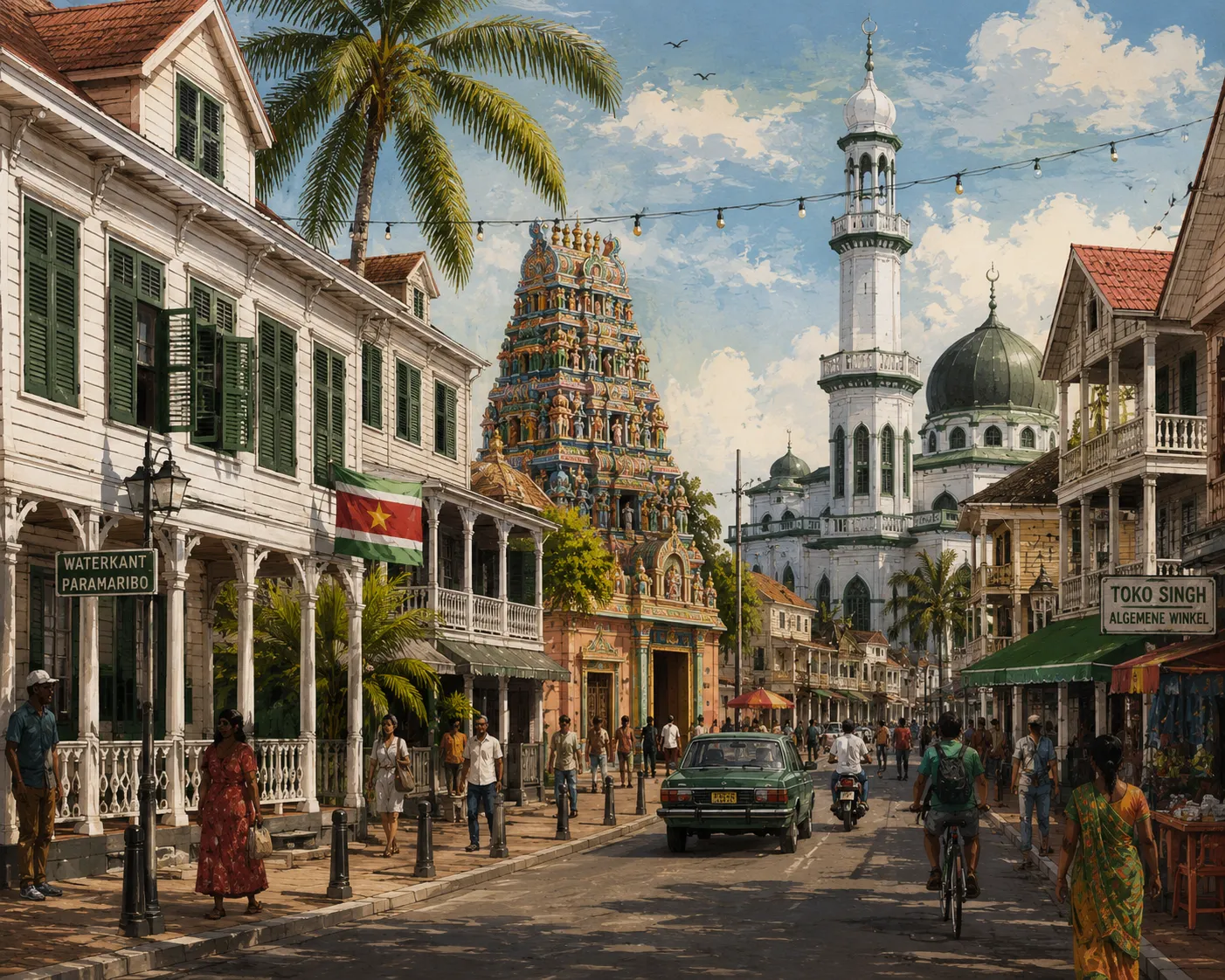
Suriname is famous for its unusually complex ethnic makeup — Hindustani (Indian-descended), Javanese (Indonesian-descended), Creole, Maroon (descendants of escaped enslaved people), Indigenous, Chinese, and Dutch communities all coexist. That's why you'll find Hindu temples, mosques, and Catholic churches standing side by side on the same street in Paramaribo. The show's Chinatown setting and multi-ethnic supporting characters aren't invented out of thin air — they reflect this real demographic mix.
There's a painful history behind how all these communities ended up in one place. Colonized by the Dutch from the 17th century onward, Suriname's economy ran on large sugarcane and coffee plantations worked by enslaved Africans. After slavery was formally abolished in 1863, indentured laborers were brought in from British India and the Dutch East Indies (modern-day Indonesia) to fill the labor gap — the origin of today's large Hindustani and Javanese communities. Suriname finally achieved full independence from the Netherlands on November 25, 1975, though the 1980s brought a military coup and a turbulent period of political instability before the country gradually settled into its current democratic system.
Economically, bauxite (aluminum ore) and gold mining have long been the backbone of the country, but the picture has been shifting recently. Large offshore oil and gas discoveries in the Guyana-Suriname basin, shared with neighboring Guyana, have drawn major investment from international energy firms including TotalEnergies. Industry watchers expect this offshore development to meaningfully reshape Suriname's GDP once it ramps up, with first oil production targeted for the late 2020s and infrastructure investment already underway. Suriname's government and international media alike have been eager to emphasize that the country is no longer defined by its old reputation as a drug-transit hub, but is instead on the cusp of an economic transformation driven by resource development.
Interestingly, this resource boom isn't unique to Suriname. Neighboring Guyana already went through a similarly dramatic transformation after its own offshore oil discoveries, briefly earning the title of one of the world's fastest-growing economies. Since Suriname shares the same geological basin, expectations are high that it could follow a similar trajectory, with some economists describing it as having the potential to become "the next Guyana." That said, a resource boom doesn't automatically translate into broad-based improvements in quality of life, and some analysts urge caution on that front.
Nature is another essential part of the Suriname story. Over 90% of its territory is covered by Amazon rainforest, giving it one of the highest forest-cover ratios of any country on Earth. The Central Suriname Nature Reserve is recognized as a UNESCO World Heritage Site for its ecological value, while Paramaribo's colonial-era historic inner city holds its own separate UNESCO cultural heritage listing. Tourism infrastructure remains limited, but the country is slowly gaining a following among travelers seeking untouched nature.
Ironically, while Narco-Saints wasn't actually filmed in Suriname, its success reportedly sparked local interest in attracting international film and TV productions. Large-scale production infrastructure is still lacking, so this will take time to materialize — but given how other Caribbean nations have used location shoots to boost tourism, it's not out of the question that a genuinely Suriname-shot production could emerge down the line.
Now, back to that "hidden football powerhouse" thread from earlier. Suriname is famous for producing more stars for the Dutch national team than for its own. A "best XI of Surinamese-descended players" compiled by a European football analytics outlet featured Liverpool's Virgil van Dijk alongside Steven Bergwijn, Georginio Wijnaldum, Ryan Gravenberch, and Xavi Simons — all current stars who represent the Netherlands. Add legends like Ruud Gullit and Frank Rijkaard, part of the trio (with Marco van Basten) that won Euro 1988, plus later-generation icons Edgar Davids and Clarence Seedorf, and it's fair to say Surinamese-descended players wrote half the story of Dutch football's golden era.
Van Dijk's own family history is a good illustration. His mother is of Chinese-Surinamese descent, and his great-grandfather is said to have emigrated from Guangdong province to Suriname in the 1920s. Behind a single footballer's name lies Suriname's characteristically layered migration history. With FIFA's recent eligibility relaxation, some of these Surinamese-descended players now have a path back to representing their ancestral country — and some analysts credit exactly this shift with fueling the 2026 qualifying upset.
Football wasn't Suriname's only sporting export, either. Dutch-Surinamese sprinter Churandy Martina became an Olympic medalist on the track, and swimmer Anthony Nesty gave Suriname its first-ever Olympic medal, earning national-hero status back home. That's an unusually high concentration of sporting talent for such a small population — a product of both its multi-ethnic makeup and its long-standing ties with the Netherlands.
Politically, Suriname is a republic with a president serving as both head of state and head of government, and its status as the only Dutch-speaking country in South America often gets it classified as a "Dutch Caribbean" nation. It's also a full member of the Caribbean Community (CARICOM) — geographically part of South America, but politically, economically, and athletically far more intertwined with the Caribbean world. Its parliament is unicameral, and unlike most of its South American neighbors, the president is chosen indirectly through the legislature rather than by direct popular vote.
Culturally, Suriname carries a genuinely layered identity. Kaseko, a genre blending African rhythms with Caribbean music, is a distinctive local tradition, and the calendar includes Diwali, Eid al-Fitr, and Christmas all celebrated at their respective times of year. Its cuisine mixes Indian curries, Indonesian nasi goreng, and African-Caribbean cooking with equal ease — for such a small country, its culinary diversity rivals that of far larger nations. This layered culture is exactly why the show's mix of ethnicities and religions never felt out of place.
If you're already imagining a trip there, here's some practical context. There are no direct flights from Korea yet, so travelers typically connect through Amsterdam or the US. The currency is the Surinamese dollar (SRD). Dutch is the official language, but Sranan Tongo, a local Creole, is widely spoken day to day, and English is understood reasonably well in tourist areas. The time zone runs about 12 hours behind Korea. It's not yet a mainstream travel destination, which is exactly why its untouched nature and culture appeal to more adventurous travelers.
Let's compare the drama's version of the country with the real one.
| Category | In the drama | In reality |
|---|---|---|
| Main industry | Drug trafficking hub | Bauxite, gold, and oil; recent offshore discoveries drawing global attention |
| Urban vibe | Lawless, dangerous port town | Paramaribo's old town is a UNESCO World Heritage tourist site |
| Filming location | Set in Suriname | Mostly shot in the Dominican Republic and Jeju Island, Korea |
| Path to fame | Global buzz via a dramatized Netflix hit | Reintroduced in 2026 through a World Cup qualifying upset |
※ This comparison is a summary drawn from public reporting and may not reflect the most current statistics.
④ The Diplomatic Row the Drama Sparked
Narco-Saints' success came with an unexpected diplomatic side effect. Within days of release, Suriname's Foreign Minister Albert Ramdin publicly voiced his displeasure. His argument: Suriname no longer matches the drug-state image portrayed in the show, and years of effort to improve the country's international reputation were being undone by the drama's popularity. His government reportedly considered legal action against the producers and floated a formal diplomatic protest to South Korea. It was an unusually high-profile move — a sitting minister publicly calling out a specific Netflix original by name — and international media covered it extensively.
When the news broke, the South Korean embassy overseeing Suriname (based in Venezuela, since Korea has no resident embassy in Suriname itself) issued a safety notice to Korean residents in the region. Fortunately, it never escalated into a full diplomatic incident, and the situation cooled once Korea's foreign ministry signaled a willingness to address any misunderstanding.
💬 A footnote worth knowing
Ironically, the show's ultimate villain, Jeon Yo-hwan, isn't Surinamese at all — he's Korean. Domestically, that led many viewers to note that nobody in Korea took offense at a Korean villain, making Suriname's official reaction feel disproportionate by comparison.
This kind of friction isn't unique to Suriname, either. Whenever a global streaming hit is set in a specific country or region, it's fairly common for that country's government or public to push back against a perceived negative portrayal. Suriname's case may have felt especially sharp simply because it was the first time a major global production had ever used the country as a backdrop at all. Some reports suggest the episode pushed Suriname's government to pay closer attention to its international image going forward — and the enthusiasm with which officials have since promoted the offshore oil discoveries may partly reflect lessons learned from this experience. In the end, the threatened legal action never materialized, and the controversy quietly faded over time.
Another controversy flared among Chinese internet users, who took issue with the show's Chinatown setting and its Chinese crime-boss character, flooding review sites with low ratings. That character, however, wasn't invented — he was based on testimony from an actual figure involved in the real case — and given that Netflix isn't even officially available in China, critics pointed out the irony of people protesting a show they, by definition, hadn't watched through legitimate means. Domestically in Korea, some noted the double standard: nobody complained about the Korean villain, yet the Chinese character alone drew this backlash.
Frankly, the phenomenon of a piece of content defining how the world sees a country isn't new. Colombia spent years fighting the drug-state image Narcos left behind, and Thailand once dealt with a wave of stereotypes tied to a single Hollywood comedy set partly in one of its regions. Suriname's experience fits neatly into this broader pattern — a recurring case study in the tension between global entertainment and national branding.
⑤ Community Reactions, Then and Now
From the moment the show dropped through to today, online communities both in Korea and abroad have had a lot to say. Here's a roundup by category.
News of Suriname's official protest left many Korean viewers a bit puzzled. Given that the show's worst villain is Korean and nobody at home took offense, plenty argued the government's reaction felt oversensitive — with some even asking, only half-jokingly, whether the real-life case of a Korean drug lord should be the thing under scrutiny instead.
Viewers with real Suriname connections pointed out the actors' shaky Dutch pronunciation and various inaccuracies, but still praised the immersive performances and the exotic, fast-paced storytelling. One viewer who lived through the country's military coup era said they were satisfied with the overall quality despite the dramatization.
In Taiwan, local media and fans took special interest in Chang Chen's guest role, with interviewers repeatedly asking about his experience working alongside the Korean cast. The show also topped Netflix charts across several Southeast Asian countries, underscoring its broad reach.
When the World Cup qualifying news broke, online communities lit up with comments like "wait, that's a real country?" and "I had no idea the show's setting actually existed," alongside plenty of people announcing a rewatch. Football forums saw the flip side too — fans who knew the name from the drama expressing surprise at just how good the country turned out to be at football.
Some Chinese users pushed back against the Chinatown and Chinese crime-boss portrayal with a wave of low review scores, but plenty of counter-commentary noted the irony, given Netflix isn't officially available in China. Korean viewers also noted the apparent double standard, since the Korean villain drew zero equivalent backlash at home.
International fans of the crime-drama genre frequently compared the show to Narcos and Narcos: Mexico, praising the fresh combination of Korean sensibility with a South American setting. Its tight six-episode runtime also drew praise for being easy to binge without padding.
Some reports suggest everyday public sentiment in Suriname was noticeably less heated than the government's official protest. Some citizens reportedly found it genuinely exciting that their country had become the backdrop of a major global production — a notable gap between the official response and public opinion.
During the World Cup qualifying stretch, posts along the lines of "I looked up which country Suriname was and ended up rewatching the show" kept popping up across communities — a neat little example of a sports story driving people back to older content.
Here's the funny pattern that emerged in 2026: people who first learned the name "Suriname" from the drama kept doing a double-take at World Cup qualifying headlines — "wait, is that really the same country?" — while football fans who discovered Suriname through the sport went digging for the Netflix show they'd never heard of. Content and sport, two completely different worlds, ended up converging on the same small country's name.
This whole phenomenon also plugs neatly into internet "geography rabbit hole" culture — the habit of falling down a Wikipedia hole for hours the moment an unfamiliar country name crosses your feed, digging into its history, demographics, even the meaning behind its flag. Suriname, with two completely separate entry points — a drama and a football story — became a recurring subject for exactly this kind of deep dive, with community-written summary threads about its history and demographics repeatedly trending on forum front pages.
Frequently Asked Questions
❓ Suriname is in South America — so why does it play World Cup qualifiers in the North American zone?
Geographically it's part of South America, but administratively it has long belonged to CONCACAF, the North, Central American and Caribbean football confederation, alongside its neighbor Guyana for the same reason.
❓ Is Netflix's Narco-Saints based on a true story?
Yes, loosely. It draws on the real case of a Korean drug organization operating in Suriname in the late 2000s and the civilian collaborator who helped bring down its leader. However, character names and much of the plot were fictionalized for dramatic effect, so it isn't a documentary retelling.
❓ Is Suriname still known for drug trafficking today?
The drama is set in 2008–2009. Suriname's government has said it has worked continuously since then to shed its old reputation as a drug-transit hub, and its recent push around offshore oil development reflects a broader effort to reshape its national image.
❓ Could players like Van Dijk actually play for Suriname's national team?
Under FIFA's nationality rules and "sporting passport" system, switching to represent a parent's or grandparent's country of origin is theoretically possible. But established stars who've built their careers with the Netherlands are unlikely to actually switch; the buzz in this qualifying cycle came from lesser-known Surinamese-descended players joining the squad instead.
❓ Does Suriname have diplomatic relations with South Korea?
Yes, the two countries maintain formal diplomatic relations. Neither side maintains a resident embassy in the other's capital, though, so a nearby embassy handles matters on a concurrent basis — which is exactly the arrangement through which the safety notice was issued during the show's controversy.
❓ How many countries did Narco-Saints top the charts in?
It hit #1 on Netflix's daily Top 10 in several countries — including Bangladesh, Hong Kong, Saudi Arabia, Singapore, Taiwan, and Vietnam — shortly after release, and reached the top of the global non-English TV chart in its second week. The exact count of "#1" markets shifts depending on the measurement date, so there isn't one single fixed number.
⑥ Closing Thoughts: One Show Widens the Map
Looking back, what made Netflix's Narco-Saints special wasn't just its ratings. It took a small South American country that most people had never heard of and turned it into a global talking point — and four years later, that same country landed back in the spotlight through a completely different channel: football. One TV drama, one national team's strong showing, and suddenly a distant country becomes a little more vivid on our mental map.
What's striking is how different the two images turned out to be. The drama left behind a picture of a dangerous, near-lawless port town; the World Cup qualifying run left behind a picture of gritty underdogs with a surprising footballing pedigree. The fact that two such contrasting impressions of the same country can coexist says something about how fragmented our media-driven understanding of any given place really is. The real Suriname is a far more three-dimensional place — definable through its multi-ethnic culture, its Amazon rainforest, and, increasingly, its resource-driven economic prospects.
Screen tourism — visiting the real-world locations behind a hit show or film — has become a genuine global travel trend. In Narco-Saints' case, though, the reveal that it was mostly shot in the Dominican Republic and on Jeju Island rather undercut any surge in travel demand toward the actual Paramaribo. Still, with far more people now able to correctly place Suriname on a map thanks to this World Cup cycle, it's not unreasonable to hope more of them will eventually consider visiting for real.
Here's a quick recap of the four-year arc covered in this piece.
| When | What happened | How people reacted |
|---|---|---|
| Sep 2022 | Netflix's Narco-Saints released, becomes a global hit | "Wait, where's Suriname?" — first exposure, plus image controversy |
| Sep 2022 | Suriname's government formally protests | Many at home called the reaction disproportionate |
| Late 2025 | Dark-horse run through final World Cup qualifying | Football fans rediscover "wait, they're actually good?" |
| Mar 2026 | Eliminated in the intercontinental play-off | Disappointment mixed with genuine respect for the run |
| Summer 2026 | World Cup underway, the story resurfaces again | Rewatches of the show, renewed Season 2 requests |
Of course, there's a clear gap between the show's version of Suriname and the real thing — and understanding that gap is part of what makes engaging with content like this worthwhile. Did you first hear the name "Suriname" from the drama, or from this year's World Cup qualifying news? Either way, if you ever get the chance to actually walk the streets of Paramaribo someday, that'll be a story all its own. Next time, maybe we'll dig into other football underdogs from this World Cup cycle, like Cape Verde or Curaçao. If there's a country you discovered for the first time watching this World Cup, feel free to share it in the comments — we'll keep tracking these little moments where a distant country steps into our everyday feed, through content or through sport. 🌴⚽